Every client on your roster needs roughly the same SEO checks, but a strategist still exports the same crawl data, cleans the same spreadsheets, compares the same week-over-week numbers, and chases the same approvals before anything ships. That repetition is exactly where AI agents SEO teams are adopting now earn their keep, and it's the same gap that makes SEO workflow automation AI worth setting up properly rather than bolting on. This guide walks through a repeatable way to automate the evidence-gathering and triage work in a technical SEO workflow, while keeping a human in charge of anything that could hurt indexability, rankings, traffic, or a client's trust. By the end you will have a workflow that turns raw crawl, log, Search Console, and SERP data into reviewed actions with a full audit trail, and a clear line for which AI SEO team tasks an agent can run on its own.
Step 1: Define the workflow and approval boundary
What to do: Pick one repeatable SEO workflow rather than trying to automate "SEO" in general. Something like "detect new crawl errors and draft tickets" or "produce a weekly Search Console change report" is a good starting point because it is read-only and low-risk. Write down nine things before you build anything: the business question you're answering, which data sources the agent can touch, what triggers a run, what transformations and checks happen to the data, the output format, who owns that output, which actions the agent can take on its own, which actions need approval, and what happens when the data is incomplete or a source fails.
Sort every action the agent might take into one of three buckets: read, recommend, or write. Start in read and recommend. Only add write permissions later, for a narrow, reversible action with a clear way to check it worked.
How to tell it's done: The workflow has a one-sentence objective, a named owner, a defined input window, a documented output shape, an approval policy, and a way to roll back or escalate if something goes wrong. A teammate who didn't build it can read the definition and understand exactly what the agent will do.
Where teams go wrong: Starting with a vague prompt like "find SEO problems" instead of a bounded task. Handing an agent production access before it's proven itself in a read-only pilot. Treating any recommendation the agent produces as an already-validated fix. Not defining what happens when a data source comes back empty or partial. And, just as often, requiring a person to sign off on every single low-risk classification, which just recreates the manual bottleneck you were trying to remove.
Pro tip: Classify every possible action as read, recommend, or write before you connect a single data source. Teams that skip this step end up either over-trusting the agent on write actions or drowning a reviewer in approvals for things that never needed one.
Step 2: Connect the data sources and establish a baseline
What to do: Connect only what this specific workflow needs, not every system the agency owns. Common sources are a crawler export or crawl API, server access logs, Google Search Console, a keyword database or SERP API, a URL inventory and sitemap, analytics data when business impact matters, and wherever the output should land, whether that's a ticketing system, a spreadsheet, a dashboard, or a chat channel.
Before asking the agent to report on change, establish a baseline. Record the crawl date, the log window, the Search Console date range, the property, the site section, and which version of the source you pulled from. Normalize URLs consistently (www versus non-www, http versus https, trailing slashes) before comparing anything, and keep the raw input alongside whatever the agent produces so a reviewer can trace any claim straight back to evidence.
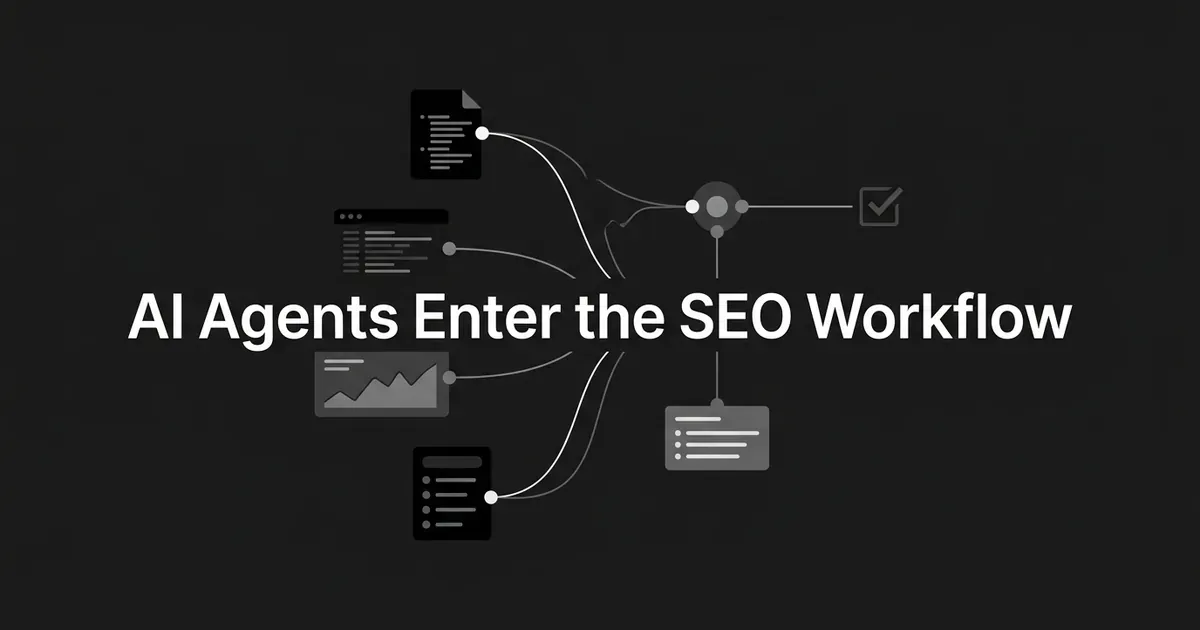
A workflow that holds up looks like this: trigger on a schedule or webhook, collect data from the connected sources, normalize and validate it, ask the agent to classify or summarize the result, return structured data rather than a paragraph, render a report or open a ticket, route it to the right owner, and log the run along with whatever a human decided about it. Structured data between each step, JSON or a table, beats an unstructured narrative that a person then has to manually convert into a to-do list.
How to tell it's done: A test run can answer what sources it used, what time period it covered, how many records it processed, which records it excluded, and where the result landed. The agent returns the same schema every time rather than a differently formatted write-up on each run.
Where teams go wrong: Comparing a fresh crawl against an older one that used different settings. Mixing www and non-www, or http and https, without normalizing first. Letting the model quietly fill in a missing value instead of labeling it unavailable. Sending a client's raw data to a tool that was never approved for it. And not keeping the original evidence once the summary is written.
For agencies running the same workflow across many accounts, a platform like DeepSmith is worth mentioning here, not as the crawler or the Search Console layer, but as the place each client's brand context, competitors, and content queue stay isolated from one another. That isolation is what makes a repeatable workflow actually repeatable across a portfolio instead of getting rebuilt per client.
Step 3: Run a technical audit agent in read-only mode
What to do: Point a crawler or audit API at the site and have the agent group what comes back: HTTP status and redirect behavior, broken internal links and redirect chains, canonical declarations and conflicts, indexability signals like robots directives and noindex controls, sitemap inclusion and freshness, titles and meta descriptions, internal-link coverage and orphaned URLs, structured-data validation results, differences between rendered and raw HTML on JavaScript-heavy pages, and response-time signals where the source provides them.
Every finding the agent produces should carry at least a URL, the issue type, the observed evidence, the affected template or section, a severity, a confidence level, a recommended next check, an owner, and whether it needs approval before anyone acts on it. One example workflow built in n8n combines a crawl with Search Console data, flags 404 and 301 pages along with the internal links pointing at them, and produces a prioritized HTML report, using a default crawl cap of around 1,000 pages. That's one team's configuration, not a limit you need to match.
Rendered evidence matters more than it looks. Google's own documentation describes search working through crawling, rendering, and indexing, with links pulled from both the raw and rendered HTML. A crawl of raw HTML alone can't always tell you what a search engine actually sees once JavaScript runs. When a page's initial HTML and its visible content disagree, the agent should flag it for a rendered check rather than confidently calling it broken or fine.
How to tell it's done: Every finding has a URL, a reproducible observation, a source, a reason for its severity, and a confidence label, and a reviewer can open the affected page or template and see the issue for themselves.
Where teams go wrong: Treating every missing meta description as a high-priority problem regardless of the page. Assuming a 200 response proves a page is indexed or ranking. Treating a crawler's simulated rendering as proof of what Google actually indexed. Applying a generic fix without checking whether it fits the site's templates or business goals. And letting the agent change canonicals, redirects, schema, or indexation rules on its own.
Step 4: Analyze server logs and crawl allocation
What to do: Server logs record what actually requested a URL, which is a different question from what a crawler simulation says should happen. A typical access-log record includes the IP address, timestamp, requested URL, response status, and user agent. Build the workflow in order: pull a representative log window, parse the format and normalize timestamps and URLs, separate bot traffic from human traffic, identify the crawler by user agent, then verify anything important by IP or another authoritative method since user agents can be spoofed. From there, segment by crawler, URL, directory, status code, and date, and calculate request volume by URL and crawler, status-code distribution, response times, crawl depth, and how much traffic is going to low-value parameters or faceted URLs. Compare against the sitemap, indexation data, and the prior period, and only send patterns above a defined threshold to the SEO or engineering owner.
The questions worth asking: which URLs is Googlebot actually requesting, which important URLs are barely getting requested at all, which filters or legacy paths are eating requests that could go elsewhere, are bots hitting errors or slow responses, and did crawl behavior shift after a migration or a template change.
Crawl budget itself is a narrower concept than teams often assume. Google defines it through crawl capacity (how much the server can handle) and crawl demand (how much Google wants to crawl, based on site size, update frequency, and page quality). Google's own guidance says this mainly applies to sites with roughly a million or more unique pages that change moderately often, sites with roughly 10,000 or more pages that change daily, or sites with a large share of pages sitting in "discovered, currently not indexed." Google is explicit that these are rough classification numbers, not hard thresholds, and a smaller site where new pages get crawled promptly usually does not need a dedicated crawl-budget effort at all.
How to tell it's done: The output separates verified crawlers from unverified user agents, covers a clearly stated window, surfaces the highest-volume waste patterns, and compares against the prior period, without claiming that crawling alone proves indexing, ranking, or business value.
Where teams go wrong: Trusting a user-agent string without verifying it. Treating a single day of logs as the full picture. Calling every uncrawled page a failure. Assuming crawl frequency by itself determines rankings. Raising a crawl-budget alarm on a small site with no evidence of a real delay. And publishing raw logs or IP addresses without thinking through privacy and retention first.
Step 5: Automate Search Console reporting without overstating the data
What to do: Use the Search Console API instead of manually exporting the same report every week. For each Search Analytics query, define the property and search type, an inclusive start and end date, the dimensions you need (date, page, query, country, device, search appearance), any filters, the row limit, and a pagination strategy. A reliable pattern is to query one day at a time once that day's data is available, store it in the agency's own reporting system, and keep a stable schema across every run.
A few constraints matter enough to build into the workflow itself rather than discover later. The API accepts 1 to 25,000 rows per response, defaulting to 1,000, and you paginate with a start-row offset. Search Analytics tops out at 50,000 rows per day per search type. Data is typically available two to three days after the fact, so a same-day report should never be presented as complete. Adding page or query dimensions gives more detail but can cause some rows to drop out. Anonymized queries are excluded from the row-level tables and API entirely, though their activity can still show up in chart totals unless you apply a query filter. The dashboard's own export caps out at 1,000 rows, well below what the API can return.
Useful automated outputs include week-over-week clicks and impressions by page type, pages where impressions moved a lot more than clicks, query or page groups crossing a set threshold, newly rising or declining pages, and sitemap or indexing anomalies worth a manual look. Every alert should link back to the exact property, date range, dimensions, and raw query output behind it.
How to tell it's done: Every report states its property, search type, date range, dimensions, filters, and collection date, and is explicit about whether it might be incomplete, so a reviewer could reproduce the same query and get the same numbers.
Where teams go wrong: Summing filtered query rows and presenting that as the site total. Treating missing anonymized queries as zero demand. Calling partial, still-processing data a final result. Ignoring row limits and pagination. Comparing two reports built with different dimensions. And letting an agent invent a reason for a traffic change without checking deployments, seasonality, or SERP shifts first.
DeepSmith is worth a mention here too, but only with the distinction made explicit: its AI Visibility product tracks prompts, mentions, citations, and share of voice across AI answer engines, which is a different dataset from Google Search performance. Search Console tells you how Google Search treats your pages; DeepSmith tells you how ChatGPT, Perplexity, and the other tracked engines represent and cite your brand. Neither one substitutes for the other.
Step 6: Automate keyword discovery and SERP qualification
What to do: Split this into two separate jobs instead of asking one agent to hand you a finished keyword list. Discovery takes seed keywords, existing monitored terms, competitor names, and search-volume and difficulty data, and expands them into candidates, often pulling in autocomplete suggestions or trend data where freshness matters. A weekly keyword-opportunity agent connected to a spreadsheet and a keyword data source can check existing monitored terms, filter for new opportunities, and return volume, difficulty, top-ranking pages, and possible titles alongside the date it found each one.
Qualification is the second job: take a candidate keyword plus location and language, pull the current top results, and compare that SERP against the site's own authority, offer, audience, and existing pages. A SERP agent can collect titles, URLs, snippets, headings, publisher types, related searches, and ranking positions, sometimes scanning the top 100 results for a target domain or summarizing the headings and content types dominating the top 10.
A sequence that holds up: expand seed terms, drop duplicates and anything already monitored, attach current volume and difficulty with a source date, cluster close variants without losing the original terms, pull the current SERP, classify intent and result format, compare against the client's authority and existing pages, flag cannibalization or weak fit, and have a strategist approve the opportunity before it enters the backlog.
How to tell it's done: Every candidate carries a source, a collection date, current SERP evidence, an intent classification, a fit rationale, and an actual human decision, with the observed fact kept separate from the agent's recommendation.
Where teams go wrong: Treating search volume as demand a client can automatically capture. Treating keyword difficulty as a universal priority score regardless of the client's authority. Clustering terms so aggressively that distinct intents disappear. Using stale SERP data for a query that moves fast. Assuming the current top result's format is the only one that can rank. And letting the agent recommend a topic without checking existing pages or whether the client actually has the expertise to back it.
Step 7: Turn findings into an evidence-backed queue
What to do: Have the agent output a structured issue or opportunity record instead of a narrative summary. Each record should carry an ID and detection date, the client, property, and site section, the URL or keyword, the source system and query parameters used, the observed evidence, a comparison against baseline, an impact hypothesis, a severity, a confidence level, a recommended next check, a suggested owner, an approval class, links back to the raw evidence, and a status history.
A simple five-tier triage keeps this usable: P0 for a severe indexation, availability, or migration issue on high-value pages; high for a broad template or crawl problem with real evidence of impact; medium for a repeatable issue with limited scope or uncertain impact; low for a hygiene item with little evidence of harm; and observe for an anomaly that needs more data before anyone acts. Resist turning a single health score into the decision. A score makes a report easier to scan, but the underlying evidence, scope, confidence, and business impact are what should actually drive priority.
How to tell it's done: A strategist can move a record straight into a ticket or a planning tool without rewriting it, and a reviewer can see exactly why the agent flagged what it flagged and what evidence would change the call.
Where teams go wrong: Ranking issues purely by technical severity while ignoring traffic or revenue. Using one scoring system across a small blog, an ecommerce catalog, and a regulated site. Mixing observation and recommendation into one paragraph that no one can trace back to evidence. Losing the client, property, or crawler configuration somewhere in the handoff. And treating an agent-generated priority list as an already-approved roadmap.
Step 8: Approve, deploy, monitor, and roll back
What to do: Set up tiered approvals rather than one blanket policy. Automatic approval fits low-risk, rule-bound, reversible actions on low-impact pages, and only after those actions have been tested. Quick review fits medium-risk recommendations that still need a named SEO lead to sign off. Mandatory review covers redirects, canonicals, indexation rules, schema on important pages, template changes, mass metadata changes, and anything in a regulated industry.
Before anything ships, check titles, meta descriptions, headings, canonicals, indexability, noindex tags, and redirects, and snapshot the current state of whatever is about to change. Keep a timestamped changelog tied to the agent run and the person who approved it. After it ships, watch rankings and impressions on the affected pages, click-through rate where titles or snippets changed, conversions on important templates, crawl stats and indexation signals, and server errors or response times. One approval framework worth borrowing checks in at 24 to 72 hours and again at the two-week mark, though that's a practical cadence to work from, not a promise about how fast Google will reflect any given change.
If something breaks: pause the automation, figure out whether the problem is technical, content-related, or a data issue, identify the affected pages starting with the highest-value ones, revert in priority order, and preserve the full run, approval, and rollback record before you resume.
Common mistake: An agent can spot a repeated 404 pattern, but that doesn't mean it should automatically redirect every one of those URLs. Check first whether the old URL has a relevant replacement, whether it still gets links or traffic, and whether the redirect would create a chain. Redirects, canonicals, robots rules, and indexation controls all need a human sign-off before they go live.
How to tell it's done: The team can answer who approved a change, what evidence backed it, what actually changed, when it changed, what got monitored afterward, and how to restore the prior state if needed.
Where teams go wrong: Reviewing a change after it's already live instead of before. Treating an agent's confidence score as a substitute for an actual validator. Skipping the rollback plan because a change looks small. Watching rankings alone while ignoring server errors, indexation, and conversions. And expanding a pilot to high-value templates before the low-risk pages have proven the process works cleanly.

What to do next
Start with one read-only workflow. Run it against a controlled page set or a single client account, compare what the agent found against a human audit of the same pages, and only expand once the evidence pack and the approval process have proven reliable a few times over. This is where AI SEO team tasks stop being an experiment and start being an operating system, and it's the point where SEO workflow automation AI actually pays for itself: the read and recommend work moves fast on its own, and a person stays firmly in charge of anything that touches production.
If the piece you're missing is visibility into how AI engines like ChatGPT and Perplexity describe your clients, not just how Google Search treats their pages, DeepSmith tracks that side directly: tracked prompts, mention and citation rates, and competitor comparisons, all kept separate per client workspace. You can start a 7-day free trial and see what it surfaces for one account before deciding whether it belongs in your stack.