A client just asked whether they show up in ChatGPT, and you had to say you'd look into it. That's a normal place to be right now. This guide walks you through the agency content stack you need to produce content and report AI visibility across several client brands, in seven steps you can run with a small team. By the end you'll know what each job in the stack has to do, how to tell a step is finished, and where lean agencies usually trip.
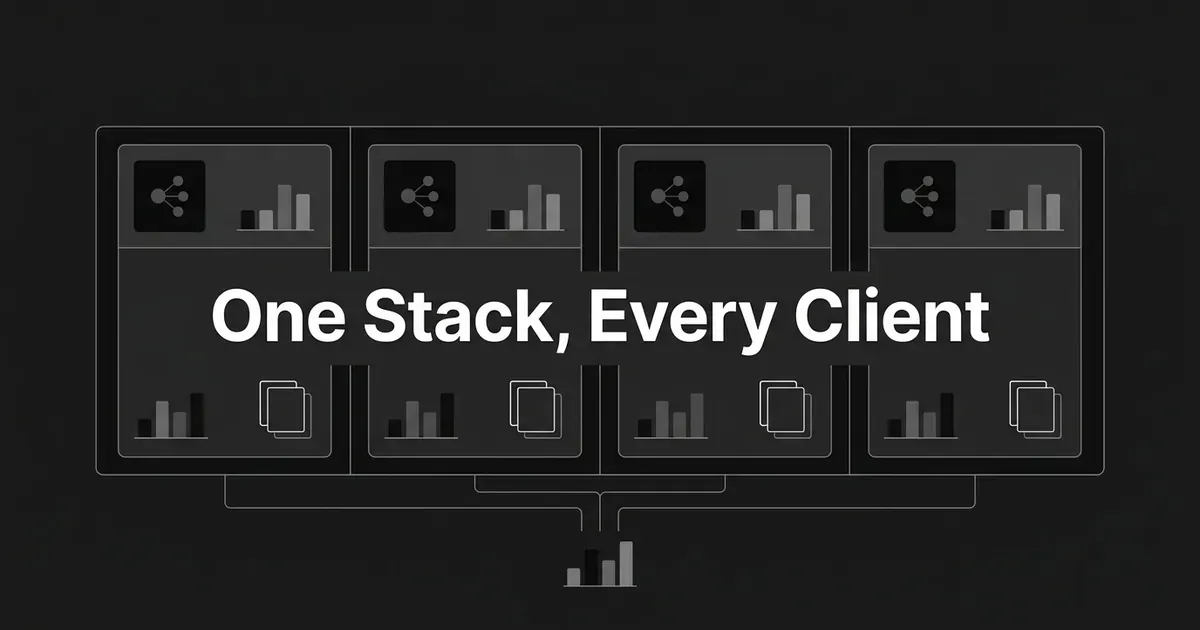
One thing before we start. Organize this by job, not by client and not by vendor logo. If you build a separate toolset per account, you rebuild your process every time you sign a logo. If you build one system with client separation inside it, every new account is a setup task instead of a project.
What the stack actually has to do
Here's the good news: the list of jobs is short. Eight of them, and a lean agency needs all eight, whether one platform covers them or four do. Judge multi-client content tools against these jobs, not against a feature list.
| Job | What it has to handle | What must stay separate per client |
|---|---|---|
| Client operations | One account, isolated workspaces | Brand, content queue, prompts, reporting, billing, permissions |
| Brand governance | Persistent brand and product context | Positioning, claims, products, personas, voice, visual rules |
| AEO measurement | Scheduled prompt tracking across AI engines | Buyer questions, answer history, mentions, citations, competitors |
| Prioritization | Evidence-backed opportunities | Losing prompts, competitor citations, topic gaps |
| Production | Research to publish-ready article | SEO, AEO structure, links, metadata, cover image |
| Publishing | Planned dates and CMS delivery | Publication date, review status, destination |
| Distribution | Article to channel versions | Social, newsletter, and community formats in that client's voice |
| Reporting | Per-client visibility reports | Mention rate, citation rate, share of voice, page attribution |
The principle underneath all eight is simple. Connect diagnosis to execution. A tracker that only reports visibility leaves you writing briefs somewhere else. A writing tool with no prompt or citation evidence produces content with no clear AEO reason behind it. The minimum useful stack closes both loops inside one client-separated system.
That's the standard to hold every tool against as you read the rest of this. Most AEO tools for agencies cover the measurement half well and stop there, so check the production and reporting columns hardest.
Step 1: Give every client its own workspace
Start here, before you track a single prompt.
Create one workspace per client under a single agency account. Not one shared project with folders. Not one brand profile you edit between accounts.
Each workspace should hold that client's own brand context, products and services, personas, brand voice, competitors, tracked prompts, content queue, visibility data, reporting, and plan limits. DeepSmith is built for exactly this pattern: one agency account, many isolated client workspaces, each with its own context, content, and reporting, and each billed and limited independently. So a heavy client can sit on a bigger plan while a small retainer sits on a smaller one, without you juggling separate logins.
Invite your team into the workspaces they work on, as owners or members. A freelancer on two accounts shouldn't be able to see the other nine.
How you know it's done. You can switch between two clients without their content or data mixing. Each client's competitors and starter prompts sit in the right workspace. Team access is assigned by workspace and role. Usage limits are visible per client, not just for the agency as a whole.
Where agencies go wrong. Treating folders or labels inside one shared setup as if they were isolation. A folder tidies files. It doesn't stop one client's product facts or tone from leaking into another client's draft. That leak is the thing you're actually preventing here.
Step 2: Load each client's brand context once
This is the step that decides how much editing you do for the next twelve months. Take it seriously and the rest gets lighter.
Onboard each client by loading their website and filling in their brand context before you produce anything. You're capturing positioning, differentiators, the claims the client wants made, the claims they will not allow, product and service profiles, features and use cases, personas with their goals and challenges, brand voice, visual guidelines, reusable content types, and trusted source domains.
In DeepSmith this layer is called Deep IQ, and it's the thing every other module reads from. Store a client's positioning, products, personas, voice, and visual guidelines once, and every article in that workspace is built on the same foundation. Onboarding builds the brand profile from the site, starts tracking how AI answers that client's buyer questions, and generates a first set of ideas.
The goal is a working client workspace fast, not a re-brief before every article.
How you know it's done. Pull up a generated idea or draft and ask six questions. Does it describe the right product? Does it use the client's approved positioning? Does it speak to the intended persona and buyer stage? Is it in the right voice? Does it avoid unapproved claims? And the one that matters most: could you tell this draft apart from another client's?
If the answer to that last one is no, the context isn't loaded yet.
Where agencies go wrong. Assuming the risk is a wrong adjective. It isn't. The real failure is cross-client factual bleed: the wrong product category, the wrong competitor, the wrong persona or proof point turning up in a draft. That's the kind of mistake a client notices and remembers. Keep this in the client's workspace, not in a strategist's head and not in a generic prompt someone pastes between accounts.
Multi-client content tools earn their keep at this step or nowhere. If a tool can't hold two clients' facts apart, the rest of its feature list doesn't matter.
Step 3: Build and schedule the buyer-prompt set
Now you can start measuring. A prompt is just a question a buyer asks an AI engine. A prompt set is the group of questions you choose to watch for that client.
Build the set from a mix: awareness questions, comparison questions, decision-stage questions, category questions, product and use-case questions, competitor questions, questions where the client wants to be recommended, and questions where they're currently absent or named without a link.
Not sure where to start? DeepSmith's Discover Prompts generates candidates from the client's product, personas, and buyer stages. Keep the ones that match how real buyers ask, cut the rest, and add your own.
Then set the collection schedule and let it run. DeepSmith checks tracked prompts against the engines on your plan, keeps the full answers, and works out whether the brand was mentioned or cited.
Keep mentions and citations apart
This one small habit will make your reporting far more honest.
A mention is when the AI answer names the brand. A citation is when the answer links to one of the brand's pages as a source. They're different signals. An answer can name a brand without linking to it. A page can get cited while the brand barely appears in the prose.
Report them separately. Collapsing them into one "visibility score" hides the exact gap you're being paid to close.
How you know it's done. Each client has a documented set of buyer questions, prompts mapped to buyer stages, named competitors, a collection schedule, a baseline of answer history, and a plan tier that covers the engines you promised them.
That last point deserves care. Engine coverage is tier-gated. Pro tracks ChatGPT. Grow adds Perplexity. Scale adds Gemini. Enterprise and Custom cover all ten engines, including Claude, Google AI Overviews, Google AI Mode, Grok, Meta AI, Microsoft Copilot, and DeepSeek. Match the plan to what you told the client you'd watch, per client, and don't sell coverage a tier doesn't include.
Pro tip. Not every client needs every engine. If a client's buyers live in ChatGPT, a smaller plan and a tighter prompt set will serve them better than a wide net nobody reads. This is where AEO tools for agencies differ most: some price per brand, some per engine, and the difference compounds across a roster.
Step 4: Turn visibility gaps into an evidence-backed backlog
Here's where most agency calendars go soft. Someone brainstorms keywords, the list looks busy, and nobody can say why any single piece is on it.
Start from the questions instead. Which prompts is the client losing? Where are they mentioned but not cited? Which competitor pages are winning the prompts they're missing? Which topics does a competitor cover more deeply, and which ones do they own outright while your client has nothing?
DeepSmith's Opportunity Agents read that data and return ideas with the data point that justifies each one attached. The Content Map crawls the client's site and their competitors' sites into one shared topic taxonomy with funnel stages, so it can show you coverage gaps where a competitor publishes more and untapped topics where the client has no page at all. Sitemaps are re-checked every 24 hours, so new pages fold in without a manual re-import.
Every idea should arrive carrying its reason.

For each one, record the losing prompt or topic gap, the buyer stage, the competitor page currently winning, the article angle, the destination page, the product and persona context that should govern the draft, the internal links you expect, the reviewer, and the target date.
How you know it's done. A strategist can explain, out loud, which client question the piece addresses, why that question matters to the buyer, what evidence shows the gap, what the competitor currently owns, and what this article adds that isn't commodity.
Pro tip. Keep the evidence attached to the idea all the way into the calendar. If the data point falls off when the idea gets scheduled, the writer has to rediscover why they're writing it, and you've quietly broken the link between measurement and production. That link is the whole product you're selling.
One honest caveat while you're building this. Evidence explains why you're producing a piece. It doesn't promise a citation. Say it that way to clients and you'll never have to walk anything back.
Step 5: Produce, review, and publish
Now the writing, which is the part lean agencies expect to be the bottleneck and usually isn't. The bottleneck is everything around it. Research, briefs, SEO cleanup, internal linking, metadata. That's the work agency content ops tools are supposed to absorb, and the reason to judge them on what a strategist stops doing.
Move each selected idea through the same four stages, every time, for every client. New Ideas holds the backlog. Planned Content is where an idea gets a date, which is what turns it from a thought into a commitment. The Writer, or Autowrite, creates the article. Produced Content is where you review, revise, and publish.
DeepSmith's Writer takes one planned idea and returns a researched, brand-grounded article with SEO and AEO structure, internal and external links, a cover image, and publish-ready metadata already in place. Deep IQ supplies the client's positioning, products, personas, and voice, so the draft comes out sounding like that client and not like your last account. Autowrite can run a piece on its scheduled date and drop it into Produced Content with nobody in the app.
Publish straight to WordPress, Webflow, Strapi, Sanity, or Contentful. If a client runs something custom, webhooks plus Markdown or HTML export cover it.
How you know it's done. The article sits in the right client workspace. Its buyer stage and purpose are clear. It uses the correct brand context. It answers the target question near the top, where an AI engine can lift it. Headings are scannable. Links are present and relevant. Metadata and cover image are ready. A human has reviewed it. The destination CMS and status are recorded.
Where agencies go wrong. Treating automation as a replacement for review. It isn't, and Google's own guidance points the same way: helpful, reliable, people-first content is still the bar, AI assistance is not disallowed but the output still has to meet the same standards, and high page volume does not improve quality on its own. Publishing a page for every search variation to nudge AI answers runs straight into scaled-content-abuse territory.
So keep the review. The platform produces and optimizes the article. You stay responsible for factual accuracy, client sensitivity, legal claims, and whether the piece is genuinely useful. That judgment is what the client is paying an agency for, and it's the part no tool takes off your plate.
Step 6: Repurpose each article into the client's channels
Distribution is part of the production unit, not a project you start after the blog post is done.
Every finished article in DeepSmith arrives with social posts already written, and the Apps Library adapts the piece into channel-native versions for LinkedIn, X, Medium, Substack, newsletter and nurture email, Reddit, and more. The variants stay inside the client's workspace and use that client's voice, so you're delivering a content package rather than a single URL.
This is the cheapest upgrade to a retainer you have available. Same research, same article, several deliverables.
How you know it's done. The article is published or with the client for approval. Social and newsletter versions are generated from the finished piece, adapted to each format rather than copy-pasted. Each one uses the right client voice and stays inside their approved claims. And you've written down which channels are actually in scope for that retainer.
Where agencies go wrong. Promising every channel to every client. Being able to generate a LinkedIn post is not the same as having posting access, an approval process, a community policy, or a cadence anyone will keep. Define the delivery boundary per retainer, in writing, before the first invoice.
Step 7: Report the same data back to each client
The report should come from the same system that produced the priorities. That's the whole point of building a content and reporting stack agency leads can actually run: measurement and production share one source of truth, so the report explains the work and the work explains the report.
A monthly client report needs the top-line movement and the evidence behind it. Mention rate. Citation rate. Share of voice. Change over the period. A per-engine breakdown. Per-prompt results with the answer history for the important ones. Which client pages earned citations and which prompts drove them. Which competitors won the prompts the client missed, and on which pages. The sources AI leans on in that category. And the content you produced in response to the gaps you found last time.
DeepSmith's AI Visibility module covers these views. Pages attributes citations to specific client URLs. The competitor view shows who won a prompt and on which page. The source views show which domains AI is drawing from, with client and competitor sources tagged.
How you know it's done. Your client can answer seven questions from the report alone. Where did we appear? Where were we cited? Which prompts improved or declined? Which pages earned citations? Which competitors won the ones we missed? What did you produce in response? What are you watching next?
If they can answer those, you'll rarely be asked to justify the retainer.
One boundary to be straight about. Per-workspace reporting can be branded for the client. That's client-level branded reporting, which is different from serving the whole platform from your own domain. If a client needs the software itself under your domain, treat that as a separate procurement conversation rather than something a workspace setting solves.
And one caveat to put in the report itself. AI visibility is observational. It reports what the monitored engines returned for the prompts you tracked in the period you collected. It doesn't control rankings, citations, traffic, or revenue. Never turn a visibility trend into a promised business outcome. Clients forgive a flat month. They don't forgive a promise you couldn't keep.

What to do next
Don't roll this out across the roster. Pick one client and run them through the whole loop.
Isolate their workspace. Load the brand context. Baseline their buyer prompts. Pick one evidence-backed gap. Produce the article, review it properly, publish it, repurpose it, and report the result.
One client, one full lap. That's how you find out where your process actually breaks, at a scale where fixing it is cheap. Then the second client is a setup task, and the tenth is a Tuesday. That single lap also tells you more about your agency content stack than a month of demos will.
You don't need a bigger team for this. You need one loop that works, and then you run it again.
Want to see it on your own accounts before committing? Start a 7-day free trial and set up one client workspace with real prompts and real drafts.