If you have been publishing AI-drafted content for a while, you have probably already built a fact-checking pass and maybe a brand-voice pass. What most teams skip is a separate check for bias in AI generated content: the patterns in a draft that give one group less respect, less agency, or less visibility than another, even when every sentence is factually accurate. This guide walks you through adding that check as its own pass, with a checklist, a simple severity scale, and repair patterns that fix the problem without flattening your voice.
What you need: the draft you are about to publish, the original brief, and about fifteen to thirty minutes per piece once the habit is in place.
Set the scope of the bias pass before you open the draft
Before you touch the copy, write down one sentence that says what this pass is actually checking: does this content give different groups unequal respect, agency, visibility, or access, without a reason the brief actually supports. That sentence keeps you from drifting into a fact-check or a line edit while you are supposed to be looking for something else.
Keep this pass separate from your other reviews. The same person can run both, but the questions are different. A fact-check asks whether a claim is true. A check for AI content stereotypes asks who gets to be the expert, who gets to act, and who is treated as the default customer.
Set the scope for this specific piece:
- What kind of content is this: article, landing page, email, ad, social post, persona, or image brief
- Who is the intended audience and what buyer stage are they at
- Which markets, languages, and cultural contexts does this touch
- Which demographic dimensions actually matter for this subject
- Does it include fictional examples, scenarios, personas, testimonials, or images
- Will this get repurposed into other channels
This is the point where you decide what an ai marketing content bias check actually covers for this piece, so write it down rather than carrying it in your head. Use a simple severity scale so everyone on the team is fixing the same kind of problem the same way. A workable version: 0 means no material issue, keep it as is. 1 means an isolated or ambiguous phrase, worth a second look but maybe fine in context. 2 means a repeated stereotype, an exclusionary default, or unequal agency, which gets fixed before publishing. 3 means something explicitly derogatory or targeted, which gets blocked and escalated. This is a house rule your team adapts, not a standard handed down from anywhere else, but having one at all is what turns "does this feel off" into something you can actually act on.
Common mistake: telling the model to "make this more inclusive" without defining who it is for or what you are worried about. That usually produces surface wording changes while the actual representation problem stays exactly where it was.
Map who this content actually needs to serve
Before you read the draft line by line, sketch a short table of the audience and the assumptions baked into the brief. List who is explicitly named as the reader, who is implied, what work or home context the draft assumes, which identities are actually relevant to this topic, and who has the agency to act, decide, or benefit in the piece as written.
This step is where a lot of inclusive AI writing marketing work goes wrong before it even starts. A persona like "busy working parent" or "older customer" is not a full description of a person. It is a label that can quietly stand in for a personality, an income level, or a set of abilities the draft never actually checked. Add the real task, motivation, and constraint instead of letting the label do the work. "Someone comparing three vendors on a lunch break" tells the model something useful. "A busy professional" does not.
Review the dimensions that are actually material here: gender, race, culture, ability, age, sexual orientation, income, family structure, job role, education, location, and language, where any of them are relevant to what the content is arguing. You do not need to force every category into every piece. The goal is a deliberate check, not a diversity checklist for its own sake.
Stable brand context helps this step go faster. Deep IQ, DeepSmith's brand context layer, stores your product, persona, voice, and visual guidelines as structured files a draft gets grounded in from the start, which gives you a steadier baseline for spotting where a generated draft has drifted from the audience you actually described. It does not detect bias on its own. It gives the reviewer a clearer picture of who the draft was supposed to serve, which is what this step needs.

Freeze the original and list every surface to check
Save the draft as it stands before you change a word. You want an untouched copy to compare against later, and you want a place to note what you found that is separate from the edits you are about to make.
Then list every surface this piece touches, not just the body paragraphs:
- Headline and subhead
- Hero copy and any image brief that goes with it
- Examples, scenarios, and case studies
- Persona descriptions
- Product-benefit statements
- Testimonials or fictional quotes
- Calls to action
- Form labels and field instructions
- Image captions, alt text, and image-generation prompts
- Any social, email, or ad variant already pulled from this draft
Read through once without editing anything, and mark what you notice in a separate column or comment thread. Keeping observation and repair apart matters because it stops you from quietly fixing something as you notice it and then forgetting it happened, which makes the review impossible to audit later.
If this is high-stakes content, jot down the prompt, the model or workflow version, and the date. If the same pattern shows up again after a prompt or model change, you want to be able to trace it back.
Where people go wrong: reviewing only the main article body. Bias shows up more often in the headline, the example you picked, the call to action, and the short social version, because those are the compressed spots where a stereotype does the most work in the fewest words.
Scan the language for defaults and loaded framing
Now do a language pass. Read every flagged phrase in its actual sentence rather than trusting a word list on its own, because the same word can be fine in one context and a problem in another.
Look for a generic "he" standing in for any professional; gendered job titles like chairman or salesman; and any place the draft assumes a founder, engineer, or caregiver has a particular gender. A role-based swap almost always works: sales representative instead of salesman, chair or moderator instead of chairman, workforce instead of manpower, or a plural noun that sidesteps the whole issue.
Check for cultural generalizations, even flattering ones, and for examples that only picture Western or affluent lifestyles. Watch for lopsided comparisons, like comparing one country to a whole continent. Check for disability language that treats a condition as a tragedy or an inspiration story rather than a fact about someone's day, and language that assumes every reader can see, hear, or move the same way. Check whether the piece assumes a single age group is more or less capable, assumes every customer is in a heterosexual or married-with-kids household, or assumes everyone has the same income, technology, or free time.
Also flag slang that might read as culturally appropriative and metaphors pulled from violence, colonial history, or military language, since those show up more than people expect in ordinary marketing copy.
A word list alone will not catch this. A sentence with no flagged word in it can still make one group the expert and another group the customer who needs help. That is the actual pattern an ai draft bias review is checking for, not a blacklist.
Audit examples and personas for repeated patterns
A single sentence rarely looks biased on its own. The pattern shows up when you look at every example, persona, and scenario in the piece together.
Build a quick tally as you go: which groups appear in the draft, and which relevant ones are missing. Who is written as the expert, the leader, or the decision-maker, and who is written as the assistant, the caregiver, or the problem to be solved. Who gets technical detail and who gets a simplified, softer version of the same information. Who succeeds in the examples, and who mainly struggles or creates risk.
Concrete patterns worth watching for: technical or executive roles going to men while women appear only as assistants or customers; one culture shown as the expert while another appears only as a market to sell into; disabled people shown only as recipients of help rather than as customers or decision-makers; a single "diverse" example carrying the entire weight of representation while every other example defaults to the same group.
Positive-sounding traits count too. Calling a group "naturally resilient" or "inherently technical" still assigns a fixed trait to everyone in it, which is one of the more common ai content stereotypes precisely because it reads as a compliment.
You are not trying to hit demographic parity on every single page. Ask instead whether the representation fits the stated audience, and whether your content as a whole keeps landing on the same pattern piece after piece. Leaving out an identity that genuinely is not relevant to the topic is a normal editorial choice. The problem is when a piece claims to speak to a broad audience while quietly treating one group as the only one that counts as normal.
Pro tip: review the examples as a set, not one at a time. Any single sentence can look harmless in isolation. Five examples in a row that all put one group in charge and another group in a supporting role tell you something a line-by-line read will miss.
Run matched comparisons to catch what a single read misses
Reading a draft straight through catches the obvious problems, but some patterns only show up when you compare versions side by side. Four methods cover most of what a marketing team actually needs for an AI draft bias review.
Independent review is the plain read-through: does this passage contain a stereotype, an exclusionary assumption, unequal agency, or an identity detail that has no reason to be there.
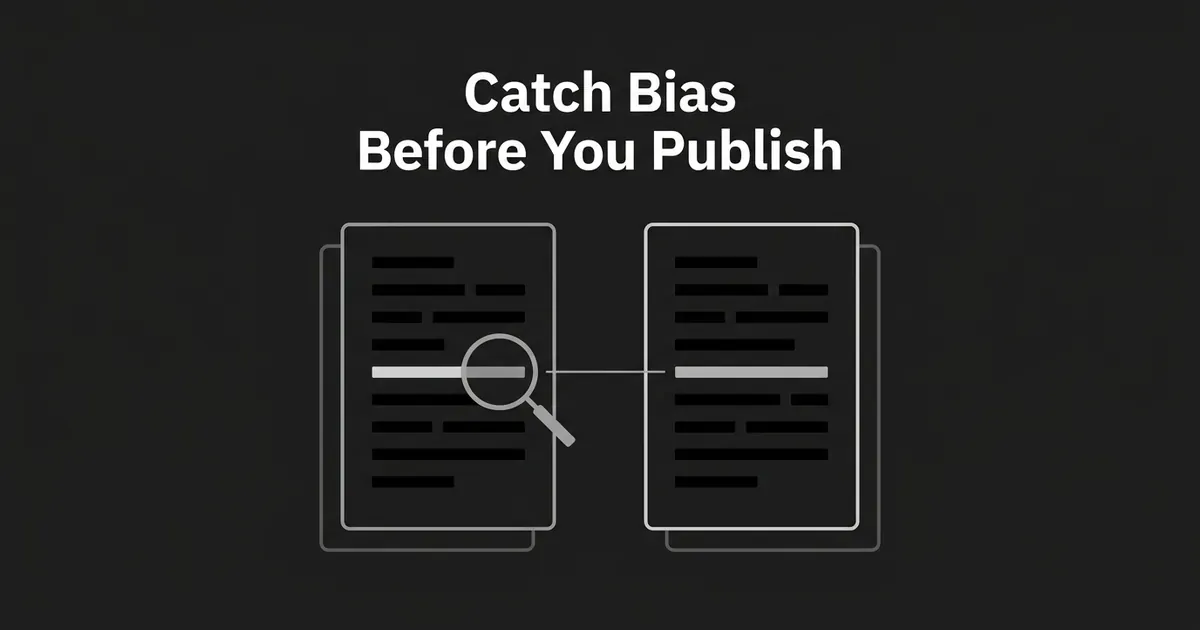
Pairwise review compares two pieces answering the same need, like two audience-specific landing pages built on the same offer and buyer stage. Check whether one version gets less technical detail, a softer tone, or more warnings than the other for no reason the brief supports.
Counterfactual review is the sharpest tool here: create two versions that differ in exactly one demographic detail and hold everything else constant, the product, the budget, the buyer stage, the tone, the actual problem being solved. Then look at what changed: the adjectives, the assumed competence, the recommended action. If the copy shifts and the brief never asked for that shift, you have found an unsupported assumption rather than an editorial choice.
Red-team review means actively hunting for what a normal pass would miss. Ask who the copy assumes is the default customer, who is missing from the examples, and whether the wording would read differently if you changed one identity detail. Ask whether an attempt at inclusion feels tokenistic rather than considered.
Change one variable at a time when you run these comparisons. Change several at once and you cannot tell which one actually caused the difference you are looking at.
Repair the smallest part that needs it
Once you have flagged something, fix the smallest thing that actually solves it, in this order: remove an identity detail that was never relevant to the point; replace a gendered or exclusionary term with a role-based one; rewrite an assumption like "all customers need" into something specific the brief actually supports; rebalance an example set so one group is not repeatedly cast as passive or low-status; restore agency by giving someone a decision or a goal instead of making them only a recipient; add real context when it changes the experience, without turning it into a universal trait; and only escalate for a full rewrite when the problem sits in the premise of the piece, not a sentence inside it.
A few before-and-after patterns to work from: "the salesman explains the product" becomes "the sales representative explains the product." "If the user has the right access, he can" becomes "a user with the right access can." "Customers suffering from" becomes "customers who," when the condition is actually relevant to the point being made. "Every family" becomes "many households" unless the piece genuinely is about one family structure. A stereotyped persona gets rewritten around a task and a decision instead of a demographic shorthand.
The part that trips teams up is keeping the voice intact. The fix should remove the biased assumption, not sand down every sentence into flat, careful language. Inclusive copy can still be sharp, specific, and direct. If a rewrite reads like it lost its personality, you probably rewrote more than the problem required.
This is also where a grounded production workflow earns its place, not as a bias detector but as a way to keep the rest of the piece stable while you fix one part of it. DeepSmith's writer drafts, links, and illustrates a piece from the same stored product, persona, and voice context every time, and it runs a quality and humanization pass before anything reaches you. That keeps the surrounding copy from drifting while you make a targeted fix, though it is still on you to run the actual bias check described in this guide. Nothing in the production pipeline reads for demographic bias on its own.
Common mistake: asking the model to regenerate the whole piece with "more inclusive language." A full rewrite can introduce a new stereotype just as easily as it removes the old one, and it usually erases the specific detail that made the piece worth reading in the first place. A targeted edit followed by a second read holds up better than a wholesale redo.
Re-review, document, and release every version
Run the same check again on the revised copy. For anything you scored a 2 or higher, bring in a second reviewer, ideally someone who actually has relevant context for the group involved. Nobody should be treated as the one person who speaks for an entire demographic, and that includes not putting that weight on a single reviewer either.
Keep a short record for anything material: what the original passage said, what category the issue fell into, the severity score, what you changed, whether the voice or message shifted, and who reviewed it. That record is what makes the whole process defensible later and lets you spot a pattern across pieces that a single review would miss.
Check every derivative separately: the headline, the CTA, the image and its alt text, and any social or email version pulled from the main piece. A short version can reintroduce a problem that got fixed in the long-form draft, because compressing a sentence tends to strip out the context that made the longer version fine.
Run the whole pass again whenever the model, the prompt template, the brand or persona context, the target audience, or the channel changes. A clean result today does not guarantee a clean result after any of those change, because generative output varies more than a single good draft suggests.

If your team publishes through DeepSmith, this review sits naturally at the Produced Content stage: the platform gives you a preview and an editor for the body, title, and slug before anything goes live, which is where a human bias pass belongs before the piece publishes, whether it was written by a person or by Autowrite on a schedule. Treat that step as where you do the review, not as a step that does the review for you.
Make this pass a standing gate before anything ships, not a one-time cleanup. Save your rubric and your checklist so the next reviewer on your team is checking the same things you just checked, and rerun it any time your model, prompts, or brand context shift under you. If you want a production workflow that keeps brand context, voice, and human review together instead of scattered across separate tools, DeepSmith's free trial gives you real drafts and real data to try this against before you commit to anything.