You have a draft. It is fine. It is also loose, a little generic, and out of order, and you are the one who has to fix all three before anyone else sees it. That is the part of the day that eats your calendar.
This guide gives you seven AI editing prompts that make the model diagnose and repair its own draft first, so the version that reaches you is already tighter and better organised. You still edit. You just start further along.
One thing to be clear about up front. A self-edit AI draft pass cannot check whether facts are true, and it does not replace your judgement. It clears the avoidable work so your judgement has somewhere better to go.
Step 1: Write the brief before you write the editing prompt
Here is the move almost everyone skips. Before you ask for a single change, tell the model what the piece is for.
Without a reader and a purpose, the model optimises for generic smoothness. It has nothing else to aim at. So it makes sentences prettier and leaves the real problem exactly where it was.
Write the brief once, then reuse it for every pass in this guide.
Before editing, use this brief as the source of truth.

Purpose: [what the piece should help the reader understand or do]
Audience: [specific reader, and what they already know]
Desired outcome: [what the reader can do after reading]
Voice: [three to five observable qualities]
Keep: [required ideas, examples, qualifications, and calls to action]
Avoid: generic introductions, repetition, inflated claims, and wording
that changes the intended meaning.
Output: preserve the existing format unless the structure clearly stops
the reader reaching the outcome.

I will provide the draft in <draft> tags next.
How you know it worked: ask the model to repeat back the audience, purpose, voice and non-negotiable content. If it can do that without guessing, the brief is doing its job.
Where people go wrong: writing "engaging" or "professional" and calling it a voice. Those are labels, not tests. Swap them for behaviour the model can act on, like "short direct sentences, concrete verbs, no inflated claims, no generic introduction."
If you build this brief from scratch every time, it drifts. That is the problem Deep IQ solves inside DeepSmith: your company positioning, products, buyer personas, brand voice and content types are stored once as structured context, so every piece of content starts from the same brief instead of whatever you remembered to paste that morning. Stored context will not make the editorial call for you. It does stop you rewriting the same instructions forty times a quarter.
Step 2: Ask for a diagnosis before you ask for a rewrite
This is the single highest-value change you can make. When you prompt AI to edit its own work, do not ask for a better draft. Ask what is wrong with this one.
Why? Because a rewrite hides its own reasoning. You get back something smoother and you have no idea whether it fixed the structure or just polished the sentences that were already fine. Split the two jobs and the work becomes inspectable.
Do not rewrite the draft yet.

Audit it against these criteria:
1. The main answer or promise is clear near the beginning.
2. Each section has one job and appears in a useful order.
3. Repetition is removed or justified.
4. Sentences are direct and specific.
5. The tone matches the brief.
6. Every required point is present.
7. No wording changes the intended meaning.

Return:
- Strengths to preserve
- Problems ranked high, medium or low
- The smallest useful fix for each problem
- Any instruction you cannot satisfy without a decision from me

<draft>
[PASTE DRAFT]
</draft>
How you know it worked: the response names specific problems tied to your criteria. "Sections three and five both explain the same idea" is a diagnosis. "The draft could be clearer" is not.
Where people go wrong: asking "what do you think?" That question gets you praise and an unranked list of everything. Give the model criteria and an output shape, and you get something you can act on.
Notice the last line of the request. Asking what the model cannot decide alone is how you find the choices that were always yours to make.
Step 3: Run a tightening pass that protects meaning
Now you can cut. This pass strips repetition, throat-clearing, filler and wordy constructions, and nothing else.
The risk here is real, so name it in the prompt. When you tell a model to be concise and say nothing about what must survive, it will happily delete the qualification that kept a claim honest, or the example that made the point land.
Revise the draft for tightness only.

Remove:
- repeated ideas
- filler and throat-clearing
- unnecessary qualifiers and intensifiers
- redundant headings or transitions
- wordy phrases that can be stated directly

Preserve:
- the intended meaning
- required examples and qualifications
- the audience and voice
- every point listed as required in the brief

Do not add new facts or claims. Do not fact-check. If shortening a
passage could change its meaning, leave it intact and flag it.

Return:
1. Revised draft
2. Three to five highest-impact cuts, with a one-line reason for each
3. Any passage you left unchanged because shortening it risked meaning

<draft>
[PASTE DRAFT]
</draft>
How you know it worked: the draft is leaner where it needed to be, and the required content and caveats are all still there. Read the list of cuts before you read the draft. It takes thirty seconds and it tells you whether the model understood the assignment.
Where people go wrong: "cut 30 percent." A percentage is not an editing standard. Use a number only when the assignment genuinely has a length limit, and always pair it with what has to survive.
Pro tip: run tightening after diagnosis, never before. Otherwise you spend a pass polishing sentences that a later structural fix deletes anyway.
Step 4: Ask for a structural rewrite, not smoother sentences
Most drafts that feel wrong are not badly written. They are badly ordered. The answer is buried in section four and the reader gave up in section two.
Sentence-level edits cannot fix that, so make structure its own pass. And say plainly that moving, merging and deleting are all allowed. Ask for "better flow" without that permission and you get cosmetic changes.
Evaluate the draft's structure before rewriting it.

The reader needs to reach this outcome: [desired outcome].

First return:
- the current section sequence in one line
- the main structural problem
- the proposed section sequence
- any content that should move, merge or be removed

Then rewrite the full draft using the proposed sequence.

Rules:
- Keep the core meaning and required information.
- Give each section one clear job.
- Put the direct answer or practical payoff near the top.
- Use descriptive headings.
- Do not add unsupported information.

Return:
A. Structural diagnosis
B. Proposed outline
C. Reordered draft
D. Structural decisions that still need review

<draft>
[PASTE DRAFT]
</draft>
How you know it worked: you can say why each section exists and why it sits where it does. The new order serves your reader, not the model's habit of opening with broad context nobody asked for.
Where people go wrong: approving the new outline without reading it. The outline is the cheapest thing to fix in this whole process. Read those four lines properly and you can catch a bad reorganisation before it becomes 2,000 rewritten words.
Step 5: Enforce voice and audience with observable rules
"Make it sound less like AI" is the most common instruction in this whole category, and it is the least useful. It names a feeling, not a behaviour, so the model has nothing to change.
Translate it. What actually reads as generic? Usually it is the opening, the sentence length never varying, the vague claims, the stacked adjectives, the transitions that could sit in any article about anything. Name those, and the model can act.
Edit the draft for audience fit and voice.

Audience: [specific reader, knowledge level, situation]
Voice rules:
- [observable rule 1]
- [observable rule 2]
- [observable rule 3]
- Avoid [specific unwanted pattern]

First identify up to five passages that sound generic, overpromotional,
too technical, too vague or mismatched to the audience. Explain each
problem briefly. Then revise the full draft.

Preserve the author's intended point. Do not add personality through
jokes, claims, anecdotes or opinions not supported by the brief.

Return:
1. Voice diagnosis
2. Revised draft
3. A short compliance check against each voice rule
How you know it worked: the model can point at the exact wording it changed and tie each change to one of your rules. If it cannot, it guessed.
Where people go wrong: adding personality instead of removing genericness. A model told to be more human will reach for a joke or an anecdote it invented. Say no to that explicitly, in the prompt.
This is the other place stored context earns its keep. Deep IQ holds Brand Voice and Buyer Persona as structured records that shape what DeepSmith produces, so voice is an input to the writing rather than a repair job afterwards. It will not match every writer's taste on every sentence. It does close the gap that opens when the brief lives in someone's head.

Step 6: Run a constraint check against your brief
You now have a much better draft. Time to check it against what you actually asked for, item by item, with a visible verdict on each one.
This pass is about compliance, not truth. The model can confirm that a required section exists. It cannot confirm that the claim inside it is correct.
Run a final instruction-compliance pass. Do not introduce new information.

Check each item as PASS, FAIL or NEEDS HUMAN DECISION:
- purpose and reader outcome
- required sections and headings
- must-keep ideas
- length or format requirement
- voice rules
- terminology consistency
- repeated points
- pronoun and point-of-view consistency
- unresolved placeholders
- claims or passages that need separate human verification

For every FAIL or NEEDS HUMAN DECISION item:
- quote the smallest useful excerpt
- explain the problem in one sentence
- propose a correction only when it follows from the brief

Then apply only the fixes that are safe under the instructions.

<brief>
[PASTE BRIEF]
</brief>
<draft>
[PASTE REVISED DRAFT]
</draft>
How you know it worked: every requirement has a status next to it, and the unresolved ones are sitting in a list instead of buried inside a polished draft.
Where people go wrong: reading a column of PASS results as proof the article is accurate. It is not. A draft can follow every instruction you gave and still be wrong about the world. Fact checking is a separate job with a human on it.
Step 7: Ask for the final draft plus an issue list
The last request produces two things: a clean draft, and an honest account of what the model changed and what it could not resolve.
That second half is the whole point. It is the handover note that tells you where to spend your attention.
Produce the final pre-edit package from the brief, diagnosis and draft.

Make only changes supported by the brief and the diagnosis. Preserve
meaning, required content and necessary qualifications. Do not invent
facts, examples, sources, customer results or product capabilities.

Return exactly:
1. FINAL DRAFT
2. CHANGES MADE, grouped under tightening, structure, voice and
   constraint fixes
3. UNRESOLVED ISSUES, including anything needing human judgement or
   separate fact verification
4. INSTRUCTION CHECK, with PASS, FAIL or NEEDS HUMAN DECISION per item

<brief>
[PASTE BRIEF]
</brief>
<diagnosis>
[PASTE DIAGNOSIS]
</diagnosis>
<draft>
[PASTE DRAFT]
</draft>
How you know it worked: you get a clean draft and a short, specific list of open questions. No claim that the facts were verified, because they were not.
Where people go wrong: asking for "just the final version." It feels faster. It costs you the audit trail, and you lose the one artefact that tells you whether the rewrite fixed the actual problem or something else.
The one-prompt version, for when you have ten minutes
Seven passes is the thorough route. Some days you do not have seven passes in you, and that is fine.
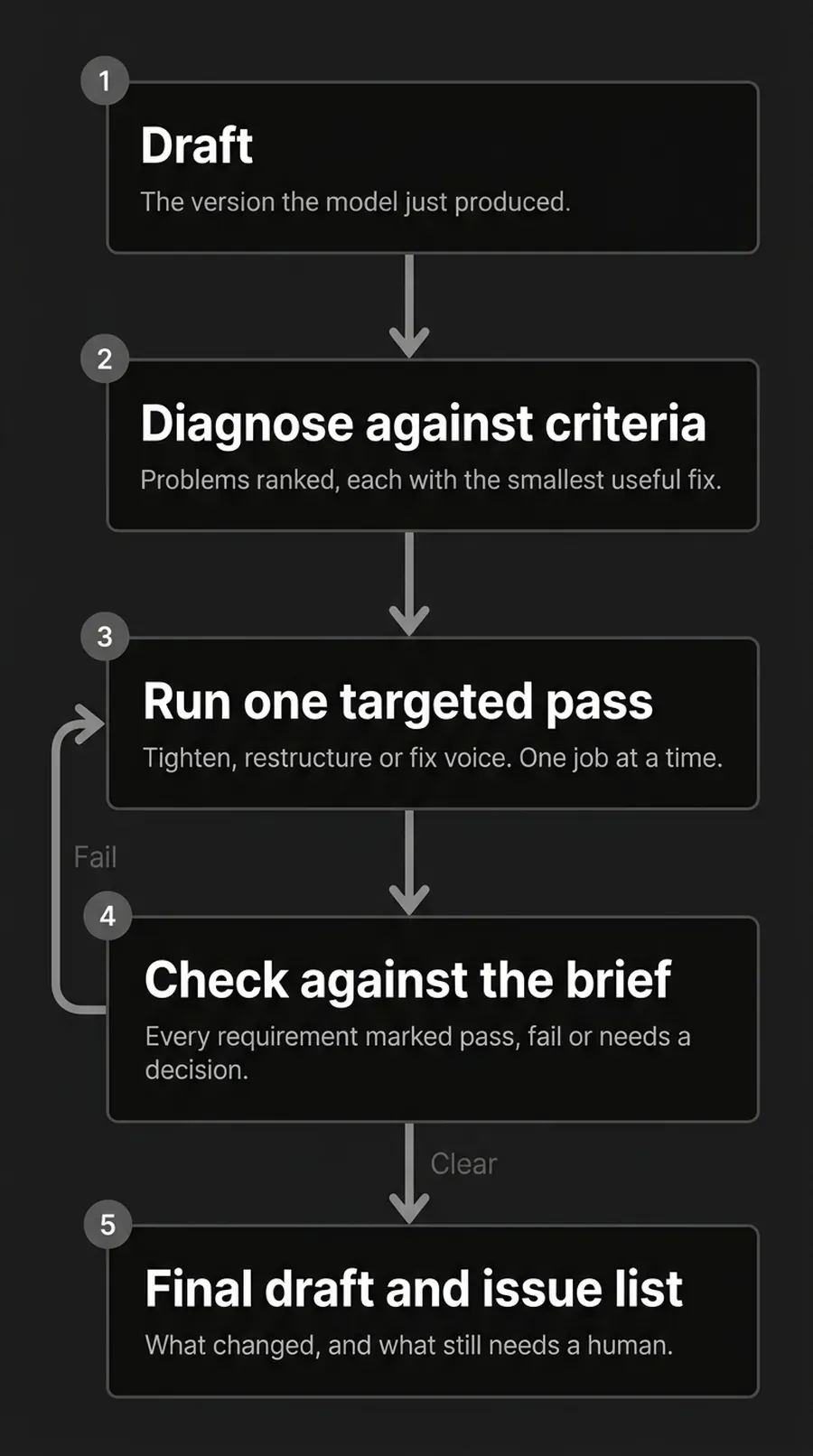
You can compress the whole thing into a single improve AI draft prompt, as long as you keep the order inside it. Diagnose, fix, rewrite, check, report. Revision prompts ChatGPT can run in one shot are harder to inspect afterwards, so save this route for lower-stakes pieces.
Act as an exacting editor. Improve the draft below for clarity,
tightness, structure, audience fit and the stated voice.

Purpose: [purpose]
Audience: [audience]
Desired outcome: [outcome]
Voice rules: [rules]
Must preserve: [ideas, examples, qualifications]
Must avoid: [patterns]
Format and length: [requirements]

Work in this order:
1. Diagnose the three highest-impact problems.
2. Give a proposed fix for each.
3. Rewrite the full draft.
4. Check the rewrite against every requirement.
5. List unresolved issues and anything needing human judgement or
   separate fact verification.

Do not add facts, claims, examples or product capabilities that are not
in the brief or draft. Do not claim to have verified factual accuracy.

Return exactly:
A. Diagnosis  B. Fixes  C. Revised draft  D. Requirement check
E. Unresolved issues

<brief>
[PASTE BRIEF]
</brief>
<draft>
[PASTE DRAFT]
</draft>
What to expect, and where this method stops
There is real research behind the loop you just ran, and it is worth knowing what it does and does not promise before you build a habit on it. The Self-Refine work formalised the pattern of generate, critique, refine using one model for all three roles, and reported a meaningful average improvement across the tasks it evaluated compared with one-step generation. Those were benchmark tasks, not your blog post, so treat it as a good reason to test the loop rather than a number to expect.
The official prompting guidance from the major model providers points the same way. Be specific about context, outcome, length, format and style. State the output format instead of leaving it open. Separate your instructions from your content with consistent delimiters. Break a complicated request into stages. Every prompt above is built from those rules.
Three honest limits on a self-edit AI draft pass, so you know what you are holding:
- A model repeats its own blind spots. When you prompt AI to edit what it just wrote, the same habits show up in both passes. Explicit criteria are what stop the second pass agreeing with the first.
- Compliance is not accuracy. Instruction checks confirm you got what you asked for, nothing more.
- More passes are not better passes. Stop when the checks come back clean and the remaining changes are matters of taste. Unbounded iteration starts moving meaning around.
Where to go next
Save the brief from step 1 somewhere you will find it again. That single artefact is what makes these AI editing prompts reusable, because the criteria stop being something you improvise per draft.
Then run steps 2 and 3 on the next thing in your queue. Two passes. That is the smallest version of this that still changes your week, and it is enough to see whether the method fits how you work.
If the bigger problem is that you are hand-repairing every draft your stack produces, that is a different fix. DeepSmith is a production engine rather than a writing assistant: brand context lives in Deep IQ, and Content Studio produces finished articles with research, internal and external links, metadata and a cover image already in place, so the review you do is editorial rather than remedial. Start a free trial and put your own next article through it.