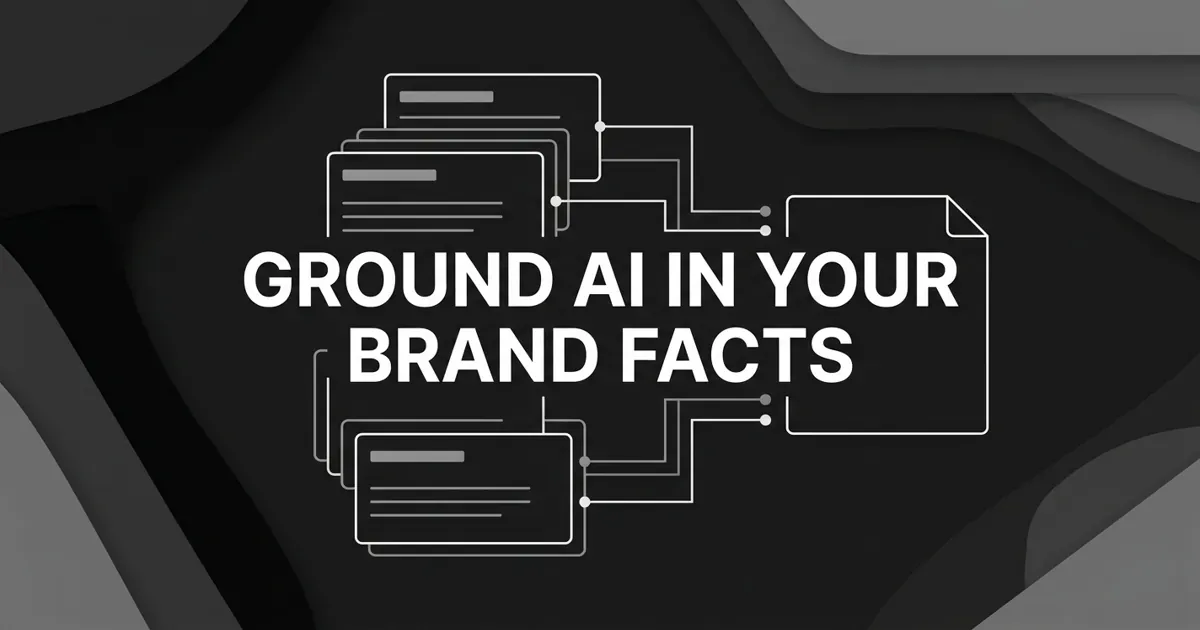
You can get a draft in ninety seconds. Then you spend two hours deleting a feature you don't ship, a price that changed last quarter, and an opening paragraph that sounds like everyone else's blog. Sound familiar? That gap is what this guide closes. By the end you'll have a reusable grounding layer, four stored context types that travel with every writing task, so AI content accuracy stops depending on how carefully you worded today's prompt.
Here's the good news: you've probably already written most of this material. It's just scattered across a positioning deck, a pricing page, a persona doc, and a style guide PDF nobody opens. We're going to make it explicit, structured, and retrievable.
Step 1: Write the claim boundary before you prompt
A model can't write from a truth you never made explicit. So before drafting, write a short grounding contract for the task.
Name the article's purpose and reader. Name the products in scope. Name the buyer stage and the problem. Then get specific about claims: which types need exact support (features, integrations, limits, pricing, availability, dates, performance, comparisons, customer outcomes), which differentiators are approved, and which claims are off limits (guarantees, unsupported superlatives, unlisted integrations, implied capabilities).
Then the piece most people skip. Say what the model should do when the evidence isn't there: state that the supplied facts don't confirm the point, omit it, or ask for an authoritative source.
Keep facts and expression in different lanes. "Do not state an integration unless an active product record names it" is a hard rule. "Prefer short, direct sentences" is a voice rule. Mixing them makes both softer.
You know it's done when a writer or a system can answer four questions without guessing: What are we writing? For whom? Which product claims are allowed? What happens when the source set is silent?
Where people go wrong: they open with "write a blog post about our product" and close with "make it sound like us." That gives no factual boundary and no usable definition of "us." Positioning language like "the easiest" gets treated as proof of a capability, which it isn't.
Pro tip: make "unknown" an allowed output. A model that can only answer or invent will eventually invent.
Step 2: Build one source of truth to ground AI in product facts
This is the step that does the heavy lifting when you want to stop AI hallucination in content. A hallucination is output that sounds plausible but is wrong or unsupported. Fluency proves nothing about whether the claim is true.
Create one record per product or service, and one per material claim. Keep current facts separate from drafts, historical facts, marketing copy, and examples. A workable product-fact record holds:
| Field | What to store |
|---|---|
| Identity | Exact product name, category, version or edition, short description |
| Capability | Feature name, what it does, the conditions under which it works |
| Use case | Problem solved, intended audience, supported workflow |
| Boundaries | Limits, exclusions, dependencies, unsupported cases, plan or regional scope |
| Commercial detail | Price, billing unit, availability, trial or contract detail |
| Comparison | Approved distinctions, and claims to avoid about alternatives |
| Language | Approved wording, allowed synonyms, prohibited wording |
| Evidence state | Source record, authority, status, last verification, effective date, review date |
Give the set a hierarchy. A current spec, release note, or approved internal record outranks an old article, an unverified sales sentence, or a model-generated summary. When two authoritative records disagree, don't let the model pick by intuition. Resolve the record or mark the claim unknown.
Every volatile fact needs scope. "Supports integration" is incomplete without the named system and the relevant plan, version, region, or condition. "Available" is incomplete when availability differs by market or date.
This is exactly the pattern behind DeepSmith's Deep IQ. About Company holds positioning, differentiators, and the claims to make or avoid. Products & Services holds a profile per product with category, features, value props, use cases, and an editable competitor list. Storing the fields is what makes them retrievable at writing time. It doesn't do the maintenance for you.
You know it's done when every material claim in the article maps to an active record with clear scope and a verification state, and no active record still contains "maybe," "usually," or a copied claim with no authority behind it.
Where people go wrong: they upload a product page and assume the model will sort current facts from obsolete text, sales copy, and navigation. Or they store a feature name without its limitations. Or they store a value proposition as if it were a measured outcome.
Step 3: Separate facts, audience, voice rules, and examples
One long brand brief is where grounding quietly fails. The model can't tell which sentence is evidence, which is an instruction, and which is a style demo, so it blends them.
Your AI brand voice belongs in its own block, well away from anything factual. Same for the persona, the positioning, and the examples. Give each layer its own labeled section:
<company_positioning>
  category, audience, problem, differentiators, approved claims, claims to avoid
</company_positioning>
<product_facts>
  only active records for the requested product, version, market, and plan
</product_facts>
<buyer_persona>
  goals, triggers, requirements, challenges, objections, vocabulary
</buyer_persona>
<brand_voice>
  stable traits, sentence texture, vocabulary, energy, point of view, banned patterns
</brand_voice>
<situational_tone>
  how the voice shifts for this content type, audience, and emotional context
</situational_tone>
<approved_examples>
  representative passages and rewrite pairs, labeled as style examples
</approved_examples>
<missing_fact_behavior>
  do not infer; state that the source set does not confirm the claim
</missing_fact_behavior>
Markdown headings, lists, and XML-style tags all work as delimiters. Use consistent, descriptive names, nest documents where a hierarchy exists, and keep each record's metadata next to the record so a current fact never reads like an archived one.
Two habits protect the boundary. Never drop a prohibited claim into an example without labeling it prohibited. Never let one memorable example become the working definition of the voice. Rules describe the boundary. Examples show the texture.
You know it's done when a maintainer can update a product limit without touching the voice guide, and you can change the audience without touching the product facts.
Where people go wrong: they merge "what is true," "how we sound," and "what this audience wants" into undifferentiated prose. The model then treats a persona aspiration as a product fact, or a past example as a current claim.
Step 4: Retrieve only the context this assignment needs
Retrieval is a relevance and freshness step, not a file dump. You ground AI in product facts by handing it the right five records, not every record you own. That distinction is the whole game, because grounding quality is capped by retrieval quality.
Work it in order:
- Parse the task for product, version, market, persona, content type, and likely claim types.
- Pull the matching active product records first.
- Pull the positioning and persona records that set emphasis and audience fit.
- Pull the relevant voice rules and a small, varied example set.
- Exclude archived, draft, disputed, and out-of-scope records.
- Keep the record label and verification state visible in the working context.
- When no authoritative record supports a requested claim, omit it or trigger the missing-fact behavior.
Retrieval-augmented generation works this way underneath: search external data, preprocess the relevant results, add them to the model's context, then generate. It's how a model uses current, private, or proprietary information it was never trained on. It is not the same as the model knowing that information, so the retrieval step stays load-bearing every time.
More context is not automatically better. Irrelevant records make an answer off-topic while still looking grounded. Stale records make it wrong while still looking grounded.
For long context, structure carries the weight. OpenAI's prompt engineering guidance recommends specific context, outcomes, length, format, and style, with instructions kept separate from context. Anthropic's prompting best practices recommend descriptive tags, nested document sections, and placing long documents before the query. Treat those as implementation patterns worth benchmarking on your own setup, not laws.
You know it's done when the generation context holds only the facts, persona details, voice rules, and examples that match the assignment, and every hard claim traces to an active record.
Common mistake: "grounded in our knowledge base" isn't an answer. Ask which records were retrieved, whether they're current, and whether they actually support the sentence the model wrote. A retrieved document can be authoritative and still be the wrong document for the claim.
Step 5: Turn your AI brand voice into observable rules
What does "on brand" actually mean to a model? "Friendly, bold, human" is not an answer. It's three adjectives a model will interpret differently every time, and that's where drift comes from. An AI brand voice has to be written as behavior you can check, not as a mood you hope lands.
Start with a sample of content your team genuinely likes. Pull the voice down to a few memorable traits, then turn each trait into a row you can check:
| Trait | Means | Do | Avoid |
|---|---|---|---|
| Direct | Lead with the task and the answer | Active verbs, concrete nouns | Long setup before the point |
| Specific | Name the behavior and its boundary | State the condition or limit | Broad claims like "does everything" |
| Human | Natural, clear language | Contractions, address the reader plainly | Forced jokes, synthetic enthusiasm |
| Calm | Confident without hype | Say what's known and unknown | Guarantees, fear, inflated superlatives |
Add a short before-and-after for each trait, preferred and prohibited vocabulary, and your rules on sentence length, rhythm, and point of view. Negative examples matter as much as positive ones, because "not generic" tells a model nothing.
Then separate voice from tone, because they're different jobs. Voice is the stable personality that should stay recognizable everywhere. Tone is how that voice flexes for a tutorial, a correction, an announcement, or a sensitive customer problem. A brand can get warmer in a troubleshooting piece without becoming a different brand.
Keep your example set small and varied. Anthropic's guidance recommends three to five examples in its documented prompting context, which is a sensible starting point rather than a magic number. Cover different lengths, sections, and situations instead of repeating one favorite paragraph. Content Marketing Institute's method for finding a brand voice is the same shape: gather your real content, describe it in a few words, build a chart, and make sure people can actually use it.
DeepSmith's Deep IQ holds Brand Voice as stored tone and human-texture context for exactly this reason. A stored voice layer beats pasting a style guide into every prompt. It still needs you to write the traits, the examples, and the banned patterns.
You know it's done when a new writer could make the same editorial call from the chart without asking what "on brand" means, and a voice check can catch a banned transition, unsupported hype, or the wrong level of empathy.
Where people go wrong: they list adjectives with no observable behavior, confuse voice with a single fixed tone, or supply only polished examples and no boundary cases.
Step 6: Write a generation contract with safe missing-fact behavior
Now assemble it. Implementation varies by model, but the contract should carry the same parts in a consistent order: identity and job, the specific task, the audience, the product scope (edition, version, plan, market, date), the retrieved source context with its metadata, the voice context, the hard constraints, the missing-fact behavior, and the output contract.
Write instructions the model can act on. Replace "avoid fluff" with "start with the reader's task, use concrete nouns, remove the introductory sentence." Replace "be accurate" with "use only the supplied active product records; do not infer price, availability, compatibility, performance, or integrations."
A short version looks like this:
Task: Write a how-to section for the named audience and product.
Source rule: The active product-fact records below are the only authority for product claims.
Claim rule: Do not add a feature, integration, limit, price, date, comparison, or outcome that a supplied record does not support.
Missing evidence: If the task needs an unsupported fact, say the supplied records do not confirm it and leave the claim out.
Voice rule: Follow the stable traits, the situational tone, the approved examples, and the banned-pattern list.
Audience rule: Use the persona to choose explanation and emphasis, not to invent customer results.
Output: Return the requested section in the specified structure and length.
One more thing worth saying plainly. If your model exposes a temperature setting, a lower value can help with factual extraction, but temperature is not a truthfulness control. It cannot repair bad retrieval or a missing fact.
This is also where stored context earns its keep in production. In DeepSmith, Deep IQ supplies the shared brand context and Content Studio is where ideas become finished articles, so the same positioning, product, persona, and voice records shape every piece instead of being re-briefed per article. The records still have to be right.
You know it's done when the contract states both the positive behavior and the refusal behavior, and the output can be checked against a known structure without anyone interpreting the prompt.
Where people go wrong: long prohibition lists with no replacement behavior, hard rules buried inside examples, a product name in the prompt with no product facts attached, and low temperature used as a stand-in for a source policy.
Step 7: Test factual support and voice separately
AI content accuracy and voice quality are two different failure modes, and a single quality score will hide one behind the other. Beautiful prose can carry a false pricing claim straight to publish.
Build a test set by coverage, not by round number. Cover each important product, persona, content type, and hard-claim category, then mix ordinary prompts with adversarial ones: a product description, a feature explanation, an integration question, a pricing or limit question, a comparison, a request for a capability you don't have, a prompt combining two products, a persona rewrite that must not change facts, a voice rewrite that pokes each trait, a request with conflicting context, a request whose answer isn't in the source set, and a long-context request padded with irrelevant records.
Score at the claim level. For hard facts, keep the release rule binary: every material claim is supported by an active authoritative record, or the claim comes out. That's an internal safety policy you set, not an industry benchmark.
Worth tracking separately:
- Hard-fact support rate: supported material claims divided by total material claims.
- Unsupported claim count: target zero for hard product claims in tested output.
- Faithfulness: factual consistency with the retrieved context. Ragas defines it on a 0 to 1 scale as supported claims divided by total claims.
- Context relevancy and recall: whether retrieved records are relevant, non-redundant, and complete enough to answer.
- Voice pass rate: whether the output meets each trait, tone requirement, and banned-pattern check.
- Abstention behavior: whether the model flags or declines when the source set is silent.
Common mistake: a faithfulness score measures consistency with the retrieved context, not the truth of that context. Score high against a stale knowledge base and you've measured nothing.
Re-run the same set after any change to product records, voice rules, retrieval filters, model, or contract. When quality drops, which one broke? Comparing failures by category answers that in a minute, so a voice regression never gets misread as a retrieval problem.
You know it's done when you have a baseline, a written pass rule for hard facts, a voice rubric, and a list of known failure cases, including the missing-data ones.
Step 8: Refresh the grounding layer when reality changes
Grounding is risk reduction, not a truth guarantee. Output can still be wrong when the source is stale, the wrong record is retrieved, a source contains an error, a claim is only partly supported, or the model adds an inference nobody authorized. Most of those trace back to a record that quietly aged.
Give every volatile record a status and a verification date. Refresh or invalidate when a product changes, a plan changes, a feature ships or retires, an integration changes, a market opens, or the voice rules move. Re-run the fact and voice tests after anything material.
Keep a short change history for the records your content system draws on. This isn't large-team governance. It's the smaller job of making sure an old fact never stays eligible for retrieval. If a record is disputed or incomplete, mark it and keep it out of authoritative context until it's resolved.
You know it's done when you can say which facts are active, which are archived, and when each volatile fact was last verified, and a product change reliably triggers both a source update and a regression test.
Where people go wrong: they build the layer once and never revisit it. They update the public product page but not the stored record. They swap a voice adjective without touching the examples.
Where to start this week
Feeling like this is a lot? It is, if you try to do it all at once. So don't. Pick one product and one content type. Write the claim boundary, build the product-fact records, split the four context layers, and run a small fact and voice test set. Fix what fails. Expand only after the source behavior holds up.
That's it. One product, one format, one test pass, and you'll have something real to widen. On-brand AI content compounds from there, because every later piece reuses the layer you just built. Momentum matters more than completeness.
If you'd rather keep those layers in one place and use them straight through production, DeepSmith stores positioning, products, personas, and brand voice in Deep IQ and carries that context into Content Studio, where planned ideas become finished articles. You can start a free trial and set up your context on real content before you commit.