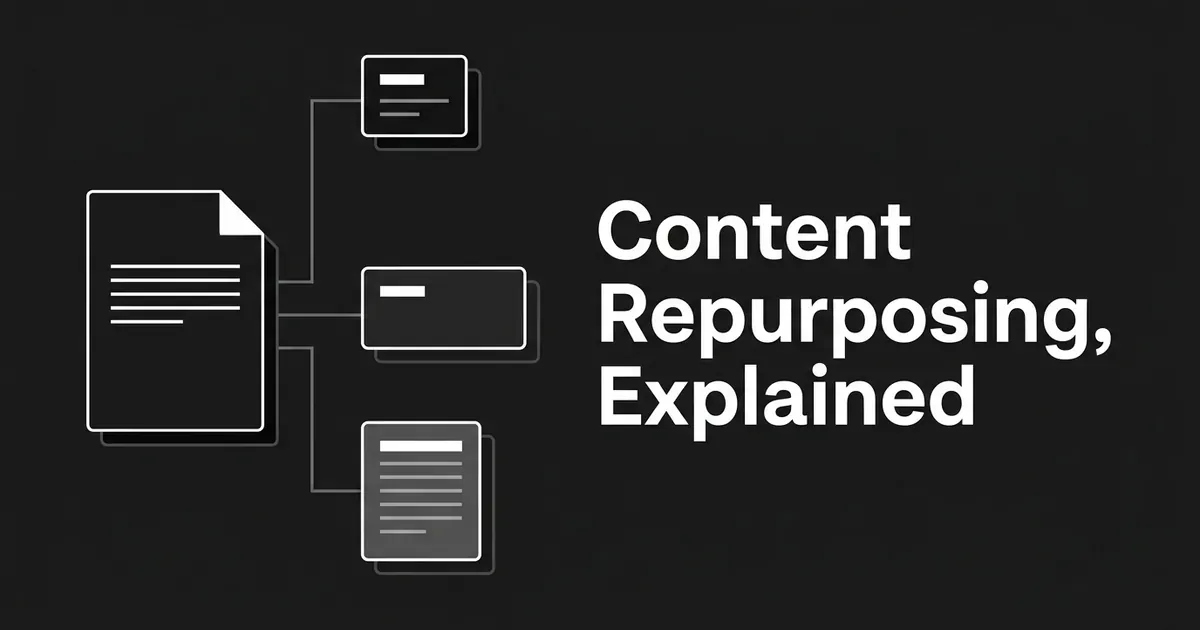
What is content repurposing? It's the practice of adapting the ideas, research, or material in an existing piece of content into a distinct asset that suits a different audience, channel, format, or purpose. The new asset draws on work you already did, but it gets shaped for the job it has to do, so it isn't just the old piece showing up again somewhere else.
If you lead a small marketing team, this is worth understanding properly, because the word gets used loosely. Some people use it to mean any time a post gets shared twice. Others use it to mean a full rewrite for a new medium. This content repurposing explained piece walks through what the term means, how it differs from reposting and a few neighboring ideas, why it can help a team that has more to say than time to say it, and where it gets misunderstood. It stays on the definition. It doesn't walk through a repurposing process or list format ideas, since those are separate topics.
What content repurposing means
Content repurposing is adapting existing material into a new asset built for another audience, channel, format, or purpose. That is the definition we'll use here, and it's a synthesis, because the sources that define the term put the weight in slightly different places. Optimizely leans on new formats and audiences across channels. MediaValet also names a new campaign or business goal. Brafton describes pulling material out of an earlier project and tailoring it to a new purpose.
What they share is the idea of adaptation for a reason. The original piece supplies the substance, meaning the research, the interviews, the evidence, and the thinking behind it. The new asset changes how that substance is selected, explained, framed, or presented so it works for whoever is going to use it.
That's why the content repurposing definition doesn't hinge on how many outputs you end up with, or on a switch of medium. Changing format is common, but a piece can be repurposed inside the same format too, if it genuinely serves a different audience or purpose. A long article turned into a short answer for a specific customer question is still an article, and it still counts. On the other hand, moving unchanged copy to a new place doesn't establish that anything was repurposed.
A small example helps make the repurposing content meaning concrete, and it shows the same idea from the reader's side. Say your team has already researched and hosted a customer webinar. If you upload the unchanged recording to a second location, that's redistribution. If you write an article that uses the webinar's approved findings to answer one specific question for a different audience, that's repurposing, because the second asset is organized around a different reader need. This is only an illustration, and it isn't a documented customer result.
Repurposing versus reposting
A repost repeats, and a repurposed asset adapts. That's the most useful line to hold onto when you're deciding which one you're looking at.
Reposting, or republishing, means the same or nearly the same asset appears again. What changes is where it is published, and the substance may not change at all. That can still be a perfectly good thing to do. Plenty of people miss a post the first time, and putting it in front of them again has real value as distribution. It just doesn't show that the material was tailored to a new job.
Repurposing means the useful substance was adapted into something with its own reason to exist. Someone reading or watching the new asset should have a reason for it to be there, beyond the fact that the old one was.
Two neighboring terms get mixed up with these, and it helps to keep them apart:
| Term | What happens to the existing material | The defining difference |
|---|---|---|
| Repurposing | Its useful substance is adapted into an asset for another use, audience, channel, or format. | The new asset is tailored, not just redistributed. |
| Reposting or republishing | The same, or nearly the same, asset appears again. | Where it appears changes, and the substance may not. |
| Syndication | An existing piece is republished on another website, commonly with permission. | It describes third-party republication, and not necessarily any real adaptation. |
| Refreshing or updating | The existing piece is revised so that piece stays accurate or useful. | An update alone doesn't necessarily create an asset for a new purpose. |
These are practical distinctions and not legal or industry-wide definitions. Some marketers use "repurposing" broadly enough to include redistribution or syndication. HubSpot, for example, treats syndication as part of a wider idea of repurposing, while defining syndication itself as republishing the same piece on other websites. For the purpose of this article, the narrower line is the more useful one, because it's the one that tells you whether the material was actually adapted.
Why the same research can support more content
The main reason repurposing appeals to a small team is that you can reuse the investment you already made in research, interviews, evidence gathering, and subject-matter thinking. You don't have to start every asset from a blank page. MediaValet describes reuse as a way to avoid duplicate work and keep things consistent, and Brafton describes it as a way to extend the useful life of earlier work.
Think about where the time goes on a typical article. A good share of it is the thinking: finding the evidence, talking to the people who know the subject, deciding what's true and worth saying. That work doesn't expire the day the article goes live. The same well-supported idea can reach people in other contexts, and doing that doesn't call for an entirely separate research project each time.
If you're a marketing lead, you probably know the feeling that the article gets published and then distribution slips, because there's already a next piece to brief. Repurposing is one way of looking at that gap. The material you paid for with your team's time is still useful after its first publication, and it can keep working if someone adapts it.
There is some survey data on how small businesses see this. In 2024, Adobe Express published a survey of 517 small-business owners. It's vendor research based on what respondents reported, so it doesn't measure the effect of repurposing, and it isn't a benchmark for B2B marketing teams. Within that sample, 70% of owners said they had repurposed content. Among the entrepreneurs who talked about benefits, 54% named saving valuable time, 52% named better brand visibility, and 45% named audience engagement. Those are the benefits people reported, and they aren't measured improvements of 54%, 52%, or 45%.
One more detail from the same survey is that one in six owners said they had used AI to repurpose content, and among those who did, 56% reported saving one to five hours per week. That figure only covers owners using AI for repurposing, so it shouldn't be read as the time saving for every team that repurposes, or credited to repurposing alone. The fair takeaway is modest: a good number of small businesses say they do this, and many of them say it saves them time.
It's also worth being careful about the efficiency claim itself. Getting more assets from one research investment can improve how much a team produces, but every asset still needs editorial judgment, accuracy checks, and real adaptation. One source doesn't turn into several good pieces on its own, and output doesn't double or triple at no extra cost. A shared factual base can help keep your message consistent, but it doesn't guarantee a consistent brand voice or good performance. Nobody has established a reliable number of assets per source, or a fixed amount of time saved.
Where the distinction gets blurred
Most of the confusion around repurposing comes from a handful of gray areas, and it helps to name them so you can spot them in your own work.
The first is the different wrapper. If you repeat the same wording under a new title and call it a new asset, that's closer to reposting than to useful adaptation. A reader or channel should have a reason for the new asset to exist, and a new title alone rarely gives one.
The second is format. It's easy to assume that repurposing always means a change of medium, but it doesn't. A change of format is common, and it can be a good sign that the material was reshaped. It isn't required, and it isn't enough by itself. Switching the wrapper without adding anything audience-relevant is a weak example of the practice.
The third is duplicate web copies, which people often worry about with search. Google says some duplicate content is normal and isn't a spam-policy violation. When pages are the same or very similar, Google may group them together and pick one URL to show, which it calls the canonical URL. So the practical point is that copies of the same page shouldn't be expected to each earn their own search visibility. A canonical preference you indicate is a hint, and Google doesn't have to follow it. This is a small nuance about how copies are treated, and it isn't a reason to turn a definition into an SEO guide.
The fourth is reuse of old facts. Repurposing carries the earlier material forward, and that includes anything that has since gone out of date. A statistic, product claim, quotation, or customer story from the original may have changed. MediaValet stresses that reused material should be current, approved, on brand, and cleared for its new use, and that permission to use something in one context shouldn't be assumed to cover every other one.
What repurposing does not guarantee
It's easy to attach big promises to a term like this, so here are the things the research doesn't back up.
Volume isn't a quality signal. Google defines scaled content abuse as producing many pages mainly to manipulate rankings and not to help users, and its guidance says that using generative AI to create many pages without adding value for users may violate that policy. Neither repurposing nor AI assistance guarantees a penalty or a ranking benefit. What matters is whether each asset gives its audience something useful.
The research also doesn't establish a universal percentage cut in production time, a reliable number of assets per source, or a guaranteed return on investment. It doesn't establish a measured increase in reach, search traffic, conversions, or AI citations either. If you see a number like that attached to repurposing without a named source, treat it with caution.
AI search deserves the same proportion. There's no evidence here that repurposing itself makes AI systems cite a brand. The most you can say is that useful, adapted content gives people another relevant way to come across the ideas underneath it.
Content repurposing explained in one idea
The value in repurposing comes from keeping what was good about the original thinking and changing how it's expressed for someone new, and it doesn't come from copying the same piece more often. That's what the content repurposing definition asks of you, and it's the test to apply when someone on your team says a post has been repurposed: was it adapted for a reason, or just moved?
If you'd like some help with the distribution side, DeepSmith's Repurpose feature gives every finished article social posts that are already written, and the Apps Library adapts an article for channels like LinkedIn, X, and newsletter email. You can try DeepSmith free for 7 days and see how that fits your workflow. Any of it still needs a person to check the result before it goes out.