If you have ever asked how long should a title tag be, the short answer from the data is 50 to 60 characters, or about 580 to 600 pixels on a desktop search result. That number comes from Zyppy, an SEO research firm, in a title-length analysis updated July 1, 2026. It is a practical display target, not a rule Google enforces, and it is worth understanding the difference before you go rewrite every title on your site.
Title tag length gets treated like a hard rule a lot of the time, and it just isn't one. Google has never published a maximum character count for the <title> element. What Google does is truncate the title link it shows in a result, typically to fit the width of the screen someone is using. So the 50 to 60 character range you see everywhere is a drafting guide based on what tends to display fully, not a spec you can fail.
That distinction matters more once you start weighing seo title length against other things you care about, like whether the title actually says what the page is about. A title that gets cut off in the search result can still be fine. A title that's the "right" length but vague about the page's subject is the bigger problem.
Is there a Google title-tag length limit?
There isn't one, at least not in the way most people mean it. Google Search Central says there's no limit on how long a <title> element can be. What you write in that HTML tag is entirely up to you.
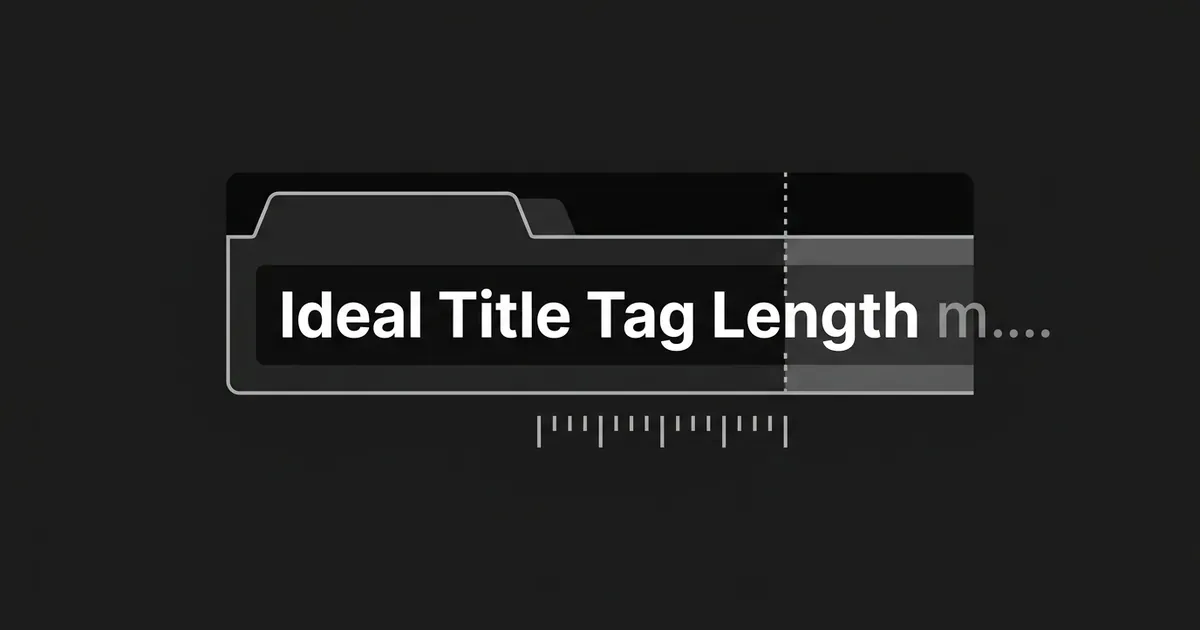
What Google does control is the title link, the clickable headline it actually shows in the result. That gets truncated as needed to fit the space available, which usually comes down to device width. Your full title still lives in the page's HTML even when the visible version gets cut short. Google isn't ignoring the rest of it, it's just not always displaying it.
So when someone says "keep your title tag under 60 characters," what they usually mean is "keep it short enough that it probably won't get cut off." That's a reasonable goal. It's just not the same thing as a Google-imposed rule, and treating it that way leads to titles that are padded out to some arbitrary length, or trimmed in ways that lose the specific detail a reader needed.
What actually fits in a search result
Character count is an easy thing to measure, but it isn't what determines whether your title displays in full. Pixels are. A lowercase "i" and a capital "W" take up very different amounts of horizontal space, so two titles with the same character count can render at very different widths.
Zyppy's numbers, the same July 2026 update mentioned above, put the desktop display budget at roughly 580 to 600 pixels, which tends to land somewhere around 50 to 60 characters depending on which letters you're using. That's a useful drafting proxy, not a precise conversion. If your title is packed with wide capital letters, you'll hit the pixel ceiling sooner than the character count suggests.
Mobile is looser. Zyppy's data shows mobile results sometimes displaying titles of 70 to 80 characters, occasionally wrapped across more than one line. That's an observation about what Google has shown, not a promise about what it will always show. If a title matters enough that you need to know exactly how it renders, check it on the actual device and layout your audience uses, rather than assuming a fixed cutoff applies everywhere.

The practical takeaway is to put the identifying information early. If your title says what the page is about in the first several words, a reader who only sees the truncated version still gets what they need. Front-loading the specific noun or benefit protects you against a cutoff you can't fully predict.
Does the research show a performance sweet spot?
This is where two different studies get mixed together more than they should. Zyppy's analysis, built from over 81,000 title tags and a separate look at roughly a quarter million URLs, is about display width and traffic patterns. Backlinko's research, drawn from more than 1.3 million pages and over 12 million search queries, looks at organic click-through rate and finds that titles in the 40 to 60 character range had the highest observed CTR in its dataset.
Those two ranges overlap, which is reassuring, but they're not measuring the same thing, and neither one is a controlled experiment. An association between title length and click-through rate doesn't tell you that shortening or lengthening one specific title will change how it performs. Pages that already do well for other reasons (a strong brand, a well-matched query, a favorable position) can pull the averages around in ways a raw comparison can't separate out.
Backlinko's own page also states two different numbers for the CTR advantage of titles in that 40 to 60 character range, 33.3% and 8.9%, in two different passages. That's a real inconsistency on the source's own page, and it's not something this article can resolve for you. The directional finding, that titles in that general range tend to perform reasonably well, is worth keeping. The specific percentage isn't reliable enough to repeat as a fact.
So take the sweet spot as a starting band, not a formula. A title in the 50 to 60 character range is a sound default. It isn't evidence that a 59-character title will outrank an otherwise identical 61-character one.
Do AI answers change the length target?
Search results aren't only blue links anymore, so it's fair to ask whether title tag length works differently when a page shows up in an AI answer instead of a conventional result. Based on Google's own guidance, the honest answer is that there's no separate rule for that.
Google's documentation on AI Overviews and AI Mode describes these features as surfacing supporting links, sometimes with a hover preview on desktop that can show a page's title or the site's name. Google's May 2026 product update describes more links placed alongside the response text. None of that guidance specifies a character or pixel target unique to AI features. Google says its existing SEO fundamentals still apply to AI Overviews and AI Mode, and that no additional special optimization is required.
The same holds for ChatGPT's web search. OpenAI's help documentation says answers may include citations, and that selecting one opens the source, sometimes with a preview. There's no stated title-length recommendation for how a page shows up there either.
What that means practically is that a citation or preview link is not a promise your full HTML title will appear verbatim in every AI interface, and there's no evidence that adopting some separate "AI-friendly" title length improves your odds of being cited. Write one accurate, well-scoped title. Don't build a second standard around it for AI surfaces that don't have a published rule to build against.
What should a team standardize on?
This is the part of the SEO title length debate that actually settles into a policy. Pull the pieces together and a workable policy looks like this. Start with identification, not a quota: the title needs to say clearly what the page is about, and padding it out to hit a target character count doesn't help anyone. Use 50 to 60 characters as your default drafting band for English-language pages, since it lines up with both Zyppy's display guidance and Backlinko's CTR range. Check the rendered pixel width on your important pages if a fully visible desktop title genuinely matters for that page, since a character counter alone won't catch a title full of wide letters.
Put the identifying words near the beginning so a truncated title still tells the reader what they're looking at. And build in room for exceptions. A shorter, accurate title is fine. A longer title that preserves a necessary detail, a specific model number, a location, a qualifier that changes the meaning of the page, can be worth the risk of truncation. Neither case is automatically wrong, and a blanket site-wide hard cap will force you into a worse title on the pages where the extra words actually matter.
Keep your AI-surface expectations separate from your desktop pixel budget. Check how your important pages actually get linked or previewed in the answer experiences your audience uses, if that's something you can observe, but don't treat a conventional SERP measurement as if it also governs an AI citation. It doesn't, and there's no published number that says otherwise.
What the numbers mean for your next title
The working range here, 50 to 60 characters, is useful because search-result space really is limited and a title that fits fully is easier for a reader to scan. It isn't a rule from Google, and it isn't a guaranteed lever for more clicks or more AI citations. Treat it as a sensible default, check the pixel width when a specific page is worth the extra step, and let identification win over the character count when the two are in tension.
Next time you're about to publish a page, read the title back and ask whether a stranger would know what the page covers from the words alone. If the answer is yes and it happens to run a little over 60 characters, that's a reasonable tradeoff. If it's under 60 and still vague, the length was never the problem.