Content marketing decides what to create, for whom, and why it matters. SEO decides whether the people who need it can actually find it and understand it once it's up. Those are two different jobs, and treating them as one job is why a lot of content marketing plans and SEO plans end up pulling in opposite directions.
Here's the short version, if you want to skip to it: most search-led businesses need both. If your main channels are email, community, events, partnerships, or sales, you can run a strong content marketing program without making SEO the center of it. Either way, the two disciplines aren't interchangeable, and neither one is a subset of the other.
If you're weighing content marketing vs SEO for your own team, or trying to settle an internal seo vs content strategy debate, the useful question isn't "which one do we do." It's "which decisions belong to which discipline, and where do they need to talk to each other." That's what this piece walks through, and it ends with a plain answer on how content and SEO work together in practice.
What content marketing is
Content marketing is the discipline that decides which audience you're serving, what they need from you, and how content helps you build a relationship with them that eventually leads to a business outcome. The Content Marketing Institute defines it as creating and distributing valuable, relevant, consistent content to attract and retain a clearly defined audience, with the goal of driving profitable customer action. That definition is doing more work than it looks like.
Strategic means it's not just publishing. Someone decided this particular audience, with this particular problem, is worth addressing, and that decision connects back to what the business actually needs. Audience-led means you start with a person and their situation, not with a topic you feel like writing about. Value-led means the content has to be genuinely useful or meaningful on its own, not a wrapper around a pitch. Consistent means this is an ongoing relationship, not a single article that has to do all the work by itself.
Content marketing also covers more ground than most people assume. It includes articles, but also newsletters, email sequences, research reports, webinars, podcasts, case studies, customer education material, community content, and sales enablement assets. A blog is one channel content marketing can use. It isn't the definition of content marketing, and it isn't the only place the discipline lives.
That's also true of distribution. Content marketing can reach people through organic search, but it doesn't have to. Email, social, communities, partnerships, events, sales conversations, and paid distribution are all legitimate ways to get content in front of the right audience. This is one of the clearest differences from SEO, which we'll get to next: content marketing's job doesn't stop at the search results page, because search isn't its only channel.
One more distinction worth holding onto: content strategy is the layer above content marketing. Content strategy decides the system, the audience, the objectives, the topics, the formats, the channels, and how you'll measure it. Content marketing is the execution of that system as a marketing activity. Content production is the actual making of the assets. SEO can feed evidence into content strategy, the same way sales calls or customer research can, but it doesn't replace it.
What SEO is
SEO, or search engine optimization, is the discipline of making a website and its content easier for search engines to discover, crawl, index, understand, and present to the right searchers. It's a search-discoverability function. It isn't the same thing as writing blog posts, and it isn't the same thing as sprinkling keywords into a page.
SEO asks a specific set of questions that content marketing doesn't automatically ask on its own: what search terms are actually relevant to this business, what is the person behind that search trying to accomplish, which page should answer that need, and can search systems actually understand and surface that page. It also looks backward at performance data, since search results reveal a lot about unmet demand and where a site has gaps that competitors don't.
SEO's scope is also wider than most people picture when they hear the word. Beyond the content itself, it covers technical accessibility, site structure, information architecture, internal linking, structured data, and how a site's authority and reputation signals read to search engines. Those are execution details this piece won't walk through, but it's worth knowing SEO is a bigger discipline than "make sure the keyword is in the H1."
What SEO doesn't do is guarantee anything. Google's own guidance is explicit that SEO makes it easier for search engines to work with your content. It doesn't promise a ranking, doesn't promise traffic, and doesn't promise a conversion. SEO is also channel-specific by design. Its job is search visibility. It doesn't own your brand narrative, your distribution plan outside of search, or what happens after someone lands on the page. Those stay with content marketing.
| Content marketing | SEO | |
|---|---|---|
| First question | What does this audience need, and what should we help them do? | What search need exists, and can the right resource be found and understood? |
| Owns | Audience, angle, format, voice, distribution, the relationship | Search intent mapping, discoverability, search performance analysis |
| Typical outputs | Articles, newsletters, video, webinars, case studies, community content | Search-informed topic priorities, visibility analysis, discoverability requirements |
| Success measures | Audience growth, engagement, subscribers, qualified leads, retention | Impressions, clicks, click-through rate, search visibility, organic conversions |
| Distribution scope | Multi-channel | Primarily search |
| Main failure mode | Publishing content disconnected from audience or business needs | Content that's technically findable but gives no one a reason to care |
This table is an editorial way of laying the two disciplines side by side. It isn't a formal industry standard, just a useful way to see where each one's authority actually sits.
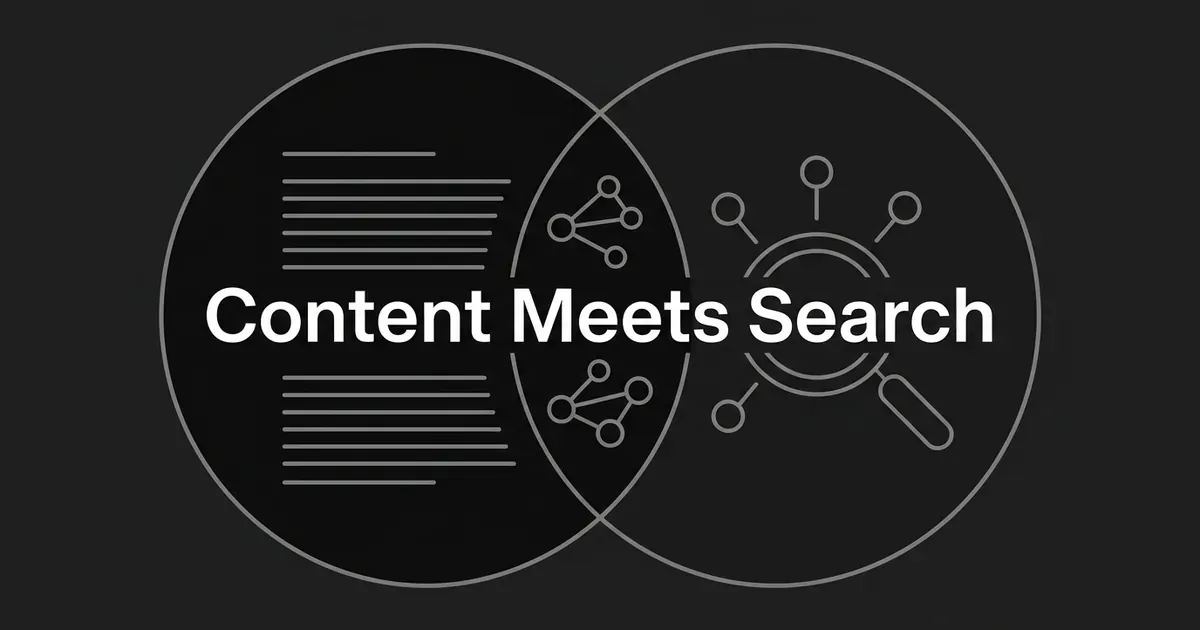
Where content marketing and SEO overlap
The overlap is real, and it's why the two get confused for each other so often. Both disciplines help decide what's worth writing about. Content marketing looks at a topic through audience need, business relevance, and where it fits in someone's decision process. SEO adds evidence about actual search demand, intent, and where a site has visible gaps. You need both views, because a topic can matter enormously to your customers with almost no search volume behind it, and a high-volume query can pull in exactly the wrong audience.
Search intent and audience intent sit close together but aren't identical. Search intent is what a query seems to want. Audience intent is the bigger picture: why this person cares, what they already know, what's stopping them, and what they should do next. A good brief connects both, because matching the query alone doesn't mean you've actually served the person behind it.
Content usefulness sits in the overlap too. Google's own people-first guidance says the priority is helpful, reliable content that benefits people, with SEO best practices applied on top of that to bring searchers additional value. That's the right order. SEO best practices exist to support content that's already worth reading, not to replace the work of making it worth reading. Content marketing usually owns the value, the expertise, the evidence, and the clarity. SEO checks whether that resource can actually be found and understood once it exists.
Gaps are another shared territory, though the two disciplines define a gap differently. A content marketing gap is a missing resource for your audience: a message, a format, a proof point you don't have yet. An SEO gap is a missing or weak page for a real search need. The opportunities worth chasing first are usually the ones that satisfy both definitions at once, not the ones that only look good on a keyword volume chart.
Measurement closes the loop. SEO performance tells you what people search for and which pages get impressions and clicks. Content marketing performance tells you whether the audience actually engages, trusts, shares, subscribes, or converts. Neither one is a complete answer by itself. Search traffic isn't the same thing as qualified demand, and engagement isn't automatically revenue, which is why the two need to be reviewed together rather than as separate scorecards.
Where they're genuinely different
Content marketing owns the audience relationship. That means deciding which audience the business is actually serving, which problem deserves attention, what unique perspective the brand brings to it, which format fits, and what the reader should do next. SEO can inform those calls with search evidence, but it shouldn't be the one making them. A business built entirely around what has search volume, rather than what its audience actually needs, ends up with a content library that ranks for things nobody who matters is searching for.
SEO owns search discoverability. That means figuring out whether a topic has a real search audience, how people actually phrase the need, whether one page or several should cover it, and whether search systems can find and interpret what's already there. SEO doesn't decide your entire editorial agenda, though. Plenty of content, customer education, sales enablement material, community posts, gets created for reasons that have nothing to do with search demand, and that's a legitimate call to make.
Content marketing also owns everything outside of search. A single asset might get distributed through a newsletter, LinkedIn, a customer community, a webinar, or a sales conversation, none of which require SEO to work. This is the clearest reason "content marketing is just SEO content" doesn't hold up. Search is one acquisition channel inside a much bigger program, not the whole program.
And SEO can't manufacture substance. It can make a page easier to find, but it can't supply first-hand expertise, a distinctive point of view, credible evidence, or a reason for someone to actually trust what they're reading. The reverse is also true: genuinely excellent content can underperform in search if it's hard for search systems to discover or interpret. That's the real argument for running both disciplines together rather than picking one, since each one covers a failure mode the other one can't.
How a lean team should split the work
You don't need two departments to hold this together, and most lean teams don't have the headcount for that anyway. One person can carry both content and SEO responsibilities. What matters is that the decisions themselves stay distinct, even when one person is making all of them.
A workable way to divide it:
| Decision | Owner | Question it protects |
|---|---|---|
| Audience and business problem | Content lead | Is this useful to the audience and relevant to the business? |
| Search demand and intent | SEO owner | Is there a search need, and what does the searcher expect? |
| Topic and format | Content lead, with SEO input | What resource should exist, and for whom? |
| Editorial angle and voice | Content lead or editor | What makes this credible and recognizably ours? |
| Search alignment | SEO owner | Can the intended audience actually find this? |
| Distribution | Content or demand-gen owner | Where does this reach the audience besides search? |
| Reporting | Shared | What happened in search, in audience behavior, and in the business? |
The workflow that keeps this honest looks something like this. Start with the audience and the business problem, not the keyword. Bring in search evidence early, so you know how people phrase the need and whether your site already covers it. Choose the actual resource, not just the query, since the right answer might be an article, a template, a comparison, or a short video. Write one shared brief that carries the audience, the business objective, the search need, the format, and how you'll measure it. Create for the person first, and make sure the result is understandable to search systems too, since those aren't competing goals. Then distribute beyond the search result, and review the outcomes together instead of in two separate reports.
A simple rule for when you're stuck deciding who's in charge of a call: if the question is "will this help the intended audience," content marketing leads. If the question is "will they be able to find and understand it through search," SEO leads. If the question is "is this the right investment for the business," whoever owns the budget decides, using both sets of evidence.
Do you need both?
Use both content marketing and SEO when search is an important way people actually find your business, when you need sustained organic acquisition rather than one-off campaigns, and when search evidence would genuinely improve what you choose to write next. For most companies with a website and an audience that searches for solutions, this is the default answer.
Lean on content marketing without making SEO central when your audience mostly finds you through a community, a newsletter, events, partnerships, or your sales team, and the content's job is customer education, retention, or sales enablement rather than pulling in new organic traffic. Search demand can be limited here and the content can still be doing exactly what it's supposed to do.
Prioritize SEO work specifically when you already have useful content that's hard to discover or interpret, when your visibility is weak for structural reasons rather than content reasons, or when you have enough content but it isn't showing up for the searches that matter. That's a discoverability problem, not a content problem, and it needs a different fix.
For most mature programs, the honest answer isn't picking one forever. It's deciding, decision by decision, which discipline leads and where the two need to share what they know. A content gap analysis is a good example of where that shows up in practice: it only works when it's tied to what your audience actually needs, not just to which keywords are missing. And if you're trying to figure out whether content marketing itself has earned a bigger commitment from your team, the signals that tell you it's working are worth checking before you scale anything up.