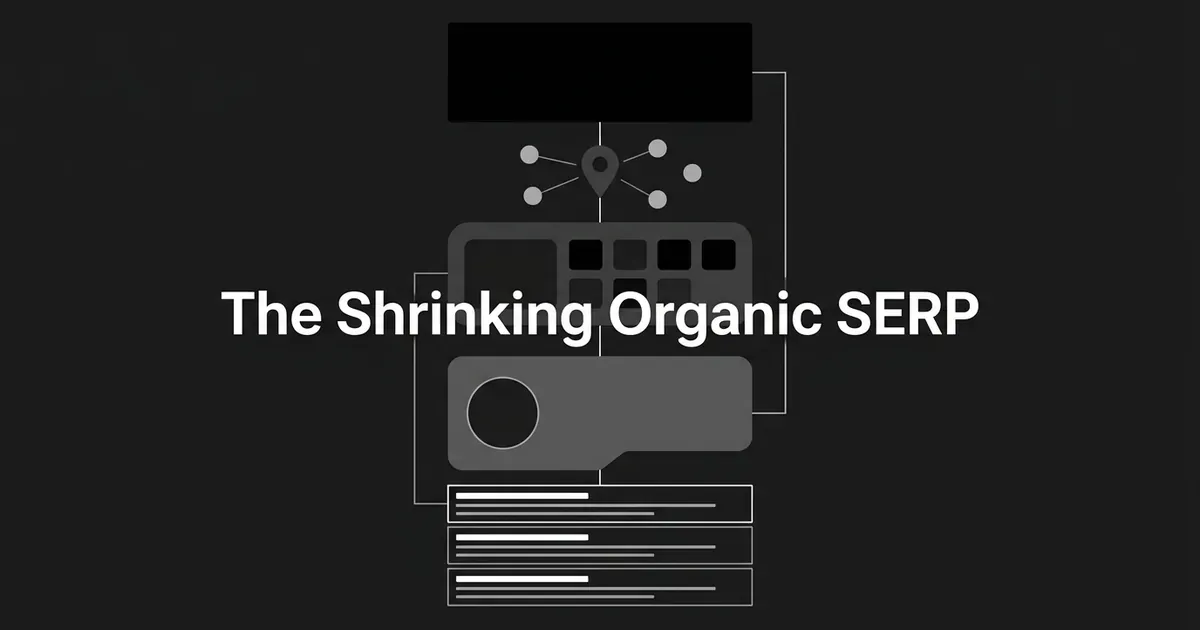
Google's results page still shows organic links. It just doesn't hand them a uniform page anymore. Since 2007, when Google started blending video, news, images, maps, and books into search results, it has kept adding ads, entity panels, local packs, product formats, and its own destinations, all competing for the same query and the same click. This is the shrinking SERP story marketing teams keep running into, and the evidence for it is strong. Clickstream studies show most searches now end without a click at all, and an academic study of organic click-through rates finds that most SERP features are tied to weaker organic performance. The verdict lands as strongly supported, with real limits on what it proves. There's no single number of organic links left on every page, and no study that pins every lost click on one feature. What follows is the SERP layout evolution in order, what the data actually shows about it, and what that means for how you measure your own pages now.
What "ten blue links" actually meant
"Ten blue links" is shorthand, not a spec. It describes the older Google page: a fairly uniform list of web results, each one a blue title, a URL, and a snippet, with paid ads kept to the side. Google never published a rule that said every query got exactly ten organic results. The phrase caught on because it captured something true about the page's structure. The dominant unit was a traditional web listing, and most listings looked and behaved the same way.
That's the baseline for organic click real estate worth holding onto, because the contrast that matters isn't "organic only" versus "everything else." The old page wasn't ad-free. The real shift is between a page built around one comparable result type and a page where several result types now compete for the same spot.
A Quick Google SERP Features History
The page didn't fill up all at once. Here's the sequence, in the order Google itself documented it.
2007: Universal Search breaks the uniform list. Google announced it was blending results from more than the open web: video, news, images, maps, and books, alongside regular pages. Google said the goal was giving searchers the most useful information, and that it planned to keep blending further so people could get what they needed directly on the results page. This is the moment the SERP stopped being a simple ranked list of similar documents and became a page that could assemble an answer out of several Google properties at once.
2012: the Knowledge Graph adds entities. Google introduced a system for understanding real people, places, and things, not just query strings. At launch, Google said the graph covered more than 500 million objects and 3.5 billion facts connecting them, spanning people, places, landmarks, movies, sports teams, and more. Two things changed on the page: Google got better at figuring out what a query actually meant, and it could summarize facts about the topic right there, without sending anyone anywhere.
Local Packs turn local queries into map answers. A Local Pack today usually shows three businesses next to a map, with hours, ratings, and a way to call or visit a website, generated by a different ranking system than ordinary organic results. Industry histories describe an earlier seven-result local format that later shrank to three. The point isn't that local businesses got a bonus ranking slot. It's that a local-intent query can now be answered by a map and a phone number before the person ever reaches a web listing.
Shopping surfaces multiply the ways a product can appear. Google's own merchant documentation lists several places a free product listing can show up at no cost: Search, Maps, the Shopping tab, Images, Lens, YouTube, and business-profile pages, on top of paid Shopping ads in their own slots. A product now has more than one way onto the page, and none of those routes look like a traditional web result. Eligibility doesn't guarantee a spot, since Google still matches listings against title, price, availability, and other attributes, but the range of surfaces is real.
2016: ads move but don't shrink. In February that year, Google removed text ads from the right rail of desktop results worldwide and pushed them to the top and bottom of the page instead, with room for up to four ads above the organic results on the most commercial queries. One class of ad inventory disappeared. At the same time, the main column got more crowded for anyone searching something with buying intent. Google's stated reason was better relevance for users and better performance for advertisers on commercial searches. That's a fair example of how the page's geometry keeps shifting rather than simply growing: it's not that every query has more ads now, it's that commercial queries can stack several paid and product results ahead of any organic link.
Google keeps a share of clicks inside its own properties. Maps, Images, YouTube, and Shopping are all Google destinations, and a click on any of them isn't a click to an outside website, even though it came from a search. A 2024 clickstream study from Datos and SparkToro found that close to 30 percent of clicks in the US went to Google-owned properties like these. That's a measure of where clicks landed, not of how many pixels those features occupy on the page, and it doesn't prove any single module caused any single click. But it's a real share of search activity that never leaves Google.
What the Click Distribution SERP Data Actually Shows
Layout is one half of this story. The other half of the SERP layout evolution is what happened to clicks once the page filled up, and here the evidence gets more careful, because clickstream studies measure outcomes, not the exact feature that produced them.
2019: zero-click crosses fifty percent. SparkToro's analysis of Jumpshot clickstream data, covering more than 100 million devices worldwide, found that in June 2019 more than half of browser-based Google searches ended with no click on anything. Desktop behavior had moved less than mobile over the period studied, with desktop organic clicks down by a few percentage points while paid and zero-click outcomes rose modestly. The study had real limits: thinner iOS coverage, no visibility into app-based searches, and a panel that can't stand in for every user. Still, the direction was clear well before 2024.
2024: fewer than half of searches send anyone anywhere. A follow-up study from Datos and SparkToro, drawing on tens of millions of users across the US and EU from September 2022 through May 2024, found that 58.5 percent of US searches and 59.7 percent of EU searches ended without a click. Only 360 clicks per 1,000 US searches, and 374 per 1,000 EU searches, went to the open web. Paid search accounted for roughly 1 percent of all clicks, counted against every search including ones with no ad on the page at all. In the most recent measurement available, most searches produced no click, and only a minority sent anyone to a site outside Google.
An academic study ties SERP features to weaker organic CTR. A 2023 paper analyzing 67,000 keywords across more than 40 US e-commerce domains, covering over 6 million clicks and 24 million views, found that 99.8 percent of the result pages it studied showed at least one SERP feature, and that most of those features correlated with lower organic click-through rates. The effect wasn't uniform. It varied by feature, by position, and by the keyword itself. That's an association in a specific market, not proof that every feature causes the same drop everywhere, but it's a large, careful dataset pointing the same direction as the clickstream numbers.
Feature-heavy pages are now the norm, not the exception. STAT Search Analytics reported on 560,000 SERPs across desktop and mobile in the US and UK, finding that SERP features accounted for about 65 percent of measured visibility on average, with carousels and knowledge graphs gaining ground. That figure blends desktop and mobile, and STAT's own reporting says the decline in traditional organic visibility is sharper on mobile, so it shouldn't be read as a desktop-only number. Even so, it backs the same pattern: organic listings are sharing the page with more competing formats than they used to.
What the evidence doesn't prove
A claim this size invites overstatement, so it's worth being just as clear about where the data stops.
There's no fixed count of organic links that shows up on every modern SERP. Query type, location, device, and personalization all change what a given search returns, so "a handful of results" describes what a lot of feature-heavy pages look like, not a technical rule Google applies everywhere.
No study shows that every SERP feature reduces organic clicks by the same amount, or that a feature always hurts rather than helps. A product rich result, a local listing, or a well-formatted answer can send a click to the business or site behind it. The academic CTR study found an association with feature presence, not a fixed penalty per feature, and it found the size of the effect varies.
Zero-click searches aren't all evidence of a Google module stealing a click. Some searches don't need an outside answer at all. Some people reformulate and search again. Some leave the browser for an app, which clickstream panels can't always see. Treat zero-click numbers as a description of an outcome, not a full account of the mechanism behind it.
None of this means Google removed a specific share of traffic from publishers on purpose, and none of it means organic visibility and organic clicks are the same thing. A page can hold its ranking and still lose clicks, because an ad, a panel, or a local pack now sits above it, or because the page itself runs longer and the organic listing sits lower on the screen. Rank alone no longer tells you what a searcher actually saw.
What to measure instead of rank alone
The practical lesson here isn't to pull back from organic SEO. It's that a rank report by itself has stopped being a reliable stand-in for visibility. A page can sit at position one and still get fewer clicks than it did two years ago, simply because of what now sits above and around it.
A few things are worth tracking instead of, or alongside, position:
CTR by query class, not just overall. A commercial query, a local one, a branded one, and a purely informational one each pull in a different mix of ads, panels, and product formats. Lumping them into one CTR number hides which query types are actually losing clicks to which features, so break performance down by intent before drawing conclusions from a single average.
Impressions and clicks as two separate signals. Search Console reports both, and they can move in opposite directions. Rising impressions with falling clicks usually means the page is still being served, just further down the page or under more competing results than before. Watching the two together catches this earlier than a traffic chart alone, which is part of why spotting decay early depends on more than one metric.
Which features actually show up on your queries. Ads, local packs, product blocks, and knowledge panels don't appear evenly. Checking which of your target queries trigger which features tells you whether a ranking drop is really a ranking problem or a page-real-estate problem, since ranking first has stopped guaranteeing much on a page this crowded.
Whether a result sits above the fold at all. A page ranked third can still be invisible if two ads and a panel push it below the initial screen. This matters most on the kind of query that also triggers a position zero result, since those formats sit above everything else on the page by design.
Clicks to Google's own destinations versus the open web, where you have data reliable enough to separate the two. It's a different number from your own site's clicks, and worth knowing apart from it.
Whether the classic SEO habits you're still running are the ones that matter now. Some fundamentals carry straight over to a feature-heavy page and some don't, and it's worth checking which is which rather than assuming last year's checklist still applies, which is exactly what a keep-or-drop audit of SEO fundamentals is for.
Trends over time, not a single snapshot. One rank check tells you almost nothing about click distribution SERP behavior on that query. A pattern across months does. If you're already tracking a handful of visibility metrics for AI answers, extend the same habit to organic CTR and impressions so you're not relying on one number pulled on one day. It's worth building that into a standing dashboard rather than a one-off check you only run when a page looks off.
None of this is a reason to stop writing for organic search, and none of it means the shrinking SERP is done evolving. It's a reason to stop treating rank as the whole picture. The organic click real estate on a given page is whatever's left once ads, panels, packs, and product formats have taken their share, and that share is different for every query type. Knowing which of your pages face a crowded page and which don't is what turns a flat traffic chart from a mystery into a diagnosis.