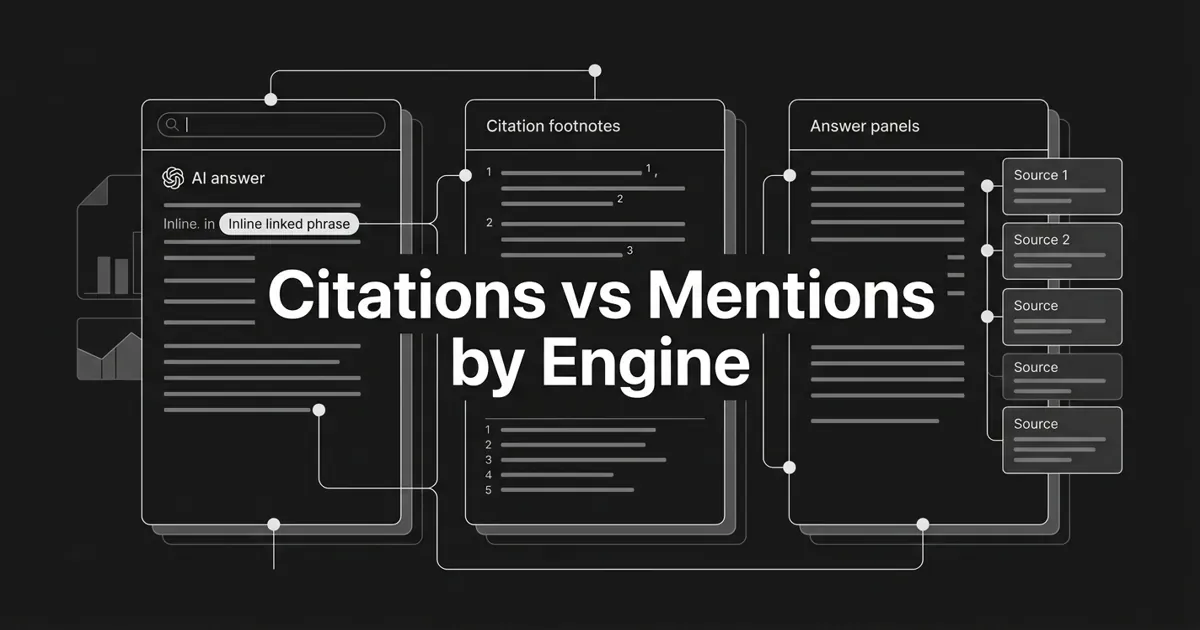
Citations and mentions do not work the same way on every AI platform. The three engines that most marketing teams watch, ChatGPT, Perplexity, and Google AI Overviews, surface them through different interfaces, attribute them to different source pools, and weight them on different scales. A brand can earn a numbered citation on Perplexity and only an unlinked mention on ChatGPT for the identical query, and the same brand can appear as a link card in Google AI Overviews while being absent from ChatGPT entirely. Reading citations vs mentions by engine correctly is therefore the prerequisite to reading any AI answer at all, because the visual grammar that signals a citation on one engine signals nothing on another.
The distinction between the two terms is structural. A mention is a brand named in the answer text with no link and no source attribution, so the reader cannot reach the brand's content. A citation pairs a claim with the brand's content through a link, a footnote, or a source card, so the reader can follow it. Mentions are reach; citations are the only form that transfers authority and produces a measurable click path back to the brand. That functional gap is constant across engines. What changes is how each one shows the difference, how often it emits each type, and which sources it draws from.
Per-Engine Citation Behavior at a Glance
The table below summarizes how each ai engine cites sources and surfaces mentions, and where the observable differences sit. The figures come from 2026 audits that used different prompt sets and sample sizes, so they are best read as directional rather than exact.
| Dimension | ChatGPT (with search) | Perplexity | Google AI Overviews |
|---|---|---|---|
| Primary citation UI | Inline links in the prose plus a Sources button that opens a sidebar of references | Numbered inline citations next to each claim, with tappable source cards and a Sources panel | Inline links in the answer text plus a right-hand panel of linked source cards |
| Citation marker | Clickable inline link, no visible number | Numbered superscript mapped one-to-one to a source | Linked word or phrase, plus cards with favicon, title, and domain |
| Source list location | Sidebar opened on demand, collapsed by default | Numbered list or expandable cards below or beside the answer | Right-hand panel, up to 3 sources visible and up to 10 on scroll |
| Mention visibility | Brand name in prose, no link, absent from Sources | Brand name in prose, no superscript attached | Brand name in prose, absent from the source panel |
| Citations per response | About 4 unique citations per turn when citations appear | About 21.87 per response in one 2026 audit | Most answers cite three or more sources; a single-source answer is rare |
| Inclusion pattern | High inclusion, roughly 3.2 times more mentions than citations in one eCommerce sample | Heavily citation-driven, high raw citation count | Lower inclusion, roughly 2.4 times more citations than mentions in the same sample |
| Top cited domain | Wikipedia, about 7.8 percent of citations | Reddit, about 6.6 percent of citations | Reddit near the top of social-led sources, alongside YouTube |
The single most important pattern in the table is that no two columns share a source pool, a marker format, or an inclusion ratio. That is the operational meaning of per engine citation behavior: the same content, submitted to the same question, is read by three systems that disagree about what to name, what to link, and what to leave out.
Citations vs Mentions: The Distinction Every Engine Assumes
The two terms deserve a precise line, because most confusion about AI visibility traces back to conflating them. A mention puts a brand into the conversation: the model holds the brand in its knowledge and names it, a genuine visibility signal, but the reader has no link to follow. A citation attaches the brand's own content to a claim through a linked footnote, a numbered superscript, or a source card, presenting the brand as a trusted source and creating the only measurable path from the answer back to the page.
Some analysts add a third tier, the recommendation, in which the answer positions a brand as the preferred option rather than one factual reference among several; where that line is drawn it sits above citation in evaluative strength, and AI-referred traffic has been measured converting at 14.2 percent against 2.8 percent for traditional organic, a premium that appears to accrue to recommended brands rather than merely mentioned ones. For reading an answer, though, the working split stays two-part, a name in the prose is a mention and a name paired with an attribution is a citation, and this comparison of citations vs mentions by engine applies that frame throughout.
ChatGPT: Inline Links and an On-Demand Sources Panel
ChatGPT search launched at the end of October 2024 and became available to all users, with no sign-up required, in early February 2025. It runs on a two-layer system: parametric knowledge from training, plus a retrieval layer that activates on a subset of queries.
Where sources appear defines how ChatGPT shows a citation. Inside the response body, links appear inline in the prose, so a reader encounters a clickable source in the middle of a sentence. Below the response sits a Sources button that opens a sidebar listing the references the model chose to attribute. Technically, ChatGPT inserts private-use Unicode placeholders during streaming and swaps them for the real, clickable citations once the answer finishes rendering. The sidebar is collapsed by default, so a reader can consume an entire ChatGPT answer without ever opening it.
A ChatGPT citation, then, is a clickable inline link tied to a sentence the model chose to attribute, plus a matching entry in the Sources sidebar. There are no numbered superscripts of the kind Perplexity uses. A ChatGPT mention is the inverse: the brand name appears in the prose with no link and no matching entry in the Sources list, because the model did not attribute the claim to any brand page.
Two behaviors explain why ChatGPT produces far more mentions than citations. Its retrieval layer does not fire on every query; one 2026 measurement activated retrieval on about 53.5 percent of commercial-intent queries, so a large share of answers carry no sources at all. When retrieval does fire, ChatGPT is highly selective, citing roughly 15 percent of the pages it retrieves in one 2026 study. Selective retrieval plus a strong tendency to name brands from parametric knowledge produced about 3.2 times more mentions than citations in one eCommerce-style audit, with brands named in 99.3 percent of answers. ChatGPT behaves, in effect, as the reach engine: it will almost always name a brand and only sometimes cite one.
Perplexity: Numbered Footnotes and Domain Chips
Perplexity is built around attribution, unlike the other two engines. It performs a real-time web search for every query, so every answer is grounded in retrieved content, and its stated promise is that every answer includes inline citations from trusted sources.
The citation form is the numbered superscript. A claim carries a marker such as a bracketed number, and that number maps one-to-one to the document whose excerpt informed the statement, so citations attach to individual claims rather than to the answer as a whole. Tapping a marker opens a source card carrying the site name, publication date, and author; on mobile it can open an in-app browser tab on the original page. Alongside the numbers, Perplexity often shows a Sources panel with a summary row across all sources used and a Links tab for an audit view, plus an option to flag a source a reader believes is wrong. It also renders domain chips inline, showing the publisher domain at the moment of the claim rather than only as a footnote, with a plus-N marker for additional sources from that domain.
A Perplexity mention follows the same rule as on the other engines: a brand name in the prose with no numbered marker attached and no entry in the Sources panel. The practical tell is the absence of a superscript.
Volume and freshness set the engine apart. Perplexity produced about 21.87 citations per response in one 2026 audit, roughly three times ChatGPT's count, so a reader sees more numbers and more source cards per answer. It favors recent material, with content from the last 30 days accounting for around 82 percent of citations in some categories, and draws from a wider news pool, with one audit counting 1,430 unique news sources for Perplexity against 881 for Google and 707 for OpenAI. Its top cited domain is Reddit, at about 6.6 percent of all citations. Because Perplexity Pro lets a user choose the underlying model, the same question can produce a different citation footprint.
Google AI Overviews: Right-Hand Source Cards and Inline Links
Google AI Overviews grew out of the Search Generative Experience experiment and launched for everyone in the United States in May 2024, moved to a Gemini 2.0 model in March 2025, and in October 2024 gained the desktop design most readers now see: a right-hand panel of source links and inline links inside the summary text, with preferred-source labels added in May 2026.
Google AI Overviews citations appear in three places at once. The source panel sits to the right of the answer box on desktop, showing up to three linked cards initially and up to ten on scroll, each with a favicon, page title, and domain; on smaller screens it collapses into a carousel below the answer. Inside the answer body, individual words and phrases are linked, and small chevron icons at the end of statements open a dropdown listing the specific sources for that sentence. Where a cited source matches a reader's pre-selected preferences, a preferred-source label marks it.
A Google AI Overviews mention is a brand name in the summary prose that does not appear in the right-hand panel and is not linked. The source panel is the deciding visual: a brand present in the prose but absent from the panel has been mentioned, not cited.
Two behaviors shape how often this happens. AI Overviews appear on a moving share of searches, reported between 13 and 19 percent in mid-2025, with one 2026 measurement putting the United States trigger rate near half of queries. They skew toward informational questions and trigger far less often on commercial ones, which is one reason brand-citation inclusion looks low in audit data, around 6.2 percent in one eCommerce sample, where the engine cited brands about 2.4 times more often than it merely mentioned them. Selection is also decoupling from organic rank: by early 2026, only 17 to 38 percent of cited pages ranked in the top ten organic results, though a large majority of citations still come from top-ten domains, an overlap that is shrinking. AI Overviews also cite Google's own search results at times, so a citation there is not always a link to an external page.
Why the Same Brand Is Cited on One and Mentioned on Another
The comparison so far explains the interfaces. The harder question is why the same brand, for parallel prompts, is cited on one engine and mentioned on another. The answer: no two engines sample from the same source pool, and each combines training data, real-time retrieval, and citation selectivity in a different proportion.
The scale of the divergence is large. Across 680 million citations in one 2026 audit, only 11 percent of cited domains overlapped between ChatGPT and Perplexity, which means roughly 89 percent of the citation landscape is invisible to a team tracking only one of the two. A separate three-engine audit found 12 percent overlap across ChatGPT, Perplexity, and Google AI Mode, a similar conclusion from a different method. The same body of work reported citation-volume variance of up to 615 times for one brand between platforms, and a separate measurement found a 46-fold gap in brand citation rates, 0.59 percent on ChatGPT against 13.05 percent on Perplexity. The gulf in chatgpt vs perplexity citations is not a rounding difference; it is the central fact of cross-engine visibility.
Several mechanisms drive the split, and they matter because they respond to different interventions. A brand with strong on-page content but a weak third-party signal can be cited on Perplexity, which runs fresh retrieval and trusts on-page evidence, while remaining absent from ChatGPT, which leans on parametric training plus a selective retrieval layer that favors brand signal. The reverse also holds: a brand with a strong signal but pages not structured for extraction can be cited on ChatGPT yet skipped by Perplexity, whose extraction step needs cleanly quotable evidence blocks. Source-pool composition compounds the effect. ChatGPT's most-cited domain is Wikipedia, Perplexity's is Reddit, and Google AI Overviews lean heavily on YouTube and Reddit among social-led sources. A category anchored in encyclopedic reference tends to surface on ChatGPT, one anchored in community discussion tends to surface on Perplexity, and one anchored in visual or product-demonstration content tends to surface in AI Overviews. The precise selection logic sits beyond this comparison; the mechanics of how each ai engine cites sources are a separate subject, examined in the retrieval-and-extraction analysis elsewhere in this cluster.
Each outcome means something specific. A brand that wins mentions on ChatGPT has won awareness inside the most-used conversational engine. A brand that wins google ai overviews citations has won link-card real estate on the most-used results page. A brand that wins citations on Perplexity has won source attribution inside the most citation-forward engine. These are not interchangeable wins, and a blended visibility number hides which one a brand holds.
Reading Each Engine's Answer Correctly
Because the visual grammar differs, the same reading habit does not transfer across engines. On ChatGPT, note the inline links in the prose, then open the Sources button below the response; a brand named in the prose with no matching Sources entry is a mention, and an answer with no Sources button at all carried no web retrieval and offers no source signal to read. On Perplexity, note the numbered superscripts, each mapping to an entry in the Sources list or, on mobile, a tappable source card; a brand name with no superscript beside it is a mention. On Google AI Overviews, note the linked words and the right-hand panel of source cards, plus the chevron icons that reveal per-sentence sources; a brand in the summary that does not appear in the panel has been mentioned, not cited.
Being cited is not the same as receiving a click. Pew Research found that clicks on links inside an AI summary occur in only about 1 percent of visits, and that users end their session more often after seeing a summary than they click through. A citation is a visibility and authority signal first; the click, where it comes, goes to the specific page named, not to every brand summarized.
Which Engine a Team Should Track First
The situation, not a universal ranking, should decide where a team starts. Because per engine citation behavior varies so widely, with engines reading from different source pools and emitting mentions and citations at different ratios, no single engine's behavior stands in for the rest.
A team tracking one engine to start should begin where its buyers ask the most questions. For much of B2B software that is ChatGPT, the highest-reach conversational engine; for research-heavy or product-comparison queries it is often Perplexity, the most citation-forward and freshest; for categories where buyers still discover on Google it is AI Overviews, with the widest reach on the results page. A team adding a second engine should add Perplexity if its buyers research deeply, or AI Overviews if discovery concentrates on Google search.
Whichever engines a team watches, mentions and citations belong on the dashboard as separate metrics rather than a blended score. Mentions measure reach; citations measure authority and the traffic path. A brand mentioned everywhere but cited nowhere has reach without authority, and a brand cited on one engine but only mentioned on the others has authority on a single channel and reach gaps elsewhere. Neither picture is visible without splitting the two per engine, per prompt, and per page.
This is the problem DeepSmith is built to make legible. Its AI Visibility module tracks mention rate, citation rate, share of voice, and visibility trend for each engine it covers, so a single prompt can show as mentioned on ChatGPT, cited on Perplexity, and absent from Google AI Overviews inside one view. The Pages view shows which of a brand's pages an engine actually cites and each page's share of total citations, and the Competitors view shows who wins citations for a brand's prompts, on which exact pages, and how each competitor performs by platform. Coverage rises by plan: Pro tracks ChatGPT, Grow adds Perplexity, Scale adds Gemini, and Enterprise covers all five named engines, ChatGPT, Perplexity, Gemini, Claude, and Google AI Mode. DeepSmith reports mention and citation across those engines and produces publish-ready content to close the gaps it surfaces; it does not control or guarantee rankings, citations, traffic, or revenue. Teams that want to compare chatgpt vs perplexity citations on their own prompts can start a 7-day free trial on the Grow plan, which adds Perplexity to ChatGPT, and read the same answer through both engines side by side.