Here is the short answer to the internal links ranking factor question. Internal links do influence how Google ranks your pages, and that part is confirmed by Google itself. Click depth, meaning how many clicks it takes to reach a page from your homepage, is strongly supported as part of that same picture. What is not confirmed is a clean formula: there is no documented three-click cutoff, and no fixed amount of ranking value that a page loses with each extra click. So when someone tells you internal links are a ranking factor, they are right. When they tell you every page needs to sit within three clicks of your homepage or it will never rank, that part is industry folklore dressed up as a rule.
This matters because the two claims get treated as one thing, and they are not. Google has told us plainly that it looks at the links between your pages to figure out relevance and relative importance. It has never told us the exact math behind that, and nobody outside Google has reverse engineered it either. Most click depth SEO advice skips straight past that gap and hands you a rule Google never published. Here is what the evidence actually supports, and where it runs out.
What people actually mean by this claim
Before getting into the evidence, it helps to pin down the terms, because people use them loosely and that is where a lot of the confusion starts.
An internal link just means a hyperlink that connects two pages on the same site. Every internal link has two sides. The page it sits on is the source, sometimes called the donor page. The page it points to is the destination, or the recipient page. A page can have plenty of outgoing links on it while still getting very few incoming links itself, and those are two different things to track. Incoming internal links are what people usually mean when they talk about internal link equity, a term practitioners use for the ranking value that internal links are thought to help move around a site. It is a useful shorthand, but it is not a number Google publishes anywhere, so treat it as a concept, not a metric you can look up.
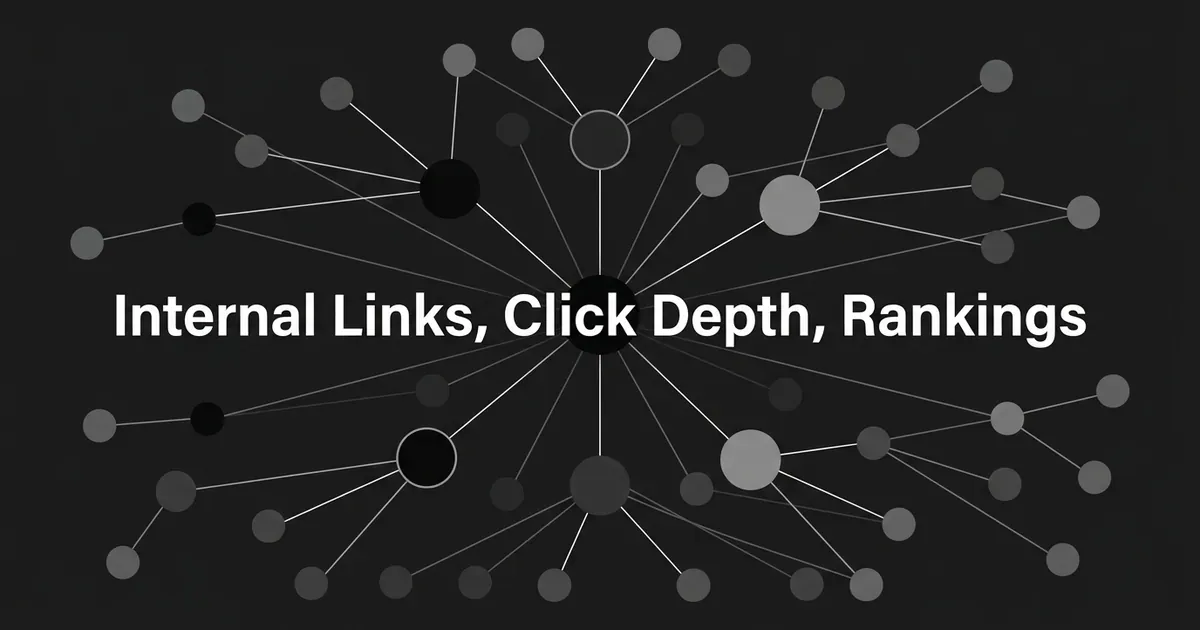
Click depth is the number of clicks it takes to get from your homepage to a given page, following the shortest available path through your internal links. The homepage itself is depth zero. A page linked directly from the homepage is depth one. A page you can only reach by going through that page is depth two, and so on. The important thing here is that this measures a route through your link structure, not how people actually browse your site.
Click depth is not the same thing as URL depth. URL depth is about how many folders deep an address sits, something like yoursite.com/blog/category/article. Google has said plainly that it does not use your folder structure to understand how your site is organized. It looks at how pages link to each other instead. So a page buried five folders deep in your URL can still sit at click depth one if your homepage links to it directly, and a short, clean URL can belong to a page nobody links to from anywhere useful. Renaming your folders does not, by itself, change how close a page sits to your homepage in link terms.
What Google's own documentation confirms
Three Google Search Central documents, all last updated December 10, 2025, give the clearest picture of what Google actually says about this.
The link best practices guide states it directly: Google uses links as a signal when determining the relevancy of pages and to find new pages to crawl. The same document tells site owners that every page they care about should have a link from at least one other page on the site, that they should link to other useful resources on their own site where it makes sense in context, and that there is no magical ideal number of links a page should contain. It also recommends descriptive, reasonably concise anchor text that makes sense both on the page it sits on and for the page it points to.
The ecommerce architecture guide goes further on the depth question specifically. Google says it analyzes the relationships between pages based on how they link to each other, and that it can use both the number of links it needs to follow to reach a page and the number of links pointing to that page to work out how relatively important that page is within the site. As a general rule, Google says, more internal links to a page tend to signal that the page is more important, and it gives the example of linking your bestselling product from the homepage to make that importance clear. Worth noting here: this particular guidance is written for ecommerce sites. Applying the same reasoning to a blog's hub and spoke structure is a sensible extension of the logic, not a separate Google statement about editorial content specifically.
The guide to Google's ranking systems rounds this out by confirming that PageRank is still part of Google's core ranking systems today, while being clear that it has evolved considerably since the early days of Google. Link analysis, the guide says, helps Google understand what a page is about and whether it might be useful for a given search. It also makes clear that ranking runs on a wide range of signals at the page level, which rules out treating internal link structure as the whole algorithm.
There is older context here too. Back in 2018, Google's John Mueller addressed a question about restructuring URLs and said that having content closer to the homepage, in terms of the number of links to follow, tends to carry a bit more weight, especially since the homepage is usually the strongest page on a site. That qualifier matters. He was not saying the homepage is always the strongest page, or that proximity to it guarantees anything. He was describing a tendency, reported by Search Engine Journal at the time, not disclosing a formula.
What the studies and tests show
Primary documentation tells you the mechanism exists. Independent testing is where you see what happens when people actually change their internal links.
The largest dataset here comes from Cyrus Shepard's Zyppy study, which looked at 23 million internal links across 1,800 websites and roughly 520,000 individual pages, comparing link counts against Google Search Console click data. Pages that received zero to four internal links averaged about two search clicks in that sample. Pages receiving 40 to 44 internal links averaged roughly four times that traffic. Beyond around 45 to 50 incoming links, the relationship actually reversed, with traffic trending down as link counts kept climbing. The study also found that pages with more varied internal anchor text tended to get more search traffic, and that pages with at least one exact match anchor had meaningfully more traffic than pages without one.
Read this for what it is. It is a large correlational dataset, and Shepard says as much himself. Pages that already matter to a site tend to get linked more, which means some of this relationship could run in the other direction: important pages attract links because they are already important, not the other way around. The study cannot tell you that adding your 45th link will help a specific page, and it should not be read as evidence that 40 links is some kind of target to hit.
Controlled experiments give a different kind of evidence, smaller in scale but better at isolating cause from effect. SearchPilot, a vendor that runs SEO split tests for its customers, ran one where an ecommerce site increased its related article links from two to four per page. Looking at both the pages that got the new links and the pages those links pointed to combined, the test found an estimated 11 percent lift in organic traffic, though that result only cleared a 90 percent confidence level, not the stricter 95 percent threshold normally used to call a result solid. Split out by role, the pages carrying the added links saw a 16 percent lift with much higher confidence, while the pages being linked to showed no detectable change at all. That split result is worth sitting with: the clearest benefit showed up on the donor and recipient pages behaving so differently, the opposite of what a simple equity story would predict.
A second SearchPilot test on a travel site reduced the visible size of an internal link block, hiding some links on first desktop load. That change produced an estimated 10.2 percent traffic lift, again positive but short of 95 percent confidence. The lesson there is narrower than it sounds: a big, visually dominant link block is not automatically better than a smaller one, but this was a presentation change, not a direct test of click depth or link count by itself.
A broader overview of SearchPilot's testing work, covering tests like adding links between nearby regional pages and adding homepage footer links to specific destinations, reports traffic gains in the five to seven percent range for the pages receiving those links. These examples back the idea that destination pages can benefit from being linked more, while also showing that the effect sizes are modest and vary by what exactly gets tested.
Where this claim gets overstated
The gap between what is confirmed and what gets repeated is where most of the bad advice lives.
The three click rule is the biggest offender, and it is the one piece of click depth SEO advice almost everyone has heard. It shows up constantly: keep every important page within three clicks of your homepage or Google will struggle to crawl or rank it. That rule traces back to industry commentary, not to Google documentation. The primary sources reviewed here establish that link path length can inform relative importance, but nowhere do they set a three click cutoff for crawling, indexing, or ranking. Treat three clicks as a reasonable planning heuristic if you like it, but do not present it to your team as a Google requirement, because it is not one.
A related overstatement is the idea that each extra click costs you a fixed, calculable amount of ranking value, as though PageRank flowed through your links in neat, countable percentages. No such coefficient exists in anything Google has published, and no independent study reviewed here isolates one either. The Zyppy numbers show an association between link counts and traffic, not a conversion rate you can apply to your own pages.
It is also easy to collapse four separate things into one: Google finding your page, Google indexing it, Google ranking it well, and people actually clicking through to it from search. An internal link test that reports an organic traffic increase might be capturing a ranking change, a click through rate change, or some mix of both. SearchPilot says this plainly about its own testing. A traffic number is not automatically proof that rankings moved, and rankings moving is not automatically proof that depth caused it.
Finally, do not let "more links" quietly become "unlimited links." Google's own guidance says there is no magical ideal number, and the Zyppy data shows the relationship between link count and traffic reversing somewhere past 45 to 50 incoming links. A page stuffed with internal links for the sake of hitting some target is not following the evidence; it is working against the part of the evidence that actually came through clearly.
The verdict, and what to actually do with it
Pulling the grades together on the internal links ranking factor question: internal links contributing to ranking is confirmed, directly from Google's own documentation. Click depth mattering to how Google assesses a page's relative importance is strongly supported, backed by both Google's architecture guidance and Mueller's 2018 comments. A fixed per click ranking penalty and a universal three click cutoff are both weak, unsupported by anything in the primary sources or the independent testing reviewed here. Whether adding more links always helps is genuinely mixed: Google encourages useful linking, but the controlled tests show effects that differ by whether a page is the source or the destination of a link, and the large scale correlational data shows the benefit topping out and then reversing at higher link counts.
What that means for how you actually spend your time: look at which of your important pages are hard to reach. That is not about a tool flagging a click depth number somewhere. It is about there being genuinely no good path from your homepage or main navigation to a page that matters. Look at which pages receive links, not just which pages send them, since the clearest evidence here points to donor and recipient pages behaving differently. Write anchor text that actually describes what the linked page is about instead of stuffing in exact match keywords, since Google says plainly that descriptive and relevant beats forced. And resist the urge to turn any of this into a quota. No study here, including the large Zyppy dataset, gives you a specific number of internal links to hit.
What would actually change this verdict is either Google disclosing a standalone click depth factor with real numbers attached, or someone running a controlled experiment that isolates depth from everything else that usually moves alongside it, like link count, anchor text, and page authority. Neither exists today. Until one does, treat your link structure as a way of telling Google, and your readers, which pages actually matter to you, rather than chasing a number a tool handed you.
If you want a practical next step: pick five pages you consider genuinely important and trace the shortest path to each one from your homepage. If that path runs through three or four low value pages before it gets there, that is worth fixing regardless of what the exact ranking math turns out to be.