An AI platform can hand you a finished-looking article in minutes, and that's where the trouble starts. The draft reads well, so it's easy to lose track of who checked the claims, whether it follows the current voice rules, and which version an editor actually approved. This guide is for marketing leads who want an editorial control AI writing process they can run on every piece without rewriting each article by hand. By the end you'll have review stages, voice rules, source requirements, a fact-check record and a sign-off step that work together as one AI writing editorial workflow.
You'll need a current reference for your company and product (including the claims you can and can't make), a few approved writing samples, one place to keep briefs, comments, source notes and approvals, and a named article owner, final approver and backup. A shared document and a simple tracker are enough. You don't need to buy anything new to begin.
1. Assign one decision owner and define the approval stages
Decide who has the last word on each article. Give every article one active final approver, and write down what has to be true before a piece moves from stage to stage. This is the base of any AI content governance routine, and it's the step teams skip most often because everyone assumes it's obvious. If you're still choosing a platform, our roundup of AI content tools with CMS publishing shows how each one hands finished posts off.
Separate the person who keeps the work moving from the person who makes the final call. A small team can combine roles, as long as each one is written down:
- Article owner: keeps the brief, prepares the review package, gathers feedback and tracks the next action.
- Editorial reviewer: checks usefulness, angle, structure, voice and whether the brief was met.
- Subject-matter reviewer: checks explanations, technical details and product claims.
- Final approver: confirms the required checks are done, then approves, returns or holds the exact version.
- Backup approver: makes the decision in place of the approver when the agreed backup trigger applies.
One person can hold more than one role.
Then lay out a short set of stages. These are labels we suggest for your own tracker, not statuses you'll find on any platform's screen.
| Stage | Done when |
|---|---|
| Brief ready | The decision owner accepts the reader, task, angle, scope and evidence needs |
| Outline accepted | Structure and scope are settled |
| Draft ready for review | A stable draft, its sources and known gaps are supplied, and each check has an owner |
| Changes required | Reviewers have named specific issues and the fixes are checked |
| Ready for final decision | Required reviews are done and material issues are resolved |
| Approved | The exact version and the decision are recorded |
Good AI content governance keeps brief and outline approval separate from final approval. Agreeing on the angle early is useful, but it doesn't mean you've agreed to every sentence written later.
You'll know this step is done when anyone opening the article record can see who decides, which reviews are required, what counts as a blocker, and who steps in if the approver is out. People go wrong by assigning approval to "marketing" instead of a name, or by treating a missed deadline as approval. Optional advice can have a cutoff, but required expertise and the final decision need a real response.
Common mistake: "No objections" isn't a recorded decision. A required approval should say what was approved and who approved it.
2. Turn your brand voice into rules an editor can test
Replace personality adjectives with things an editor can check. "Friendly and confident" is a direction, but two editors can read it two ways. "Start with the reader's task" is something both of them can look for.
Begin with your current approved work. Our brand-voice guidance suggests gathering five to 10 strong pieces and looking at how they open, how long the sentences run, how technical they get, which words they use and how they handle uncertainty. Then write three to five voice principles. For each one, give a short definition, the actions a writer should take, a boundary that says what it doesn't allow, an approved example and an off-brand example with its correction.
A principle like "Specific" might say: name the action, the object and the condition, and don't invent numbers to sound concrete. "Assign one editor to approve the final version and record any unresolved claims" is better than "Unlock a revolutionary approach to seamless content excellence," because it names a person and an action.
Mark which rules are non-negotiable and which are preferences, since a forbidden product claim isn't the same as an editor who likes shorter paragraphs. Give the reference an owner, a date and a version number.
This is the first place DeepSmith genuinely does some of the work. Deep IQ stores your structured brand context, including company positioning, product profiles, buyer personas, Brand Voice and Content Types, so the Writer gets your current rules when it generates a draft. Your job is to refine the Brand Voice and related context so it matches the reference you just wrote. If you want more depth on writing the reference itself, our guide on how to document your brand voice and tone walks through it, and the guide on making AI drafts match your brand voice at scale covers the platform side.
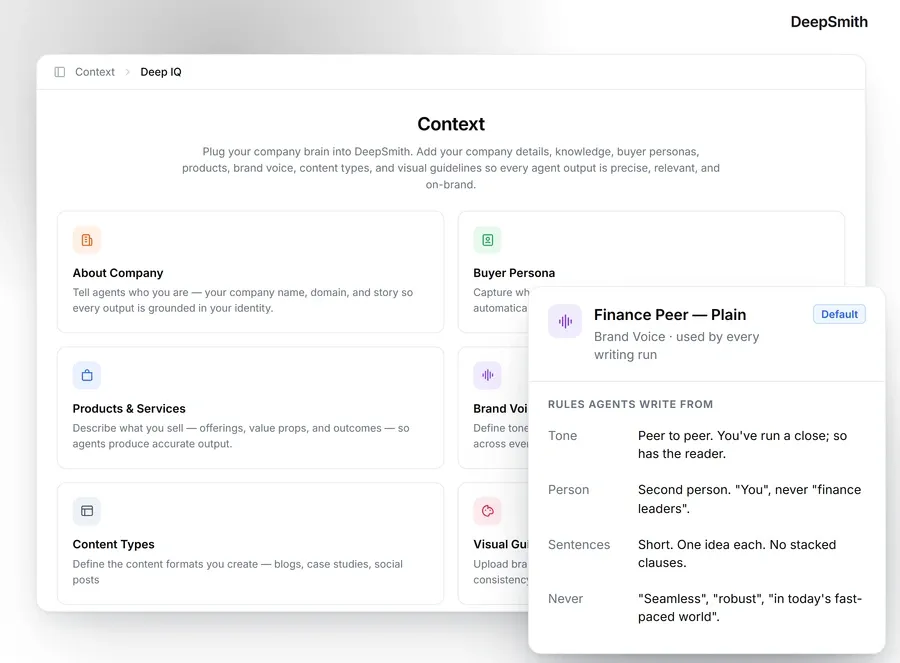
You'll know this step is done when two editors can apply the reference to the same sample and explain their decisions with the same rules, and when the rules sit in the context the platform uses and not only in a style document nobody opens. The most common trap is assuming that a draft that sounds right must also be right.
Pro tip: Pair an approved sentence with a believable but unacceptable version. Boundary examples teach the platform and your reviewers where a rule stops.
3. Set source requirements before the draft is generated
It's much easier to decide what counts as evidence before the draft exists than after you're holding a polished article full of claims. Write down what kind of proof each type of claim needs, and give the platform a source packet to work from.
Think of three layers: your canonical brand facts, external facts such as studies and documentation, and article-specific material such as original examples and approved customer evidence. Our guide on grounding AI content in your brand voice and product facts covers the first layer in more detail.
Then match the evidence to the claim, and skip the idea of a fixed number of sources.
| Claim type | Best evidence | What to verify |
|---|---|---|
| Product capability or price | Current official documentation or pricing page | Scope, date, tier and conditions |
| Statistic or research finding | The original study or dataset | Population, method, period and limits |
| Customer result | An approved case study | What was measured, for whom, over what period |
| Quotation | The recording or original publication | Exact wording, speaker and context |
A trusted publisher is a good place to start looking, but it isn't proof for every sentence.
Add a missing-evidence rule to your instructions, something like: "Don't invent facts, statistics, quotations, customer outcomes or citations. Mark missing support for the editor."
Moving facts need a freshness rule. Flag any claim that says "current" or "latest," and recheck prices, features and comparisons close to final approval.
You'll know this step is done when every material claim you plan to make has suitable evidence or is clearly marked as unsupported, and the team knows what to remove, qualify or escalate when proof isn't available.
4. Approve the brief and outline before generating the full article
Settle the reader's task, the angle, the boundaries and the required evidence before you ask the platform for the full piece. A weak brief is the main reason people end up regenerating articles that were wrong from the start.
A minimum brief records the reader and task, the central answer, the angle, what's in and out of scope, the content type, the brand context versions, the required evidence, any approved or clearly labeled illustrative examples, prohibited claims, the review route and the acceptance criteria the editor will use. Review the outline against the task before you read any polished sentences. Ask whether the order lets the reader finish the task, whether any section needs evidence you don't have, and whether the piece wanders into a topic you excluded.
This is the second place DeepSmith fits. Content Studio carries an idea from New Ideas to Planned Content, then the Writer, then Produced Content. The Writer researches and produces a brand-grounded article with internal and external links, a cover image and publish-ready metadata, using the context stored in Deep IQ. DeepSmith doesn't run an outline-approval gate or route work to reviewers for you, so keep those records in the review system you already use.
You'll know this step is done when the owner can summarize the reader, outcome, angle, exclusions and acceptance criteria without digging through a conversation history. The usual mistakes are handing the platform a title and letting reviewers discover the angle afterward, and assuming outline approval also covers the final wording and facts.
5. Verify claims and citations against the original evidence
Check the draft one factual claim at a time, not one reassuring paragraph at a time. A paragraph can look solid and still hold a single wrong number, and the only way to find it is to take the claims apart.
Save the exact draft you're checking, including the title, body, tables, captions, links and metadata, and label any citation the draft supplies as unverified. Then keep a simple ledger as part of your AI writing editorial workflow with one row for each claim you can check. Each row holds where the claim sits in the draft, the exact wording, the source the draft offered, the original source and passage you found, the scope and date check, the result (supported, needs qualification, replace source, remove or pending), and who checked it. The ledger is a review habit we recommend, not a feature of any platform. For a fuller walkthrough, our guide to fact-checking an AI draft covers hallucinated and fabricated citations.
Apply three separate tests to every citation. Identity asks whether the source exists and whether its title, author, publisher and date match what the draft says. Access asks whether the link reaches the intended document and not an unrelated page. Support asks whether the source actually establishes the wording used, including its qualifications. A page that loads only passes the access test, and a real study can still be cited for something it never concluded.
Names, dates, plan limits, statistics with their units, words like faster, cheaper or only, and quotations are the facts a model can make sound most convincing. Google's guidance on generative AI content, updated October 1, 2026, calls for manual fact-checking and review before publication and extends that review to titles, meta descriptions, structured data and image alt text.
Recalculate numbers instead of matching digits, since a rise from 20 percent to 25 percent is five percentage points, not five percent. If a quotation isn't in the original, use an accurate attributed paraphrase or remove it.
Give every failed claim an outcome: keep it, narrow it, replace the source, remove it, or hold it for a qualified reviewer. Update the ledger whenever you change the wording.
Tools and AI passes can help flag numbers, broken links and inconsistent names, but neither proves a source is authentic or read correctly. Reuters requires that AI-generated facts, sources and claims be independently verified, and NIST's generative AI profile recommends documenting fact-checking techniques.
You'll know this step is done when every material claim traces to suitable evidence and high-consequence claims have had the qualified review they need. Be careful about asking the same model whether its answer is accurate and treating a "yes" as verification, and about checking the body while leaving an exaggerated title in place.
Common mistake: A link that opens isn't a fact-check. Confirm the source exists, that you reached the right material, and that it supports the actual sentence.
6. Edit for voice, usefulness and reader completion
Once the factual problems are settled, the editorial control AI writing needs most is a clean voice pass, so look at whether the article is clear, sounds like your brand and helps the reader finish the task. Do this as its own pass, so accuracy and prose quality don't get mixed up in the same comments. Compare the draft with a current approved sample and the accepted brief.
Check five things: voice match, factual accuracy (does the edited version still match the verified evidence), clarity, structure and audience fit. A simple Pass, Revise or Block label for each makes the decision visible. Our guide to scoring AI draft quality before publishing shows one way to set that up. For a how-to guide, confirm every step says what to do, how to tell it's done and where people go wrong.
Read the opening, headings and product mentions closely, since that's where drafts drift most. Also ask whether the piece adds real explanation, examples or expertise and doesn't just rearrange pages that already exist. Google's people-first guidance, updated October 5, 2026, emphasizes original value, clear sourcing, demonstrated expertise and whether the reader can reach their goal.
This is the third place DeepSmith helps. Produced Content is where you review and edit a finished article, with a blog-style preview and a full editor for the body, title and slug. It also offers editing actions called Improve writing, Make it specific and Fix grammar. Use them to revise the article, and remember that an AI-assisted edit that changes the factual meaning needs the relevant fact check again. DeepSmith aims to deliver publish-ready work, not a bare first draft that always needs rescuing, and your approval is still a separate human responsibility even when the output is close to final.
You'll know this step is done when the editor can point to the rules and reader outcomes the article meets, and the remaining comments are resolved or accepted as preferences, not unexplained feelings that it "sounds a bit AI." Common slips include rewriting acceptable copy to suit each stakeholder's taste, giving vague feedback like "make it more human," and treating a good voice pass as proof the article is accurate.
7. Approve the exact version and record the decision
Final approval has to name the article version, the person who approved it and any conditions still open. Without that, "approved" turns into a feeling that somebody looked at something at some point.
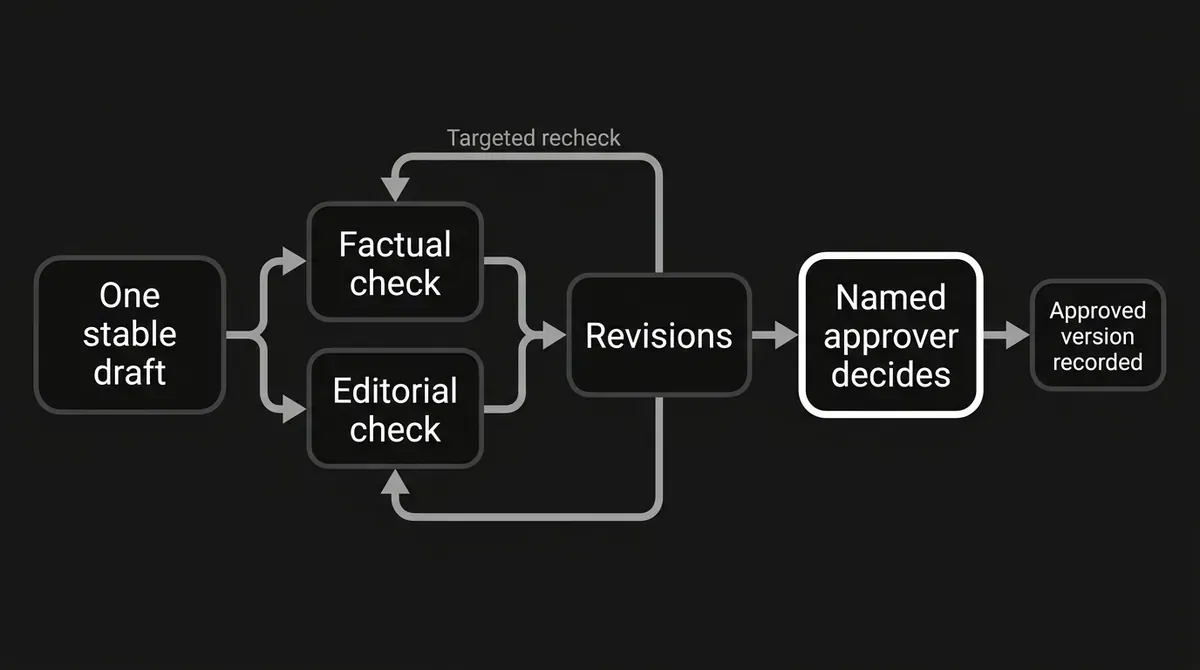
When the factual and editorial reviews can look at the same stable draft, run them at the same time, and keep dependent work in order. Use one designated review copy and one place for feedback. The owner groups duplicates, and the decision owner settles real disagreements by going back to the brief. Removing the approval step altogether is a separate decision, and we cover it in our look at whether auto-publishing AI content to a CMS is safe. A reasonable aim is one round of substantive feedback, one revision pass, then a targeted check and sign-off.
Before the sign-off, run a final gate. The article matches the approved task, the required factual and specialist reviews are complete, material claims have evidence, product descriptions are accurate, voice hard rules are met, titles, captions, alt text and tables were reviewed, and the approver has seen the identified version. The threshold we suggest is zero unresolved material blockers, which is an internal standard and doesn't promise zero errors. Blockers include unsupported claims, invented quotes or numbers, contradictions and a missing required review.
Record each decision with the article title or identifier, a fixed version label or saved snapshot, the checks completed and who did them, the decision (approved, changes required or held), the named approver, the date and time, any open conditions, and who does what next. An approval with open conditions doesn't mean those conditions are finished. A link that always opens the latest draft also isn't a fixed approved version, so save a copy of what was approved if your review tool can't hold a version for you. A typo fix can be covered by a minor-edit rule, but a changed factual claim or a stronger product statement needs a targeted review and a new sign-off.
You'll know this step is done when another team member can rebuild exactly what was approved, who approved it, when, and whether later edits need another decision. People go wrong by recording "looks good" without saying which version, by treating silence as consent, and by revising material claims after approval without reopening the review. If your team is stuck waiting on one person, our guide to a content review and approval process that doesn't bottleneck covers how to spread the load, and the human review and QA gates guide shows where each gate sits in the pipeline.
8. Feed repeat corrections back into the rules
When the same error shows up again and again, fix it where it starts, in the brief, the source packet, the product reference or the voice guide, and not in the draft each time. Otherwise you'll spend your review time making the same edit forever.
Keep a correction log after each batch. For each correction, note the article and content type, the failure category (fact, source, product detail, voice, structure or scope), the original wording, the approved fix, the rule or evidence that should have prevented it, whether it was a blocker, the root cause, what context you updated and how you retested it.
Then build a small, fixed set of test tasks that match your real output, such as a brand introduction, a product explanation and a how-to opening. After a meaningful change to your context, run the same tasks again and compare the results with approved examples. OpenAI's documentation recommends evaluation tests to monitor how prompts behave as prompts and model versions change, and the lesson for an editor is to test real recurring tasks instead of assuming an updated rule works.
Our brand-voice guidance suggests reviewing high-volume content types monthly and the full guide quarterly, and a product launch or repeated errors are good reasons to update sooner. Track simple measures you build yourself, such as how many approved articles have a full decision record and how often the same failure repeats, and keep the counts next to every percentage. A higher acceptance rate isn't an improvement if reviewers have stopped finding unsupported claims.
You'll know this step is done when a repeated correction has a named upstream fix and a retest result. Avoid changing several instructions at once, because then you can't tell what helped.
What to do next
Pick one real article and run this process on it from start to finish. Keep the brief, the source ledger, the reviewer comments and the final decision together in one place. When the first correction repeats, update the stored rule or the evidence packet before you add more content types, and you'll see quickly which stage was the weak one.
If you'd like to try this with stored brand context and a reviewable content workflow, start a seven-day DeepSmith free trial and test it on one planned article with your own brand rules and review checklist.
Related guides
- Junia AI Alternatives: 8 Best AI SEO Writing Tools for 2026: Ranks eight AI SEO long-form writing tools as Junia AI substitutes (DeepSmith, Surfer AI, Scalenut, Frase, Writesonic, KoalaWriter, Byword, SEOWriting.ai), comparing entry pricing, what each tier actually includes.
- Rankability Alternatives: 8 Best AI Visibility and SEO Content Tools for 2026: Ranks eight Rankability substitutes (DeepSmith, Frase, Semrush, Surfer, SE Ranking, Profound, Scrunch and more) for buyers who want AI visibility tracking and SEO content optimization inside one workflow.
- WordHero Alternatives: 8 Best AI Copywriting Tools for 2026: For lifetime-deal users who now need long-form output, this ranks eight AI copywriting tools (DeepSmith, Writesonic, Jasper, Scalenut, Anyword, Copy.ai, Rytr, Hypotenuse AI) on template breadth, real article.
- Yarnit Alternatives: 7 Best AI Content Platforms for 2026: Ranks seven Yarnit alternatives, DeepSmith, Jasper, Writesonic, Simplified, Typeface, Copy.ai, and Canva, against workflow coverage, agentic automation, SEO and AI-search depth, visual output, and pricing, recommending each for.
- AI Writing Tool or AI Content Platform: What Is the Difference?: Tell an AI writing tool from a content platform by what each handles.