You are probably here because one tool is being asked to do two jobs. Track how AI engines talk about your brand, and help you produce the content that fixes what you find. If your setup only half does that, you are not behind. The workflow just needs a better fit.
It comes down to one question: how much of the distance between "we found a gap" and "the article is live" does the tool cover for you?
That is the lens for every entry below. We looked at eight products a buyer weighing rankability alternatives is likely to shortlist, mixing does-both platforms with AEO-native trackers.
How we ranked these Rankability alternatives
Rankability sits across two areas at once, so a fair replacement has to be judged on both. Here is what we scored:
- AI visibility measurement. Prompts, mentions, citations, competitors, engines, sentiment, and trends.
- SEO content research and optimization. Briefs, keyword and topic coverage, on-page guidance, internal linking, and article creation where the vendor documents it.
- The distance between insight and execution. A connected loop from a gap to an idea to a queue to a published article scores higher than two feature sets that never talk to each other.
- Fit for a marketing lead. Brand context, voice consistency, scheduling, distribution, CMS connections, and how much manual work is left on your desk.
- Transparent pricing and usable limits.
One quick note on rankability pricing, for orientation. The public Rankability pricing page starts at $99 per month with unlimited users, showing Feature Starter at $99, Core at $199, and Team at $399. That is budget context, not a review.
Now the caveat that will save you a bad comparison. Prompt counts are not equivalent across these tools. A "prompt" can mean a tracked question, a generated AI answer, a daily query, or an allowance tied to one engine. Engine counts differ too, because some plans count Google AI Overviews, Google AI Mode, and Google Search separately. Compare the units, not the headline number.
No independent study proves one of these tools earns a higher citation rate than another, and being cited does not guarantee traffic on its own.
The 8 best Rankability alternatives at a glance
| # | Tool | Orientation | AI engines covered | Content side | Entry price |
|---|---|---|---|---|---|
| 1 | DeepSmith | Does-both platform | Ten named, tiered by plan | Full production: writing, links, metadata, scheduling, publishing, repurposing | $99/mo |
| 2 | Frase | SEO and GEO content platform | ChatGPT, Perplexity, Claude, Gemini, Google AI | Audit, research, writing, Content Guard, CMS publishing | $49/mo |
| 3 | Semrush | SEO suite plus visibility toolkit | AI Mode and ChatGPT standalone; more on broader plans | Topic Finder, briefs, AI Article Generator, repurposing | $99/mo toolkit |
| 4 | Surfer | SEO-first editor with AI Tracker | Gemini, AI Overviews, AI Mode, ChatGPT, Perplexity | Content Editor, topical maps, competitor gaps, internal linking | $49/mo yearly |
| 5 | SE Ranking | SEO platform with AI Search add-on | AI Overviews, AI Mode, ChatGPT, Gemini, Perplexity | Full-cycle Content Editor with briefs, NLP guidance, scoring | $129/mo plus $89 |
| 6 | Profound | Enterprise AEO intelligence and agents | One, three, or up to nine by tier | Prompt research, agents, AEO templates, FAQ generation | $99/mo yearly |
| 7 | Scrunch | AI monitoring, citations, and APIs | Not fully published | No documented article editor | $250/mo |
| 8 | Otterly | Monitoring and GEO audit | Four base, three as paid add-ons | Content Audit, GEO Optimization, crawlability checks, briefs | $29/mo |
1. DeepSmith
Best for
Marketing leads who want one place for AI visibility, evidence-backed planning, on-brand production, publishing, and distribution. It fits best when your problem is not only "we cannot see where AI cites our competitors," but also "we know what to fix and still cannot get it written."
That second half is the one teams underestimate. Finding the gap takes an afternoon. Closing thirty of them takes a system.
Why it ranks first
DeepSmith connects the visibility question to the production action, which is the criterion this list is built on.
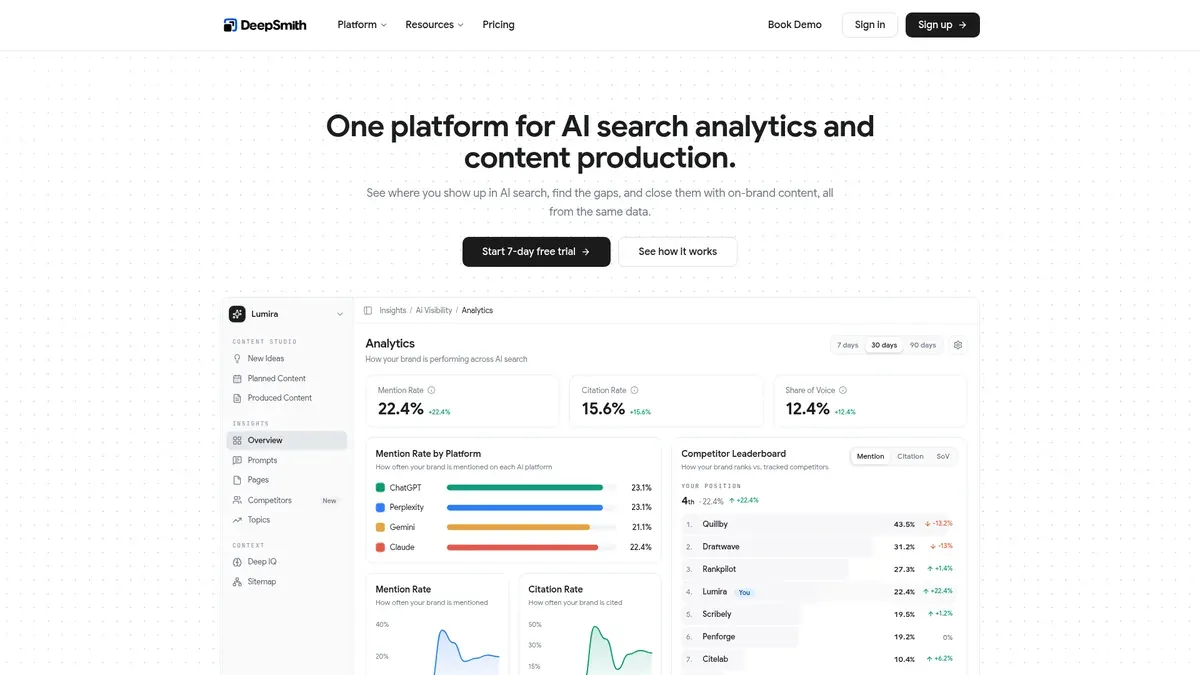
Here is the loop. You define or discover the buyer prompts that matter. The platform measures your mention and citation performance on them. It shows you the exact competitor pages winning those citations. It maps your coverage against theirs. Then it turns what it found into evidence-backed ideas, and Content Studio takes an idea through planning, writing, review, publishing, and repurposing.
DeepSmith is an AI search analytics and content production platform, not an answer tracker with a writing feature bolted on. Deep IQ is what makes that work. It stores your positioning, products, buyer personas, brand voice, visual rules, and content types once, and every module reads from it.
Key features
AI visibility. The Overview gives you mention rate, citation rate, and share of voice with trends, a per-platform breakdown, a competitor leaderboard, and the sources AI cites most. Prompts carry their own mention and citation rates plus full answer history, and Discover Prompts generates a starter set from your product, persona, and buyer-stage context, so you are not staring at an empty tracker on day one. Competitor citations names who wins a tracked prompt, on which exact page, and how they perform per platform.

Engines. Ten are covered: ChatGPT, Gemini, Perplexity, Claude, Google AI Overviews, Google AI Mode, Grok, Meta AI, Microsoft Copilot, and DeepSeek. Coverage is tiered by plan, as explained below.
Content Map. Your site and your competitors' sites are crawled into one shared taxonomy, every page landing on a topic and a funnel stage. Because your site defines the taxonomy, the comparison is like for like. Coverage gaps show topics where a competitor publishes more than you. Untapped topics show where they publish and you have nothing. Sitemaps are rechecked every 24 hours.
Opportunity Agents. Agents read your own data and hand back ideas with the reason attached. Get cited for a tracked prompt. Turn a mention into a citation. Close a funnel-stage gap against up to four competitors at once. Every run is kept as a record, so you can defend the backlog instead of guessing at it.
Content Studio and Autowrite. Ideas land in New Ideas, become Planned Content when you give them a date, and arrive as Produced Content after writing. The Writer produces a researched, brand-grounded article with internal and external links, a cover image, and publish-ready metadata. Autowrite goes further: configure an article at planning time and it writes itself on its scheduled date with nobody in the app. That is the difference between a calendar you aspire to and one that keeps moving during a bad week.

Publishing and distribution. Publish straight to WordPress, Webflow, Strapi, Sanity, or Contentful, or to your own webhooks. Finished articles arrive with social posts already written, and the Apps Library adapts one article for LinkedIn, X, Medium, Substack, newsletter email, and more.
SEO and AEO built in. Keyword coverage, heading structure, schema markup, internal linking, and metadata are part of the writing pipeline, not a cleanup pass afterward. The pipeline scans your enriched sitemap and can place up to five internal links during generation. If internal linking eats an hour per article today, that hour comes back.
Pricing
| Plan | Monthly | Billed yearly | Articles/mo | Prompts | Seats | Engines |
|---|---|---|---|---|---|---|
| Pro | $99 | $80/mo | 20 | 50 | 5 | ChatGPT |
| Grow | $199 | $160/mo | 40 | 100 | 7 | ChatGPT, Perplexity |
| Scale | $399 | $299/mo | 90 | 200 | 10 | ChatGPT, Perplexity, Gemini |
| Enterprise | Custom | Custom | Custom | Custom | Custom | All ten engines |
A seven-day free trial gives you real data and real drafts before you pay. No long-term contracts, no cancellation fees. Enterprise adds 1:1 expert onboarding and a dedicated account manager.
Honest limitation
Engine coverage is tiered. Pro tracks ChatGPT, Grow adds Perplexity, Scale adds Gemini, and all ten sit on Enterprise or Custom along with higher prompt volume. If your board wants Grok and Meta AI on the dashboard next quarter, that is an Enterprise conversation.
For most teams it is a sequencing choice rather than a wall. Your buyers are concentrated on a couple of engines today, and Pro, Grow, and Scale let you start where they actually are. If you want a pure measurement layer to feed a data warehouse and you already have a production stack you love, a specialist tracker will serve you better. DeepSmith earns its place when the production half is also your problem.
2. Frase
Best for
Content teams that want a direct SEO, GEO, and AEO workflow, with research, writing, auditing, optimization, and publishing in one loop, plus AI visibility layered in.
What it does
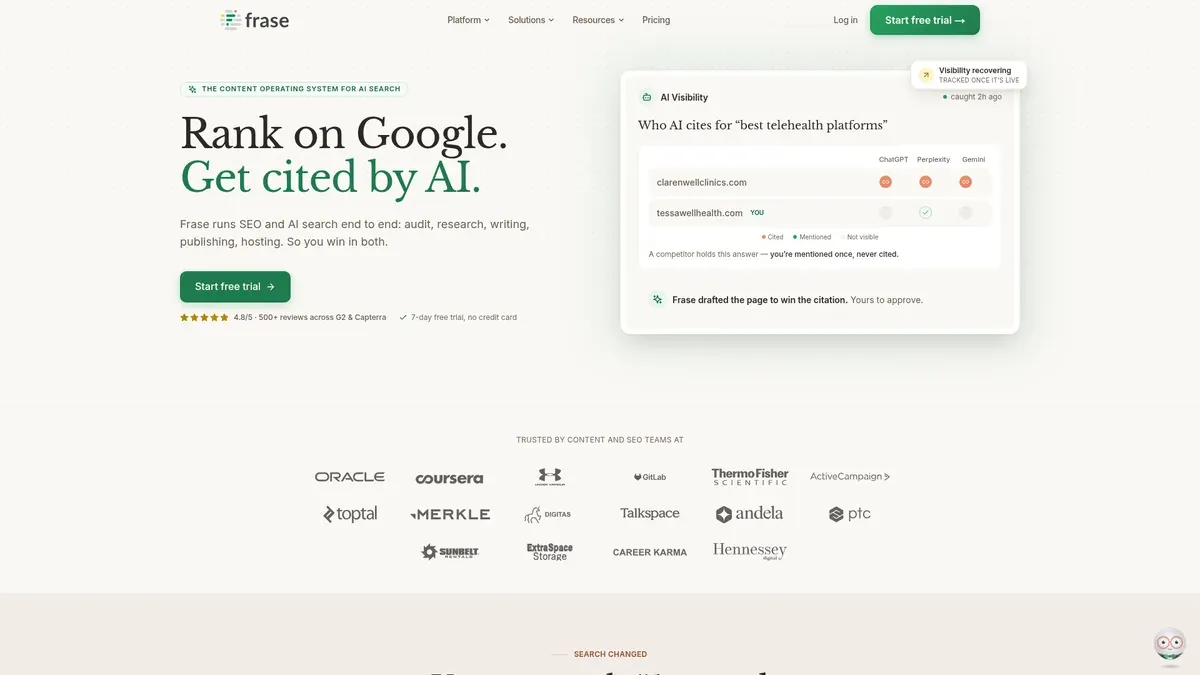
Frase writes and optimizes content meant to rank on Google and get cited by AI. The workflow runs page-by-page auditing, live SERP and competitor analysis, drafting in a team voice, and a path from research through to publishing.
Its AI visibility side monitors daily across ChatGPT, Perplexity, Claude, Gemini, and Google AI. Content Guard is a genuinely useful piece. It watches for Google ranking or traffic drops, drafts a revision, and waits for your approval instead of quietly changing the page. Publishing goes to WordPress, Webflow, Sanity, Wix, or FraseCMS.
Pricing
Starter is $49 per month month-to-month or $39 billed yearly, with 25 AI generations, 10 articles, 50 audit pages, 1 site, and 1 seat. Professional is $129 or $103 yearly. Scale is $299 or $239 yearly, with 100 articles and 1,000 audit pages. AI visibility prompt limits run separately at 50, 200, and 500. Starter includes a seven-day trial with no card.
Limitation
Frase presents AI Visibility and Content Guard as distinct capabilities rather than one loop that carries a visibility finding into an idea and a scheduled article. Confirm on your plan how a finding becomes a brief. Keep the unit types apart when you price it too. Generations, articles, audit pages, sites, seats, and visibility prompts are five different meters.
3. Semrush
Best for
Established SEO and marketing teams that want AI visibility inside a broad suite, with deep keyword and competitor research and an ecosystem they already live in.
What it does
Semrush gives you two relevant layers. The standalone AI Visibility Toolkit is a measurement product: an AI Visibility Score, competitor-gap analysis, Prompt Research with topic volume and intent, Brand Performance with share of voice and sentiment, and Prompt Tracking with day-by-day results on Google AI Mode and ChatGPT. A site audit flags AI-crawling blockers.
The Content Toolkit is the other half: Topic Finder for real-time demand, a brief generator built from top pages, an AI Article Generator that takes audience, keywords, word count, and brand voice, and repurposing to LinkedIn, X, and email. Named connections include Google Docs, WordPress, and Mailchimp. Semrush markets the workflow on a research base of more than 28 billion keywords, a vendor claim about scale rather than an independent quality measure.
Pricing
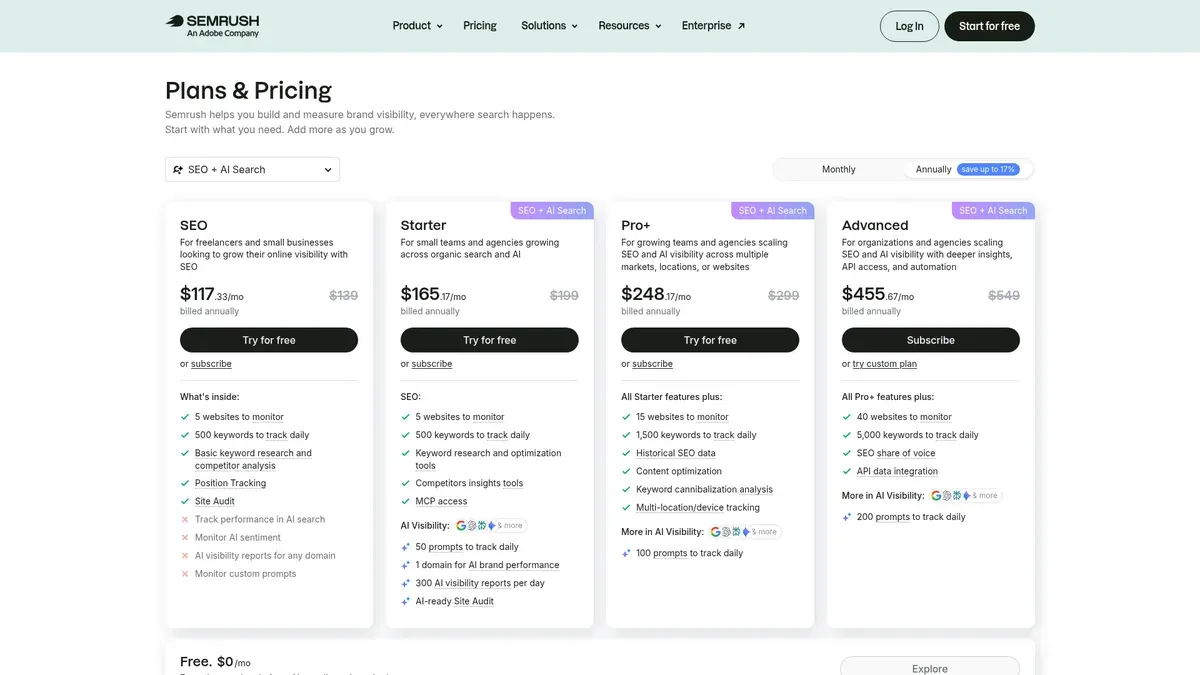
The standalone AI Visibility Toolkit is $99 per month with 1 folder, 1 Brand Performance domain, 25 tracked prompts, and up to 100 audited pages. An extra 50 prompts is $60. The broader plans are SEO at $139, Starter at $199, Pro+ at $299, and Advanced at $549, with annual billing saving up to 17 percent. Content optimization is listed from Pro+ upward.
Limitation
The capability is broad, but you have to assemble the right package. The $99 toolkit is a measurement product, and the public materials do not establish that it writes and publishes an optimized article. That packaging work is the real cost, not a shortage of tools.
4. Surfer
Best for
SEO-first teams that want a mature content editor with topical and competitor guidance and internal-link help, and want prompt-level AI measurement alongside it.
What it does
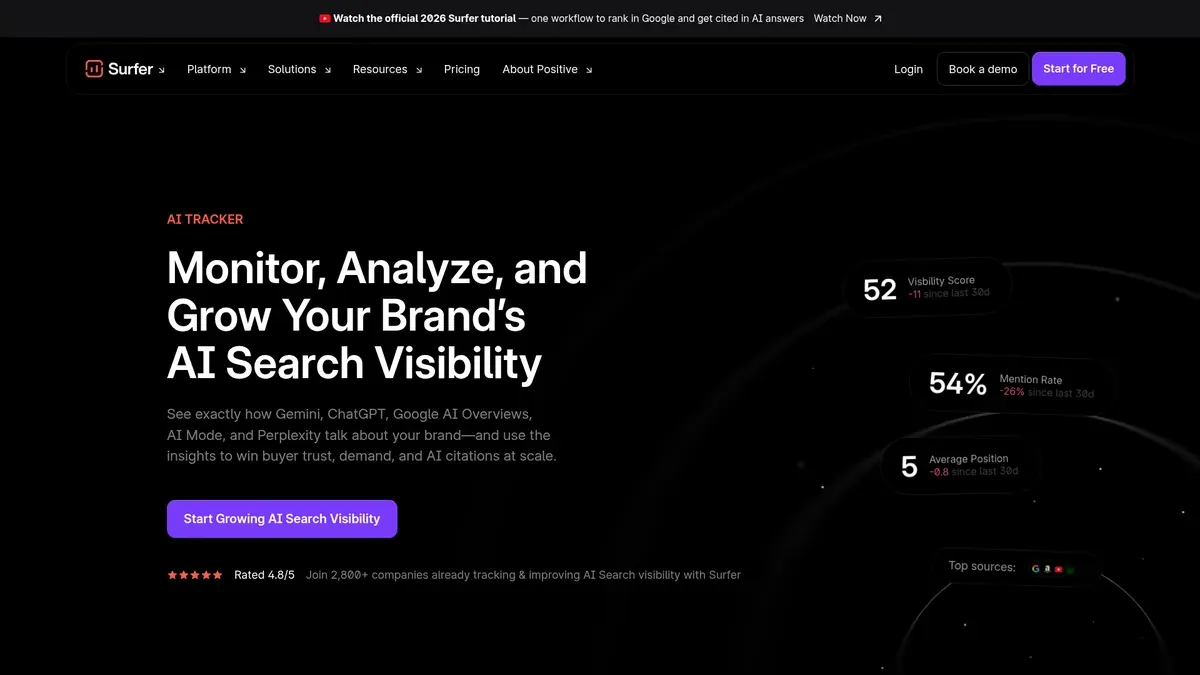
Surfer's AI Tracker monitors product, brand, and buyer-intent questions across Gemini, Google AI Overviews, Google AI Mode, ChatGPT, and Perplexity, evaluating one prompt across all five. It reports Visibility Score, share of voice trends, missing mentions, cited sources, sentiment, and competitor benchmarks. Surfer says it uses real scraping rather than an API and averages several queries per day and model to cut noise, a thoughtful answer to how jumpy AI answers can be.
The tracker feeds the content workflow. Plan uses Topical Map and Fanout Queries, Optimize improves missing AI-ready articles, and Maintain runs Content Audit. The Content Editor is the mature part, with Content Score, more than 500 ranking factors, keyword and entity optimization, and Custom Voice. Internal Linking scans your domain and inserts relevant links.
Pricing
Discovery is $49 per month billed yearly with 10 pages and zero AI prompts. Standard is $99 with 50 pages and 25 weekly prompts. Pro is $182 with 200 pages, 5 brands, and 50 daily prompts across all five engines. Peace of Mind is $299 with 500 pages and 100 daily prompts, and Enterprise is $999.
Limitation
AI coverage is heavily plan-gated. The entry plan has no AI prompts at all, Standard has a small weekly ChatGPT-oriented allowance, and the five-engine set starts on higher plans. The pricing pages do not publish a comparable article-generation quota either, so test your real volume first. Just do not read the entry price as a five-engine package.
5. SE Ranking

Best for
Teams that want a familiar SEO platform with keyword, SERP, site, and content workflows, and want structured AI-search monitoring without buying an enterprise AEO product.
What it does
The AI Search Visibility tool tracks AI Overviews, AI Mode, Perplexity, ChatGPT, and Gemini. It reports linked and unlinked brand mentions, citation frequency, average positions, citation dynamics, AI Overview traffic, and average ranking inside generated responses, side by side against up to five competitors.
Content Editor is a full-cycle creation tool: competitor research, keyword analysis, writing and optimization, Content Score, readability, SERP briefs, outlines, NLP-related keywords, and density guidance. Documents can be shared with people who do not have a subscription, which matters if you work with freelancers.
Pricing
Core is $129 per month or $103.20 billed yearly, with 10 projects, 2,000 daily keywords, 100 daily AI prompts, and 25 content articles. Growth is $279 or $223.20 yearly. AI Search is an add-on at $89 per month or $71.20 yearly, covering up to five LLMs with prompt options displayed at 200, 450, and 1,000. A 14-day fully functional trial is available.
Limitation
AI Search is an add-on, not part of the base price, so budget both lines. The public pages do not spell out a shared queue that carries a citation gap into a brief or a scheduled article, so test that handoff during the trial. SE Ranking's own material notes that AI-search benchmarking is still developing, which is a refreshingly honest thing for a vendor to say.
6. Profound
Best for
Enterprise marketing, SEO, and communications teams that need deep AI-search intelligence, prompt research, competitive analysis, agents, and API-led workflows more than they need an article editor.
What it does
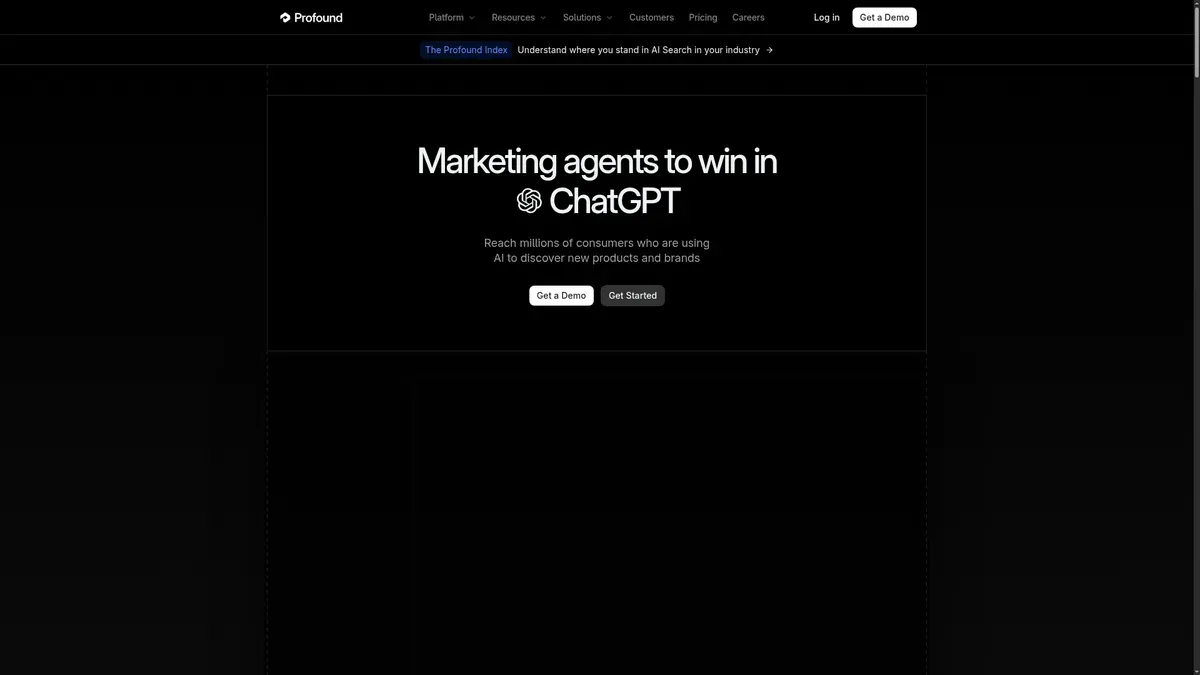
Profound focuses on Answer Engine Insights: structured prompts across AI platforms, citation analysis, brand sentiment, ranking, competitive presence, and research grounded in what large numbers of people ask AI. It offers marketing agents plus templates for content and Content AEO, including AEO-optimized FAQs for landing pages.
The product names Perplexity, ChatGPT, Claude, Gemini, Grok, Microsoft Copilot, DeepSeek, and Google AI Overviews. The API Cookbook shows how to build charts, KPIs, and tables from public API calls, which matters if a data team will fold AI visibility into wider reporting. Integrations span ads, CDN, CMS, and web analytics, including Looker and Google Search Console.
Pricing
Starter is $99 per month billed yearly with 50 prompts, 100 agent credits, and ChatGPT tracking only. Growth is $399 billed yearly with 100 prompts, 400 agent credits, and three answer engines. Enterprise is custom with up to nine answer engines. Annual billing is displayed as two months free. Trial terms are not stated publicly, so ask.
Limitation
Profound's public materials emphasize visibility, research, agents, and APIs. They do not document an end-to-end SEO article editor with keyword optimization, an editorial calendar, internal-link automation, and direct publishing. If you are a small team hoping one subscription replaces both the tracker and the writing system, this is not that product. Engine count also climbs with the tier, so the homepage's named set is not what Starter includes.
7. Scrunch

Best for
Companies that need AI-search monitoring, citation and trend intelligence, API access, and visibility into how AI agents crawl their site, especially where engineers will wire the signals into an existing stack.
What it does
Scrunch calls itself an Agent Experience Platform, split between observing AI experiences and acting on them. AI Monitoring and Citations covers prompt results, authoritative citations, signals, and changes. AI Search Trends adds approximate prompt volumes, brand-presence benchmarks, and benchmarked topic share.
The API layer is the distinctive part. The Query API captures brand presence and sentiment by platform. The Responses API returns full AI answers with citations, competitors, and prompt metadata. The Agent Traffic API captures AI-bot logs from your CDN, edge, or hosting layer, a signal most tools on this list do not offer. API pricing is based on AI responses rather than calls, so cost rises as you add brands, prompts, or platforms.
Scrunch's marketing reports more than 6 million citations weekly, plus a customer example showing a 364 percent increase in brand presence for non-branded prompts. Those are vendor-reported figures, not controlled benchmarks, and not a typical outcome to plan around.
Pricing
Core is $250 per month with 125 unique prompts, 5 site audits per month, 1 brand workspace, and sitemap capacity of 25 pages. There is a seven-day free trial with no card. Enterprise is custom.
Limitation
Core's limits are tight for the price. More importantly for this buyer, the public material does not document an SEO article editor, an editorial calendar, or a direct CMS publishing path. Scrunch is a measurement and API layer. Plan to pair it with something that produces the content.
8. Otterly

Best for
Smaller teams that want an affordable entry into AI-search monitoring, brand reports, citations, crawlability checks, and GEO recommendations, and are fine using another tool to write.
What it does
Otterly covers AI Prompt Research, AI Search Analytics, Content Audit, and GEO Optimization. Public materials describe coverage rate, share of voice, platform visibility and trends, brand mentions, average brand position, citation tracking, crawlability audits, content briefs, and actionable GEO recommendations.
Base engines on the pricing page are ChatGPT, Google AI Overviews, Perplexity, and Microsoft Copilot. Claude, Google AI Mode, and Gemini are add-ons. The homepage names all seven, so read the pricing page rather than the homepage when you are budgeting.
Pricing
Lite is $29 per month or $25 billed annually with 15 prompts, unlimited brand reports, and 1,000 GEO URL audits. Standard is $189 or $160 with 100 prompts and 5,000 audits. Premium is $489 or $422 with 400 prompts and 10,000 audits. Enterprise starts at $1,000 per month. A no-commitment free trial is offered without a stated duration.
Limitation
Otterly is a monitoring and audit product, not a production replacement. The base engine set is four, three more cost extra, and the public pages do not describe full article generation, a content calendar, or CMS publishing. Choose it when affordable measurement matters more than a closed loop from gap to published page.
How to choose the right Rankability alternative for your team
Still weighing rankability.com competitors against each other? Answer one question: where does your work stall?
If it stalls at production, choose DeepSmith. Visibility data, evidence-backed ideas, writing, scheduling, publishing, and repurposing sit in one workspace on shared brand context. Start on Pro and grow engine coverage as your buyers spread out.
If you want a mature SEO and GEO content workflow, choose Frase. Auditing, writing, Content Guard, and CMS options are strong, at the lowest entry price here.
If you already live inside a big SEO suite, choose Semrush. The surrounding keyword and competitor research is the broadest, once you work out which package holds what you need.
If SEO editing is your center of gravity, choose Surfer. The Content Editor, topical maps, and internal linking are the draw. Skip the entry plan if you need prompt tracking.
If your team likes a classic SEO platform, choose SE Ranking. Familiar workflows plus five-engine monitoring as an add-on, and a 14-day trial to test the handoff you care about.
If you need enterprise AEO intelligence and APIs, choose Profound. Prompt research, agents, and reporting depth, with a separate production system still needed.
If you need API-level signals and agent traffic data, choose Scrunch. Especially where engineers will connect it to the stack you already have.
If budget is the binding constraint, choose Otterly. Twenty-nine dollars a month gets you real monitoring and GEO audits. Plan for a second tool when production becomes the bottleneck.
Pick two you can trial in the same fortnight, run them on your own prompts, and compare what actually reached your calendar. Real data beats any comparison table, including this one.
Try the whole loop before you commit
If the production half is where your week disappears, that is the half to test first. Start a DeepSmith free trial, connect your site, and watch one evidence-backed idea travel from a competitor citation you did not know about to a finished, on-brand article. Seven days, real data, real drafts, no contract.