If you're weighing Yarnit alternatives, you're probably not trying to replace one AI writer with another. Yarnit is positioned as an agentic platform for marketing and ecommerce, with multi-agent workflows, campaign tools, and its own take on brand voice and SEO. So the real question isn't which tool writes faster. It's where you want your content operation anchored: campaign breadth, visual production, search depth, or a system that measures AI visibility and produces content to close the gaps it finds.
This list covers seven tools like Yarnit worth a look in 2026, chosen against seven criteria that actually predict whether a platform fits a marketing team: end-to-end workflow coverage, agentic or automated execution, SEO and AI-search depth, multi-format and visual output, brand governance, publishing and integrations, and commercial fit. We ranked DeepSmith first because it's the only option here that connects AI-search measurement directly to content production, but we're upfront about where each best yarnit alternative actually wins and where it doesn't. You won't find Narrato on this list. Its own product page confirms the service is shutting down in mid-2026, so it's not a safe pick for anyone starting fresh.
Quick comparison
| Rank | Platform | Best for | Agentic workflow | SEO and AI-search depth | Multi-format output | Starting price |
|---|---|---|---|---|---|---|
| 1 | DeepSmith | Connecting AI-search measurement to content production | Opportunity Agents, Autowrite, scheduled production | Native AEO, citation tracking, Content Map gap analysis | Articles, cover images, social, newsletters | $99/mo |
| 2 | Jasper | Governed agentic marketing across text and image | 100+ specialized agents, connected pipelines | SEO, GEO, AEO measurement (Surfer add-on) | Text, images, ads, email, social | $69/seat/mo |
| 3 | Writesonic | SEO, GEO, and AI-search action | Agentic SEO and content workflows | Deepest search layer here: audits, tracking, Action Center | AI articles, limited visual production | $79/mo |
| 4 | Simplified | Brief-to-campaign production | Brief-to-approval campaign agent | Structured articles, no dedicated SEO scoring | Copy, design, video, social scheduling | $79/mo |
| 5 | Typeface | Enterprise marketing orchestration | Arc Agents, Arc Spaces, Arc Forge | Not established in public material | Multimodal, multi-channel campaigns | Custom |
| 6 | Copy.ai | Reusable research and GTM workflows | Custom Workflows, credit-based | SEO article workflows, no measurement suite | Text, GTM assets, translations | $29/mo |
| 7 | Canva | Visual content and branded assets | Lighter automation, strong design AI | Not an SEO or citation tool | Templates, video, presentations, graphics | Free |
1. DeepSmith: best for connecting AI-search insight to content production
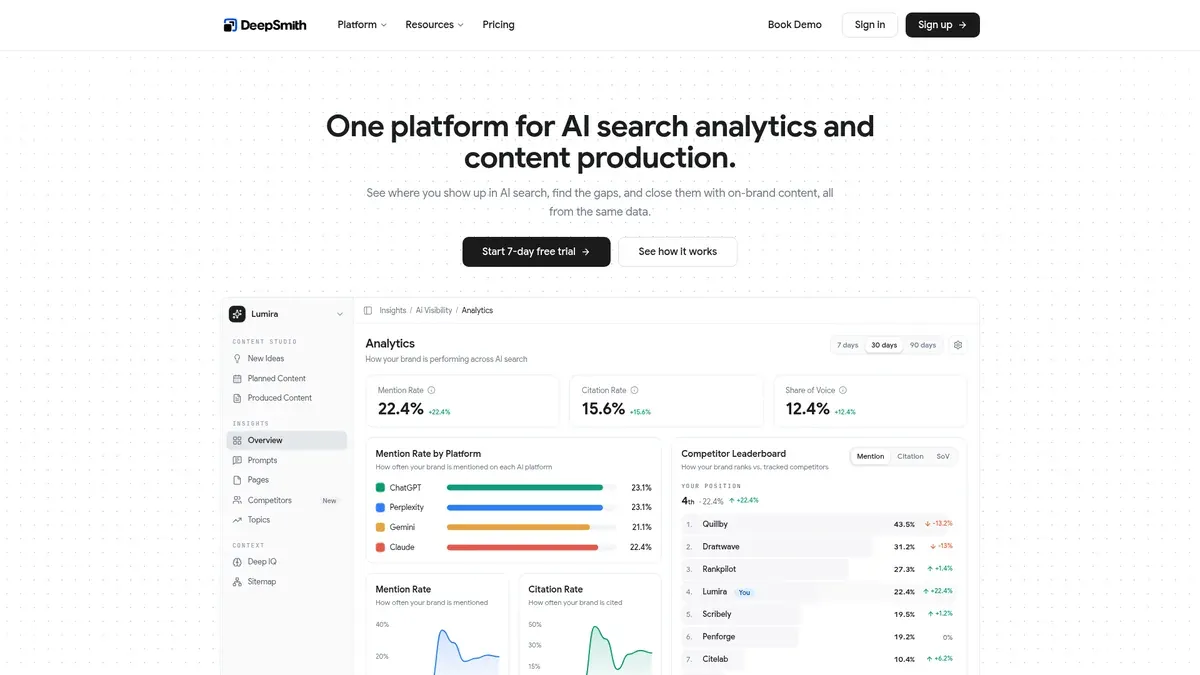
DeepSmith is the only platform on this list built as both an AI-search analytics system and a content-production system in one place. Instead of starting from a blank brief, the workflow starts from your tracked prompts, your competitor citations, and your topic coverage, then moves straight into planning, writing, publishing, and distribution. That matters for a reader trying to answer four questions at once: which buyer questions AI actually answers about your category, where you're mentioned or cited and where competitors are winning instead, which topics and funnel stages are thin, and whether the system in front of you can actually produce and ship the content needed to close those gaps.
The AI Visibility module tracks how AI engines answer questions about your brand, with mention rate, citation rate, share of voice, and visibility trends broken down by platform, plus a competitor leaderboard and the sources AI cites most. You can track individual prompts with full answer history, and Discover Prompts builds a starter list from your product, persona, and buyer-stage context so you're not staring at a blank tracking sheet. The Pages view shows which of your own pages AI is actually citing and which prompts are driving those citations, while competitor citation reporting shows who's winning the prompts you care about and on which exact pages.

Content Map turns your site and your competitors' sites into one shared topic and funnel-stage map, re-checked every 24 hours so new pages fold in automatically. Coverage gaps show where you publish less than a competitor, and untapped topics show where you have nothing at all while a rival has a whole cluster. This is what powers internal linking, ideation dedup, and the AEO Pages view, so the same data structure shows up everywhere in the platform instead of living in a separate spreadsheet.
Opportunity Agents read your own visibility and Content Map data and hand back ideas with the specific data point that justifies each one, whether that's winning a tracked prompt, turning an existing mention into a citation, closing an awareness-stage gap against up to four competitors at once, or building topical authority on a chosen subject. You can set a 30, 90, or 180-day window and add free-text instructions, and every run is logged so you can defend the backlog instead of guessing at it.
Content Studio is where those ideas become finished articles: New Ideas is the shared backlog, Planned Content is where you schedule, and the Writer researches, links internally and externally, adds a cover image, and finishes with publish-ready metadata, all built in during creation rather than bolted on in a separate SEO pass afterward. Autowrite takes this further: configure an article at planning time and it writes itself on its scheduled date with nobody needing to open the app. Once published, articles arrive with social posts already drafted, and the Apps Library can turn one piece into LinkedIn, X, newsletter, and other channel-native formats, which solves the common problem of content that gets published and then just sits there because nobody gets around to distributing it. Underneath all of this, Deep IQ stores your company positioning, product details, persona profiles, brand voice, visual guidelines, and content-type templates, so every draft pulls from the same grounded context instead of a fresh brief each time.

Pricing runs four tiers. Pro is $99 a month ($80 billed annually) with 20 articles, 50 tracked prompts, 5 seats, and ChatGPT tracking. Grow is $199 a month ($160 annually) with 40 articles, 100 prompts, 7 seats, and Perplexity added. Scale is $399 a month ($299 annually) with 90 articles, 200 prompts, 10 seats, and Gemini added. Enterprise is custom pricing with custom limits and all ten tracked engines: ChatGPT, Gemini, Perplexity, Claude, Google AI Overviews, Google AI Mode, Grok, Meta AI, Microsoft Copilot, and DeepSeek. Every plan gets a 7-day free trial with no long-term contract and no cancellation fee. Publishing connects to WordPress, Webflow, Strapi, Sanity, and Contentful, plus custom webhooks and Markdown or HTML export as a fallback.
The honest limitation is that DeepSmith isn't a general-purpose design canvas. It handles cover-image generation and applies your visual guidelines inside the writing workflow, but it won't replace a tool with millions of templates and a drag-and-drop editor. That's a scope difference, not a shortcoming: a team whose bottleneck is SEO-ready articles, AI-search measurement, and distribution is solving a different problem than a team whose bottleneck is visual campaign assets, and for that second team, Canva or Simplified below is the better starting point. The other real limit is engine coverage by tier: full ten-engine tracking needs Enterprise, so teams that only care about ChatGPT or ChatGPT plus Perplexity can stay on a lower plan without losing anything they'd actually use.
2. Jasper: best for governed agentic marketing across text and images
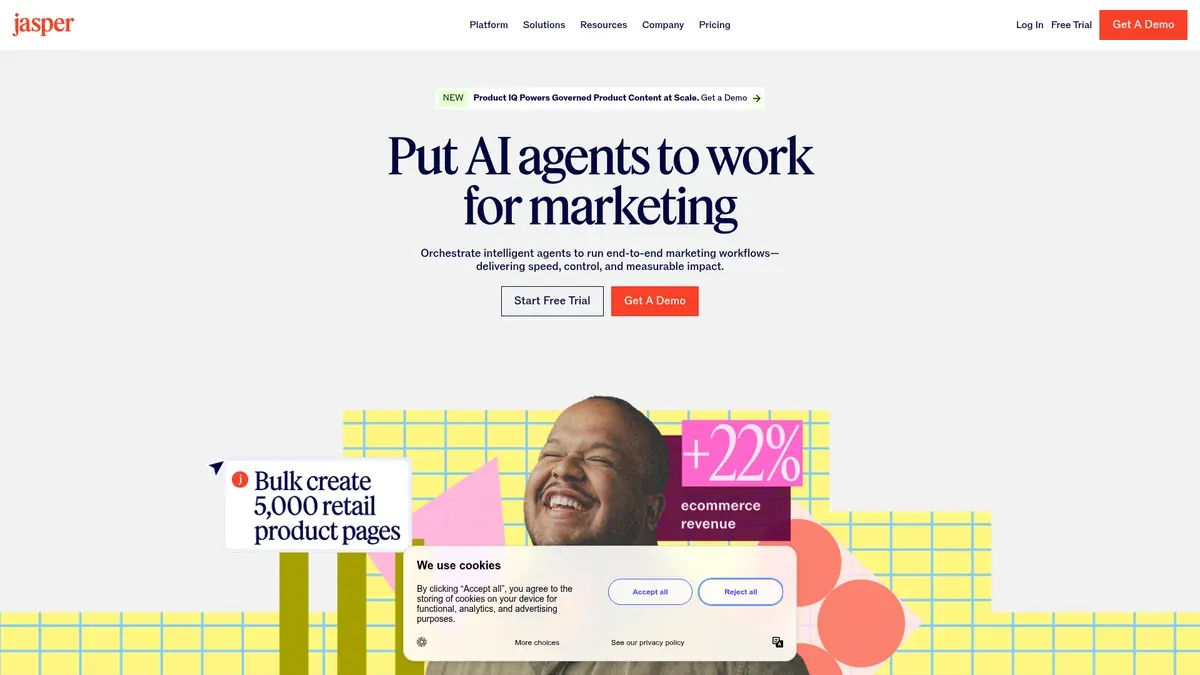
Jasper's current pitch is built around more than 100 specialized agents and connected content pipelines covering SEO, GEO content, campaign execution, email, social, and research tasks. Jasper IQ stores brand voice, style guides, audience profiles, and product knowledge once, and administrators set rules that every generation follows after that, which matters for larger teams juggling multiple sub-brands or regional voices. It's also genuinely multimodal: articles, emails, ads, and social posts sit alongside Image Pipelines for on-brand product imagery, background removal, and upscaling.
Jasper's SEO story is stronger than its old reputation as a copywriting tool suggests, with GEO and AI Optimization features, citation-rate monitoring, and content-gap identification built into the product. Its Surfer SEO integration compares content against what's already ranking, though that's an add-on rather than something bundled into the base Pro price. Pricing starts at $69 per seat per month for Pro, with two Brand Voices, five Knowledge assets, and a 7-day trial; Business pricing is custom and adds unlimited brand voices.
The trade-off is that per-seat pricing adds up as a team grows, and some SEO capability sits behind that add-on rather than in the core plan. Jasper is the stronger pick when you need a broad marketing-agent layer and image production working together across a bigger team; DeepSmith is the better fit when the priority is AI-visibility measurement and content-gap intelligence feeding directly into a production queue.
3. Writesonic: best for SEO, GEO, and AI-search action
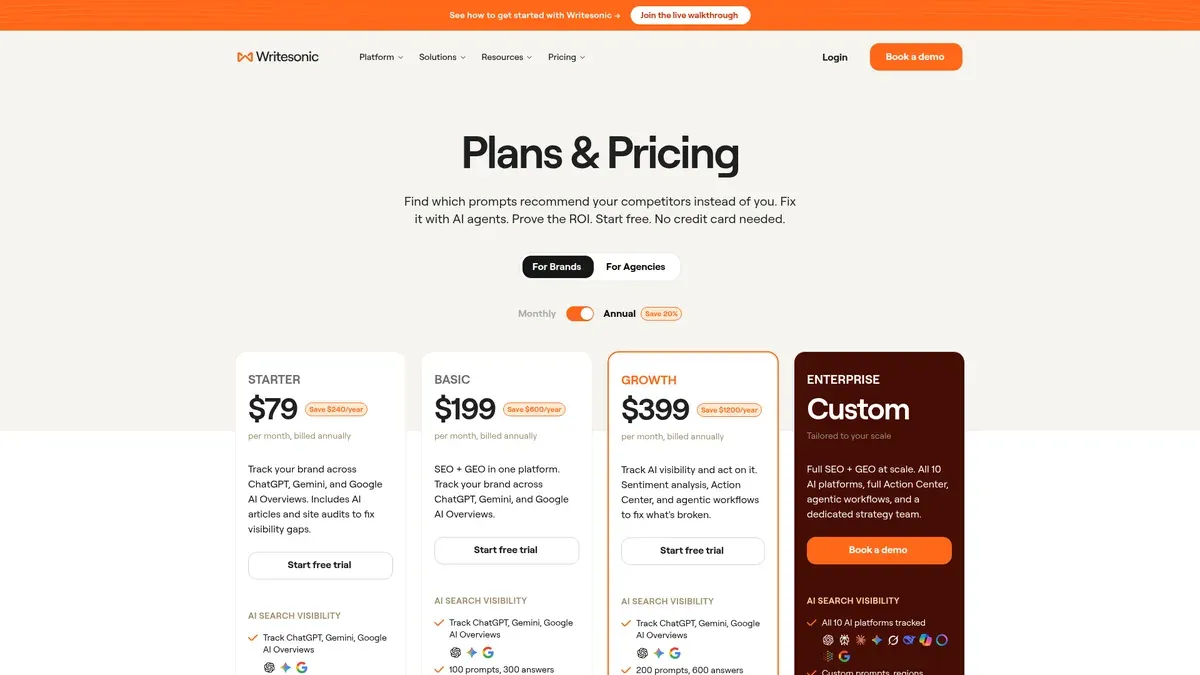
Writesonic positions itself squarely as an AI search visibility platform, and its search layer is the deepest of any option here besides DeepSmith: AI-visibility tracking, SEO and GEO positioning, site audits, sentiment analysis on higher tiers, and an Action Center that can trigger fixes rather than just reporting them. Integrations reach Google Search Console, Ahrefs, Google Analytics 4, and WordPress, and Writesonic says it connects to more than 20 systems in total, pulling in queries, clicks, and AI Overview citation data along the way.
Pricing runs from Starter at $79 a month (billed annually) with 15 AI articles and tracking across ChatGPT, Gemini, and Google AI Overviews, up through Basic at $199 and Growth at $399, with Enterprise adding all ten AI platforms and a dedicated strategy team. The catch is that lower tiers cap both AI-platform coverage and agentic-workflow runs, and the reviewed material doesn't establish a broad visual-design environment to match tools like Canva or Simplified.
Choose Writesonic when search data and measurable AI-search actions are your central buying criteria. Compare it closely against DeepSmith if you also want that measurement layer wired directly into a content-production backlog rather than living as a separate audit tool.
4. Simplified: best for brief-to-campaign production
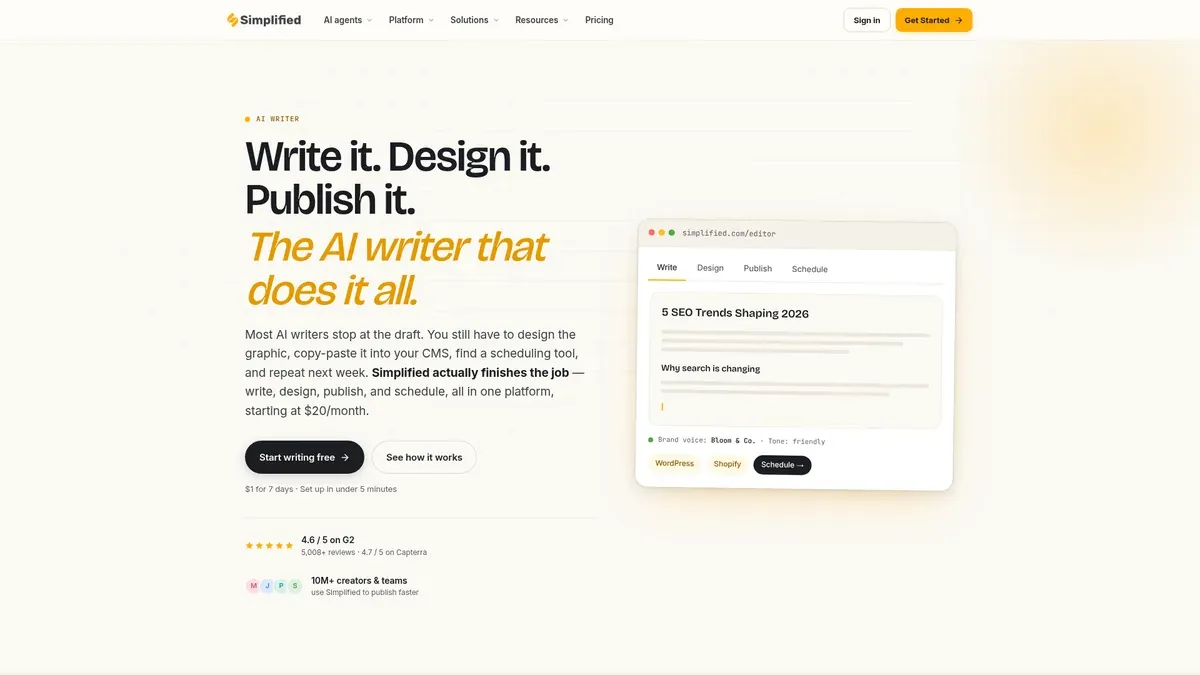
Simplified's agent model works at the campaign level rather than the single-asset level. Brief it in plain language, something like launching a promotion across Instagram and LinkedIn, and it returns a reviewable campaign: a batch of six social posts, a three-to-five email sequence, or a paid-ad set with three variants, depending on what you asked for. Every plan also includes Simplified's design, video, and social-scheduling tools even when you're not using the agent layer, and the AI Writer covers more than 50 formats from blog posts to product listings.
Its Knowledge Base stores brand guidelines and tone documentation that gets applied automatically to new output, and the AI Writer can produce structured long-form articles with outlines and keyword targeting that publish to WordPress with heading structure and meta fields intact. Simplified is honest that dedicated SEO scoring and keyword-density analysis aren't native, so teams that need those still pair it with a separate SEO tool. Pricing starts at $79 a month for Starter, which includes five campaigns, 100,000 AI words, and 100 AI designs, with extra campaigns available at $10 each on any plan.
Simplified is the better call when campaign assets and visual output are the actual bottleneck. DeepSmith is the better call when the bottleneck is AI-citation tracking and content-gap analysis driving what gets written next.
5. Typeface: best for enterprise marketing orchestration

Typeface is built for large marketing organizations juggling approvals, governance, and a stack of connected systems. Its architecture splits into four parts: Arc Graph grounds output in brand guidelines and approved layouts, Arc Agents handles multi-stage tasks across channels, Arc Spaces manages planning through publishing in one workflow, and Arc Forge lets teams turn workflows into custom agents extended through MCP and APIs. Content Workflows add real-time status visibility, automated approval routing, custom review steps like legal review, and audit trails, with direct publishing to a DAM or CMS.
The connector list is broad, reaching Adobe Experience Manager, Braze, BigQuery, Google Workspace, and creative tools like Figma and Photoshop. What's missing from the public material is any specific SEO or AI-search measurement capability, and pricing isn't published at all. You're looking at a demo and a sales conversation before you know what it costs.
Typeface wins over DeepSmith when enterprise-scale approvals, multimodal campaign orchestration, and deep creative-system integration matter more than self-serve pricing. DeepSmith wins when you want transparent pricing plus AI-search visibility and topic-gap intelligence feeding a production queue without a sales cycle.
6. Copy.ai: best for reusable research and workflow automation
Copy.ai's core idea is the Workflow: a set of AI actions stitched together to codify a repeatable process, whether that's building an account plan or writing an SEO article. Workflows can combine research, content generation, website scanning, tool integrations, and API calls in one chain, and its Brand Voice feature builds a usable voice profile from as little as 300 words of source copy, refined by adding or replacing examples over time.
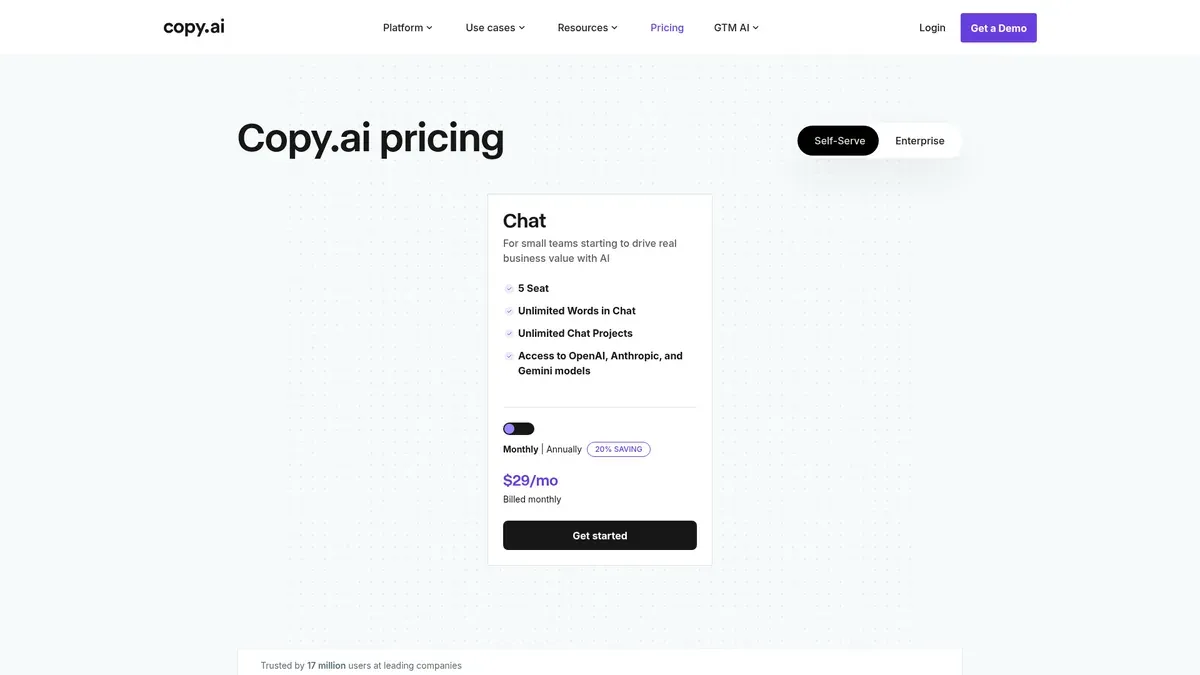
The current platform leans increasingly toward go-to-market automation rather than pure content production, and while SEO-article workflows exist, an integrated SEO or AEO measurement suite isn't part of the picture. Pricing starts at Chat for $29 a month (five seats, unlimited words in Chat), then jumps sharply to $1,000 a month for Growth with 20,000 workflow credits, scaling up from there. Because credits track workflow complexity rather than a flat article count, cost at higher volume is harder to predict than a simple monthly quota.
Copy.ai fits organizations that want to encode a repeatable GTM process across research, content, and integrations, and that can manage variable credit consumption in exchange for that flexibility. DeepSmith fits better when AI-search measurement should directly set the production backlog rather than running as one workflow among many.
7. Canva: best for visual content and branded asset production
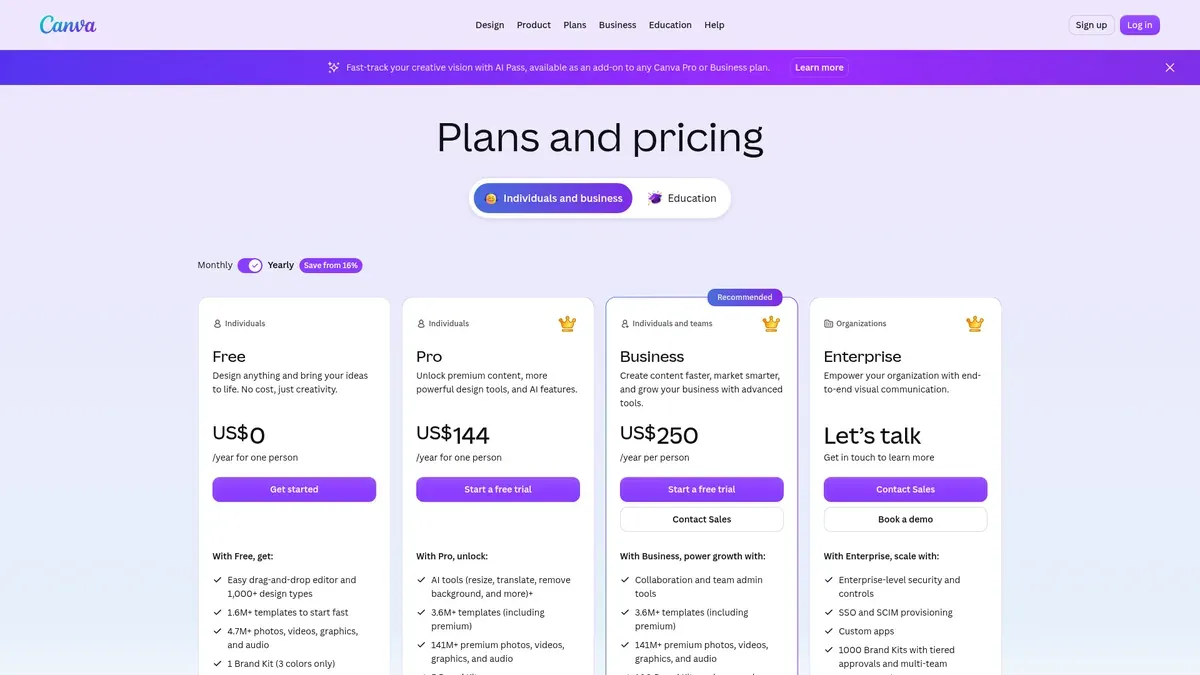
Canva remains the strongest design-led option here by a wide margin. The Free plan alone ships more than 1,000 design types, over 1.6 million templates, and close to 5 million photos, videos, and graphics, plus a limited Brand Kit and a small AI allowance. Magic Studio adds AI tools like Magic Write, Magic Resize, Magic Edit, and Magic Charts, and Pro layers in premium content, five Brand Kits, social scheduling, and more AI access for $144 a person per year, with Business at $250 adding approvals and 100 Brand Kits.
What Canva doesn't offer is any integrated SEO content map, competitor content-gap system, or AI-citation tracker, and its AI access is allowance-based with fair-use limits rather than unlimited generation. That's fine, because it isn't trying to be a content-production or measurement system in the first place. Marketing leads often run it alongside a dedicated content or SEO platform rather than instead of one.
Pick Canva when visual production is the actual bottleneck: templates, presentations, social graphics, and brand kits before you need anything resembling AI-search intelligence. Pick DeepSmith when the bottleneck is turning search data into publish-ready articles and the assets that go with them.
How to choose
If your bottleneck is visual campaign output, not written content, Canva or Simplified will get you there faster than any content-first platform on this list. If enterprise governance, approvals, and connecting a dozen creative and CMS systems outweigh self-serve pricing, Typeface is built for exactly that, even without public pricing to compare against. A broad agentic marketing layer with strong image production and per-seat brand governance points toward Jasper. If SEO, GEO, and AI-search action are the entire buying criteria and you're comfortable running content production as a separate concern, Writesonic's search layer goes deeper than most. Copy.ai makes sense when you want to encode a repeatable GTM process across research and content rather than run a straightforward article pipeline.
For the marketing lead whose actual problem is finding out where their brand is invisible in AI answers and then producing the content to fix it, without stitching together a tracker, a writer, and a publishing tool separately, DeepSmith is built around that exact loop. If AI-search visibility has become a board-level question, if competitors keep showing up in ChatGPT or Perplexity where you don't, or if your content backlog is really a stack of SEO gaps nobody's turned into a production plan, that's the case for putting DeepSmith at the top of your Yarnit alternatives shortlist. Start a 7-day free trial to see your own visibility data and a sample draft before you commit to anything.