An AI writing tool helps you create or improve text. An AI content platform connects the writing to the rest of the work around it, like planning, shared brand context, production, publishing, distribution, and measurement. So the real difference in the ai writing tool vs ai content platform question is which jobs the software handles and which ones your team still has to carry from tool to tool. It has little to do with the product label or with whether the software can produce a whole article, because both can.
If you're trying to decide between the two, a simple question helps. After the text is generated, what still has to happen, who does it, and where is that work tracked? A second question catches the work before drafting: what evidence picked this topic, and does that evidence make it into the brief and the production queue? Your answers usually show where the bottleneck is. If it's the wording, a writing tool may be all you need. If it's everything around the wording, that's where a platform starts to make sense.
AI Writing Tool vs AI Content Platform at a Glance
The table below describes scope to look into, not features every product has. Software in either category can be stronger or weaker than the description, so use the last column as a list of things to ask about.
| Decision criterion | AI writing tool | AI content platform | What to establish |
|---|---|---|---|
| Primary job | Helps create or improve text | Connects several stages of content work | Is the bottleneck the wording or the surrounding operation? |
| Topic selection | Can brainstorm from your instructions | May tie ideas to site coverage, audience needs, or performance evidence | Why is this topic in the backlog? |
| Brand context | May use prompts, templates, or saved context | May share structured context across planning and production | Is context kept once and reused, or pasted again each time? |
| Briefing | Can help draft a brief | May keep the brief with the planned content | Do approved inputs survive the handoff? |
| SEO production details | May help with headings, keywords, or metadata | May build these into the production process | Which details are delivered, and which are only suggested? |
| Internal linking | May generate suggestions | May use your existing content inventory to place links | Are the destinations real, relevant, and current? |
| Scheduling | May leave scheduling to another tool | May connect planned dates to production or publishing | Does the date trigger a task, a draft, or a publish? |
| Review and accountability | Usually depends on your own process | May include statuses, roles, and review steps | Who can edit, approve, and publish? |
| Publishing | May need copy and paste or an export | May offer CMS integrations | What transfers correctly, and what stays manual? |
| Distribution | Can rewrite text for another channel | May connect channel versions to the source article | Are channel versions created, reviewed, and actually sent? |
| Measurement | Often happens in other systems | May tie performance or visibility findings back to content decisions | Which measurements are built in, integrated, or missing? |
| Operational overhead | Fits an existing process with little change | Can cut handoffs but adds setup and adoption work | Does it remove more work than it adds? |
The part of the table that matters most is the connection between stages. A long feature list doesn't tell you whether a topic, the evidence behind it, your approved context, the finished article, and its results stay linked to each other.
What an AI Writing Tool Handles
A writing tool is software whose main job is helping a person create, revise, or transform text. That covers brainstorming, outlining, drafting, rewriting, editing, and feedback. It isn't limited to spell checks or short snippets, and a writing tool can produce a complete article. Some also offer saved instructions, collaboration, or integrations, and those are useful, but they don't by themselves mean the tool is running your content operation.
The unit of work is the piece of text. The question it answers is "can you help me write or improve this?"
There's real evidence that this kind of help is worth having. A peer-reviewed study published in Science in July 2023 ran an experiment with 453 college-educated professionals doing occupation-specific writing tasks, and half of them were randomly given AI writing assistance. The group with assistance finished about 40% faster on average, and experienced professionals who graded the work without knowing who used AI rated its quality about 18% higher. Those tasks took roughly 20 to 30 minutes each, and examples included cover letters and internal emails.
It's worth being careful about what that study shows. It tested particular tasks and a particular 2023 system, and the tasks didn't need precise facts about a specific company. It doesn't tell you anything about publishing throughput, rankings, AI citations, or revenue, and it isn't evidence that a platform beats a writing tool. What you can safely take from it is that writing help can make bounded writing tasks quicker and better, so test the work that happens before and after drafting separately.
If your topics are already chosen, your briefs are good, someone owns review, and publishing works, then better text production may be exactly what you need. A writing tool is a sensible choice in that case, and a bigger system would just duplicate what you have.
What an AI Content Platform Handles
For this comparison, an AI content platform is software that connects several stages of content work through shared context, content records, workflow, and integrations. Writing is one function inside a bigger scope. The stages it may cover include finding opportunities, planning, briefing, research, production, review, publishing, repurposing, and measurement. A given platform might cover only some of these, so you have to check which ones.
The unit of work is the content item moving through a repeatable process, linked to what went into it and what it's used for afterward. The question it answers is "how does this get from a justified idea to a published piece, and how do we decide what happens next?"
A few terms get mixed up here, so it helps to keep them apart. A workflow manages the work: tasks, order, owners, status, and handoffs. A content lifecycle is wider, since it includes what happens to a page after it goes live, like measuring, refreshing, reusing, or retiring it. A production workflow can stop at publication, but the lifecycle doesn't. Content operations means the people, processes, and technology that make all this repeatable, and buying broader software doesn't remove the need for owners, editorial standards, and specialist review.
A platform also doesn't have to replace your content management system, include every channel, run on its own, or track AI search to count as broader content software. Your CMS is often the place a platform publishes to, and some AI content tools push finished posts straight into it. If you're searching for the best ai writing platform, it helps to know that the phrase can mean either category, and "ai content software" is an umbrella that covers both. Neither phrase tells you how much of the workflow is covered, so when you shop for ai content software, ask what each product handles instead of trusting a label.
Shared Brand Context and Production Handoffs
Writing speed and production throughput are two different questions. A tool can make drafting much faster while the overall process stays stuck on briefing, review, linking, images, formatting, or approvals. If you're the person doing all that around the draft, a faster draft may not change your week very much.
Brand context is a good place to see the difference. The question isn't whether a system can follow a tone instruction. It's how the context is kept and reused. Look at whether product facts, audience details, approved claims, voice rules, and content formats are available at every step, and ask what happens when your positioning changes. Good evidence is a visible, editable context record you can watch shape several different pieces. Weak evidence is one impressive sample that came from a very detailed prompt you'd have to rebuild for every article.
Stored context doesn't guarantee accuracy either. Wrong or outdated context gets reused just as consistently as correct context, so someone should own it, and consequential claims still need a check.
Planning has a similar split. Generating ideas is different from keeping a backlog where each idea has a reason attached. Useful connections include an idea linked to a topic coverage gap, an article tied to a specific audience and buying stage, an opportunity linked to an AI-search citation gap you've observed, and an existing article marked for a refresh instead of a duplicate.
Publishing, Distribution, and Measurement
Check the delivered article, not the label "SEO-ready." Look at the heading structure, search intent, factual support, metadata, internal links, image handling, and how the page renders in your CMS. A writing tool may do several of these well. The platform question is whether they are repeatable steps that connect to the rest of production.
An integration earns its keep when it removes a real handoff without losing quality or control. Check exactly what transfers: body formatting, links, images, alt text, metadata, and publication status. Find out whether it creates drafts, publishes right away, schedules, or only exports a file. Repurposing is also different from distribution. Creating a social post doesn't mean it has been scheduled or posted, and a version rewritten for another channel still needs a review that fits that channel.
Measurement is where the connection matters most. A dashboard sitting next to an editor isn't the same as a usable path from a finding to a decision. Ask whether a visibility or coverage finding can become a traceable content idea and then move into planning and production, and how your team looks at results afterward. It also helps to keep a few terms separate:
- A brand mention means an answer names your brand.
- A source citation means an answer identifies or links one of your pages as a source.
- An AI-search impression means a search feature showed a link to your site.
- A referral visit means a person actually arrived from that source.
- A conversion means a defined action happened, like a qualified inquiry or a signup.
A mention doesn't always include a link, a citation doesn't prove a click, and a higher citation rate isn't automatically more revenue. Also, a tracked prompt set measures the questions you chose, which isn't the same as every buyer's experience. If you want to compare over time, write down the prompt set, the engines, the schedule, and the metric definitions, and mention any change before you read a trend.
Quality and Review in Either Category
Publish-ready doesn't mean review-free. A system can deliver a finished production package and you still own the editorial responsibility. Generative AI can state false things with confidence, which NIST calls confabulation in its generative AI risk profile, and it recommends evaluation, provenance, and human oversight. In practice that means tracing important claims to sources and checking anything the system transformed. Google's guidance on generative AI content also extends accuracy review to titles, meta descriptions, structured data, and image alt text, so the review covers the production details too.
Formatting for AI answers doesn't guarantee inclusion. Clear answers, descriptive headings, and supported claims make a page easier to understand, but they don't promise a citation or a ranking. Google's current guidance says special AI text files and special schema markup aren't required for its generative search features, and structured data doesn't stand in for useful, reliable content. The same guidance warns that producing many pages without adding value can break its scaled content abuse policy, so more pages is not a strategy on its own.
Total Cost Beyond the Draft
Compare the cost of an accepted, published article, not the cost of generating a draft. Your baseline should include topic research, briefing, drafting, factual and specialist review, editing, SEO checks and internal linking, images and formatting, CMS work, repurposing, rework, and the software, integrations, onboarding, and upkeep. Then the math is simple:
- Monthly operating cost is software and integration costs plus labor across all those stages, plus setup and maintenance, plus any outside production costs.
- Cost per accepted, published article is that monthly cost divided by the number of articles you accepted and published in the period.
Here is arithmetic with invented numbers, only to show how the calculation works. They aren't market prices, customer results, or a DeepSmith savings claim.
| Assumption or result | Hypothetical writing-tool setup | Hypothetical platform setup |
|---|---|---|
| Accepted, published articles per month | 10 | 10 |
| Total labor hours per article | 5 | 3 |
| Fully loaded hourly labor cost | $60 | $60 |
| Monthly software cost | $30 | $200 |
| Monthly labor cost | $3,000 | $1,800 |
| Monthly combined cost | $3,030 | $2,000 |
| Combined cost per published article | $303 | $200 |
In this made-up case a higher subscription pays for itself because of the labor saved. If you reverse the assumed labor savings, the answer reverses too. That's why your own observed workflow is the proof, and these numbers are not.
How DeepSmith Fits
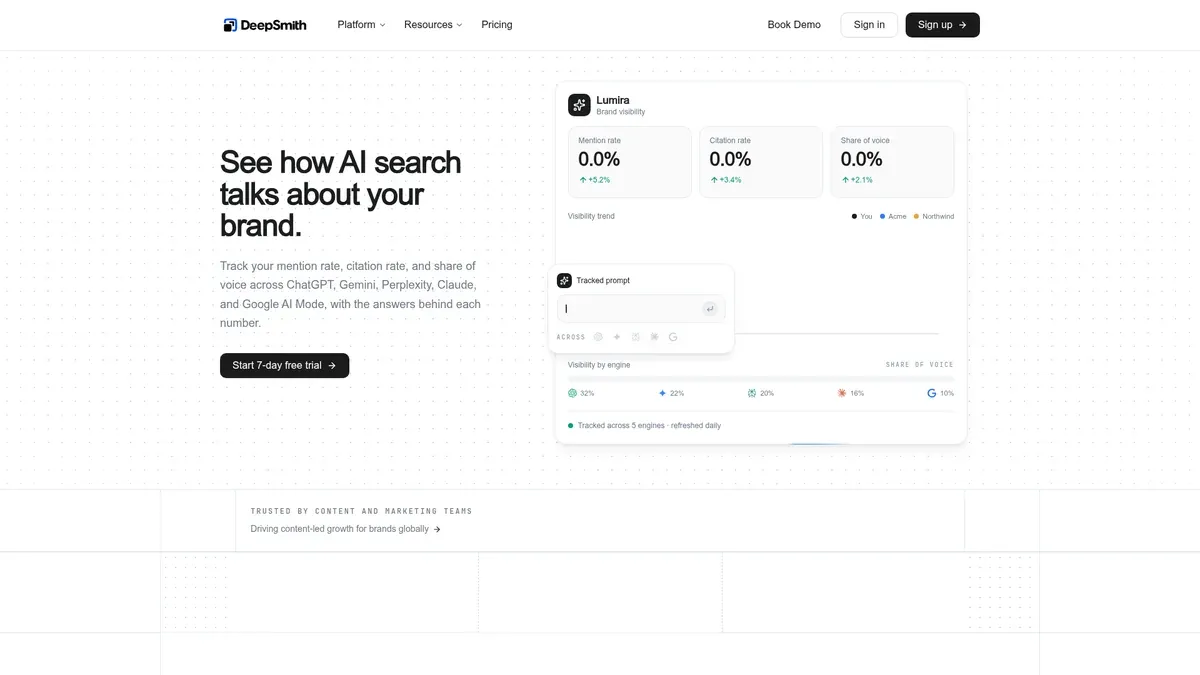
DeepSmith is the publisher of this guide, so here is where it sits in the comparison. DeepSmith is an AI search analytics and content production platform in one. It's a production engine rather than a writing assistant, and the part of it that's useful for this article is the connection between seeing a gap and producing content from that finding.
Here is how DeepSmith's parts map to the responsibilities above:
- Context: Deep IQ stores your company, products, buyer personas, brand voice, visual guidelines, and content types once, and every other part of the platform uses it.
- Coverage: Content Map turns your site and your competitors' sites into one map of topics and buying stages, and separates coverage gaps from untapped topics.
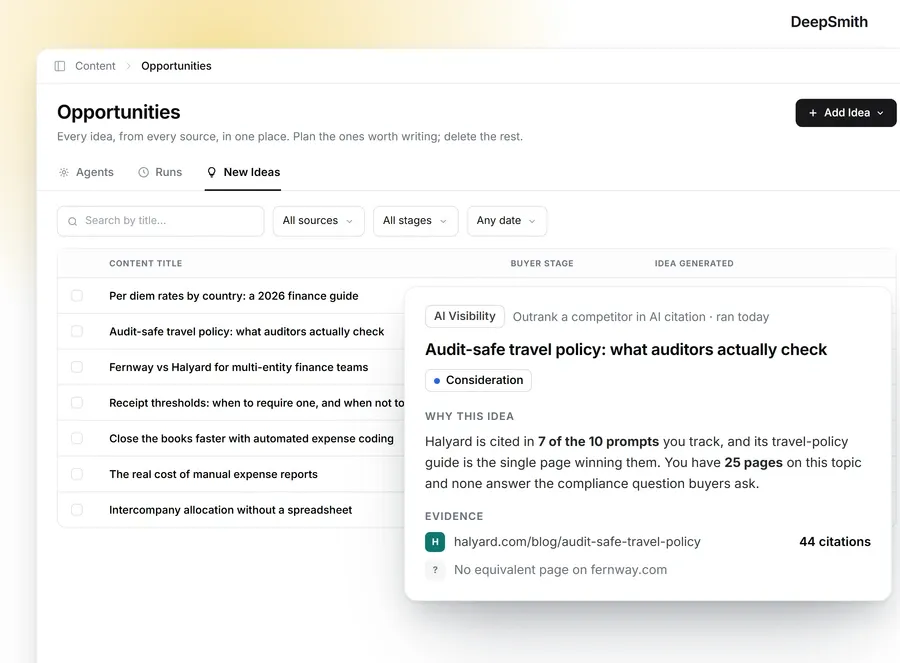
- Evidence-backed ideas: Opportunity Agents read your visibility or Content Map data and return ideas, each carrying the data point that justifies it.
- Planning and production: Planned Content gives an idea a date, the Writer produces a researched, linked article with a cover image and publish-ready metadata, and Autowrite can generate it on its scheduled date.
- Review and release: Produced Content is where you review, edit, and publish to WordPress, Webflow, Strapi, Sanity, or Contentful, with Markdown and HTML export as a fallback.
- Distribution: Repurpose and the Apps Library turn a finished article into channel versions for LinkedIn, X, newsletters, and more.
- Measurement: AI Visibility tracks mentions, citations, cited pages, share of voice, and competitors for the prompts you choose.
The two figures below do different jobs. The first shows the measurement side connecting to planning, with an idea that arrives carrying the evidence for it. The second shows the production side, where a draft runs against the stored context and the finished run can be checked against its targets. The numbers in both are demo data, not customer results.
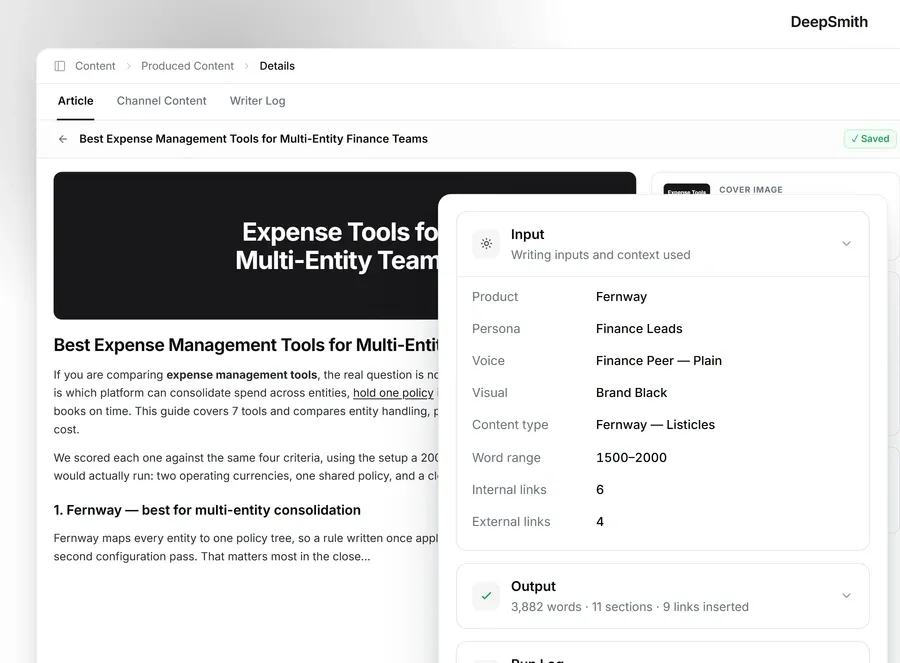
A few boundaries are worth knowing before you evaluate it. Pro tracks one engine, while the same plan includes 20 articles a month, 50 tracked prompts, and five seats, so check that the tracking scope fits what you need. If your CMS isn't one of the five direct integrations, Markdown and HTML export are the fallback, and that's not the same amount of saved work as a native connection. The API and MCP server are read-only, so they read workspace data and don't create or publish content, while webhooks notify your own systems so you can build downstream steps yourself. And "publish-ready" describes the finished output, not a guarantee of accuracy, rankings, or citations, so factual review is still yours to do, especially on sensitive content.
How to Test Either One Before You Buy
Start with a responsibility map. For each stage, write down who owns it now, which system it lives in, how much active time it takes, how long it waits for approvals, and where rework tends to happen. That shows whether a purchase would remove work, move it, or add one more interface to check.
Then ask for demonstrations that matter instead of a general tour:
- Context reuse: ask for two different formats from the same approved product facts and voice rules, and see whether you have to brief the system again.
- Evidence continuity: start from a real content gap and see whether the reason for the idea is still there once it's in planning.
- Source fidelity: check that the sources behind important claims exist and support the actual claim.
- Production completeness: get a representative article with the agreed links, metadata, and assets, and see whether you have to add any of it yourself.
- Scheduling: find out what actually happens on the selected date, since "scheduled" sometimes means only a reminder.
- Publishing: send an approved article to a test destination and check formatting, links, assets, and status.
- Measurement and portability: ask for a metric to be explained and linked to a next action, and check that you can export your content and data if you leave.
Run a pilot with real formats, your approved sources, and your normal publishing destination. Include one routine article and one more complicated piece, hold both setups to the same quality bar, and measure active labor separately from elapsed time. Track corrections, rework, rejected outputs, and missing production details, and set your acceptance criteria before you look at results. A sensible rule is that an unresolved material factual error blocks publication.
Which One Fits Your Situation
- You're an individual writer with a process that already works. A writing tool fits well. If research, briefs, review, publishing, and measurement are handled, a broad operating layer may just duplicate them.
- You're a marketing lead who is also the production coordinator. A connected platform deserves a real evaluation. Repeated briefing, production cleanup, internal linking, and publishing prep are bigger than a text problem. Judge it on whether those responsibilities actually shrink, since buying one doesn't create a strategy or remove review.
- You have a working specialist stack. Keeping writing help inside what you have may be the better fit. A platform should replace or improve identifiable work, not repeat your calendar, CMS, analytics, and approvals.
- You're building an AI search program. Put the connection between measurement and production first. You need to define the buyer questions, watch mentions and citations, look at the pages being cited, and turn that into justified content work. Not every content platform includes AI search measurement, and not every monitoring tool includes production, so check that link directly.
- You publish high-risk or technical content. Put evidence and specialist review first in either category. Automating the work around the draft can still help, but the people approving public claims stay accountable.
- Your needs are occasional and low volume. A writing tool and your current process can be enough.
Try It on a Real Article
If you're a marketing lead who wants AI search tracking and content production connected, DeepSmith is built for that. The 7-day free trial has no long-term contract, so you can start a free trial and give it a real content item plus a defined set of buyer questions. Use the week to look at the output and see whether the workflow fits how your team works. It isn't long enough to show a change in search or revenue, and it's fine to decide that a writing tool is the better fit for you.
Related guides
- What Can an AI Content Agent Do That a Chat Assistant Cannot?: See the concrete differences between an AI content agent and a chat assistant, such as multi-step tasks, tool use, persistent context and acting on a CMS, so you.
- Are Free AI Writers Good Enough for Business Blogging?: Judge where free AI writers suffice for business blogging and where they fall short.
- Seven Content Automation Myths That Cost Teams Time and Traffic: Spot seven common myths about content automation, such as that volume alone wins or that automation removes editing, and see how each one wastes team time or costs.
- How Content Optimization Scores Work and Whether They Predict Rankings: Understand how optimization scores are generally built from competitor term coverage, length and structure signals, and weigh what evidence exists on whether a higher score leads to better.
- How to Generate Ecommerce Product Descriptions at Scale and Keep Them Current: Generate product descriptions with an AI platform and keep them current as catalog data changes.