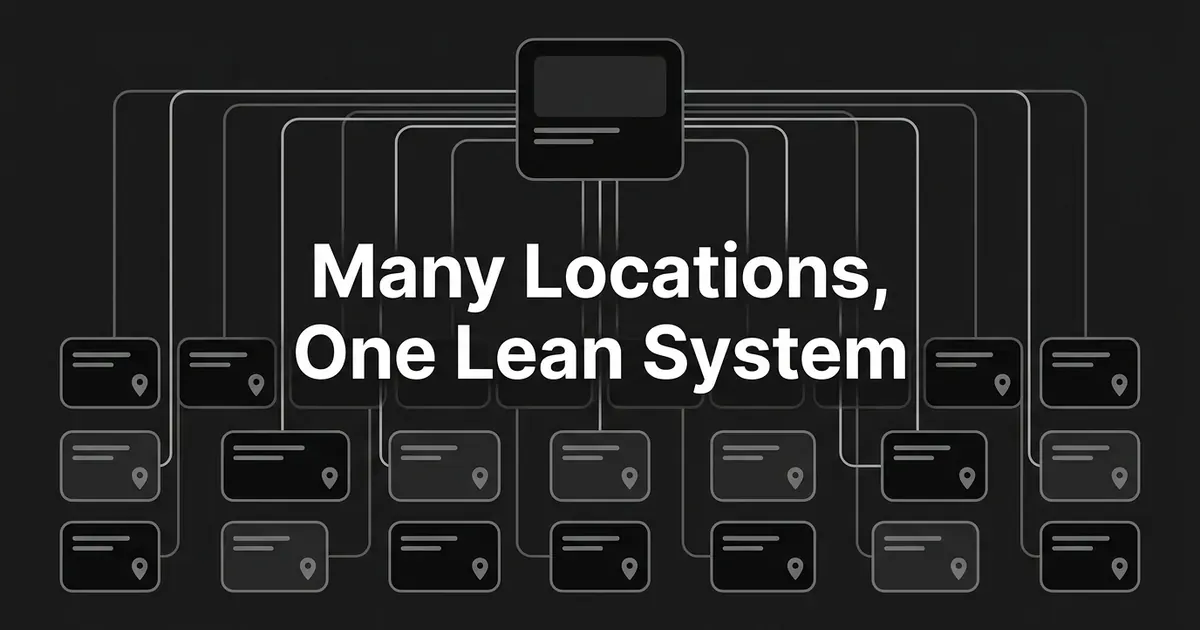
You have forty locations and one and a half marketers. Somebody keeps asking why the Cincinnati page still lists last year's hours. If that's you, take a breath. You don't need a writer in every market. You need a system that produces content for many locations from two things you can actually maintain: one shared template, and one honest record of what is true in each place.
This guide walks you through seven steps to build that system. By the end you'll have a multi-location content strategy you can run with a small central team, and pages that are genuinely useful in each market instead of the same article with the city swapped out. Most advice written on this subject assumes a local content ops small team doesn't exist. It does. It's you.
Here's the good news: the hardest part is a decision, not a workload. Let's start there.
Step 1: Decide which locations actually deserve a page
Every multi-location content strategy starts with a subtraction, not an addition. Before you write anything, build a location inventory. One row per location, with the fields you'll need over and over: name, address, phone, service area, opening hours and special hours, business category, the services actually available there, the page URL, the Google Business Profile status, and the name of the person who can confirm all of it.
Add one more column, and make it the important one. Does this location have real local proof? Reviews, photographs, staff, directions, a service the other branches don't offer. Something.
Now sort your list into three piles.
Physical locations. A real branch that customers visit is the clearest case. If someone needs location-specific information to understand, choose, contact, or visit it, that location earns a page.
Service-area businesses. If you travel to customers, you can make pages for cities you genuinely serve. These pages have to carry proof: project features, local reviews, staff interviews, photos, localized tips. Evidence of a real relationship with that market.
Markets where you just want to rank. Don't build the page. A city page created because you hope to show up there, with nothing true and specific inside it, is the exact thing that turns a location program into a pile of near-duplicates.
How to know this step is done
For every page you plan, you can answer yes to most of these:
- Does a real customer need this page?
- Does it help someone understand, trust, choose, contact, or visit this location?
- Do you genuinely operate in or serve this area?
- Can you name several facts, services, or proofs specific to this location?
- Would the page still be useful if search engines didn't exist?
- Does it help a customer choose between two nearby branches?
If it's mostly no, leave the location in the inventory and out of the production queue. A smaller set of useful pages beats a large set of city-name variations every time.
Common mistake: creating a page for every city in your spreadsheet before checking whether you have a real customer or service relationship there. Almost everyone does this first. Catch it now and you save yourself a cleanup project later.
Step 2: Build one shared template and one location data source
You're going to build exactly two artifacts in this step, and then you'll reuse them forever.
The first is a page template made of fields, not fixed paragraphs. Think of it as a form your pages fill in:
- Location-specific title and heading pattern
- A short answer near the top naming the location and its primary service
- Name, address, phone
- Hours and special hours
- Services, products, or inventory specific to this location
- Directions, parking, landmarks, and transit
- Accessibility details
- Staff or team information
- Local reviews or testimonials
- Original photographs of this location
- Local FAQs
- A clear next action: call, book, check availability, get directions
- Links to related service pages
- Links to nearby locations
- Location-level structured data
- Metadata and social-sharing fields
- A review and approval status
If you're running a franchise content strategy, this template is the thing your franchisees fill in, not a document they're asked to read and interpret. Make the modules optional where they should be. A clinic, a restaurant, a dealership, and a retail store do not need the same local information. The template controls structure. It does not dictate identical prose.
The second artifact is your single source of truth for location facts. A spreadsheet is fine. A CMS collection is fine. A database is fine. What matters is one operating rule: your writer never retypes a fact from memory and never goes hunting for it again on the next page.
Then assign ownership at the field level, so nothing sits in the gap between two people:
- Central marketing owns the template, the voice, the SEO rules, the page architecture, and publishing.
- Local operators verify facts, services, photos, hours, and operational detail.
- One final editor owns consistency, claims, and whether the page is good enough for a customer.
How to know this step is done
You have one approved template, one structured record per location, a named owner for each field group, a status flag for missing or stale data, a documented approval route, and a way to update every affected page when a shared policy changes.
Pro tip: treat the template as a content schema, not a document. Reusable things (positioning, core services, claims to make, claims to avoid, voice rules) live centrally. Local things live at the location level. That single split is what prevents voice drift on one side and location-page sameness on the other.
Step 3: Separate your brand layer from your location layer
This is the step that makes everything after it cheap. You're building two stacks of context that never mix.
Your shared brand layer holds positioning and differentiators, approved product and service descriptions, claims you can make, claims you must avoid, personas, voice and tone rules, preferred terminology, content-type instructions, visual rules, internal linking rules, evidence standards, and your shared conversion language.
Your location layer holds the exact name, address, phone, and hours. Services that differ from the network standard. Local availability. Directions and access. Parking, transit, accessibility, landmarks. Neighborhood context. Local staff and their expertise. Location reviews. Original photos and video. Current local offers. Local FAQs. Nearby locations. The business profile details.
Now the rule that protects you: never let an AI system fill a missing local field by guessing. A missing parking detail stays missing, or gets routed to the person who knows. It does not quietly become an invented convenience on a live page. A local page states a fact only when that fact sits in the approved location record.

Why does this matter beyond tidiness? AI-assisted search expands a local question into more specific follow-ups. A page carrying only generic brand copy gives an answer engine almost nothing location-specific to work with. A grounded page gives a reader and a machine the same thing: concrete facts, real distinctions, and a clear action. That's what citable local content actually is. It isn't more local keywords. It's being the clearest source on what's true and different about that location.
This is where a platform earns its keep for a lean team. DeepSmith's Deep IQ stores your shared brand layer as structured context: About Company, Products and Services, Buyer Persona, Brand Voice, Visual Guidelines, and reusable Content Types. Set it up once and every draft is written against it, so you stop re-briefing voice and claims on every article. It handles the shared half. It does not verify that the Cincinnati branch has a wheelchair ramp. That half is still yours, and it always will be.

How to know this step is done
A reviewer can look at any page and tell which sentences came from shared brand context and which came from the location record. Every local claim has an owner. And when a location fact changes, you can regenerate that page without rewriting the brand brief.
Step 4: Write from evidence, not from find and replace
Every page gets a brief. Not a long one. It should carry the target location and page type, the customer intent, the primary local need, the approved location facts, the required local proof, which shared sections to include, which local sections to include, claims to avoid, required internal links, the call to action, metadata and schema requirements, and a reviewer with a date.
Then build the page around one customer standing there with a question. A good location page lets a visitor answer six things:
- Is this the right location for what I need?
- What does this location offer?
- Where is it and when can I go?
- How is it different from the other branch nearby?
- What shows me it serves people like me?
- What do I do next?
The modules that answer those questions are the ones worth your time: directions from a landmark people know, parking and access, transit, accessibility, local service or inventory differences, staff profiles, local reviews, local case examples, real interior and exterior photos, local FAQs, nearby locations, and offers that are actually current.
Here's the trap. Paraphrasing is not differentiation. Swapping one city name for another, or rewriting the same paragraph with different words, produces nothing new for anyone.
One practitioner guide from BrightLocal suggests aiming for more than half of a location page to be unique to that location, and describes a 40% to 60% range as a working heuristic. That's a practitioner rule of thumb, not a Google threshold, so don't treat it as a number you have to hit. The better test is simpler: does this page contain enough that applies only to this location to help a customer choose or act?
Common mistake: dropping a new address and phone number into a master page and calling it a location page. A unique contact record does not make the surrounding copy unique. If the page says nothing new, you've published low-value duplication.
For the production half of this step, DeepSmith's Content Studio moves an approved idea from New Ideas to Planned Content, and the Writer turns it into a researched, brand-grounded article with internal and external links, a cover image, and publish-ready metadata. For content for many locations, the honest workflow is this: you supply the approved shared context and the verified location inputs, the platform does the repeatable assembly, and you review the output for local truth. It is not a license to generate two hundred unverified city pages.
Step 5: Add the local search foundations
You've got useful pages. Now make sure they can be found, understood, and trusted. This is the part a local SEO content lean team sets up once and mostly stops thinking about.
Keep your business information accurate. Google says local results are based mainly on relevance, distance, and prominence, and that complete, accurate information helps Google understand what your business does, where it is, and when customers can visit. For each location, maintain a full address where customers can visit, an accurate service area where you travel to them, hours and special hours, the correct business category, phone, the location URL, and useful attributes like parking. Google's own guidance also says to use the fewest categories that describe your core business, to highlight what makes the business unique, and to avoid duplicate profiles for the same business.
Add location-level structured data. Model each physical location as a LocalBusiness entity, using the most specific subtype available, like Restaurant or DaySpa. Only name and address are required. The recommended properties worth adding are geo, telephone, url, and review or aggregateRating where the rules apply. Point url at the fully qualified working URL for that specific location, include country and area codes on phone numbers, and include every address property you actually have. Validate with the Rich Results Test, spot-check a few pages with URL Inspection, and fix critical errors. Then be patient with recrawling. Structured data helps a machine understand your page. It does not promise you a rich result or a better ranking.
Make the pages discoverable. Build a locations hub, link it from primary navigation where that fits, link the hub to every location page, link nearby locations to each other, and link relevant service pages to the right locations. Use plain HTML links people and crawlers can follow, put the location pages in an XML sitemap, and consider a separate location sitemap if that makes monitoring easier. A store finder is great for humans. Don't let it be the only way in.
Keep page-level SEO distinct. Each page gets its own title, heading, description, image treatment, and call to action where intent differs. Don't stuff city lists or repeat location phrases until the sentences sound strange. Local relevance comes from useful information, not from wedging a city name into every heading.
How to know this step is done
The page has a matching, accurate business profile. NAP, hours, services, and contact details agree everywhere. Structured data identifies the right location and validates. The page is linked from the locations system and from service pages. It's in the sitemap. It isn't blocked by noindex, robots rules, or a login. And the headings distinguish the location without keyword stuffing.
DeepSmith builds keyword coverage, heading structure, schema markup, internal linking, and metadata into the writing pipeline rather than bolting them on after, and its Content Map crawls and classifies your pages by topic and funnel stage and rechecks sitemaps every 24 hours. That takes the repetitive central work off your desk. You still validate the live implementation.
Step 6: Run one centralized QA pass
You don't need a big review process. You need one checklist with three layers, and two people.
Layer 1, facts. Name, address, phone, URL. Hours and special hours. Services, products, inventory. Parking, transit, accessibility, directions. Staff. Reviews and testimonials. Offers and their dates. Images and permissions. Profile and citation consistency.
Layer 2, editorial and brand. Shared voice and terminology. Approved claims only. No invented local facts. No generic intro that could belong to any location. A clear answer near the top. Logical headings and short sections. A clear next action. No unnecessary city-name repetition. No duplicated sections that add nothing local.
Layer 3, technical. Unique title and description pattern. Correct canonical and URL. Working internal links. In the right sitemap. Useful image filenames and alt text. Structured data validates. Page is indexable and renders. The business profile points at the right page. Nearby-location links are accurate.
Two people, two jobs. A central editor checks voice, structure, and search quality. A local owner checks whether the facts are true. Your local reviewer is not a writer and shouldn't be asked to be one. Give them a short, structured verification task they can finish in ten minutes.
A local content ops small team should batch the QA by field instead of by page. Review all the hours at once. Then all the phone numbers. Then all the schema records. Then all the titles. It's faster, and you'll catch more, because your brain isn't switching tasks on every page.
Common mistake: using a style guide PDF as your only governance layer. A document can describe the voice you want. It can't carry structured context, reusable fields, ownership, or a checklist anyone actually opens.
How to know this step is done
Every page has a factual approver, an editorial approver, a recorded status, a date of last verification, a list of unresolved fields, and a refresh trigger. Nothing goes live with a guessed local fact or an unreviewed promise about what a location can do.
Step 7: Publish, measure, and refresh by exception
The last habit is the one that keeps a franchise content strategy alive after launch week. You measure per location, and you only touch a page when something says you should.
Judge locations individually, never by a network average. Watch local organic visibility by location, Local Pack visibility where it matters, target query coverage, impressions and clicks on location pages, and the conversions that count for you: calls, direction requests, bookings. Watch indexation and crawl issues, citation accuracy, review volume and ratings, stale-data flags, and where you track it, AI mention and citation visibility for local prompts. Google notes that prominence is influenced by things like sites linking to your business, review counts, and positive ratings. Signals to watch, not levers that guarantee an outcome.
Then refresh by exception. Update a page when hours change, a service changes, staff or local leadership changes, a location moves or opens or closes, parking changes, an offer expires, a photo stops being accurate, a review no longer reflects the place, visibility or conversions drop, or a competitor publishes something materially better for that market.
A cadence that works for a small team looks like this:
- Weekly: urgent changes, broken pages, new locations, scheduled content.
- Monthly: sample pages across locations and compare facts, links, metadata, and how differentiated they really are.
- Quarterly: revisit the template, page types, local prompt coverage, conversion data, and your weakest locations.
- On change: update the shared context once, find the affected locations, refresh only those pages.
This isn't a universal standard. It's a rhythm that fits a local SEO content lean team without eating the whole week.
DeepSmith's AI Visibility module tracks prompts, mention rate, citation rate, share of voice, sentiment, and visibility trend, and shows which of your pages get cited and which competitor pages win instead, across the engines on your plan. Content Map and Opportunity Agents turn coverage and competitor gaps into ideas that carry the evidence for why they matter. Autowrite generates planned content on its scheduled date so the queue moves during a busy week. Repurpose and the Apps Library turn a finished page into LinkedIn, newsletter, and social versions, so distribution stops being the thing that falls off. None of that decides whether a local fact is true. That's the part you keep.
What to do next
Don't roll this out to forty locations. Pick a representative pilot set, maybe five, spanning your different business types and your strongest and weakest markets. Build the template. Fill the location records. Write the pages. Run the QA. Then put two of them side by side and ask honestly whether a customer could tell them apart.
Fix the system on five pages. Then scale it. That order saves you a rewrite.
If you'd like the shared half handled for you, start a free DeepSmith trial and set up your brand context, then bring your location records to it. The trial runs 7 days on real data, so you'll see actual drafts before you decide anything.
You're closer than you think. One template, one location record, one checklist. That's the whole system.