Your content calendar says what should publish, but it doesn't show which article is sitting in an editor's queue or what a last-minute request is about to push out. A short content sprint makes those trade-offs visible and protects the time your writers need. This guide is for the marketing lead who coordinates writers, editors, and reviewers, and it walks through eight steps for borrowing the parts of agile content marketing that help and leaving the software-team ritual behind.
Before you start, have a few things in place: one shared backlog and board (a spreadsheet works fine), a written quality checklist, a realistic idea of who is available over the next two weeks, and one person who can make priority calls.
What agile and Scrum mean for an editorial team
Agile is the wider idea. The Agile Marketing Manifesto frames it as values such as customer value over activity, delivering early and often, and responding to change over following a static plan. Scrum is one specific framework inside that idea, with defined roles, events, and artifacts, and a team can work in an agile way without running it.
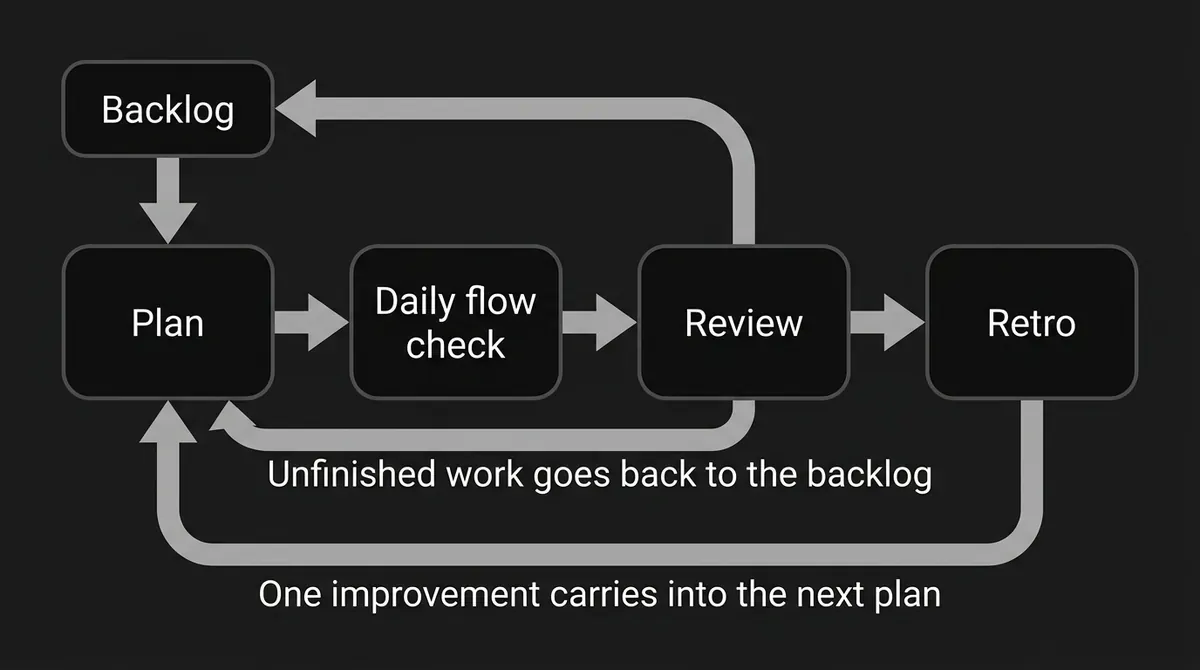
That distinction matters for scrum for content, because most of the ceremony people complain about is optional. Story points, planning poker, user-story wording, and burndown charts are not required by the Scrum Guide. The parts that earn their place are a fixed cycle, one goal, a shared definition of finished, a short daily check, and a review and retro at the end.
If you leave out required Scrum elements or swap the daily meeting for written updates, you are not running full Scrum. Call it a sprint-inspired agile editorial workflow and you'll avoid arguments with anyone who has been through a formal Scrum course.
1. Choose a sprint length and write one goal
Start with a consistent two-week cycle unless your delivery pattern gives you a clear reason to pick something else. The Scrum Guide caps a sprint at one month, Scrum Alliance's guidance for marketers usually suggests one to two weeks, and Content Marketing Institute's editorial guidance describes one week to one month, with two weeks as a common choice. None of these proves one best length, so treat two weeks as a sensible default for a mixed team producing full articles.
Put the planning, review, and retro dates on the calendar, name the person who sets priorities, and confirm who is available. Then write one goal that connects the content to an audience problem. "Give evaluating buyers a usable comparison-and-implementation content pack" is a goal you can use to decide whether a proposed article belongs. "Keep everyone busy and write six posts" measures activity and gives you nothing to trade off against.
You'll know this step is done when anyone on the team can state the dates, the goal, who decides priority, and who is available. The usual mistakes are treating a quarter-long roadmap as a sprint, stretching the sprint until every piece is finished, and picking a longer cycle when the real problem is an unavailable approver.
2. Select finishable content from a prepared backlog
Choose complete, useful deliverables rather than a pile of writing activities. A comparison article is a deliverable, and the first 700 words of an ebook is a task.
Before planning, get the top candidates ready. Each content card should carry the audience question, the angle, the evidence for why it matters now, the deliverable, what is in and out of scope, any piece-specific acceptance criteria, the research or product facts it needs, named dependencies, owners, a real deadline if one exists, and a rough size. If you need a way to find the evidence, turning AI-visibility gaps into a content backlog is one place to start.
A short readiness check keeps weak cards out. Is the reader clear, is the angle bounded, are the facts and access available, is the required approver free this sprint, and can it reach done inside the timebox? For the order of selection, go with audience value, then real time sensitivity, then dependencies, then whether it can realistically be completed. You don't need to invent a scoring formula.
DeepSmith's New Ideas view works as the shared backlog, and giving an idea a date moves it into Planned Content. Ideas can come from manual entry, an import, or an Opportunity Agent, which attaches the data point that justified the idea so the team can see why it was proposed. Deciding what serves the sprint goal is still your call.
You're done when every selected card has a clear deliverable, enough evidence, an owner, acceptance criteria, and dependencies you can actually meet. Where people go wrong is treating every brainstormed topic as ready, pulling in an article that depends on an interview nobody has booked, and counting research, drafting, editing, and publishing as four separate finished articles.
3. Define done before you estimate anything
Decide what finished means, write it down, and apply it the same way every time. Your Definition of Done is the shared quality floor, and individual cards add their own acceptance criteria on top of it.
A workable editorial version might say that the article:
- answers the agreed audience question in the promised format,
- has claims, figures, and product details checked against real evidence,
- passes review for angle, structure, and brand voice,
- has the SEO and AEO elements it needs, such as headings, a direct answer where useful, and relevant links,
- has metadata, imagery, and alt text complete,
- has any required subject-matter or compliance approval recorded,
- and has reached the endpoint you chose, checked in the place it publishes.
Scrum doesn't prescribe SEO, imagery, or social posts, so adjust the list to what your pieces need. For the quality checks, a rubric for scoring AI draft quality can be adapted into the checklist. A brand consistency QA checklist is another starting point for voice and product accuracy.
You do need to pick the endpoint openly. If your team owns publication, "published and checked" is the cleanest finish line, and an approved piece waiting to go live is still unfinished. If release is controlled by a separate launch schedule, "approved and publish-ready" can be the endpoint, as long as you track the queue of unreleased pieces so it doesn't grow out of sight. Don't switch between the two to make the numbers look better.
Common mistake: Calling an article finished when the writer submits it, and then letting editing, images, links, and publishing disappear into work nobody tracks.
You'll know the step is done when two people looking at the same card would reach the same conclusion about whether it is finished. In Scrum, work that doesn't meet the Definition of Done isn't part of the increment, and it goes back to the backlog rather than being presented as complete at the review.
4. Forecast against the bottleneck, then schedule production
Plan the amount of content your whole chain can finish, which is a different number from how many drafts your writers can start. A 60-minute planning session is a reasonable default for a two-week content sprint, with the preparation done beforehand. The Scrum Guide's eight-hour planning limit applies to a one-month sprint, and a two-week content team shouldn't spend anywhere near that.
A simple agenda is ten minutes to confirm the goal and availability, twenty to select prepared cards, fifteen to check capacity at each stage, ten to sequence the work and reserve review slots, and five to confirm owners, first actions, and how interruptions will be handled.
For capacity, start from the time each person really has after other work, leave, and meetings, then look at each stage separately. A writer with open drafting time can't make up for an editor with no review slots, and faster generation doesn't create more legal or product-approval capacity. Here is a made-up example, not a benchmark or anyone's real results.
| Stage | Available sprint time | Demand for three articles | Left over |
|---|---|---|---|
| Two writers combined | 40 hours | 24 hours (8 per article) | 16 hours |
| Editor | 8 hours | 6 hours (2 per article) | 2 hours |
| Publishing contributor | 4 hours | 3 hours (1 per article) | 1 hour |
Writing has room, but review and publishing are tight. A fourth article would use all eight editor hours and all four publishing hours, leaving nothing for rework or an urgent correction, so the sensible plan is three articles and not filling the writers' spare time with new starts. Swap in your own numbers, since these hours are assumptions for this example only.
For estimation, use the lightest method that improves the forecast, such as rough hours or small, medium, and large. The Scrum Guide leaves sizing to the people doing the work and doesn't require story points, so use them only if they help, and never to compare writers.
Once the content is chosen, schedule it in Planned Content. Autowrite can generate a configured article on its scheduled date and place it in Produced Content for review, and the Writer researches, links, and adds a cover image and metadata, grounded in your Deep IQ brand context. Line up generation dates with your real review slots, because faster production shouldn't build an uncontrolled queue in front of your editor, and a scheduled generation date isn't a promise of a live publication date. Your Definition of Done and your approvals still apply, which keeps the agile editorial workflow honest.

You're done when you have a forecast the contributors agree to, review slots on the calendar, and a sequence that can reach done. The mistakes to watch for are planning on everyone's total hours, ignoring editing and publishing capacity, treating estimates as promises, and scheduling all the generation for the last day.
5. Pull work across a visible board and limit what is active
Make waiting visible and finish what is open before you start more. A starting board can be as simple as Backlog, Selected, Research and Draft, Editorial Review, Required Approval, Ready to Publish, and Published. Drop the approval column if you don't need it, and don't add a column for every small task.
Each active card should show its current owner, who is needed next, the due date, any blocker, and the next action. Keep one main card per article, with research, images, links, and metadata as checklist items under it so your article count doesn't inflate.
Limiting work in progress is a Kanban idea that fits alongside a sprint. For a small team with two writers and one editor, you could test two articles in Research and Draft, one in Editorial Review, one in Required Approval, and four started-but-unfinished in total. These are pilot values and not Scrum or Kanban standards, so change them when your real capacity says to. Count blocked work too, since taking it off the count just gives you permission to start more. A new article starts only when there's room under the policy, and if review is full, the useful move is to help clear review, by checking sources, preparing assets, or answering a reviewer's questions, and not to commission another draft.
A board by itself isn't Scrum, and adding limits doesn't replace Scrum's other parts. It does give you a clear view of where articles wait, which is what makes agile content marketing more than a calendar with new names.
You're done when the team can name every started article, where it's stuck, and why another can or can't start. People go wrong by hiding a review queue outside the board, moving cards between vague statuses with no next action, and raising the limit every time the queue touches it.
6. Run a daily flow check, not a status performance
Spend the daily check on what the work needs in order to move toward the sprint goal, and skip the round of everyone listing what they did yesterday. Aim for 10 minutes with a 15-minute ceiling, which matches the formal Daily Scrum timebox.
Walk the board from the right-hand side back toward the left, so you start with what is closest to done. For each card that matters, ask what changed, what has to happen for it to finish, what is blocked or aging, and who takes the next action and by when. The cards that haven't moved are often the ones worth asking about, and headline debates or line editing belong in a separate conversation with only the people involved.
The familiar yesterday, today, and blockers format is optional. The current Scrum Guide lets contributors choose their own structure as long as the check looks at progress toward the goal and ends with a plan someone can act on.
If time zones or schedules make a live meeting hard, a daily written update tied to the board works as an adaptation. A simple template has the card, progress since the last update, next action, any blocker or decision needed, and who is needed by when. Choose a posting deadline in a named time zone, ask one person to check for unresolved blockers, and flag a dependency that has been stuck for one working day. Those numbers are team policy and not an agile standard, and written updates are an adaptation, not the formal Daily Scrum.
For freelancers and agencies, give them visibility into the cards they own, the acceptance criteria, and what reviewers expect. Daily board updates plus joining when a handoff needs them is a reasonable alternative to attending every standup.
You're done when every blocker has an owner and a next action, and the board changes because of the conversation. The common mistakes are reading out updates already visible on the board, reporting upward to the lead instead of coordinating with each other, and posting asynchronous updates that nobody answers.
7. Protect the goal and make interruptions explicit
A new request should trigger a visible priority decision and shouldn't quietly add to the sprint. Send it through the person who sets priorities and sort it with an agreed policy. A useful idea that isn't time-critical goes to the backlog. An important change that fits the goal gets renegotiated with contributors. An urgent correction to inaccurate published content is handled promptly, with the displaced work made visible. A campaign or executive request gets weighed for value, deadline, capacity, and what it would displace before anyone says yes. A change that makes the goal obsolete means reconsidering the sprint, and formal Scrum gives that call to the Product Owner.
When you accept an interruption, write down why it's urgent, who approved it, what enters the sprint, what leaves, and whether the goal is still achievable. Swapping something of comparable size is a good starting policy, though capacity and goal fit matter more than matching sizes.
You'll hear two versions of the rule. Some marketing Scrum guidance says the workload can't change once a sprint starts, which is a useful simplification. The Scrum Guide's more precise rule is that changes must not endanger the sprint goal, and scope can be clarified and renegotiated as the team learns. So the backlog isn't frozen, and it isn't open either.
When something misses the sprint, don't extend the sprint, lower the quality, or mark the article done. Send it back to the backlog for an explicit decision, look at why it missed, and carry its remaining work into the next forecast. Repeated carryover points to scope, dependencies, approval availability, or overcommitment, and it doesn't mean your writers need more pressure.
You're done when anyone can look at the board and see the accepted interruptions and what each one displaced. People go wrong by saying "agile means responding to change" to justify unlimited intake, saying "the sprint is locked" to ignore a serious factual error, and letting seniority be the only definition of urgent.
8. Review the content, run the retro, and change one thing
The review is for the content and the retro is for how you made it, so keep them as two separate conversations. A 25-minute review is a reasonable pilot format: five minutes to revisit the goal and name what finished, ten to look at the actual content and any stakeholder feedback, five to talk about what you learned about the audience or angle, and five to adjust the backlog and record decisions.
Look at real pages, not a slide deck of completed tasks, and explain unfinished work openly without counting it as done. Don't hold approved work until the review, either, because the sprint is a planning and learning boundary and doesn't force publication into batches.
For the retro, Orbit Media's practitioner guide recommends 30 minutes after every sprint. A simple agenda is five minutes of silently noting what helped, what blocked work, and what caused rework, ten minutes grouping those and looking at the cards, ten minutes choosing one improvement and defining how you'll test it, and five minutes assigning an owner and deciding how the next retro will judge it. "Improve communication" is a weak action. A useful one reads more like this: for the next sprint, the editor reserves two review slots before writing starts, and the facilitator checks whether any article waits more than one working day for its first review. At the next retro, look at that action before you add another, because a retro with no follow-through is the theater you're trying to avoid.
On measures, keep production and quality separate from marketing outcomes. The Kanban Guide's four flow metrics are work in progress, throughput, work item age, and cycle time, and two editorial diagnostics are worth adding: how long a piece waits for review to begin, and the reasons for rework. Decide your start and finish boundaries before you calculate cycle time, and don't compare a research report with a short product update as if the counts meant the same thing. Traffic, conversions, and AI citations need a later checkpoint, since two weeks of data on new content is too early to call success or failure. The KPIs that matter for AI visibility can help you plan it. If you publish only a few posts a month, the metrics that matter at that pace are worth a look.
If distribution assets are part of your deliverable, DeepSmith's Repurpose and Apps Library create channel-specific versions of a finished article, including ready-to-copy social posts and formats for channels like LinkedIn, X, and newsletters. DeepSmith creates the assets and you post them, so decide whether done means prepared, approved, scheduled elsewhere, or posted.
You're done when the review produces a content or backlog decision and the retro produces an owned experiment that the next planning session picks up. The mistakes to avoid are merging review and retro into one status meeting, measuring only article count, and blaming a person before you've looked at the queue or the requirements.
What to keep, adapt, or skip
The short version of scrum for content is to keep the fixed short sprint, one goal, an ordered backlog, a Definition of Done, a daily coordination check in whatever format works, an outcome-focused review, and a regular retro. Add work-in-progress limits where they improve flow. Treat story points, user-story wording, burndown charts, a separate refinement meeting, and new job titles as optional, and skip required standing, long status decks, and unrelated quotas.
There's also a fair case for not using a sprint at all. If incoming work and approval timing are very unpredictable, continuous flow with WIP limits and a regular retrospective can be more honest than a forecast that gets disrupted every week. A sprint should give you protected focus and visible trade-offs, and it shouldn't become a recurring two-week emergency.
What to do next
Run one two-week pilot on a coherent set of content, then use its retro to change one constraint before the next cycle. With the settings above, the meeting time works out to 215 minutes per person per sprint, which is a calculation of these proposed settings and not a benchmark. Don't expect a transformation after one sprint, since you'll need several cycles before your own numbers are comparable.
When you're ready to try the production side, start a 7-day free trial of DeepSmith, schedule the pieces you selected, review the finished articles against your quality checklist, and prepare their distribution assets.