You want to ship a whole cluster of articles without every one of them taking a week. This guide shows you how to build reusable content templates that hold the structure steady while the research inside each article stays original. It is written for a content marketing lead who publishes on a cadence, wants more output, and refuses to put out thin pages to get it. By the end you will have a block-level scaffold, a brief that fills it, and a loop that improves both.
Here is the promise up front. When you standardize article format across a cluster, you are standardizing the shape of a page, not the words on it. Every article still gets real research, real sources, and a real point of view. What repeats is the skeleton: the answer-first block, the heading pattern, the FAQ, the takeaway, the link slots, the metadata. That is the whole idea, and everything below is how you build it.
One thing to keep close as you read. Google's spam guidance treats scaled content abuse as many pages generated mainly to manipulate rankings rather than help people, including using automated tools as a low-effort way to produce pages that add little value next to what already exists on the topic. A structure template is not that. A word-swap template often is. Hold that line and the rest of this is safe ground.
Step 1: Pick the article types your cluster actually ships
Start by naming the small set of shapes your cluster repeats. Not "blog post." The real ones: how-to guides, comparisons, list articles, decision-stage pages, glossary entries, FAQ pages.
Now pick the two or three that account for most of your monthly output. Those are the reusable content templates you build first. Everything else waits.
Write a single paragraph for each type you picked. Who reads it, what question they arrive with, and what job the page does in the buyer journey: awareness, consideration, or decision. That paragraph is the reason the template exists, and you will lean on it in every later step.
How to tell this step is done. You can name your two or three types out loud, and each one has a one-paragraph description of its reader and its funnel stage. If you cannot say what job a type does, you are not ready to template it.
Where people go wrong. Two traps. The first is lumping everything into one type, which produces a hybrid template that fits nothing. A how-to and a comparison do different jobs and need different bones. The second is picking six types at once. Ship two or three, learn from them, then add.
Not sure which types dominate your output? This is where a coverage map beats a guess. DeepSmith's Content Map crawls your site and unlimited competitor sites, classifies every page onto a granular topic and a funnel stage, and re-checks those sitemaps every 24 hours so new pages fold in on their own. You get to see whether your cluster is top-heavy on awareness or thin at decision, which usually settles the question of what to template first.
Step 2: Map every block the template will contain
A template is a list of blocks in a fixed order. Sketch that list before you write a single line of prose guidance.
For a how-to, the blocks look like this:
- Answer-first block. One to three sentences that answer the title's question directly.
- Context block. A short paragraph naming the audience and the outcome.
- Step sections. Action-based H2s, one per step, in the order a reader would do them.
- FAQ block. Three to four questions with short answers.
- Takeaway block. Three to five bullets written as actions.
- Footer block. A slot for related articles and a slot for distribution assets.
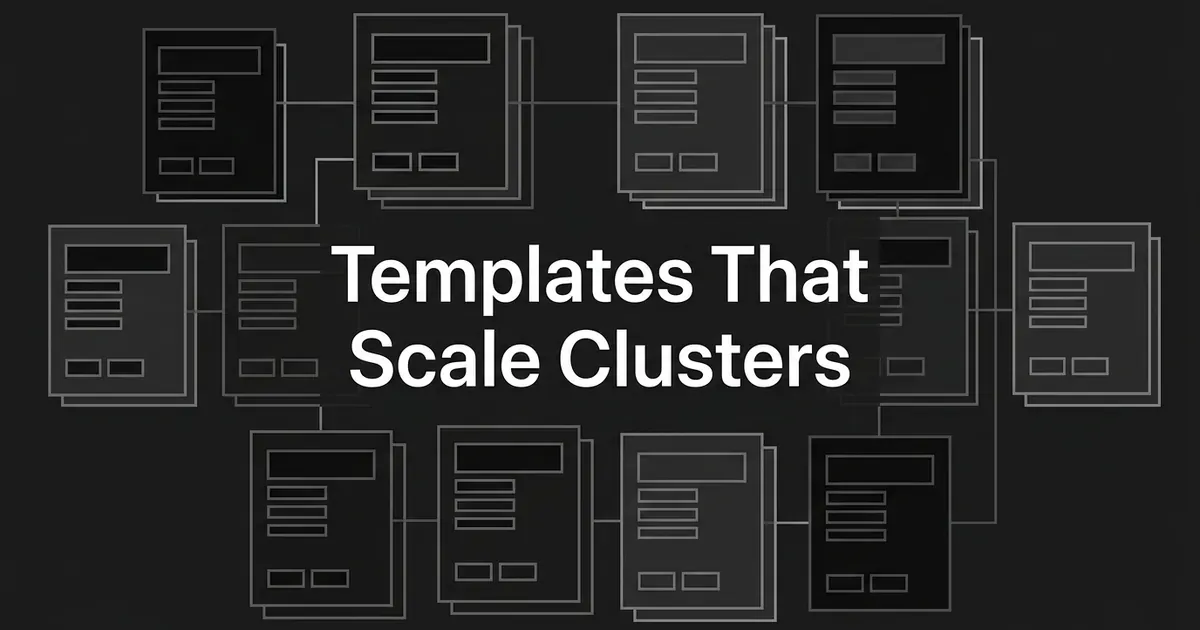
Then do the part most teams skip. Mark each block as invariant or variable. Invariant blocks hold the same shape on every page in the type. Variable blocks hold the research that changes every time. That single distinction is what keeps an article template for scale from turning into a fill-in-the-blank page.
How to tell this step is done. Hand your block map to someone who has never read a page in the cluster. They should be able to predict the section order of any new article in that type. If they cannot, the map is still a vibe.
Where people go wrong. People merge blocks that do different jobs. The answer-first block and the takeaway block are mirrors of each other, and collapsing them into one saves a little space and loses two functions. The other failure is block sprawl. Five to eight blocks is the healthy zone. Twelve blocks means a committee built your template.
Common mistake: burying the answer. The most important sentence keeps drifting into the middle of the body, where a skimming reader and an AI engine both miss it. Lead each section with the crisp answer, then expand, then add nuance. Google's own guidance asks for content created primarily for people rather than for search engines, and leading with the answer is what that looks like in practice.
Step 3: Define the fields the template will accept
A block is a container. A field is what goes in it. This step turns your block map into a content production template a writer or a production system can actually fill.
For every variable block, list its fields. Then give each field a constraint. Not encouragement, a constraint:
- A word range.
- The allowed format (paragraph, numbered list, table, Q and A).
- The kind of source the field must pull from.
- What good looks like, and what bad looks like, in one line each.
For a how-to, the step field might read: five to nine steps, each carrying what to do with a specific threshold, how to tell it is done, and where people go wrong. That is a field a person can fill without inventing structure.
Invariant fields work the same way, just filled from a fixed checklist. The "what you need" line on a how-to is a good example.
How to tell this step is done. A writer can complete every field without asking you a structural question. Every variable field has a constraint attached. Your content production template now reads like a checklist instead of a mood board.
Where people go wrong. Vague field prompts. "Write a good intro" is not a field, it is a wish. Replace it with the shape you actually want: a one-paragraph definition, then a one-sentence promise of the outcome, in 60 to 90 words. Brief patterns that hold up across teams share this trait, and they also carry a defined point-of-view field, because a stated angle is what stops two articles in the same cluster from reading like the same article twice.
Step 4: Build the answer-first skeleton
Now write the skeleton itself. This is the artifact, the thing your production system reads.
The answer-first block sits above the first H2 and has three fixed positions:
- One sentence that answers the question implied by the title.
- Two or three sentences setting the scope, the audience, and the outcome.
- An optional single line naming what the reader needs to start.
Under it, lay out the H2 pattern you expect. Action-based headings, one step per heading, in the order a reader would work through them. H3 sub-steps only where a step genuinely splits into distinct parts.
Then write the FAQ block and the takeaway block into the skeleton as fixed positions, not as afterthoughts.
Write those positions down as literal rules, because an article template for scale only holds if the positions are fixed.
How to tell this step is done. Read only the answer-first block and the takeaway block. If those two carry the article's core argument between them, in roughly 80 to 120 words and under 30 seconds of reading, the skeleton works. The takeaway adds the call to the next action; that is the only difference between them.
Where people go wrong. The answer arrives late. If the most important sentence shows up after the second H2, the block is wrong no matter how good the writing is. And do not chase a heading count while you are here. Google's starter guidance says plainly that there is no ideal number of headings, and that if a page feels like it has too many, it probably does.
Here is the part that decides whether the skeleton survives contact with volume. A template controls structure. It does not control voice. Ship 20 or 90 articles a month off the same skeleton with no voice layer underneath and the cluster will sound like one long paragraph.
That layer is what Deep IQ stores in DeepSmith: product context, brand voice, persona details, visual guidelines, and Content Types, which are reusable formats like how-to, comparison, and listicle held as structured data. Every draft is written against those records instead of a fresh prompt. So the how-to template you define once shapes structure, and the stored voice and product facts keep the prose from flattening out across the cluster.

Step 5: Specify the FAQ and takeaway patterns
These two blocks do the heaviest lifting for AI visibility, and they are the two most often left to whoever is writing that day. Specify them.
For the FAQ, write down the rules: three to four questions that mirror the buyer prompts your cluster targets, each answered in one to two sentences, each answer standing alone without the article around it. Add a one-line micro-takeaway per answer that the next article in the cluster can pick up and reuse.
For the takeaway block: three to five bullets, written as actions rather than descriptions. "Pick your two highest-volume article types" beats "article types are important."
Then write down how the two cross-link, so a reader who lands in either one can get to the other.
How to tell this step is done. A reader who skips the body entirely can re-derive your main answer from the FAQ or the takeaway alone. Neither block repeats the body word for word.
Where people go wrong. Promising a prize Google no longer gives out. Current Google documentation says FAQ rich results, the visual FAQ box in search results drawn from FAQPage structured data, are shown only for well-known authoritative government and health websites. If your site is neither, you are not getting that box. That is fine, and it does not make the block a waste. An on-page FAQ still gives AI engines clean question-and-answer units to lift, still helps readers skim, and still recycles across the cluster. Build it for those reasons, and be honest with your team about the search box.
Step 6: Move the metadata into the template
Metadata is part of the article. It is not cleanup, and the moment you treat it as cleanup it becomes the thing that eats your week.
List these slots inside the content production template so every brief carries them:
- Title tag pattern and meta description pattern.
- Slug pattern.
- Structured-data slot appropriate to the article type.
- Image alt text pattern.
- Internal-link slots, with placement rules and anchor-text rules.
- External citation slots, with the format claims should carry.
- The cover-image slot.
Note what a slot is. It is a placeholder with rules, not a finished link or a finished sentence. The linking step fills it later.
How to tell this step is done. An article that reaches review with an empty slug, missing alt text, or no internal links fails QA automatically, because the slots are listed in the brief rather than living in someone's memory.
Where people go wrong. Leaving all of it to post-production. This is the exact place a marketing lead loses 30 to 60 minutes per article, cross-referencing the site by hand for internal links and fixing headers after the fact. Multiply that by a cluster and you have your bottleneck. Also, keep the structured-data promise modest: markup helps Google understand your page, and it is not a guarantee of any rich result.
Pro tip: standardize article format, never the words. Every step here holds the structure constant and lets the substance move. The moment your template starts prescribing sentences, you have drifted toward the thin templated pages Google's scaled content abuse policy is aimed at. Structure repeats. Research does not.

Step 7: Lock the dogfood loop that revises your templates
A template you never revisit is a guess you made once. The loop is what turns it into a system.
The loop is simple. Ship the template. Watch what wins. Change the template to keep doing what wins.
Give it a cadence so it actually happens:
At 30 days. Pull the first ten articles produced from the template. Score each on the signal that matters to your cluster: AI citations won, qualified organic traffic, internal-link clicks. Then look at how the top three used the template differently from the bottom three. Longer answer-first blocks? FAQ in a different position? A specific kind of source? Whatever the pattern is, write it into the brief.
At 90 days. Pull your coverage map. Are the articles landing at the funnel stage you intended, or has the cluster gone top-heavy on awareness? Cross-reference which prompt groups you are winning and losing, then match each gap to a template you already have rather than inventing a new one.
At 180 days. Audit the templates themselves. Some will no longer fit the buyer journey because the buyer moved. Retire those, and redesign around the patterns the loop surfaced.
How to tell this step is done. Each template has a changelog. Each revision names the data that justified it. The next batch of briefs uses the revised fields. That is it.
Where people go wrong. Treating the loop as a meeting nobody schedules. It is a 60-minute pass with a spreadsheet, four times a year. The discipline is the hard part, not the work.
For the measurement side, you need to know which pages AI engines actually cite, not just which pages get traffic. DeepSmith's AEO module tracks mention rate, citation rate, share of voice, sentiment, and visibility trend, and its page-level view shows which of your exact pages are cited and which prompts drove those citations. Engine coverage follows your plan: Pro tracks ChatGPT, Grow adds Perplexity, Scale adds Gemini, and Enterprise covers all ten engines. That is the data that makes the top-three and bottom-three comparison fast instead of speculative. The loop is still yours to run; the data just removes the guesswork from it.

What to do next
Pick your highest-volume article type and run these seven steps on it this week. One type, one skeleton, one content brief template AEO production can reuse. Do not template the whole cluster on the first pass.
Then produce three articles from it and read them side by side. You will spot the fields that were too loose within about ten minutes, and fixing them now is far cheaper than fixing them at article thirty.
If you want the structure, the stored brand context, and the citation data in one place instead of three, start a 7-day DeepSmith free trial and set up your first Content Type. You get real data and real drafts before you pay, and there are no long-term contracts.