NeuronWriter costs less and scores your draft against the live search results, with a small AI answer tracker built in. The Semrush Content Toolkit (ContentShake AI) charges one fixed price for a guided path from topic to WordPress post on Semrush data, and it does not track AI answers. DeepSmith is the alternative when you want tracking and writing on one plan, with Autowrite producing each scheduled article on its date.
If you are weighing NeuronWriter vs Semrush Content Toolkit on a small SEO budget, the choice mostly comes down to how you like to work. NeuronWriter starts from the search results and helps you edit toward them. The Semrush Content Toolkit starts from a topic and walks you toward a published post. Both offer a 7-day trial, so you can test either one before you pay. DeepSmith sits next to both as a platform that tracks how AI engines answer your buyers' questions and writes the articles that respond. Prices and features are as of September 2026.
NeuronWriter vs Semrush Content Toolkit: the short answer
- Choose DeepSmith if you want AI answer tracking and article production on one self-serve plan, with Planned Content scheduling in bulk and Autowrite writing each piece on its date, from $99 a month ($80 billed annually).
- Choose NeuronWriter if you edit against live search results and want the lowest public price, from $23 a month ($19 billed yearly), with unlimited team members and the API from the $69 Gold plan.
- Choose the Semrush Content Toolkit if you want one guided workflow from topic to WordPress post on Semrush keyword data, at $60 a month billed annually, with repurposing and approvals included.
| Criterion | DeepSmith | NeuronWriter | Semrush Content Toolkit (ContentShake AI) |
|---|---|---|---|
| Entry price, monthly billing | $99/mo (Pro) | $23/mo (Bronze) | Not listed |
| Entry price, annual billing | $80/mo (Pro) | $19/mo (Bronze) | $60/mo (Base) |
| Volume at entry tier | 20 articles/mo | 25 writer analyses/mo | 10,000 articles/mo, 5 SEO boosts/mo |
| Free trial | 7 days | 7 days, no card | 7 days |
| SERP-based content scoring | - | Yes | Yes |
| Keyword research with volume data | - | Partial | Yes |
| Internal linking | Yes | Yes | Not listed |
| Brand voice | Yes | Partial | Yes |
| AI answer tracking | Yes | Yes, 5 to 20 questions | No |
| Scheduled auto-publishing | Yes | Not listed | Not listed |
| Bulk article generation | Yes | Not listed | Not listed |
| Publishes to a CMS | Yes | Yes, WordPress | Yes, WordPress |
| Public API | Yes, read-only | Yes, Gold and up | Not listed |
| Review rating | 4.8/5 on G2 | 4.4/5 on G2 | 7.2/10 on Info-Tech SoftwareReviews |
Pricing and features as of September 2026, from each vendor's site and public reviews.
NeuronWriter

NeuronWriter is a SERP-based content editor with AI drafting. It reads the Google results for a keyword, then gives you term, entity, heading and length suggestions and a live content score as you write. It is aimed at freelancers, small businesses and small agencies, and it lists five public plans from $23 to $117 a month. A separate AI Visibility module checks a small set of questions for brand mentions and citations.
The standout is the price and the way the editor holds research and drafting in one place. Gold at $69 a month ($57 billed yearly) adds unlimited team members, WordPress, Search Console, the API and an MCP server, so a small team does not pay per seat. The limits are real, though. Bronze and Silver do not list Content Designer, plagiarism checks, WordPress or the API, and the AI Visibility allowance is 5 to 20 questions unless you buy an add-on.
On reviews, NeuronWriter has ratings from several platforms, checked in September 2026. It shows 4.4/5 on G2 from 31 reviews. It also shows 4.5/5 on Trustpilot from 68. Reviewers praise the SERP guidance and the value. They also say the AI drafts can be generic and need editing, and some mention a learning curve.
Semrush Content Toolkit (ContentShake AI)

The Semrush Content Toolkit is the product that used to be called ContentShake AI, and the old name now redirects to it. People searching NeuronWriter vs ContentShake AI are looking at this product under its former name. It combines a Topic Finder, an SEO Brief Generator, an AI Article Generator, a Content Optimizer, brand voices and repurposing, all driven from a chat and a board. It is built for individual marketers, small content teams and SEO beginners who want one guided flow at one price.
The standout is the Semrush data behind it. Topics and briefs carry keyword volume, difficulty and intent, and the tool publishes to WordPress, Mailchimp and Semrush Social Poster. The limit that comes up most is the 5 SEO-boosted articles a month on Base, with 10 more costing $30. Semrush also advises human review before you publish, and the Toolkit does not track AI answers.
In a NeuronWriter vs Semrush Content Toolkit review, the evidence is uneven, because the review picture is thin for this product on its own. Info-Tech SoftwareReviews lists it at 7.2/10 from 7 reviews. The G2, Capterra and TrustRadius scores cover the whole Semrush suite, so they say little about this tool. Hands-on reviewers liked the topic discovery and the briefs, and said generated text and images need a person to check them.
DeepSmith: the alternative that writes on schedule and tracks AI answers
Neither tool documents two things a small team often ends up wanting: producing many articles on a calendar without sitting in the app, and seeing which AI answers those articles show up in. NeuronWriter lists its AI tracking as a small module and does not document bulk or scheduled writing. The Semrush Content Toolkit documents articles generated one at a time and sells AI visibility as a separate toolkit.
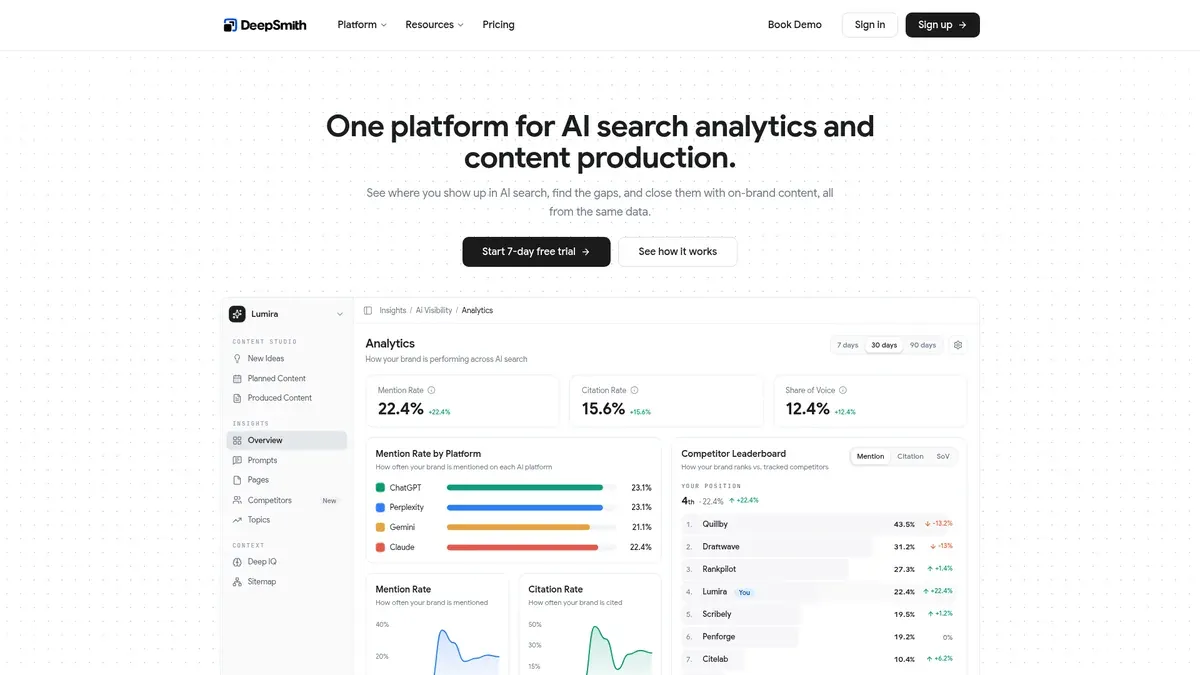
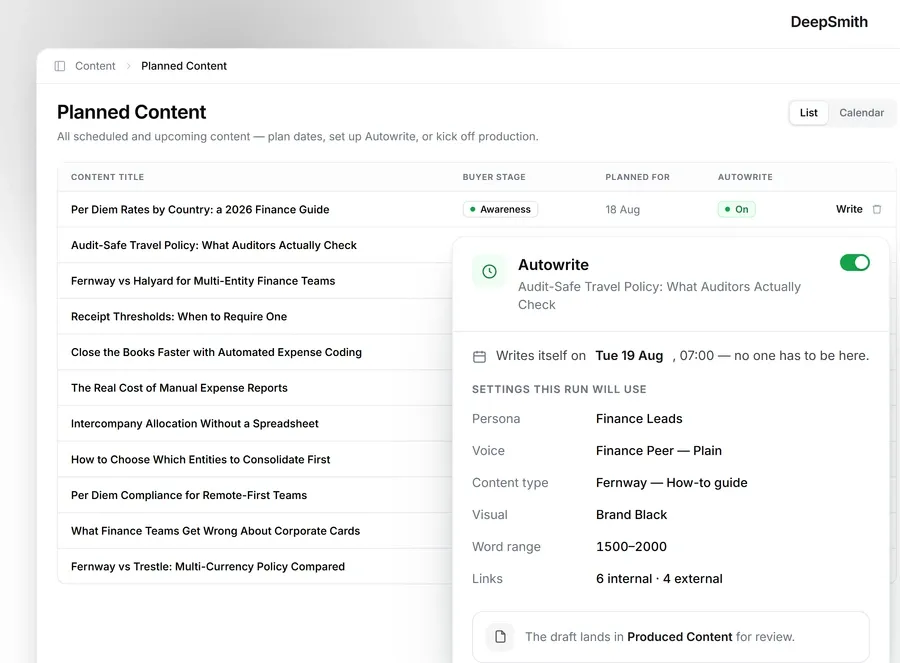
DeepSmith puts both on one plan. You track the questions buyers ask ChatGPT and other engines, and the Writer produces the article that responds. That article is researched, linked internally and externally, with a cover image and publish-ready metadata, grounded in your brand context in Deep IQ. In Planned Content you give ideas dates in bulk, and Autowrite writes each article on its scheduled date and drops it into Produced Content for review. From there you publish to WordPress, Webflow, Strapi, Sanity or Contentful, or send it to your own webhook.
Content Map adds the coverage view, comparing the topics on your site with those on your competitors' sites and flagging the gaps, so you decide what to write from data. Plans start at $99 a month for Pro ($80 billed annually) with 20 articles, 50 tracked prompts and 5 seats, and Grow is $199 ($160 billed annually) with 40 articles and 100 prompts. A 7-day free trial lets you see real data and real drafts before you pay, and there are no long-term contracts. DeepSmith is rated 4.8/5 on G2.

Pricing and value
NeuronWriter wins on price. Its $23 Bronze plan is the lowest public entry point of the three, and its $19 annual rate is a third of the $60 a month the Semrush Content Toolkit asks on annual billing.
The fair comparison is at the tier where each tool gives you a full workflow. NeuronWriter Gold is $57 a month billed yearly, against $60 a month for Semrush Base, and both come with a 7-day trial. NeuronWriter's trial needs no card and includes 3 analyses, while Semrush charges the first payment automatically at the end of the trial unless you cancel. The two have different catches. NeuronWriter charges more for AI monitoring beyond the included questions, starting at $9 a month for 10 questions on the Advanced add-on. Semrush lists $30 a month for 10 more SEO-boosted articles and $20 a month per extra user, and its month-to-month Base price was not published when we checked. Semrush's pricing page says 10,000 articles a month, while a help article says unlimited standard articles, so the allowance is worth confirming at checkout.
What DeepSmith does: it prices tracking and production together. Pro includes 20 articles, 50 tracked prompts and 5 seats at $99 a month, so the monitoring that the Semrush Content Toolkit leaves to a separate toolkit, and that NeuronWriter limits to a few questions without an add-on, sits in the same bill as the writing. Annual billing brings Pro to $80 a month.
Research and optimization
NeuronWriter is the stronger choice for optimizing a draft against what already ranks, and the Semrush Content Toolkit is the stronger choice for finding keywords to write about.
NeuronWriter analyzes the top 10, top 30 or top-intent results for a keyword and returns terms, entities, headings and a content score, usually within about a minute. Its keyword research is partial, with related keywords, volume and competition in Next Content Ideas on Gold and up, but no standalone keyword database. The Semrush Content Toolkit groups keywords into topics with total volume, average difficulty and intent from Semrush data, and its brief generator pulls in top-ranking pages for your keyword and location. Its Content Optimizer gives an on-demand score that mixes SEO and AI search checks, though Semrush does not detail how the score is built.
What DeepSmith does: it starts from AI answers and competitor coverage instead of keyword lists. Content Map shows the topics where competitors publish more than you, and Opportunity Agents return ideas that each carry the data point behind them, such as the prompt a competitor page is winning. The Writer then researches as it writes, so the article is built from sources and not only from search terms.
Writing and brand voice
On writing, Semrush Content Toolkit vs NeuronWriter comes out split, with Semrush ahead on voice controls and NeuronWriter ahead on grounding and model choice.
The Semrush Content Toolkit builds a brand voice from an uploaded writing sample and suggests audience personas, and you can keep up to 50 voices. NeuronWriter's AI Profile reads your website or documents to pull out products, personas and a brand voice, and its templates let you pick between GPT 5, GPT-5-mini, Claude Sonnet 4.5 or Gemini Flash 2.0. Gold and up can use their own OpenAI or Anthropic key. Both vendors' reviewers say the drafts need editing, and a March 2025 review of the Semrush tool noted limited reuse of detailed brand and product facts.
What DeepSmith does: it grounds every draft in stored Deep IQ context, which holds your company, products, personas, brand voices and content types as structured records. The Writer runs against those records each time, so you do not re-brief it per article, and a finished article arrives with links and metadata already in place.
AI answer tracking
NeuronWriter wins here, because the Semrush Content Toolkit does not track AI answers at all.
NeuronWriter's AI Visibility module reports share of voice, brand mentions, domain citations, sentiment, competitors and opportunities, and rechecks questions about every 24 to 48 hours. Every plan includes 5 to 20 Standard questions, which cover Google AI Overviews and Google AI Mode. ChatGPT and Perplexity need the paid Advanced add-on, which runs from 10 up to 1,000 questions. Semrush sells AI visibility as a separate AI Visibility Toolkit. The Content Toolkit's optimizer only checks your content against AI search criteria such as Q&A formatting and authorship. For a team that wants to see AI answers, that gap decides the comparison.
What DeepSmith does: it tracks mention rate, citation rate, share of voice, sentiment and trend across up to ten engines, with Pro on ChatGPT, Grow adding Perplexity and Scale adding Gemini. The Pages view shows which of your own pages AI cites, so a gap in the tracking turns into a specific article to write.
From insight to action
The Semrush Content Toolkit has the more complete path from draft to distribution for one person, and NeuronWriter leaves more of the publishing to you.
The Semrush Content Toolkit publishes to WordPress sites (up to 100), Mailchimp and Semrush Social Poster, turns an article into posts for LinkedIn, Facebook, Instagram, X and Pinterest plus email newsletters, and lets teammates comment on shared boards and approve content. NeuronWriter exports to WordPress on Gold and up and has a Chrome extension for Google Docs and WordPress, but repurposing is only a prompt away rather than a workflow, and approval steps are not documented. Neither one documents writing and publishing on a schedule without a person in the loop.
What DeepSmith does: it closes the loop from the tracking data to a published article. Opportunity Agents feed New Ideas, you plan them in bulk in Planned Content, Autowrite produces each one on its date, and Produced Content publishes to your CMS. Every finished article arrives with social posts already written, and the Apps Library adapts it for LinkedIn, X, newsletters and more in your brand voice.
Which should you choose
Whether you land on NeuronWriter or Semrush Content Toolkit mostly depends on where your time goes today, and DeepSmith is worth a look if that time goes to research, scheduling and tracking.
- DeepSmith fits a freelancer, lean team or agency that wants to see where its brand shows up in AI answers and produce the articles that fix the gaps from one plan, with scheduled hands-off production and a 7-day trial to test it.
- NeuronWriter fits a freelancer or small team on the tightest budget that edits drafts against live search results, wants many teammates without per-seat fees, and is happy with a small AI tracking allowance.
- The Semrush Content Toolkit fits a solo marketer or SEO beginner who wants a guided topic-to-WordPress flow on Semrush keyword data, with repurposing and approvals built in.
Start a 7-day free trial of DeepSmith to track your AI answers and schedule your first Autowrite articles on the same plan.