Semrush Content Toolkit (ContentShake AI) and Writer are built for different buyers. The Content Toolkit is a guided, SEO-first workflow from topic to WordPress post at $60 a month billed annually, which suits a small team. Writer is an enterprise platform for governed agents and company knowledge, with no published Starter price. DeepSmith is the stronger alternative for a small team that wants AI answer tracking, competitor gap analysis and scheduled article production on one plan, from $99 a month.
If you run SEO for a small team and you are weighing Writer AI vs Semrush Content Toolkit, you are really choosing between two kinds of product. One is a content tool built around search data. The other is a governed enterprise platform that can write content among many other jobs. This guide compares them on price, SEO features, publishing and AI answer visibility, then says which one fits a team of a few people. DeepSmith is covered too, because it adds AI answer tracking and competitor gap analysis, which neither documents as a dedicated feature.
Writer vs Semrush Content Toolkit: the short answer
- Choose DeepSmith if you want one self-serve plan that tracks AI answers, finds competitor gaps and produces and schedules finished articles, starting at $99 a month ($80 a month billed annually).
- Choose Semrush Content Toolkit if your team wants a guided SEO workflow, from Semrush keyword data to a WordPress post, at $60 a month billed annually.
- Choose Writer if you sit inside a larger organization that needs governed agents, company knowledge and security controls, and you can work with a sales-led price.
| Criterion | DeepSmith | Writer | Semrush Content Toolkit |
|---|---|---|---|
| Entry price, monthly billing | $99/mo (Pro) | Not listed (Starter shows no price) | Not listed |
| Entry price, annual billing | $80/mo (Pro) | Not listed | $60/mo (Base) |
| Articles at entry tier | 20 a month | Not listed (credit-metered) | 10,000 a month per pricing page, 5 SEO-boosted |
| Free trial | 7 days | 14 days, no card | 7 days |
| Brand knowledge grounding | Yes | Yes | Partial |
| SERP-based content scoring | - | Not listed | Yes |
| Internal linking | Yes | Partial, legacy editor only | Not listed |
| Direct CMS publishing | Yes | Yes, no WordPress connector | Yes, WordPress |
| Scheduled write and publish | Yes | Partial | Not listed |
| AI answer visibility tracking | Yes | Partial, playbook use case | No |
| Bulk article generation | Yes | Partial | Not listed |
| Public API | Yes, read-only | Yes | Not listed |
| SOC 2 | Yes | Yes, Type II | Not listed |
| Review rating | 4.8/5 on G2 | 4.4/5 on G2 | 7.2/10 on Info-Tech SoftwareReviews |
Pricing and features as of September 2026, from each vendor's site and public reviews.
Writer

WRITER is an enterprise AI platform, founded in 2020 and based in San Francisco, built around WRITER Agent, Playbooks and a graph-based Knowledge Graph. It is meant for large organizations, led by marketing and revenue teams, that want AI workflows grounded in their own data and brand rules under IT governance. Writer says so itself, and it fits less well as a self-serve SEO writing tool for small teams. Teams that decide it is too much platform can compare Writer alternatives.
The standout is depth in governance and brand control. Voice profiles link to style guides and banned terms, security includes SOC 2 Type II and several ISO certifications, and Enterprise adds SAML SSO. Developers get an API and an MCP server.
The limits matter more to a small SEO team. Writer has no native keyword database or SERP-based scoring documented, and its keyword data comes through a Semrush connector that needs a Semrush account. Starter allows up to five users and a 14-day trial, but the plans page shows no price, and Enterprise is quoted by sales and metered in credits. Publishing connectors cover Webflow, Adobe Experience Manager and Contentful, with no WordPress connector listed.
In September 2026 Writer showed 4.4/5 from 130 reviews on G2 and 4.5/5 from 8 on Capterra. The TrustRadius score is lower, at 5.7/10 from 27 ratings, which is worth weighing. Reviewers praise ease of use, faster drafting and brand-voice consistency. Some describe generic output that needs editing.
Semrush Content Toolkit

The Semrush Content Toolkit is the product formerly called ContentShake AI, and the old name now redirects to it. It is built for individual marketers, small content teams and SEO beginners who want one guided workflow from topic to published WordPress post at a single fixed price.
The standout is that connected workflow. Topic Finder suggests topics with search volume and keyword difficulty, the SEO Brief Generator builds a brief from top-ranking pages, the AI Article Generator drafts the piece, and the Content Optimizer scores it for SEO and AI-search criteria. Repurposing turns the article into social posts and emails.
The real limit is how little sits around that workflow. Base includes five SEO-boosted articles a month, and ten more cost $30 a month. Semrush documents no bulk generation, internal linking tool, public API or knowledge base beyond a brand voice sample, and it does not track brand visibility in AI answers. Semrush sells that separately.
Reviewers like topic discovery and briefs, and they also say drafts need human review. The only product-specific rating is 7.2/10 from 7 reviews on Info-Tech SoftwareReviews, so treat it as a thin sample. The G2, Capterra and TrustRadius scores cover the whole Semrush suite.
DeepSmith: the alternative that tracks and writes

Both tools stop at a similar place for a small SEO team. The Semrush Content Toolkit helps you write and optimize a page, and Writer helps you govern and automate work, but neither documents a dedicated way to see which AI answers cite you, which competitor pages win those citations, or which topics a competitor covers and you do not. Writer can be set up to monitor AI answers as a playbook, and Semrush Topic Finder points at content gaps, so each gets part of the way there.
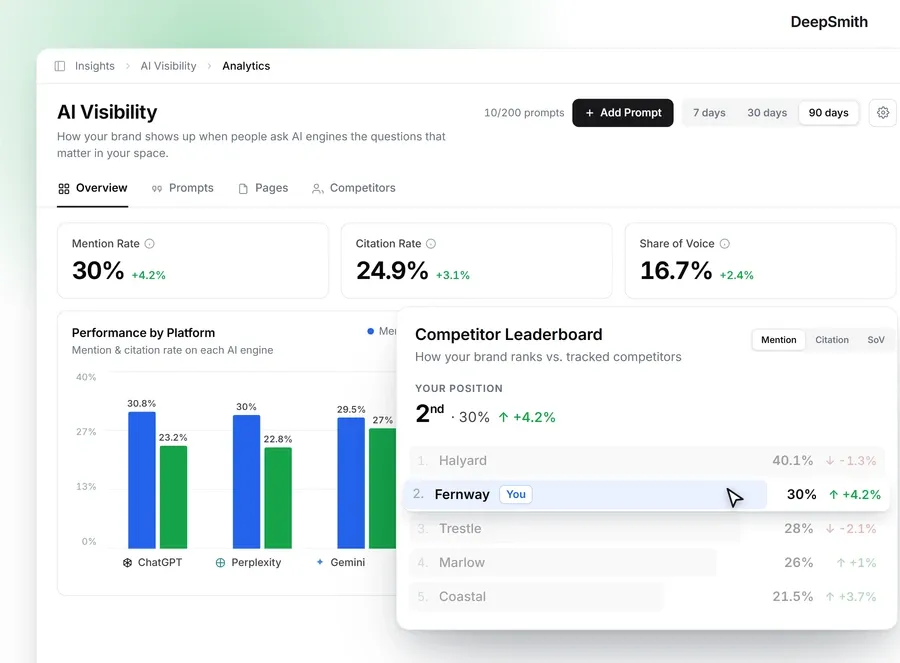
DeepSmith puts those steps on one platform and one set of data. Its AEO module checks the questions you define on a schedule and reports mention rate, citation rate and share of voice, with a per-platform breakdown and a competitor leaderboard. Content Map turns your site and your competitors' sites into one topic map that shows coverage gaps and untapped topics. Opportunity Agents read that data and return content ideas, each carrying the data point that justifies it.
Production starts from those ideas. The Writer turns a planned idea into a finished article that is researched, internally and externally linked, and has a cover image and publish-ready metadata. Autowrite can write it on a scheduled date with no one in the app, and you can publish to WordPress, Webflow, Strapi, Sanity or Contentful. Deep IQ stores your company, products, personas, voice and content types once, so every module writes from the same context.
DeepSmith plans run $99, $199 and $399 a month for Pro, Grow and Scale, or $80, $160 and $299 billed annually. Pro includes 20 articles, 50 tracked prompts and 5 seats, and every plan starts with a 7-day free trial and no long-term contracts. DeepSmith is rated 4.8/5 on G2.
SEO research and content scoring
In Writer AI vs Semrush Content Toolkit on SEO research, the Semrush Content Toolkit wins clearly. Topic Finder groups keywords into topics with total search volume, average keyword difficulty and intent. The SEO Brief Generator analyzes top-ranking pages for your keyword and returns a title, meta description, outline, word count and writer instructions. The Content Optimizer then computes a content score with SEO and AI-search checks. The SEO Booster scans live results before generation, and Base includes five boosted articles a month. Reviewers named that allowance as a constraint.
Writer has less here. Keyword data and search volume come through the Semrush connector, and no SERP analysis or SERP-based content scoring is documented. Its content score checks drafts against your own writing rules, not against top-ranking pages. Prebuilt agents cover meta titles and SEO content refresh, but there is no on-page recommendation panel.
What DeepSmith does: keyword coverage, heading structure, schema markup, internal links and metadata are applied while the article is written, rather than added after. Because the Content Map knows what your site and your competitors already publish, the topic is chosen from measured coverage before the first draft starts.
Brand voice and company knowledge
Writer wins this axis, and it is the main reason to pick Writer AI or Semrush Content Toolkit by team size. It builds voice profiles from examples or a description and links them to style guides and term banks, then grounds output in a Knowledge Graph and Enterprise Brain. Starter is narrower, with one team voice and a limited Knowledge Graph, and unlimited voices belong to Enterprise. Voice profiles are English only.
The Semrush Content Toolkit supports up to 50 brand voices built from a writing sample, each with editable audience personas. That helps with tone. No knowledge base or product-fact store is documented, and a March 2025 hands-on review reported limited reuse of detailed brand and product facts. A small team that publishes technical or product-specific pages should plan to check facts by hand.
What DeepSmith does: Deep IQ holds your About Company, Products and Services, Buyer Persona, Brand Voice, Visual Guidelines and Content Types as structured records. Every module uses them, so a freelancer brief is not needed to keep a draft on brand or to keep product claims accurate.
Pricing and value
The Semrush Content Toolkit wins on clarity and entry cost. Base is $60 a month billed annually, which is $720 over twelve months, and the monthly-billed price was not shown on the pricing page. Extra users cost $20 a month each, and ten more SEO-boosted articles cost $30 a month. The 7-day trial charges the first payment automatically unless you cancel. The pricing page says Base includes 10,000 articles a month, while a help article says standard articles are unlimited, so confirm the allowance at checkout.
Writer is harder to budget. Starter is a self-serve trial tier for up to five users, but the plans page does not show a seat price or a credit amount, and Enterprise is custom and metered in credits. A third-party article reported Starter rates, but the vendor does not confirm them, so ask for a written quote before you plan around any number. For a small SEO team comparing Writer vs Semrush Content Toolkit for small teams, price predictability alone points to Semrush.
What DeepSmith does: DeepSmith publishes its prices. Pro at $99 a month includes 20 articles, 50 tracked prompts and 5 seats, Grow at $199 includes 40 articles, 100 prompts and 7 seats, and Scale at $399 includes 90 articles, 200 prompts and 10 seats. Tracking and writing share one plan, so you are not buying a second tool to see whether the articles get cited.
Publishing and workflow automation
The Semrush Content Toolkit wins for a small team publishing to WordPress, and Writer wins for a team that needs custom multi-step workflows. The Content Toolkit has a WordPress plugin that publishes or sends a draft to up to 100 sites. Repurposed posts go out through Mailchimp or Semrush Social Poster. The workflow itself is fixed, running from topic to brief to article to optimize to repurpose, and unattended scheduled article publishing is not documented.
Writer offers Playbooks with schedule and event triggers, step approvals and chained workflows. Starter allows five Playbooks and up to three scheduled routines, and Agent Builder is Enterprise only. It can push content to Webflow, Adobe Experience Manager and Contentful, and writing and publishing on a schedule can be composed from those pieces, but it is not described as a turnkey feature.
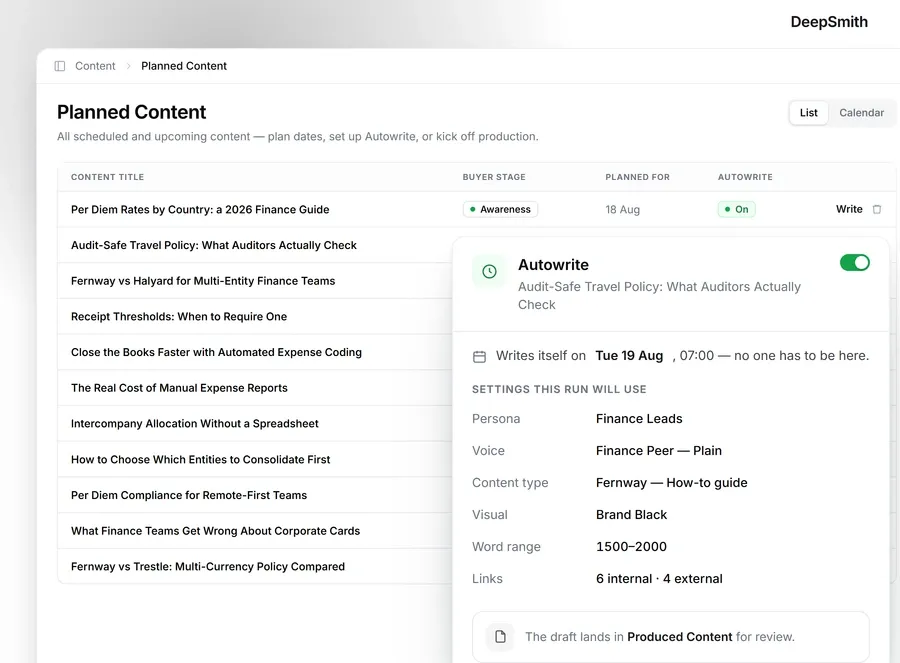
What DeepSmith does: Planned Content gives each idea a date, and you can schedule individually or in bulk. Autowrite then writes each article on its date against your stored persona, voice, content type and link targets, and the finished piece lands in Produced Content for review or goes out hands-off.
From insight to action
In Semrush Content Toolkit vs Writer AI on this axis, Writer comes closer, because it can be set up to monitor AI answers and the Semrush Content Toolkit does not track them at all. Writer lists scheduled visibility monitoring across ChatGPT, Claude and Perplexity as a playbook use case with weekly reports. It documents no dedicated tracker, prompt counts or collection method, so you would be building the measurement yourself.
The Semrush Content Toolkit optimizes content for AI search with checks such as authorship, question-and-answer formatting and structural summaries, though the effect on citations is a vendor claim. Tracking whether AI engines cite you is sold as the separate AI Visibility Toolkit. For a small team that means a second subscription and a manual step between what the tracker finds and what the writer produces.
What DeepSmith does: the same platform that measures also feeds production. AI Visibility reports which of your pages AI actually cites and which competitor pages win the prompts you track. Opportunity Agents turn those findings into ideas with the evidence attached, and Content Studio produces the articles. Repurpose then writes social posts and channel versions in your voice.
Which should you choose
If you are deciding between Writer AI or Semrush Content Toolkit, the answer depends on who sits in your team and what happens after the article is published.
- DeepSmith fits a small marketing or SEO team that wants to see where it shows up in AI answers, find the topics competitors cover that it does not, and turn those gaps into published articles from one plan, with scheduling and workspaces for each brand or client.
- Semrush Content Toolkit fits a solo marketer or a small team that works from Semrush keyword data, publishes to WordPress, and wants a fixed, public price for a guided topic-to-post workflow.
- Writer fits a larger marketing or revenue organization with IT governance needs, company knowledge to ground output in, and a budget set through a sales conversation.
Try DeepSmith with a 7-day free trial and see tracking and production on your own site.