If you are about to buy an AI visibility tool, one of the first questions is whether to pick a single engine tracker that watches one platform closely or a tool built for cross platform AI visibility tracking that watches several. Both are reasonable choices, and the right one depends mostly on how many AI platforms actually affect your buyers and your reporting. This page walks through the trade-offs so you can decide before you start comparing vendors.
It compares the two approaches only. It does not name or rank specific products, because that belongs in the tool roundups in this series.
The short answer
Choose a single-engine tracker when one specific AI surface is the only one that really matters to you right now, and you are fine with not knowing what happens anywhere else. Choose a cross-engine tracker when two or more platforms matter, when leadership wants one view across them, or when you need to see where your visibility differs from platform to platform.
If you need to track multiple AI platforms, look for a tool that gives you both breadth and per-engine detail. Covering many engines does not have to mean shallow reporting, and a tool focused on one engine is not automatically deeper. There is no evidence that single-engine tracking is always cheaper, or that a bundled multi-engine plan is always better value. The details of each tool decide that.
Single-engine vs cross-engine at a glance
| Decision axis | Single-engine tracker | Cross-engine tracker | What to verify |
|---|---|---|---|
| Coverage | One chosen platform or surface | Several platforms or surfaces | Which engines and surfaces are included, and whether that is fixed by plan or configurable |
| Depth | Can focus all its effort on one surface | Can show a shared overview plus per-platform detail | Prompt history, full answers, mention and citation metrics, cited URLs, competitors, trends, exports |
| Comparability | Good for following one surface over time | Can compare the same prompts across surfaces if settings line up | Same prompts, period, location, language and repeat policy |
| Cost | May have a lower entry price, though that is not guaranteed | May need a higher tier, but one plan can replace several subscriptions | Total cost for the engines, prompts, runs and users you need |
| Reporting effort | Simple if only one surface matters | One workflow, but more data to read and interpret | Per-engine exports, access controls, and whether totals hide differences |
| Best fit | One evidence-backed priority, or a deliberately narrow pilot | Two or more platforms that shape strategy | How many platforms your audience and leadership care about |
What each approach covers
A single engine tracker records how one AI platform answers the prompts you care about. That can be a good fit for a focused experiment, or for a team whose audience clearly lives on one platform. What it cannot do is tell you anything about the platforms it leaves out, so a good result on one engine is not a result for the others.
Cross platform AI visibility tracking records the same kind of data on several platforms, ideally using the same prompts and showing each platform separately. That lets you compare where your brand shows up and where it does not, and it can save you from collecting separate reports by hand. A long list of supported engines does not tell you how good the measurement is, though, so coverage counts are only the starting point.
It also helps to agree on what you mean by "engine" before you compare tools. Sometimes people mean a model, sometimes an app, and sometimes a particular answer surface. Google AI Mode and Google AI Overviews are different experiences, and research has found their answers and cited URLs can differ. Microsoft reporting can combine several Microsoft and partner AI experiences into one number. When a vendor says it covers an engine, ask exactly which surface it queries and whether you can filter each one on its own. Our guide to AI Overviews vs AI Mode covers that Google split in more detail.
One more point of vocabulary. A mention means an answer names your brand. A citation means an answer links to one of your pages as a source. They are separate events, since an answer can name you without linking to you, or link to a page without naming you clearly. Keep the two apart when you read any tracker's reports.
Depth is not the same as engine count
It is tempting to assume that watching one engine means seeing more of it, and that watching many means seeing less of each. The label alone does not tell you that. When you assess depth for either type of tool, go through the same short list:
- Can you see the tracked prompt, the full answer, the collection date and the history of past runs?
- Are mentions and citations defined separately, and is sentiment explained if the tool reports it?
- Can you see the exact URL that was cited, whether it is yours or a competitor's, and which prompts produced it?
- Can you compare named competitors and look at the pages they get cited for, not just a blended market score?
- Can you break results out by engine and follow trends over a period you choose?
- Can you export or pull the underlying answer and URL records for your own reporting?
A cross-engine dashboard that offers prompt answers, page-level citations, competitor sources and separate trends for each engine can be very deep. A single-engine tool might offer much less than that. The way to find out is to run your own prompts through a trial and look at the real data, instead of going by how the tool is described.
Why one engine is not a stand-in for the others
The strongest reason to track more than one platform is that different engines tend to pick different sources, and that the answers move around from run to run. A few findings are worth knowing, along with their limits.
A 2026 study collected daily results from ChatGPT, Gemini, Google AI Mode and Perplexity across four Swiss-German campaign verticals, using eight prompts per campaign over roughly 45 days. Between consecutive days, the overlap in cited sources was 34 to 42 percent, and the overlap in which brands appeared was 45 to 59 percent, with wide variation. The authors concluded that a single daily query cannot give a reliable estimate of true visibility. In the same study, ChatGPT returned no extracted citations in 57.8 percent of its runs in the dataset used. That figure belongs to that study and should not be read as a general rate for ChatGPT, but it shows why a tool needs clear rules for answers that have no citation at all.
A separate 2026 snapshot looked at 15 English-language commercial prompts about AI search visibility software across four engines. Of 528 distinct exact URLs, 509 (96.4 percent) showed up on only one engine, and 317 of 356 domains (89.0 percent) showed up on only one engine. That benchmark is small, its author is associated with an AI visibility software vendor, and strict URL matching can count near-duplicate pages as different sources. It is best read as an illustration of the risk of using one engine as a proxy, not as a market-wide rate.
On the Google side, an Ahrefs analysis of September 2025 US data compared AI Mode and AI Overview answers for the same queries, across 540,000 query pairs. It found the same URLs in both experiences 13.7 percent of the time, with a top-three citation overlap of 16.3 percent. Those numbers come from one generation per surface, so they are a rough guide, but they support treating the two Google surfaces as separate things to track.
Taken together, these findings point in one direction. If several platforms matter to you, measure several platforms. They do not mean you should buy the largest engine count on offer, because the right number is the one that matches where your audience looks for answers. They also mean that whichever approach you choose, you want repeated observations instead of a single run, since one answer from a probabilistic system is a snapshot and not a stable estimate. If you are still deciding which platforms to start with, a prioritization method for which engines to track first is a good next read.
Check the metrics before you compare tools
Single-engine and cross-engine tools can calculate the same metric differently, so agree on definitions first.
- Mention rate or visibility rate is usually the number of responses that mention your brand divided by the total number of responses. Ask what counts in the total: every scheduled response, only the ones that came back successfully, or a filtered set.
- Citation rate is often the share of collected answers that cite at least one of your pages. Some vendors count every citation event or every unique URL instead, so confirm which one is in use.
- Share of voice is your mentions divided by the mentions of all tracked brands, yours included. It is relative, so adding a competitor to the list can change it even when nothing changed about how often you are mentioned.
- Citation count, cited-page count and citation share are different measures. Ask for each definition.
- A mention or citation does not imply a high position, a positive description, traffic or a sale.
Denominators matter most when a cross-engine tool shows one headline number. Say your brand is mentioned in 80 of 100 answers on one engine and 20 of 100 on another. The per-engine rates are 80 percent and 20 percent, and the pooled rate over all 200 answers is 50 percent. Add a third engine with 100 answers and no mentions, and the pooled rate drops to 33.3 percent, while the first two engine rates have not moved at all. So a cross-engine headline number should come with its aggregation method, and the per-engine breakdown should stay visible next to it.
Collection settings change what you are measuring
A tracker records the output of a system that changes, not a fixed results page, so "covers ChatGPT" says less than it sounds like. OpenAI's help documentation explains that ChatGPT may search automatically when it decides a question would benefit from current information, that it can rewrite a prompt into one or more targeted queries, and that it may use approximate location or saved memory when those are enabled. The OpenAI documentation on searching the web with ChatGPT describes that behavior, and the API's web search tool can be set up differently from the consumer app. These are documented behaviors, not proof that every tracker that uses an API differs from what a person sees. They are a reason to ask how each tool collects its answers, which our explainer on how AI visibility tools collect data goes through.
Whichever approach you pick, ask the vendor to document these things:
- The exact platform, surface, model or interface that was tested.
- Whether search was automatic, forced or switched off, and whether results are live or cached.
- The query text, language, location, personalization assumptions and collection time.
- Whether "sources" means all URLs retrieved, only the citations visible in the answer, or only what was detected in the rendered page.
- What happens when an answer has no citation, no brand mention or no response at all.
- How many times each prompt is repeated.
Google's documentation adds one more point for tracking. AI Overviews appear when Google decides they add value beyond classic results, so they do not show up for every query, and AI Mode is meant for queries that need more exploration or comparison. Both can use query fan-out, and Google says the two may use different models and techniques. Not seeing an AI Overview on one prompt does not mean the query is absent from Google Search, and it is part of why Google AI Overviews tracking has position problems of its own. Google lays this out in its guidance on AI features and your website.
Cost: compare the whole measurement plan
No tracker price comparison was part of this research, so there is no market-wide conclusion here about which approach costs less. What helps is comparing the full cost of the same measurement job over the same period:
- The subscription or quote, including the tier needed to unlock each engine you require.
- Prompt limits, refresh frequency, seats, workspaces, markets and how much history is kept.
- Collection or API charges, if you build your own.
- Setup, maintenance, quality checks, exports, and the analyst time spent joining reports together and explaining why their definitions disagree.
A useful way to size the job is prompts times engines times runs times markets. With 50 prompts, one run a day and one market over a 30-day month, one engine produces 1,500 answer observations and three engines produce 4,500. Run the same 50 prompts across three engines, two markets and three repeats a day, and you get 27,000 observations in the same month. Those are arithmetic examples, not tool limits or recommended sample sizes, but they show how quickly the volume grows when you widen coverage, and why plan limits deserve a close look.
Reporting effort is a cost too
A cross-engine tool gives you one workflow, but it also gives you more data to read and interpret, and an aggregate that hides differences between engines can mislead you. If you only watch one surface, your reporting stays simple, but you take on manual work the moment a second platform starts to matter.
Native reports and where they stop
The reporting that comes with search platforms can cover part of what you need, and it is a useful supplement. It is not the same as monitoring your brand across providers.
Google says appearances in AI Overviews and AI Mode are included in overall search traffic and reported in the Performance report in Search Console under the Web search type. The documentation does not describe a separate AI-only view or a citation-by-prompt breakdown.
Microsoft announced AI Performance in Bing Webmaster Tools as a public preview on February 10, 2026. It reports total citations, average cited pages, grounding queries, page-level activity and trends across Microsoft Copilot, AI-generated Bing summaries and select partner integrations. Microsoft says the data is a sample of overall citation activity, and it cautions that counts do not establish ranking, placement or importance. You can read the details in the Bing announcement of AI Performance. It is helpful, but it is aggregated across the Microsoft side and is not a view across every provider.
OpenAI's API documentation also says the full list of sources can include more URLs than the inline citations an answer shows, so a report of visible citations and a report of everything consulted are not the same thing.
A practical setup is to pair these native tools with a tracker. The native reports can answer narrow questions inside their own scope, and a cross-engine tracker is what you reach for when you need consistent prompt-level comparisons across several providers. Check account requirements and current capabilities before you assume any of them is free or enough.
Where DeepSmith fits
DeepSmith is an AI search analytics and content production platform, and its AI Visibility module tracks how AI engines answer the questions you define. It reports mention rate, citation rate and share of voice, with a per-platform breakdown, prompt answers, the pages of yours that get cited, and which competitor pages win citations. It covers ten engines: ChatGPT, Gemini, Perplexity, Claude, Google AI Overviews, Google AI Mode, Grok, Meta AI, Microsoft Copilot and DeepSeek.
Coverage rises by plan. Pro tracks ChatGPT, Grow adds Perplexity, Scale adds Gemini, and Enterprise covers all ten. Pro is $99 a month ($80 a month billed annually), Grow is $199 ($160 annually), Scale is $399 ($299 annually), and Enterprise is custom. There is a 7-day free trial and no long-term contract. So if ChatGPT is the only platform you need, Pro is the one-engine option, and if you need several, you check which plan includes the specific engines you require.
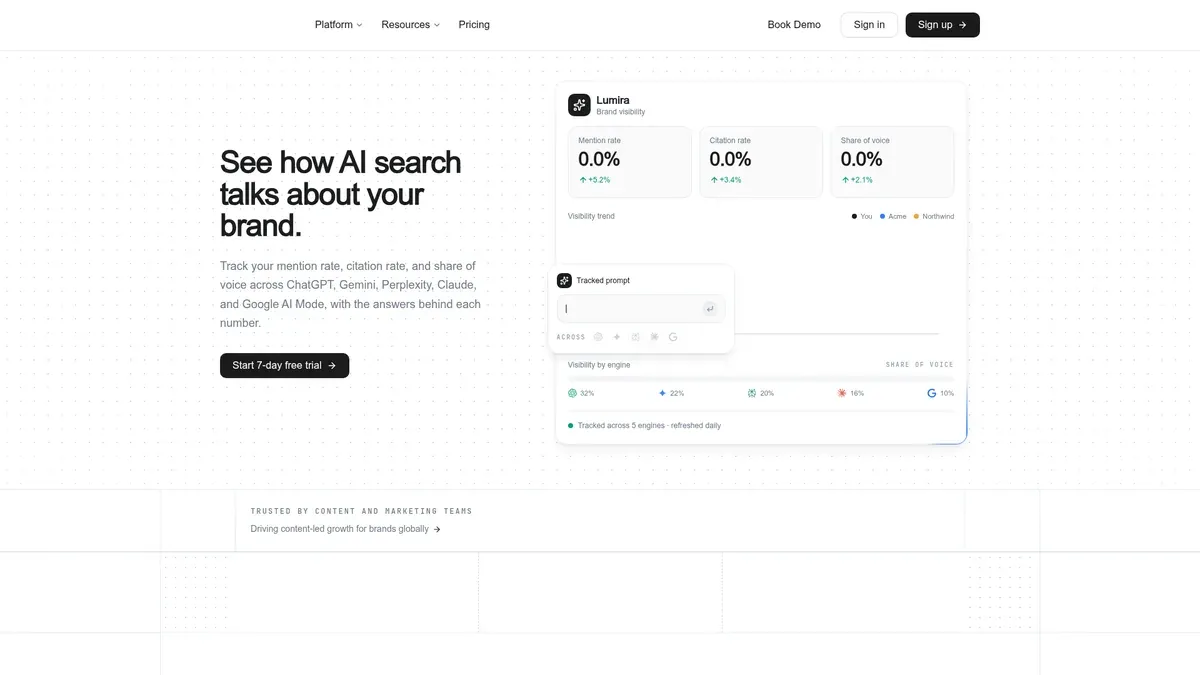
Here is what the per-engine view looks like in practice. The overview keeps mention rate, citation rate and share of voice as separate top-line numbers and breaks them out by engine, next to a competitor leaderboard. The numbers in these screenshots are demo data.
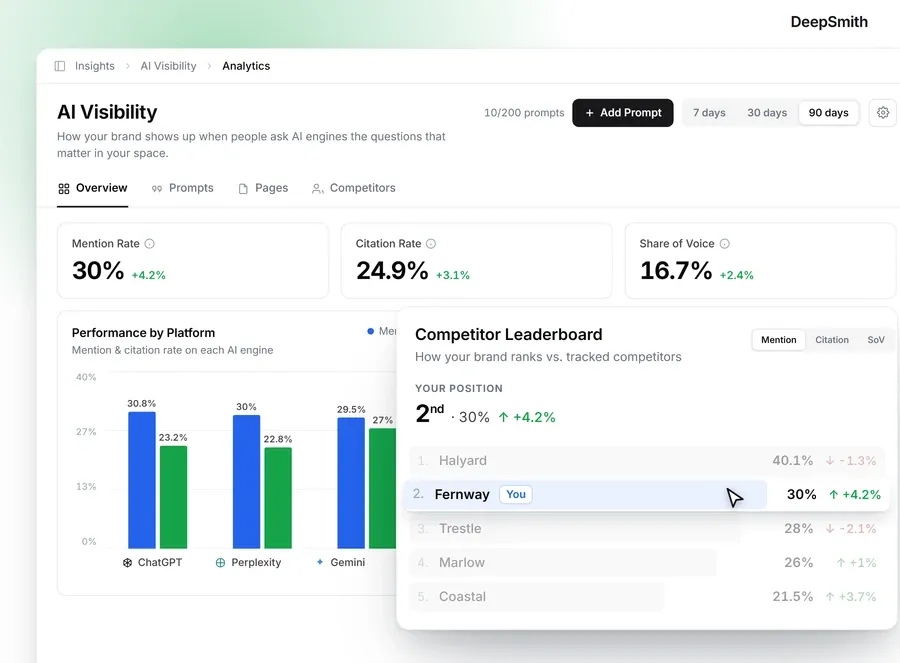
The same detail is available for each prompt. Every tracked prompt carries its own mention and citation rate per engine, plus the specific pages of yours that were cited in those answers.

That is the shape to look for in any cross-engine tool: a combined view for the team and the engine-level detail underneath it. This does not make DeepSmith the cheapest or the deepest option for every reader, and a team that only ever needs one surface may be well served by a narrow tool. You can test it on your own prompts with the 7-day free trial.
Which approach should you choose?
Choose a single engine tracker if:
- One platform is clearly where your audience looks, or you are running a specific experiment on it.
- You want to study one platform in detail and do not need cross-platform decisions yet.
- You can say plainly what you will not learn from the platforms you are leaving out, and you accept that.
- Your budget or analyst time only supports a focused program, once you have checked actual plan limits.
Do not justify this choice by saying one platform represents all AI search. Treat it as a deliberate scope decision. If you do go narrow, the roundup of ChatGPT visibility tools and the roundup of Gemini visibility tools show what is available for those platforms. The Google AI Overviews tracking tools roundup does the same for Google. Microsoft Copilot has its own list of Copilot visibility tools. Claude visibility tracking tools are compared in a separate roundup too.
Choose a cross-engine tracker if:
- Two or more platforms affect your content plans, your leadership reporting or your defined audience.
- You need to see where your brand, your competitors and your cited pages differ by platform.
- You want one comparable reporting workflow and have confirmed it keeps per-engine detail.
- Missing a platform-specific difference would cost you more than the extra collection and reading effort.
Confirm the surfaces queried, whether prompts are consistent, how metrics are defined, whether response history is kept, and whether any data is sampled or missing.
Start staged or hybrid if:
- You have one main platform but want a regular check on others to test whether your assumptions still hold.
- Native console data can answer part of your question and you need a cross-engine view for comparison.
- You are not sure which platforms matter and want evidence before you expand a recurring program.
In that case, keep a core prompt set stable, read the results for each engine separately, and add coverage when the data will change a decision. Write down your repeat policy so you are not treating a single run as the answer. Once you know what to look for, our guide to evaluating an AI visibility tool lists the questions to ask before you pay, and the best AI visibility tools roundup is where specific products are compared.
Related guides
- How to Choose the Right Solution for ChatGPT Visibility Tracking: Decide between manual checks, a general AI visibility tool and a ChatGPT specialist using criteria such as prompt volume, budget, reporting needs, team time and how much detail.
- How ChatGPT Visibility Tracking Works: Search Mode, Citations and Memory: Understand how tracking tools measure ChatGPT: why search mode and plain answers differ, how citations are captured, what memory and personalisation do to results, and why samples vary.
- How to Improve Your Visibility in Perplexity: What You Can Influence: Identify what you can influence in Perplexity: source quality and freshness, clear answer passages, authoritative third party mentions and crawl access, and which factors sit outside your control.
- How to Track Microsoft Copilot Visibility and Rankings: Set up Copilot tracking: select prompts, record whether your brand is mentioned and cited, capture ranking within answers, repeat on a schedule, and read trends rather than single.
- How to Monitor Claude Mentions and Referral Traffic: Monitor Claude by running prompt checks for brand mentions, then find referral traffic in analytics by identifying Claude referrers, tagging landing pages and separating it from direct visits.