If you are looking at GEO tools right now, you have probably noticed that they split into two groups. Some only measure how you show up in AI answers. Others measure it and also help you make the content that changes it. So the real question is whether you need a GEO tool that creates content, or whether a dashboard is enough for your team. Tracking-only fits a team that already has the people and the process to turn findings into published work. Tracking-plus-content fits a team where good opportunities keep piling up because nobody has time to act on them.
Neither choice takes away the need to decide what matters, check facts, and approve what goes live. What changes is how much of the work between "we found a gap" and "we published the fix" stays on your plate. Here is how the two categories line up.
| Decision criterion | Tracking-only | Tracking-plus-content |
|---|---|---|
| Core job | Measure visibility and support diagnosis | Measure visibility and help produce the response |
| Best-fit team | Has a working editorial operation with spare capacity | Has useful opportunities but not enough production capacity |
| Where execution happens | Your existing editorial and publishing workflow | Partly or mostly inside the platform, depending on scope |
| Content output | None from the tracking tool itself | Anything from briefs to finished articles |
| Handoffs | Findings move into another workflow | Fewer handoffs if the evidence travels into production |
| Human responsibility | Interpretation, production, review, publishing | Prioritizing, approving sources and claims, review, publishing |
| Main operational risk | Reports pile up and nobody implements them | Drafts pile up, or weak content ships faster |
| Measurement quality | Judge it on its own | Same standard, and content features do not make up for weak tracking |
| Cost to evaluate | Subscription plus the time and tools needed to act | Subscription plus the research, review, and publishing work that remains |
| Success test | Findings become approved changes through your team | More approved changes ship, at acceptable quality, with less total effort |
The takeaway is to choose based on the work your team cannot finish today, not on how many boxes a platform checks.
Tracking-only GEO tools
A tracking-only tool measures how AI engines answer questions about your brand and your category. It does not write the content that addresses what it finds. Many of these tools still give you recommendations, competitor analysis, alerts, and exports, so it would be unfair to call them decorative charts. They just stop before the writing.
Measurement is one of three jobs in GEO, which is generative engine optimization, the work of improving how a site or brand appears in answers from generative search systems. The other two are diagnosis, which means deciding what the observations imply, and execution, which means updating or creating pages, fixing technical barriers, and publishing. The guide to the kinds of GEO software goes through which products cover which job.
A GEO dashboard only setup can be exactly right when you already have someone who owns visibility analysis, writers or experts with room in their week, a briefing and editorial process you trust, a CMS routine that works, and a way to turn findings into tasks with owners and dates. In that case a tracking-only purchase adds the missing measurement layer without asking you to replace a production system you like. It also makes sense when your goal is smaller, like setting a baseline, reporting to leadership, or finding out whether a particular AI surface matters to your business.
The limit is that measurement does not create capacity. After the diagnosis, someone still has to research sources, update the old page or draft the new one, fact-check it, add internal links, write metadata, pick images, format it in the CMS, and distribute it. If the person reading the report is also the person who is too stretched to do that, the report becomes one more thing waiting in a queue.
I would not tell you that tracking-only tools are always cheaper, more accurate, or easier to use. Those are questions about individual products, and this guide stays at the level of the category. If you are weighing individual products, the best AI visibility tools roundup is a better place to start.
Tracking-plus-content GEO platforms
A tracking-plus-content platform does the same measuring and adds some form of content creation. That covers a lot of ground. It might mean a brief generator, a draft writer, a research-grounded article workflow, or a fuller pipeline with links, images, metadata, review, and publishing. A GEO platform with content generation is only useful if it removes the step that is actually slowing your team down, so the feature list matters less than where your own bottleneck sits.
The strongest case for this category is a steady gap between opportunities found and improvements shipped. When an integrated workflow works well, it carries context from one stage to the next: the question you tracked, the answer the engine gave, the competitor page that was cited, the gap or wrong claim you found, the audience and stage the page should serve, your approved product facts, and then the visibility checks you run after publishing. When those pieces travel together, you spend less time rebuilding context by hand between a report, a brief, a draft, and a CMS. That is an operational reason to prefer the integrated route, and it is not proof that every integrated platform delivers it.
There are real limits too. A content feature can stop short of what you need, since a draft generator does not necessarily handle research, internal links, factual review, or publishing. Automation can also push the bottleneck down the line. If your team can generate ten pieces but only has time to review two, the unreviewed pile just grows. And a publishing pipeline on your own site does not fix what third-party sites say about you.
So tracking-plus-content suits a team whose main constraint is turning known opportunities into good published work. It does not replace subject knowledge, and it is not a reason to publish pages that add nothing for the reader. For a marketing lead who spends the week on briefs, SEO review, linking, and formatting, it is usually the stronger category to look at, because it can take that repetitive work and give the time back to deciding what to publish and why.
What a GEO finding is really asking you to do
It is easy to assume that low visibility means you need another article. Often it does not.
| What you observe | A possible response | Why writing alone may not solve it |
|---|---|---|
| Buyers ask a question your site does not answer | Create a useful page that answers it | The page still needs reliable evidence |
| A suitable page exists but is vague or out of date | Update that page with current facts | A new article could duplicate what you have |
| A page cannot be reached or indexed properly | Look into technical eligibility and crawler controls | More text does not remove an access barrier |
| AI describes your product incorrectly | Clarify your official product information and check the cited sources | The wrong statement may come from a site you do not control |
| Citations rise but visits do not | Look at referral traffic and behavior separately | Citation counts are not click counts |
Some actions belong to a technical owner, and two official facts show why. For Google AI Overviews and AI Mode, a page has to be indexed and eligible to show in Google Search with a snippet, and Google says there are no extra technical requirements beyond that. Its AI features guidance also says you do not need special AI text files or special schema markup to appear. Meeting those requirements still does not guarantee a citation. For ChatGPT search, OpenAI separates OAI-SearchBot, which is for search, from GPTBot, which concerns content that may be used for model training, so you can allow one and block the other.
Measurement quality in both categories
Whichever category you pick, the measurement underneath has to be good. A content feature should never distract you from weak tracking.
Ask which engines are included on the plan you would actually buy, how the data is collected, how often it runs, and whether each question is repeated. Ask whether you can open the raw answer with its source links and timestamp, and whether failed requests and answers with no sources are kept and labeled. These are buying questions, not claims that every tool supports all of them.
Read the metrics carefully too, because the same label can mean different things in different tools. If your brand is named in 30 of 100 valid sampled answers, your answer-level mention rate is 30% under that definition, which does not mean 30% of all real users see your brand. Share of voice depends on the competitor set, and it is not market share.
Repeat measurement matters as well. A manuscript on repeated AI search observations, Don't Measure Once, found a lot of variation in the sources cited and the brands mentioned, even under controlled conditions. Source sets overlapped by 34% to 42% between consecutive days, and brand sets by 45% to 59%. Its peer-review status was not established in the material reviewed, and it does not set a universal number of runs, but the practical lesson holds. Use several observations and comparable time windows, and note when you change pages or tracking settings.
Citations and traffic are different things. In July 2025, the Pew Research Center reported on browsing data from 900 U.S. adults in March 2025, covering 68,879 unique Google searches. Users clicked a traditional result link in 8% of visits that had an AI summary, compared with 15% of visits without one, and clicked a link inside the summary in 1% of visits. That looked at Google only and describes associations, so it does not mean AI citations are worthless. It does mean being cited and getting a visit are different outcomes, and a good setup measures them separately.
Content capacity and the execution gap
A useful way to choose is to ask three questions about your team. Can you decide what matters, meaning someone can tell relevant findings from noise? Can you produce the response, meaning someone or something can research, write, link, format, and prepare it? And can you approve and ship it, meaning someone owns factual sign-off and publication? A tracking-only tool mostly helps with the measurement input, and a geo platform with content generation can take on a good share of the second question. Neither answers the first or third for you. This is a thinking framework, not a published industry benchmark.
You can put numbers on the gap with a simple backlog model. Your next backlog is your current backlog, plus newly approved actions, minus completed actions, never below zero. Say six worthwhile content actions enter your queue each month and your team finishes two. The backlog grows by four every month, and a more detailed report does not change that arithmetic. Now say a tool lifts your generation capacity to eight pieces a month, but you can only review and publish two. Your real throughput is still two.
Quality belongs in this decision, because speed alone proves nothing. Google's guidance on generative AI content names research and structuring original content as useful applications of generative AI, and it stresses accuracy and manual fact-checking before you publish. It also defines scaled content abuse as generating many pages mainly to manipulate rankings. The concern is unoriginal, low-value content however it was made, so using AI is not the violation by itself.
So do not assume AI-written content gets penalized, and do not assume it improves visibility either. The original GEO research by Aggarwal and colleagues found that adding reliable citations, credible quotations, and relevant statistics improved source visibility by roughly 30% to 40% on one measure and 15% to 30% on another, in the GEO study they ran on systems available at the time. Results varied by domain, and the study did not compare tracking-only software with tracking-plus-content software. It supports the idea that execution matters. It does not promise that any tool will raise your citations or your traffic.
If you test a GEO tool that creates content, test the work between spotting a gap and publishing something worth reading. Check whether each idea keeps the question, the visibility problem, and the cited pages behind it, because a generic list of topics is not an evidence-backed queue. Check whether the workflow avoids invented statistics and flags unsupported claims. Check how product details and voice get in, and check each step separately: research, brief, drafting, links, metadata, images, CMS formatting, and distribution. Ask whether scheduled writing creates a draft, sends work to review, or publishes.
Total cost of useful output
No defensible price range or controlled return comparison exists for either category, so do not assume one is always cheaper. A cleaner way to compare is cost per useful change, not cost per generated draft.
For tracking-only, count the subscription, the time to analyze and prioritize, the time to research, write, and edit, the linking, images, metadata, and formatting, and any other software you need to finish those steps. For tracking-plus-content, count the subscription, setup, keeping brand context current, the research and expert input that remains, fact-checking and approvals, publishing work the platform does not cover, and rework on output you reject. Count a saving from a retired tool only when you will really cancel it.
Here is a hypothetical break-even. If an integrated option costs $200 more per month and your loaded labor cost is $75 an hour, it needs to save about 2.67 hours a month to cover the added subscription alone. That is an illustration, not a price comparison or a customer result, and it leaves out setup, quality differences, and business impact. The question of software or a service is a separate decision with its own trade-offs, so it is not covered here.
Where DeepSmith fits
DeepSmith is the second kind of platform. It is an AI search analytics and content production platform in one, so it tracks how AI engines answer questions about your brand, finds the gaps, and produces the on-brand content to close them from the same data. It is a production engine, not a writing assistant, and its output is a finished article rather than a first draft to rescue.
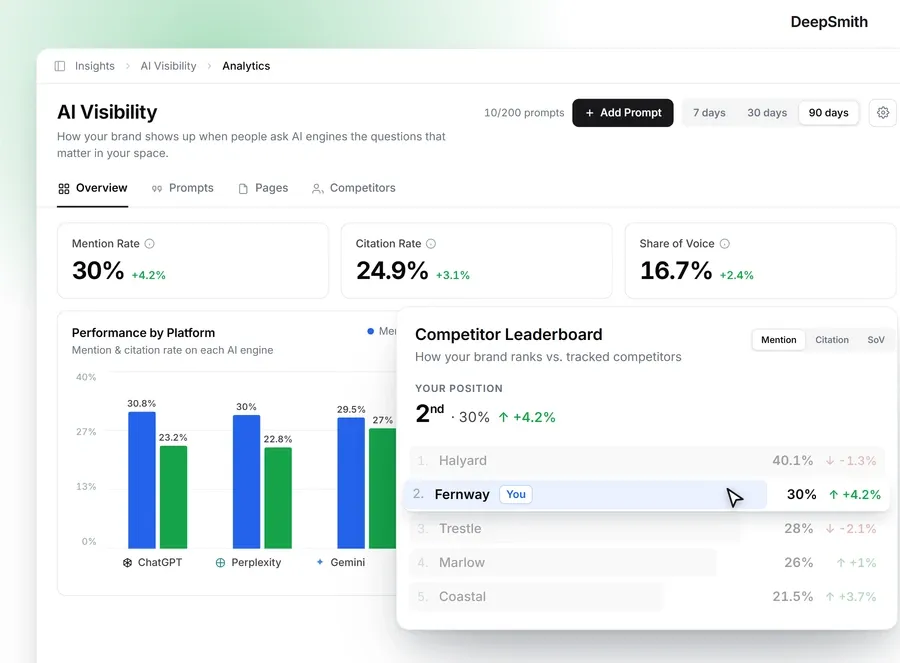
On the measurement side, you define the questions and DeepSmith checks them on a schedule. You get mention rate, citation rate, share of voice, sentiment, and trends, with a per-platform breakdown, a competitor leaderboard, the full answer history, and the sources AI cites most.
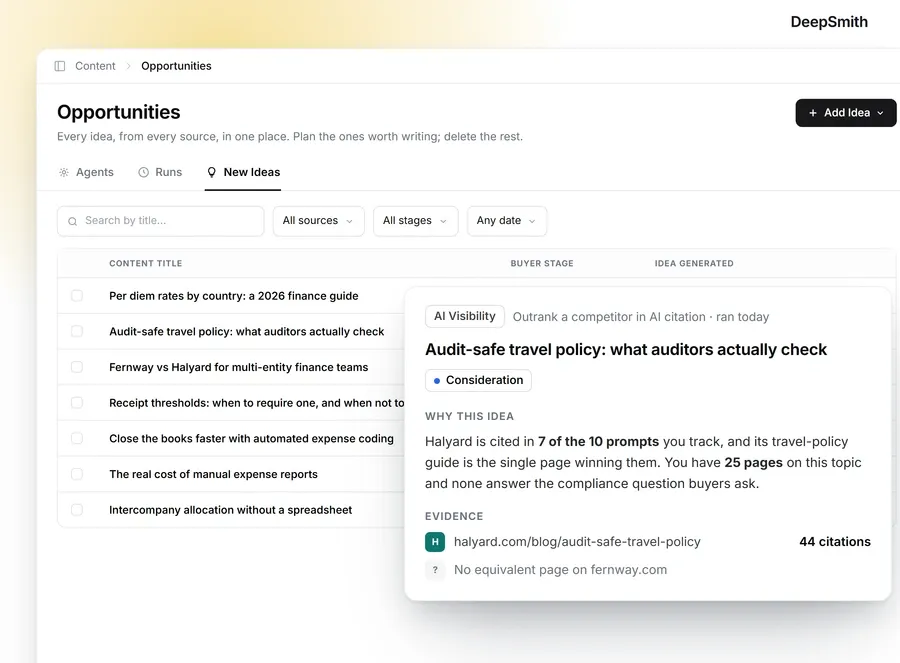
What matters for this decision is what happens after the finding. Opportunity Agents read your visibility data or your Content Map and return content ideas, and each idea carries the data point that justifies it, such as the competitor page winning the citation and the gap on your own site. An idea then moves through New Ideas and Planned Content to Produced Content, and the Writer turns one planned idea into a finished article that is researched, internally and externally linked, and has a cover image and publish-ready metadata. Deep IQ holds your company, product, persona, and voice context so you do not re-brief every piece. Autowrite can write a planned article on its scheduled date without anyone starting the run, and you can review and publish it from Produced Content to WordPress, Webflow, Strapi, Sanity, or Contentful.
A few honest limits help you place it. Pro tracks ChatGPT, Grow adds Perplexity, Scale adds Gemini, and Enterprise covers all ten supported engines, which include Claude, Google AI Overviews, Google AI Mode, Grok, Meta AI, Microsoft Copilot, and DeepSeek. If you need to track Google AI Mode, that points to an Enterprise conversation. A focused ChatGPT program can work well on Pro, which includes 50 tracked prompts and 20 articles a month, though that is a narrow scope and it does not mean other engines are unimportant. The API and the MCP server are read-only, so they let you pull data out but do not create or publish articles. DeepSmith also does not remove your responsibility for factual sign-off, since how much review an article needs depends on your subject and your risk.
Pricing is $99 per month for Pro, $199 for Grow, and $399 for Scale, or $80, $160, and $299 per month billed annually, with custom Enterprise pricing. Those plans include 20, 40, and 90 articles a month, 50, 100, and 200 tracked prompts, and 5, 7, and 10 seats. There is a 7-day free trial and no long-term contract.
A practical way to test either category
Compare the same real workflow instead of two unrelated demos. Pick a representative set of buyer questions across your topics and stages. Open the raw answers and cited pages, and repeat the check instead of trusting one answer. Choose one finding you can act on, then produce the response. With tracking-only that means your existing editorial process, and with tracking-plus-content it means seeing how much context moves into production without you rebuilding it. Time the whole process, not only the first draft, and hold the result to one quality bar, which is whether you would accept and publish it. Then publish it or write down the blocker, and keep measuring under similar settings while you keep your business analytics separate from citation metrics.
The right fit for your team
Here is how I would decide, based on your situation.
Choose tracking-only if you have a dependable team and workflow that can research, produce, approve, and publish the changes the data points to. A GEO dashboard only purchase is a sound choice there, and you keep the production process you already trust.
Choose tracking-plus-content if worthwhile opportunities keep stalling because the same people cannot finish the production work. Check that the platform covers the stages causing the delay, not only the drafting. If you are a small team, GEO tools for startups show how that tends to play out when one person wears the marketing hat. A one-person team can also read about GEO tools for solo founders.
Fix ownership first if nobody can prioritize findings or approve claims. More measurement and more generated content can both turn into unattended queues, and a new tool will not fix that on its own.
Your team type shifts the answer a little. Editorial groups can compare options in GEO tools for content teams, and B2B marketers can look at GEO tools for B2B to see how others handle it. Agencies running several clients have their own constraints, covered in GEO tools for agencies. Larger organizations with heavier approval steps can read about GEO tools for enterprise teams. To see how a score from a tool is built before you trust it, the explainer on how GEO tools score content helps. For the wider list, the full GEO tools roundup is the place to go.
If you decide production is your bottleneck, a good next step is small. Start a DeepSmith free trial, test one real question, look at the visibility evidence, and produce one piece that closes a genuine gap. Nothing in the trial promises citation gains, but you will see how much of the work moves off your plate.
Related guides
- How GEO Tools Score Content: What Is Inside an AI Readiness Score: See what signals typically feed an AI readiness score, such as structure, evidence and entity clarity, and how much weight to give the number.
- Allable Alternatives: 7 Best All-in-One AI Content Tools for 2026: A comparison of seven Allable alternatives (DeepSmith, Writesonic, Scalenut, Frase, Surfer, Semrush, Jasper) for teams wanting one platform across research, writing, SEO, and publishing, with pricing, an honest.
- Asklantern Alternatives: 8 Best AI Visibility Trackers for 2026: Compares eight AI visibility trackers a team can move to from Asklantern, including DeepSmith, Profound, Peec AI, OtterlyAI, Scrunch, Ahrefs Brand Radar and Semrush.
- Brandofy Alternatives: 8 Best AI Brand Visibility Trackers for 2026: Eight Brandofy.ai competitors reviewed on published facts and prices: DeepSmith, OtterlyAI, Peec AI, Profound, Scrunch, Rankscale, Goodie, and the Semrush AI Visibility Toolkit, compared on engine coverage, prompt.
- Cited.so Alternatives: 8 Best AI Citation Trackers for 2026: Eight Cited.so alternatives for tracking which prompts mention your brand and which sources AI engines cite: DeepSmith, Profound, Semrush AI Visibility Toolkit, Peec AI, LLMrefs, OtterlyAI, Rankscale, and.