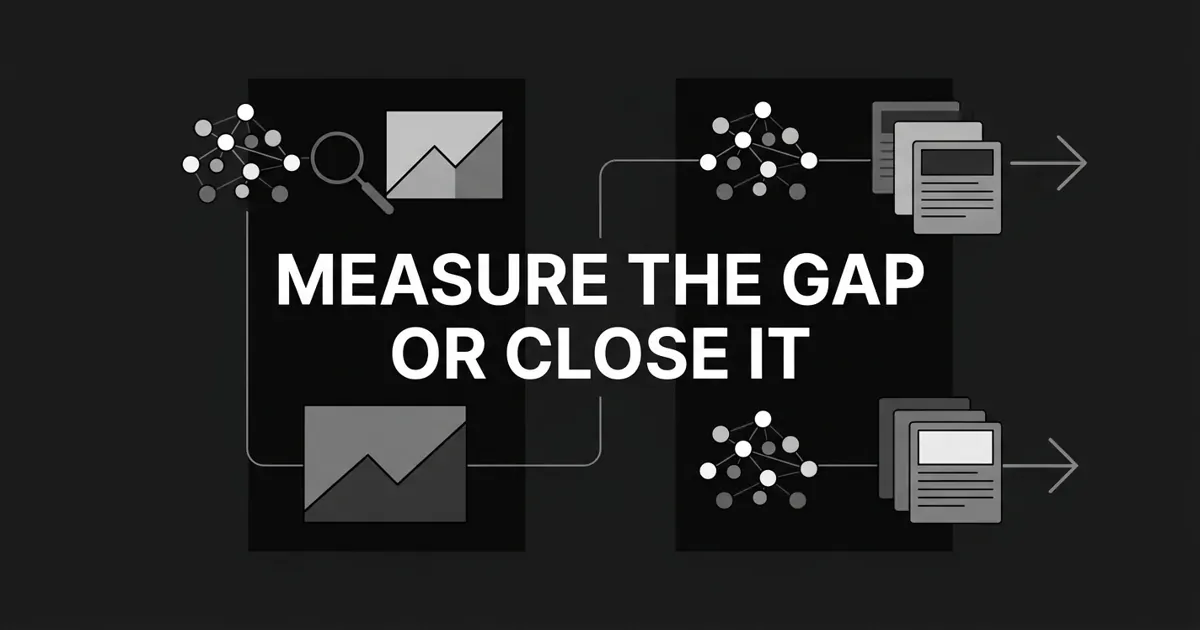
The DeepSmith vs Otterly decision is not a contest between a better and a worse tracker. Both platforms belong to the same emerging category of AEO monitoring tools, the software that measures how often ChatGPT, Perplexity, Gemini, and similar assistants name a brand, cite its pages, and describe it in a particular tone. They separate on a structural question rather than a feature-depth one: what the platform does once the dashboard has identified a gap. Otterly stops at measurement, audit scoring, and recommendation. DeepSmith treats measurement as the first half of a workflow whose second half is a content production pipeline that runs in the same workspace.
For a marketing lead evaluating the two, the useful framing is therefore diagnostic rather than competitive. If the constraint is knowing where the brand is invisible in AI answers, Otterly is a mature and well-recognized instrument for that job. If the constraint is closing those gaps at volume, a monitor that hands back briefs leaves the harder half of the work unaddressed. What follows works through that distinction criterion by criterion and closes with a recommendation by situation.
DeepSmith vs Otterly at a glance
| Dimension | DeepSmith | Otterly |
|---|---|---|
| Positioning | AI search analytics plus content production | Pure-play AI search monitoring and optimization |
| Engines named | Ten, including ChatGPT, Gemini, Perplexity, Claude, Google AI Overviews, Google AI Mode, Microsoft Copilot | Seven: four base engines plus Gemini, Google AI Mode, Claude as add-ons |
| Engine access | Pro: ChatGPT; Grow: adds Perplexity; Scale: adds Gemini; Enterprise and Custom: all ten | Four base engines on every plan; Gemini, Google AI Mode, Claude are paid add-ons |
| Core metrics | Mention rate, citation rate, share of voice, sentiment, visibility trend | Mention frequency, brand position, Brand Visibility Index, sentiment, link citations |
| On-page audit | AEO formatting built into the writing pipeline | GEO Audit Engine scoring roughly 20 factors with remediation steps |
| Content production | Full pipeline to publish-ready articles, plus Autowrite | None; outputs are audits, briefs, recommendations |
| Distribution | Apps Library for channel-native repurposing | Not offered |
| Publishing | WordPress, Webflow, Strapi, Sanity, Contentful, webhooks, Markdown and HTML export | No native CMS publishing |
| Reporting integrations | Not surfaced | Looker Studio, Semrush App Center, CSV, public API, MCP server |
| Country and language | Not publicly published | 50 or more on every plan |
| Entry pricing | Pro, $99/mo ($80/mo annual) | Lite, $29/mo (about $25/mo annual) |
| Trial | 7 days, real data and drafts | 14 days, no credit card |
| Recognition | None surfaced | Gartner Cool Vendor 2025, G2 Top SEO Software Q4 2025, G2 High Performer in AEO, OMR Top Rated GEO Tool |
The two platforms overlap on measurement and diverge on what follows it, on how engine access is priced, and on whether the output is a report or an article.
What Otterly is

Otterly.AI is a Vienna-based platform built for the AI search era, and it markets itself as the highest-rated AI search monitoring platform for tracking how assistants describe, mention, and cite brands. Its scope is deliberate: Otterly AI monitoring measures and recommends, and the company positions it as monitoring plus optimization rather than as a content tool. That is a design decision rather than an omission, and it shapes every other characteristic of the product.
The product organizes around three pillars. Prompt Research organizes buyer-intent prompts and patterns intent across them. AI Search Analytics reports visibility, mentions, citations, sentiment, and competitor benchmarking across the supported assistants. AI Search Optimization runs a GEO audit engine that scores on-page factors and returns recommendations and content briefs.
Underneath those pillars sits a deep feature inventory. Brand Reports break out mention frequency, average brand position, and coverage over time, segmented by prompt and by platform. A Brand Visibility Index composites those signals into a single score, while Domain Ranking and Link Citations show which cited domains the assistants trust most, with link position data attached. The GEO Audit Engine evaluates roughly twenty on-page factors spanning citation readiness, fluency, and technical schema, and outputs remediation steps rather than a bare score. Sentiment Analysis reports how assistants characterize the brand and its competitors, and Agent Analytics tracks AI agent traffic and event volume by plan. One methodological detail separates Otterly AI monitoring from much of its category: data is collected through web-interface interactions rather than API endpoints, which the company argues approximates what a real user sees.
The limitations follow from the same design decision. Otterly does not generate or publish content, so turning a brief into a shipped article stays with the team. It does not tie visibility to traffic, revenue, or pipeline, so attribution has to be assembled elsewhere. Data refresh runs on scheduled crawl cycles, and lighter tiers update weekly rather than daily, which can feel slow relative to API-based competitors. Site crawling, backlink analysis, and keyword rank tracking are out of scope. Third-party reviews also note that sentiment scoring on less-common AI surfaces is less reliable than on the major engines.
What DeepSmith is

DeepSmith is one platform for AI search analytics and content production. It tracks how AI engines answer the questions that matter in a category, identifies where the brand is absent or losing, and produces on-brand articles to close those gaps, all from a shared context layer built during onboarding. It is a production engine rather than a writing assistant, and its output is publish-ready rather than a first draft to rescue.
The measurement side reports mention rate, citation rate, share of voice, sentiment, and visibility trend, with a per-platform breakdown, a competitor leaderboard, and the sources engines cite most. Tracked prompts carry per-prompt mention and citation rates with full answer history, and a Discover Prompts function generates a starter set from stored product, persona, and buyer-stage context. A Pages view attributes citations to specific pages and surfaces the prompts driving them, connecting brand-level visibility data to individual assets, while Competitor Citations shows which rival pages win on which prompts, broken out by platform.

Production is where the platform separates from a pure monitor. Content Studio moves an idea from an always-stocked New Ideas backlog through a Planned Content calendar to the Writer, which turns one planned idea into a finished article with research, internal and external links, a cover image, and publish-ready metadata. Autowrite extends this to unattended operation: an article configured at planning time writes itself on its scheduled date and lands in Produced Content with no one in the app, where review, editing, and publishing run straight to WordPress, Webflow, Strapi, Sanity, Contentful, or custom webhooks. The Apps Library then converts a finished article into channel-native versions for LinkedIn, X, Medium, Substack, newsletter and nurture email, Reddit, Facebook, Instagram, Slack and Discord, WhatsApp, and other channels.

Two supporting layers matter for consistency at volume. Deep IQ stores positioning, per-product profiles, buyer personas, brand voice settings, visual guidelines, and reusable content-type templates, and every module reads from it, so drafts are grounded in the same stored facts rather than re-briefed article by article. Content Map crawls the brand's pages and its competitors' pages onto one shared topic taxonomy, and powers internal linking, coverage and gap signals, and the Pages view.
The limitations are real. Engine coverage is tier-gated, and the entry plan measures ChatGPT only, so broad cross-platform measurement requires moving up the ladder. There is no standalone GEO audit score for existing pages; AEO formatting is applied at write time rather than diagnosed retrospectively. Country and language coverage is not published, and DeepSmith carries no third-party league-table recognition of the kind Otterly has accumulated. Publish-ready is also not the same as zero oversight; sensitive or regulated content still warrants human review before it ships.
Engine coverage compared
The headline numbers mislead in both directions. Otterly markets seven engines, DeepSmith names ten, and neither figure describes what a given plan actually buys until the purchasing conditions are examined.
Otterly includes four base engines on every plan: ChatGPT, Google AI Overviews, Perplexity, and Microsoft Copilot. Gemini, Google AI Mode, and Claude are sold as paid add-ons whose price scales with the plan tier. Seven is therefore a ceiling reachable with additional spend, not a default entitlement. DeepSmith's ten engines are similarly laddered, with Pro measuring ChatGPT only, Grow adding Perplexity, Scale adding Gemini, and Enterprise and Custom covering all ten, Google AI Overviews, Microsoft Copilot, Grok, Meta AI, and DeepSeek among them.
The apples-to-apples question is which engines the specific plan under consideration actually includes. On that basis Otterly's base four beats DeepSmith's entry one and its Grow two, so a team buying at the bottom of either ladder sees more surfaces from Otterly. Higher up the ladder the comparison inverts: the three engines Otterly meters as add-ons are bundled into the DeepSmith tiers that name them, and DeepSmith's full set is the wider of the two. Copilot and Google AI Overviews are the clearest case of that trade, included in Otterly's cheapest plan but sitting on DeepSmith's Enterprise and Custom tiers. A team that needs Claude or Gemini should price the add-ons on Otterly and compare that total against the DeepSmith tier that includes them natively. Any serious evaluation of cross-platform visibility trackers should run this exercise against the tier being bought rather than the marketing list.
Pricing compared
The two vendors price for different buyers, and the entry points are far enough apart that the comparison only becomes meaningful mid-range.
| Plan level | DeepSmith | Otterly |
|---|---|---|
| Entry | Pro, $99/mo ($80 annual): 20 articles, 50 prompts, ChatGPT | Lite, $29/mo (about $25 annual): 15 prompts, 1 workspace, 4 base engines |
| Mid | Grow, $199/mo ($160 annual): 40 articles, 100 prompts, adds Perplexity | Standard, $189/mo (about $160 annual): 100 prompts, unlimited workspaces, 4 base engines |
| Top published | Scale, $399/mo ($299 annual): 90 articles, 200 prompts, adds Gemini | Premium, $489/mo (about $422 annual): 400 prompts, unlimited workspaces, 4 base engines |
At the bottom of the range Otterly is substantially cheaper, and $29 per month for fifteen prompts is a genuinely low barrier for a solo marketer testing whether AI visibility deserves budget at all. DeepSmith has no comparable entry point, because its entry tier bundles twenty articles per month alongside fifty prompts.
The middle tier is where the comparison is closest. Standard at $189 and Grow at $199 both carry one hundred tracked prompts at nearly the same monthly price. The difference is what accompanies those prompts: Otterly adds unlimited workspaces, daily monitoring, and the full audit and reporting stack, while DeepSmith adds forty published articles per month and a second tracked engine. Neither is strictly better value; they are answers to different bottlenecks.
Two pricing mechanics deserve attention. Otterly's add-on ladder compounds quickly, and full engine coverage on Standard, meaning Gemini, Google AI Mode, and Claude stacked on top, lands near $416 per month before any extra prompts, above DeepSmith's top published plan. There is also no prompt rollover or pooling, and extra capacity is sold at $99 per month for one hundred additional prompts. On the DeepSmith side, annual billing reduces the effective rate by roughly nineteen percent against Otterly's fifteen percent, with no long-term contracts. A complete cost comparison should also weigh the internal hours each tool removes, since the total cost of an article is dominated by labor rather than software.
Audit depth versus production capacity
This is the structural divide, and it is more consequential than any pricing line.
Otterly's GEO Audit Engine is a mature diagnostic instrument. It scores roughly twenty on-page factors, spanning citation readiness, fluency, and technical schema, and returns remediation steps for a specific page. Paired with content briefs and crawlability checks, it produces a defensible work queue for a team that already has writers and editors to execute against it.
DeepSmith offers no equivalent retrospective score. Its AEO handling is applied during writing rather than diagnosed afterward: citation-ready structure, concise answers near the top of sections, clear heading hierarchy, schema markup, keyword coverage, internal linking, and metadata are produced inside the pipeline. The Pages view then reports which pages AI engines actually cite and which prompts drive those citations, an outcome measure rather than a readiness score. The two approaches answer adjacent questions. Otterly asks whether an existing page is likely to be cited; DeepSmith asks which pages are being cited and produces new ones designed to be.
Production capacity is the other half of the divide, and here the asymmetry is absolute rather than a matter of degree. DeepSmith publishes twenty, forty, and ninety articles per month across Pro, Grow, and Scale. Otterly publishes none, by design. A team that has identified more gaps than it can staff writers to fill will feel that difference immediately, and the relevant comparison is not between two subscriptions but between a platform and the cost of additional writers or an agency retainer. A team with editors already idle for want of direction will not feel it at all.
Integrations, reporting, and multi-brand operation
Otterly's integration surface is the broader of the two on the reporting side. A Looker Studio connector, presence in the Semrush App Center, CSV export, a public API, and an MCP server let technical teams and agencies pull visibility data into existing dashboards and client reporting pipelines. Unlimited workspaces on Standard and Premium support multi-brand delivery without per-client subscriptions. For an agency whose deliverable is a monthly visibility report, this combination is difficult to beat at the price, and it is where Otterly outperforms most AEO monitoring tools at its tier.
DeepSmith's integration surface points the other way, toward delivery rather than reporting. Direct publishing to WordPress, Webflow, Strapi, Sanity, and Contentful plus webhook delivery means the output leaves the platform as a live page rather than a data export. Multi-Workspace supports fully isolated brands or clients, each with its own Deep IQ context, content, and independent billing, which suits an agency whose deliverable is published content rather than a dashboard. The absence of a Looker Studio connector or published API documentation is a real gap for teams that consolidate marketing reporting in one place.
Country and language coverage separates the two more sharply than either integration list. Otterly publishes coverage of fifty or more countries and languages on every plan, including Lite. DeepSmith does not surface equivalent coverage publicly, so a brand operating across non-English markets should confirm coverage directly before assuming parity.
Strengths and limitations
Otterly's strengths concentrate in measurement maturity and market validation. It carries Gartner Cool Vendor 2025 recognition in AI in Marketing, G2 Top SEO Software placement for Q4 2025, G2 High Performer status in answer engine optimization, and OMR Top Rated recognition as a generative engine optimization tool. It offers the broader engine set on entry and mid plans, a deep on-page audit, published multilingual coverage, a low entry price, a fourteen-day trial, and the stronger reporting integrations. Its limitations are the absence of content production, the absence of traffic or pipeline attribution, add-on pricing that escalates for the marquee engines, weekly rather than daily refresh on lighter tiers, and reduced sentiment reliability on niche AI surfaces.
DeepSmith's strengths concentrate in production and consistency. It converts monitoring signal into finished articles at twenty to ninety pieces per month, grounds every draft in a reusable brand context layer, schedules unattended production through Autowrite, publishes directly into major content management systems, and generates channel-native distribution assets. Its limitations are tier-gated engine access that gives the entry plan ChatGPT alone and puts Copilot and Google AI Overviews on the Enterprise and Custom tiers, no standalone audit score, unpublished country and language coverage, a shorter seven-day trial, and no comparable league-table recognition. Neither vendor should be judged on marketing claims alone, and neither controls or guarantees rankings, citations, traffic, or revenue.
Which should you choose
The decision resolves by situation rather than by an overall winner, and the situations are unusually easy to distinguish because the products do not overlap on the second half of the workflow.
Otterly is the stronger fit when the binding constraint is diagnosis. A team with writers and editors already in place, an agency scoped to measurement and reporting, a solo marketer validating whether AI visibility warrants budget, or a brand operating across many countries and languages will find Otterly AI monitoring aligned with the actual need. The GEO audit depth, the base engine set including Copilot and Google AI Overviews, the reporting integrations, and the $29 entry price make it the more efficient instrument for that job. Teams that require Copilot or AI Overviews measurement on a modest budget will reach those engines sooner on Otterly, since DeepSmith carries both but only from Enterprise upward.
DeepSmith is the stronger fit when the binding constraint is production. A team that has already identified more content gaps than it can staff writers to fill, that wants monitoring signal to feed a writing pipeline without a handoff, that publishes into WordPress or a similar system on a regular cadence, or that needs distribution assets generated alongside each article will get more from a platform built to do both. For a marketing lead searching for an Otterly AI alternative because the briefs pile up faster than the team can execute them, that gap is the whole reason to look.
Budget shape is the practical tiebreaker at the margin. A team with roughly $200 per month and one hundred prompts to track is choosing between unlimited workspaces plus a mature audit engine and forty published articles plus a second engine. Which is the better purchase depends on whether the next hour of team time goes into deciding what to write or into writing it.
The deepsmith or otterly question therefore reduces to a prior question about where the work stalls. If nobody knows which prompts the brand loses, Otterly resolves that faster and cheaper. If the gaps are already documented and nothing gets published, monitoring alone will not move the number.
For teams in the second situation, the fastest way to test the claim is on live data rather than a demo. A DeepSmith free trial surfaces real visibility data and real drafts within seven days, which puts the production claim against a brand's own gaps.