Your competitor just published their fifteenth blog post this month. They sponsor every podcast in your category and show up on every relevant keyword you type into Google. Meanwhile, you're sitting there with a small team, a tight budget, and a product that's genuinely better for your specific customer.
But nobody knows you exist. I’ve been there. It’s a frustrating place to be.
You can't out-spend them. But you can out-target them.
This isn’t about building a vanity metric for your board deck. This is about using share of voice as an operating system. Early-stage SaaS teams win by building excess share of voice in the narrow corners where big competitors are weakest, then compounding that advantage through repeatable SEO and smart distribution. Let's build that playbook.
Why "share of voice" is the only fight smaller SaaS can win (if you define it correctly)
The trap: copying big competitors' channels and budgets
When we see a competitor dominating, our first instinct is often to copy their strategy with a smaller budget. Write more blog posts. Run some paid ads. Post on LinkedIn. It feels strategic, but it’s a resource race you are guaranteed to lose. I’ve made this mistake myself.
Big competitors have brand recognition that boosts click-through rates on every channel. They have domain authority built over years and dedicated teams for each channel. When you spread your limited budget across all those same places, you're just permanently underinvested everywhere.
The goal: create excess share of voice in a narrow wedge, then expand
The winning move is concentration. You have to pick a specific set of keywords, a specific customer problem, a specific buying stage, and just dominate that before you even think about expanding.
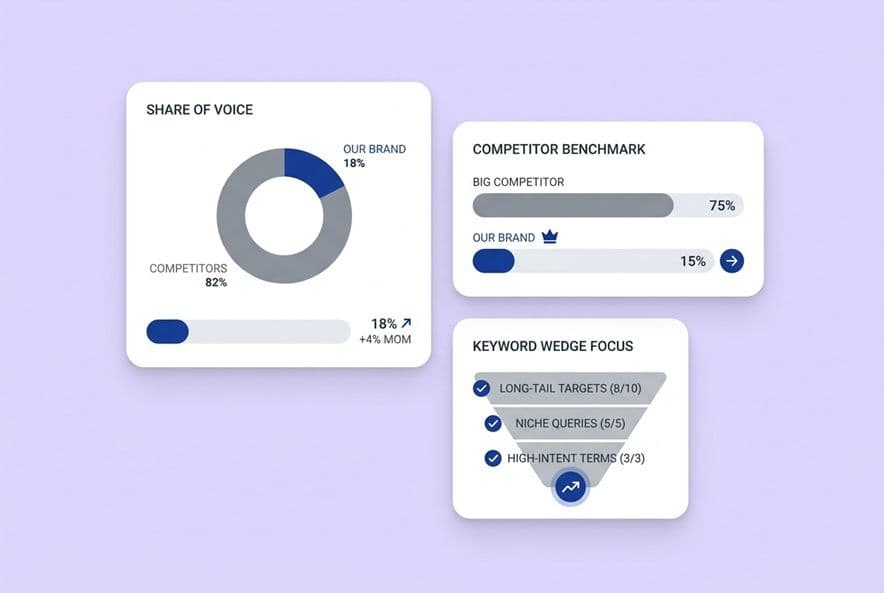
When your share of voice in that tight niche is higher than your actual market share, you create what’s called excess share of voice (ESOV). That gap is your growth engine.
Share of voice vs market share (and when SOV predicts growth vs lies to you)
Definitions that matter: spend-based SOV vs conversation SOV vs SEO SOV
"Share of voice" gets thrown around loosely. For us, three definitions matter.
- Spend-based SOV: Your ad spend as a percentage of total category spend. This is useful for paid search, but it’s rarely the right primary metric for a lean team.
- Conversation SOV: Your brand mentions as a percentage of all mentions in your category. This can be noisy for B2B SaaS. A viral tweet isn’t always a buying signal, as fun as they are.
- SEO SOV (organic visibility share): The percentage of available clicks from your target keyword set that go to your site. This is the one. This is where you should focus. It compounds, it's measurable, and it maps directly to real moments in the buying journey.
For most early-stage B2B SaaS teams, SEO SOV is your primary dial. You can use conversation SOV for monitoring, but not for optimizing.
ESOV in plain English for SaaS categories
The original research on this came from traditional media. The idea is that if your share of voice exceeds your market share, you tend to grow. The mechanics hold true in SaaS, even without TV budgets.
If you own 2% of the market but capture 15% of the visible organic search traffic for your core buying-intent queries, you're punching way above your weight. That visibility gap is what feeds your pipeline over time. The trick is keeping your "battlefield" small enough that a 15% SOV is even possible. Scope selection is everything.
Three situations where rising SOV won't create growth
A rising SOV is a leading indicator, not a guarantee. I’ve seen teams get burned by this, so watch out for three common traps.
- Wrong audience visibility: Your SOV goes up, but the pipeline doesn't. You’re ranking for terms your ideal customer profile (ICP) isn't searching for.
- Wrong intent match: You get a lot of traffic from informational content that never connects back to your product's value. You get visits, but no conversions.
- Negative sentiment amplification: You gain more visibility, but the conversation around your brand is skeptical or hostile. This is a special kind of painful.
Choose your battlefield: the SaaS-specific SOV scope that makes "stealing" possible
This is the part where most SOV advice falls apart. People tell you to "measure your share of voice" but don't tell you that deciding what to measure is 80% of the work.
Pick the right competitor set (category giants vs true deal competitors)
Your category giants are not your real competitors for every deal. A 10,000-person enterprise software company might show up in the same Google searches you do, but are they really who you lose deals to at the point of purchase? Probably not.
Go open a spreadsheet and build two competitor lists. One is your visibility competitors, meaning whoever ranks for your target keywords. The other is your deal competitors, the ones prospects actually evaluate alongside you. For SOV, you need to know where your visibility competitors are weak. For positioning, you need to know how you win against your deal competitors.
Define your "wedge": ICP + use case + buying stage keywords
Your wedge is where three things intersect: who you serve best, the specific problem you solve for them, and what they search for when they're close to buying.
If you have a project management tool for engineering teams at Series B companies, your wedge isn't "project management software." It's "sprint planning tool for engineering teams" or "Jira alternative for startups." This is where you calculate your SEO SOV. Your keyword universe should be 30–100 high-intent terms that reflect actual buying searches, not broad head terms where a huge domain will always beat you. You need specific, longer-tail queries where you can actually compete.
And you should weight those keywords by traffic value and buying intent. A keyword with 200 searches a month and high commercial intent is worth much more to you than a 5,000-search informational term with no path to conversion.
Channel prioritization for lean B2B SaaS: SEO, paid search, social, PR
If you're wondering where to put your effort, here’s a rough rule of thumb I’ve learned.
- SEO SOV first: It compounds. Every article you rank has a cumulative effect on your authority.
- Paid search second: Use it to test positioning and cover critical gaps while your SEO builds. Impression share is a clean metric here.
- Social and PR third: These are useful for monitoring brand sentiment, but they're less useful for primary growth unless you have a really strong community play.
Don't try to "do all channels" equally. Concentrated attention in SEO produces outsized returns for resource-constrained teams like ours.
The timeframe rule: what to track weekly vs monthly vs quarterly
- Weekly: New content published, keyword rank movement on your wedge terms, and any brand mention spikes that need a look.
- Monthly: Your SEO SOV percentage across the full wedge keyword set, what your competitors published, and your traffic-to-pipeline conversion rate.
- Quarterly: The full SOV snapshot across all channels, a review of your competitor set, and decisions on whether to expand your wedge.
The real advantage isn't just in the analysis. It's in shipping consistently. A tight keyword set, a clear cluster, a monthly scoreboard, and a weekly publication cadence will out-earn any slow-moving competitor, regardless of their budget. That content moat gets built one article at a time.
And that only happens when publishing is the default, not the exception. This is where systems matter. DeepSmith's Autowrite feature exists for exactly this reason: to keep the content pipeline moving on schedule, even when you’re deep in product or fundraising.
Build a unified SOV scoreboard (so you can make decisions, not slides)
The normalization problem: why channel SOV metrics don't compare directly
Organic click share, paid impression share, and social mention percentage are all measuring different things. You can't just average them. What you can do is put them side-by-side with a "trend" and a "next action" column. This way, you're never confused about what to do with the number.
A practical "one-page" SOV scoreboard (table)
| Channel | Metric | Scope | Baseline | Target | Trend | Next Action |
|---|---|---|---|---|---|---|
| SEO | Organic click share | 60-term wedge set | 4% | 10% | ↑ | Expand cluster to adjacent terms |
| Paid Search | Impression share | Core 15 buying-intent terms | 18% | 25% | ↑ | Hold; reallocate to SEO |
| Social | Brand mention % | Category keywords | 6% | 7% | ↓ | Check sentiment; flag review |
| Review Sites | Share of reviews | G2/Capterra category | 8% | 15% | ↑ | Request reviews from recent wins |
Update this scoreboard monthly. Use it weekly to ask one question: "What moved, and what do we do about it?"
The bigger failure here isn't measurement. It’s when insights sit in a dashboard and never become actual work. If you're tracking SOV gaps but they're not turning into published assets fast, that's where the system breaks. DeepSmith's Topic Explorer is built for this: find the gap and push it to production in one step, instead of letting your strategy spreadsheet get stale in a browser tab.
How to turn SOV movement into next-week actions
A few decision rules to guide your response.
- SEO SOV rises but pipeline is flat? Your content is getting seen but isn't converting. Check the conversion paths on your high-traffic pages. Are you sending high-intent traffic to a page with no clear next step? Visibility without a conversion architecture is just a leaky bucket.
- Paid impression share drops? This usually means either competitors raised their bids or your Quality Score slipped. Review your ad relevance against your landing page content. It can also be a sign that a competitor changed their messaging, which you need to analyze.
- Social mentions spike suddenly? Open your monitoring tool first, not your content calendar. Before you react, you have to diagnose why it happened. Is it good news (an influencer shared you) or bad news (an outage)? The right response depends entirely on the cause.
SEO share of voice: the compounding lever bigger competitors hate
This is where the real work lives.
How to calculate SEO SOV that reflects reality (keyword universe + weighting)
Start with a keyword set of 50–80 terms that map to your wedge. Pull estimated click volumes. Assign a simple weight to each term (a 1–3 scale works fine: 3 = high-intent buying signal, 1 = early awareness).
SEO SOV = (your weighted clicks) / (total weighted clicks across you + competitors) × 100
Run this monthly. If you add new terms to the universe, restate your baseline so you're comparing apples to apples. And please, avoid vanity keywords (broad, category-wide head terms) and branded terms. They just inflate your number without reflecting competitive visibility.
The "wedge cluster" method: win a small cluster end-to-end
Pick one micro-topic. Build a cluster around it. That means one strong pillar page targeting the core query, three to five supporting pages targeting specific sub-questions, and a tight internal linking structure connecting them all.
The goal is for Google to see you as the authority on this narrow topic, not just as a site with one article that touches on it. Cluster depth signals topical authority in a way a single article never can. Win the cluster, then pick an adjacent one and do it again.
Tactics that move SEO SOV in competitive SERPs
Here’s what actually works when larger domains already hold the top spots.
- Comparison and alternatives pages: "[Competitor] vs [Your Product]" and "Best [Competitor] Alternatives" pages consistently attract high-intent, late-stage buyers. Incumbents often hate writing these pages because they don't want to acknowledge their competitors. Their loss is your gain.
- Pain-point content at the specific ICP level: Not "how to manage projects," but "how Series A engineering teams manage sprint planning without a dedicated PM." Specificity beats domain authority at the long-tail level.
- Structured data and SERP features: Use FAQ schema, how-to markup, and table formatting to compete for featured snippets and People Also Ask boxes. A strong answer can beat a strong domain.
- Refresh underperforming articles: A page stuck on page two is often just one focused update away from page one. Refreshes can yield faster SEO SOV gains than new content.
- Internal linking as a compounding advantage: Every time you publish a new cluster piece, link it to and from existing content. This is how search engines learn your topical structure. It’s often the difference between a cluster that works and one that doesn't.
On that last point, the manual work of finding and inserting the right internal links is where good SEO strategy often dies. DeepSmith's Content Studio handles this by scanning your site during the drafting process, so every article ships already connected to your cluster structure.
Diagnose why you're not gaining SEO SOV (quick checklist)
- Intent mismatch? Your content answers a different question than the keyword implies. Check what's actually ranking.
- Thin information gain? Your article says the same things as page one. Add an original take or a different structure.
- Weak cluster structure? Your pillar page is lonely. Build out the supporting pages and interlink them.
- Domain authority gap too large? You're targeting head terms again. Narrow your scope to more specific queries.
- Slow index / crawl issues? Your new content isn't being crawled. Check Google Search Console.
Don't let visibility backfire: negative SOV, sentiment, and category conflicts
More visibility means more surface area for criticism. Most playbooks ignore this, but it’s a huge mistake.
What "negative SOV" looks like in B2B SaaS
It might be a competitor's comparison piece that misrepresents your pricing, a customer complaining during an outage, or a negative G2 review from a churned user. Each one is a visibility event, just not the kind you wanted.
For an early-stage company, negative SOV can be devastating because you don't have years of positive brand signals to dilute it. One bad review thread can haunt your search results for months.
A lightweight mitigation plan founders can actually run
You don't need a PR firm. You just need a simple system.
- Set monitoring triggers: Use Google Alerts or a social listening tool for your brand name and common misspellings. Check weekly.
- Assign response ownership: Who replies to reviews? It needs to be a real person with a name and a face.
- Create counter-programming content proactively: Publish transparent pricing pages, honest comparison content, and case studies before a crisis. That way, positive content is already indexed when a negative mention spikes.
- Respond to legitimate criticism publicly and fast: A complaint handled well in public can build more trust than a perfect review. Don't hide from negative signals; address them.
Emerging channels: AI-powered search and the next version of share of voice
From rankings to answers: what changes in AI-driven discovery
When a buyer asks an AI assistant for a recommendation, your brand either appears in the answer or it doesn't. That's a new kind of share of voice: AI visibility share, or citation share. You don't "rank" in the traditional sense. You get cited.
The mechanics are still evolving, but the pattern is clear. AI systems tend to cite content that is well-structured, well-sourced, and authoritative on a specific topic. This means all your SEO SOV work, like cluster strategy and structured data, directly feeds your AI visibility.
What to track now (without boiling the ocean)
Start here, it's not that complicated.
- Define 10–15 prompts a buyer in your category would actually type into an AI assistant.
- Run them monthly and track whether your brand appears, and where.
- Track competitor citations in those same prompts to get a baseline.
- Prioritize citation-ready content formats: direct answers, structured comparisons, and clear product positioning.
DeepSmith's SEO to AEO Shift explains how to structure content for AI citations, so you can monitor if you're showing up in AI answers instead of finding out you're invisible when a prospect tells you.