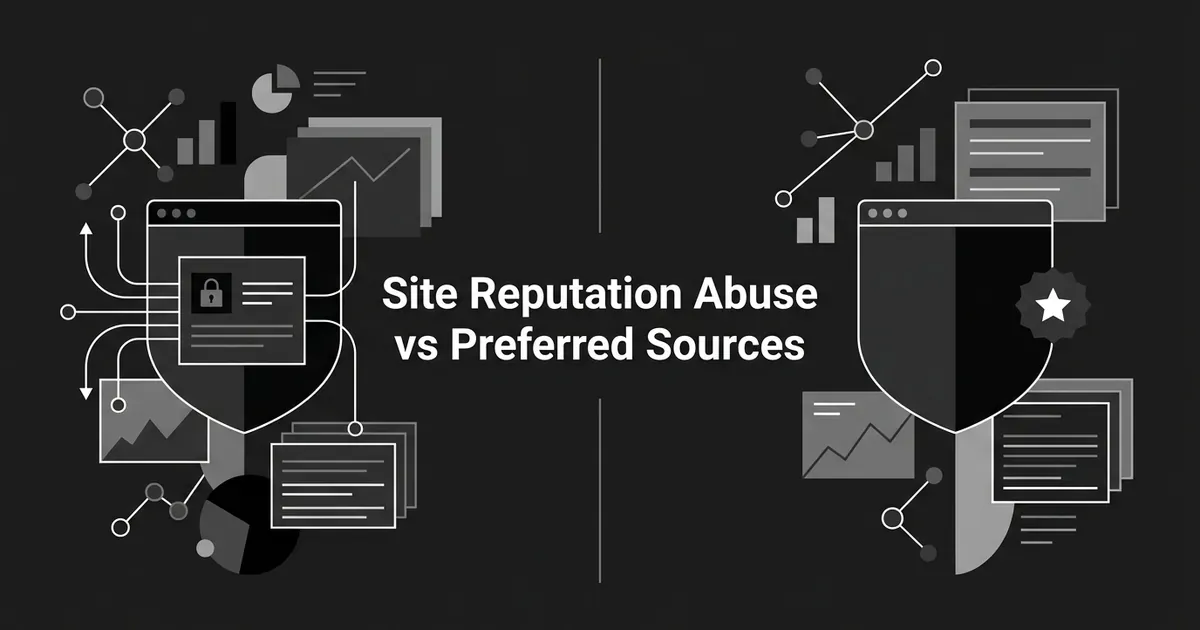
Google's site reputation abuse policy addresses third-party content published on an established website mainly to benefit from that website's existing ranking signals, rather than ranking on its own merits. That is the whole policy in one sentence, but it gets confused with something else almost every time it comes up: Google Preferred Sources, a setting a reader controls, not a trust score Google hands out. These two things get lumped together because they both involve the word "trust," but they answer completely different questions. One is Google reviewing publishing arrangements that try to borrow a site's reputation. The other is a person deciding which websites they personally want to see more of.
If you run content for a brand and you've heard both terms thrown around in the same breath, worth untangling them properly, because the advice for one is close to useless for the other. You'll also still hear this policy called the "parasite SEO policy" in a lot of SEO writing. That's industry shorthand, not Google's own name for it, and it points at the same mechanism described below.
What is Google's site reputation abuse policy?
The policy addresses third-party content hosted mainly to benefit from the established site's ranking signals. Third-party content by itself is not a violation. Google says so directly: having content written by someone outside your organization is not inconsistent with the policy on its own.
What matters is why that content is there. Google's current documentation calls it the "site reputation policy" (the older, more descriptive phrase "site reputation abuse" is still useful shorthand, and it's the one most people search for, so we'll keep using it here too).
Third-party content, in Google's definition, is content created by someone separate from the site hosting it: users of the site, freelancers, white-label services, anyone not directly employed by the host. That's a definition of who wrote it, not a verdict on whether it's a problem. A freelancer writes plenty of legitimate editorial work. A white-label arrangement or a sponsored section needs to be looked at on its own circumstances, not waved through or rejected just because of the label attached to it.
Google explained the reasoning behind the policy back in March 2024: a visitor's trust in a website doesn't automatically transfer to content that happens to sit on that website for other reasons. Google's own example is a trusted educational site hosting sponsored payday-loan reviews written by a third party, the same reviews distributed across other sites too. The site's established reputation (built on its real educational content) gets borrowed to help those reviews rank, and a visitor who trusts the host site has no reason to extend that trust to a payday-loan review that landed there mainly for ranking purposes.
A second published example: a medical website hosting a low-quality "best casinos" advertising page from a third party, not integrated with the rest of the site, placed there to take advantage of the medical site's ranking signals. Same pattern. The content doesn't belong, and it's there because of what the host site has already earned, not because it fits.
Takeaway: having outside writers, partners, or sponsored sections is not automatically a problem. The question Google is actually asking is why that content is there and who it's really for.
Which publishing arrangements cross the line?
The presence of a freelancer, an affiliate link, a sponsorship label, or a partner doesn't settle anything by itself. What Google looks at is purpose and circumstances, and the current guidance is more detailed about this than the original 2024 announcement was.
A few things Google explicitly says are not, on their own, inconsistent with the policy: wire-service or press-release content, news sites carrying syndicated stories from other news publishers, forums and comment sections, columns and opinion pieces, advertorial or native advertising meant to share content with readers rather than manipulate rankings, affiliate links handled appropriately, and third-party ad units running through a page. Google calls this list non-exhaustive, meaning there are other legitimate situations too.
That matters because it's easy to read "site reputation abuse" and assume Google is hostile to third-party content in general. It isn't. Freelance work alone is not a violation, and Google says so in its own FAQ. Affiliate content alone is not a violation either; the policy was never meant to target affiliate monetization as such. The appropriate treatment of links still matters, but having affiliate links on a page doesn't put that page in scope just because it has them.
This is also where the "parasite SEO policy" label gets misused the most: it gets stretched to cover almost any third-party content a site hosts, which isn't what Google's actual guidance says. Google's current guidance even includes an example of a news site launching a brand new cooking section with an original, authored affiliate article from a freelancer, something it describes as an unlikely-action scenario. A new editorial subject area, launched the normal way, is not automatically a red flag just because it's new and the content isn't written in-house.
Where it gets more complicated is editorial oversight. Google clarified in November 2024 that first-party involvement, including a host reviewing or approving third-party content, does not automatically excuse an arrangement whose main purpose is exploiting the host's ranking signals. An editor glancing at a page and signing off isn't the same thing as genuine editorial integration, and Google said plainly that it would look at the substance of the arrangement rather than take a site's description of its own process at face value.
But the current, more detailed guidance does consider the host's actual contribution: its editorial input, how the content is presented, who is responsible for it, and whether the same content is appearing elsewhere too. So the honest answer sits between two wrong ones. "Oversight makes any partnership safe" is wrong. "Oversight never matters" is also wrong. What counts is whether the host is genuinely contributing to and standing behind the content, not just stamping it.
Takeaway: a nominal sign-off doesn't substitute for actually evaluating whether an arrangement is built around reader value or around borrowed ranking signals.
How does Google enforce the policy now?
When Google's systems flag a part of a site as potentially out of line with the policy, that section goes through human review. If a manual action results, the site owner finds out through the Manual Actions report and the Search Console message center, and from there they can fix the issue and request reconsideration, with mediation available to eligible sites after that.
What's new, as of August 30, 2026, is that enforcement now differs by where the person searching is located. Google announced this change on August 28, following discussions with the European Commission. It also said in that announcement that it's concerned an overly broad reading of the Digital Markets Act could get in the way of protecting search quality. That's Google's stated position, not a legal ruling, and it's worth treating it that way.
Outside the European Economic Area, a site reputation manual action can still directly affect the ranking of the relevant portion of a site, while Google says the rest of the site is unaffected by that specific action. Inside the EEA, the impact of that manual action no longer applies to what EEA users see. Instead, the affected section may get separated out in Google's systems so that, over time, it ranks on its own rather than riding on the rest of the domain. Google also says it's lifting earlier EEA actions under this policy, with those sections moving toward that same independent treatment.
That is a meaningfully different thing from "Google stopped enforcing the policy in Europe," which overstates what actually changed. The manual-action penalty doesn't apply there anymore, but separate categorization is still a real, ongoing consequence, and it can still change how a section performs compared to when it was riding on the domain's broader signals. Worth being precise about this if you're explaining it to a client or a leadership team, because the two descriptions lead to very different expectations.
A few things Google's guidance is clear don't fix an existing issue: noindexing the affected content doesn't automatically remove a manual action (you still have to go through Search Console and explain what you did), and moving the content to a different subdirectory or subdomain on the same site doesn't resolve the underlying issue either; Google is explicit that this can look like an attempt to get around the action rather than a genuine fix. Moving content to a different, already-established site can clear things up for the original host while creating the same problem somewhere else. A genuinely new domain, with no existing reputation, is far less likely to run into this policy, but that's a different situation, not a guarantee, and an existing manual action still needs its own reconsideration process.
Takeaway: where your readers are searching from now changes the real-world consequence of an action, and the geography matters more than it used to.
What does Google Preferred Sources actually change?
Preferred Sources lets a reader pick websites they want to see more often, in the experiences Google supports for this. For Top Stories, Google's publisher documentation says a selected site's fresh, relevant content is more likely to appear there, carrying a small preferred badge next to it. For AI Mode and AI Overviews, selected sources can be highlighted the same way, a feature Google rolled out starting in May 2026.
This is a reader's own choice, recorded by Google and applied to that reader's results. It is not Google publicly endorsing a site, and it isn't a trust score that shows up for every visitor regardless of what they've selected. Readers still see plenty of content from sites they haven't selected, and they can add or remove sources from their list whenever they want, through either the star-style control next to Top Stories or the Source preferences page in their Google account's personalization settings.
Preferred Sources is global now, which is a real change from where it started. It launched in the US and India in August 2025, expanded to worldwide English-language availability by the end of that year, and reached full multi-language global availability for Top Stories by the end of April 2026. The AI Mode and AI Overviews rollout followed in May 2026, available wherever those features themselves are available.
Google has published a couple of adoption figures worth knowing, with the right caveats attached. More than 200,000 unique sites had been selected as of the April 2026 announcement, and that grew past 345,000 by the May 2026 one. Those are counts of distinct sites selected, not counts of users or a measure of resulting traffic, and the two numbers are separate snapshots in time rather than figures that add together. Google has also said that people are about twice as likely to click through to a source once they've marked it preferred, in both the April and May announcements. That's a real, repeated figure from Google, but it describes people who already chose to prefer a publisher, so it's measuring interest alongside the preference itself, not proving that adding a "prefer this site" button on your own blog will double your traffic.
Takeaway: a preferred badge reflects one reader's choice, applied to that reader. It's not a ranking signal Google is handing out to everyone who sees your page.
Can publishers influence source preferences?
Publishers can make it easier for readers to select them, but they can't select a reader's sources for them. Google's current publisher guide lays out three ways to invite the choice: a standard JavaScript button that renders Google's own styled interface in a couple of lines of code, a more advanced JavaScript integration for a custom look, or a plain deeplink that sends readers straight to the source-preferences tool, usable in a newsletter, a social post, or an email footer for sites that can't add a script.
Eligibility has some real limits. Google's guide supports selection at the domain or subdomain level, not individual folders or subdirectories, so a single blog section within a bigger site isn't separately selectable the way the whole domain or a dedicated subdomain can be. Google also notes that sources which aren't updated with any regularity may not show up in the selection tool at all. For a site to appear as a preferred source inside AI Mode or AI Overviews specifically, it also needs to be included in Search's generative AI features through Search Console.
None of this is complicated to set up, and it's a legitimate audience-development move: inviting readers who already like your content to see more of it. But it's a different project from managing policy risk around third-party content, and it's worth keeping the two separate in how your team thinks about them. Nothing in Google's published guidance says that adding the button, or picking up preferred-source selections, changes how a site is evaluated under the reputation policy in any direction.
Takeaway: promoting Preferred Sources is an audience-relationship tactic you can run today. It has no documented connection to ranking position or to how a reputation review comes out.
What should marketing teams do differently?
Treat these as two separate jobs, because they get decided by different people for different reasons. Reviewing a third-party publishing arrangement, a sponsored section, or a white-label partnership is a policy-risk and editorial-governance question: who actually creates and controls the material, what the host site genuinely contributes, how it's presented, who's responsible for it, and whether the business case depends mainly on borrowing the host's existing search visibility. Promoting Preferred Sources is an audience-development question: giving the readers who already value your content an easy way to tell Google they want to see more of it.
Keep your measurement honest across both, too. A click on a "prefer this source" prompt is not automatically a completed selection. A selection is not automatically a visible impression in someone's results. An impression is not automatically a citation in an AI answer. Each of those is a separate step, and Google's own public figures don't connect all the dots between them, so don't let an internal report imply they do.
The same discipline applies to AI visibility more broadly. The confirmed surfaces for Preferred Sources are Google's own AI Overviews and AI Mode. Google's announcements don't establish anything about how ChatGPT, Perplexity, or other AI tools handle source preference, and there's no reason to assume a Google setting carries over to a platform that has nothing to do with it.
Borrowing a publisher's ranking advantage and earning a reader's preference are not the same move, and they shouldn't be sold internally as if they were. Google is addressing the first through a policy with real, region-dependent consequences, and supporting the second through a setting an individual reader controls. Neither one is a shortcut to guaranteed search or AI visibility, and the clearest way to use both terms correctly is to keep asking which question you're actually answering before you reach for either one.