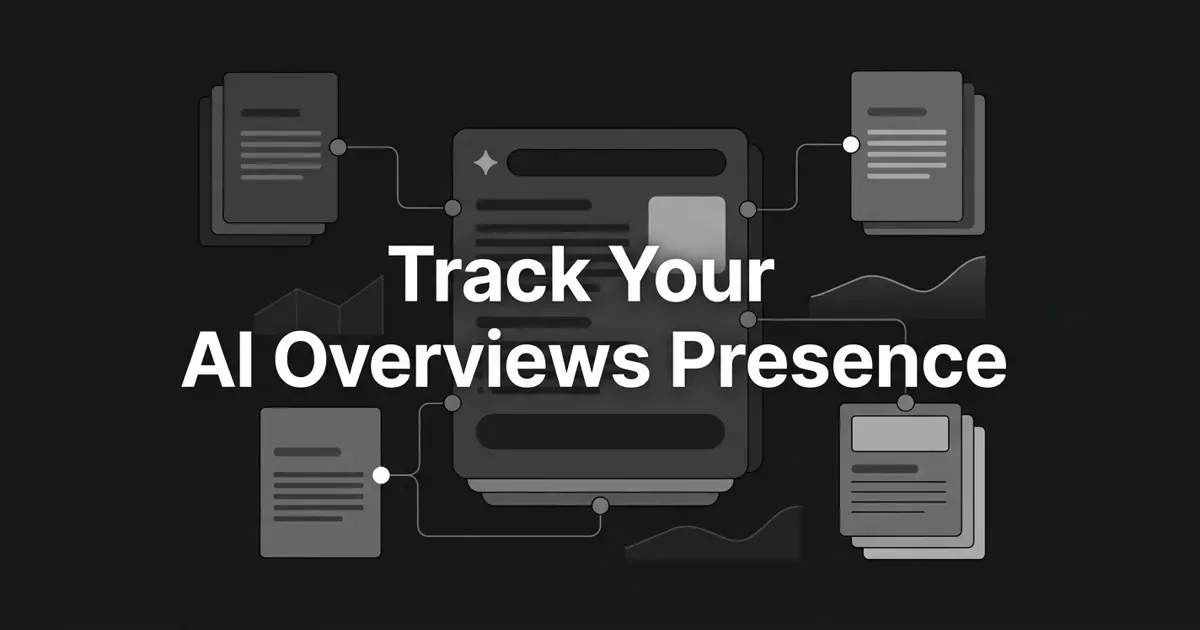
You searched your own core question in Google, saw that AI answer block at the top, and wondered: is my page in there, or is it quietly sending my traffic to someone else?
That feeling is normal, and it's the right question to be asking. This guide shows you how to track google ai overviews presence for the prompts your buyers actually type, week after week, so you stop guessing and start seeing the trend. It's built for a marketing lead who owns content and needs a system, not a one-time screenshot.
By the end, you'll have a fixed prompt list, a way to monitor ai overviews presence on a schedule, and a weekly routine that tells you exactly where you show up and where you don't.
One thing before we start. AI Overviews fire inconsistently. The same query can show an Overview for one person and nothing for another, and that's not a bug in your tracking. It's the reality we're going to design around.
Step 1: Get clear on what you're actually tracking
Before you measure anything, let's name the thing precisely. It saves you from chasing the wrong signal for a month.
An AI Overview is the generative answer block Google shows above the ten blue links. That's different from AI Mode, which is Google's chat-style search tab that people open on purpose. It's also different from a featured snippet, which is a single quoted source. This guide is about AI Overviews only. If you started out with the older term SGE, that's the same surface, so sge visibility tracking and google ai overviews tracking mean the same job here.
Here's the part most people miss. An Overview can fire with zero citations. So you're really tracking two separate events, and you have to keep them apart.
- Did an Overview fire for this query at all?
- Was a page on your domain cited inside it?
The question "am i in ai overviews" only makes sense once an Overview actually appeared. If no Overview fired, that's data too, not a failure.
There are two ways to hold this. Model A is per prompt: for each query you record whether an Overview fired and whether your domain was cited. Model B is per page: for each URL on your site, you count how many prompts cite it. Start with Model A. It's simpler, and it maps to how buyers search.
Common mistake: treating "an Overview showed up" as "I got cited." Those are two different wins. Track them in two different columns from day one.
Step 2: Build your prompt set
Your tracking is only as good as the questions you feed it. So this step matters more than the tool you pick later.
A prompt set is a fixed list of the real questions your buyers ask. Pull them from a few honest places:
- Sales and support calls, where people ask in their own words.
- The "People also ask" boxes on your core queries.
- Competitor page titles, rewritten as questions.
- Your existing keyword list, filtered down to the long-tail and question-shaped ones.
Aim for a mix: roughly a third branded, a bit under half category and comparison queries, and the rest long-tail problem questions. For how many, 25 is the floor. Around 100 to 200 gives you real trend lines. You need several hundred before share of voice against competitors gets sturdy.
Then lock the list. Keep it stable for at least a quarter. If you keep swapping prompts, you can't tell a real change from a list change.
If staring at a blank prompt list feels heavy, you don't have to invent it from scratch. This is one spot where DeepSmith can help: its Discover Prompts feature generates a starter set grounded in your product, persona, and buyer stage, so you begin with prompts your buyers would actually ask rather than a guess. You still curate. It just gives you a running start.
Pro tip: add one new prompt a month from a real customer question. Small, steady, and it keeps the list honest without churning it.
Step 3: Run a manual incognito check first
Before you pay for anything, do this by hand. It's free, it takes ten minutes, and it teaches you what you're looking at.
Here's the routine for each prompt:
- Open an incognito or private window, and sign out of Google. Signed-in results are personalized and will mislead you.
- Pin your location. Add
gl=andhl=to the URL (for example,google.com/?hl=en&gl=US) so you're searching from your real market, not Google's guess. - Type the prompt exactly as written. Don't let autocomplete change it.
- Record what you see: did an Overview fire, which URLs did it cite and in what order, is your domain in that list, and where.
That's how you answer "am i in ai overviews" for one prompt, on one run. Do this weekly for your top handful of prompts. That's it.
Manual checks are perfect for spot-checking your most valuable queries and for sanity-checking any paid tool later. They fall apart past about 25 prompts, and they can't draw you a trend line. So treat this as validation, not your whole system.
Common mistake: running a query once and believing it. AI Overviews shift week to week. One look is a snapshot, not the truth.
Step 4: Turn on Search Console's AI performance report
Now let's get a free signal that runs on its own. Google added dedicated AI performance reports to Search Console in mid-2026, showing impressions and clicks your pages earned from generative surfaces, including AI Overviews.
To use it:
- Open the AI performance report for a verified property.
- Set a 90-day window so you're looking at a trend, not noise.
- Filter to the queries pulling AI Overview impressions, sort by impressions, and watch the shape over time.
- Export weekly and lay it next to your prompt-run data.
Be clear-eyed about the limits, though. Search Console shows your own data only. It tells you a page got impressions from AI surfaces, but not whether a specific URL was cited as a source for a given query. And it only covers queries Google already links to your pages. It's a real signal for sge visibility tracking, but it can't see the prompts where you're invisible, and it can't show you a competitor.
Common mistake: treating Search Console as the whole picture. It's your side of the story. You still need prompt-level checks to see where you're absent and who's winning instead.
Step 5: Pick a paid tracker once you're past 25 prompts
When manual checks stop scaling, a paid tool takes over the boring part: running your prompt list on a schedule and drawing the trend for you. Here's the honest landscape, so you can match a tool to your situation.
If you want the cheapest way in and you're focused squarely on AI Overviews, a dedicated tracker like Otterly.AI has an AI Overviews tab with cited-domain share of voice, and its entry tier is friendly to small teams. If you need broader engine coverage and a dedicated Overviews dashboard, Profound tracks many engines and reports citation sources and sentiment.
Already paying for Semrush or Ahrefs? Turn on their AI Overview surface before you buy anything new. Semrush shows whether Overviews fire for your tracked keywords inside Position Tracking and Sensor, and Ahrefs Brand Radar reports cited domains and share of voice across AI features. The marginal cost is close to zero.
DeepSmith fits a different need. It tracks your brand across ChatGPT, Gemini, Perplexity, Claude, and Google AI Mode, and reports mention rate, citation rate, and share of voice with trends. What sets it apart isn't a longer engine list. It's that the same workspace turns what you learn into published content, so measuring and fixing live in one place instead of two tools and a spreadsheet. If a big part of the Google picture you care about is AI Mode, and you want tracking and production together, it's worth a look.
One caution that saves real confusion. Don't compare absolute numbers across tools. Each samples differently, so the numbers won't match. Trends inside one tool are reliable. Cross-tool comparisons are not.
Pro tip: whatever you pick, keep doing a manual incognito check on your top 10 prompts. It catches tool blind spots and keeps you honest.
Step 6: Or build your own with a SERP API
Prefer to own the pipeline? You can build google ai overviews tracking yourself with a SERP API, and for some teams that's the right call.
A couple of providers parse the Overview block for you. SerpApi returns the AI Overview as structured data, including whether it fired, the cited URLs in order, and the text. DataForSEO offers similar AI Overview parsing in its SERP payload. Both let you pin locale and device.
The build has four parts:
- A prompt table holding each prompt, its locale, its device, and the last run time.
- A scheduled job that calls the API for each prompt and stores the raw result.
- A parser that pulls out whether an Overview fired, the cited URLs in order, and your domain's presence and position.
- A dashboard for trigger rate, citation rate, share of voice, and the weekly trend, plus an alert when your citation rate drops.
Build when you've got engineering capacity, hundreds or thousands of prompts, a data-residency requirement, or locales no tool covers well. Don't build under about 50 prompts, or if no one can maintain the parser when Google reshapes the Overview layout, which happens a few times a year. Weigh that buy versus build honestly before you commit an engineer to it.
Common mistake: underpricing maintenance. The API call is the easy part. Keeping the parser alive through Google's layout changes is the real cost.
Step 7: Standardize your four metrics
Whatever method you land on, measure the same four things every week and call them the same names. Shared language is what turns scattered checks into a trend you can act on.
- Trigger rate: the share of your tracked prompts where any Overview fired. This is your ceiling. You can only be cited where an Overview exists.
- Citation rate: the share of tracked prompts where the Overview links to a page on your domain.
- Share of voice: of all the citations across your prompts, the fraction that go to you versus your competitor set.
- Citation position: where your domain sits in the source list when you are cited.
Track those four consistently, alongside your existing set of AI visibility metrics, and the weekly picture stops being anecdotes and becomes a line you can read.
Keep trigger rate visible next to citation rate. If your citation rate falls, trigger rate tells you whether you lost a citation or the Overview simply stopped firing. Those need different responses.
Step 8: Lock your sampling method
This is the step most guides skip, and it's the one that makes your numbers trustworthy. Sampling just means deciding, on purpose, exactly how you run each check so this week compares cleanly to last week.
Set these once and hold them:
- Prompts: the fixed list from Step 2. Same prompts all quarter.
- Cadence: weekly at a minimum. Daily only for your top 10 to 20 prompts. Run at a similar time of day.
- Locale: pick your primary market and pin it. Don't average across countries, because en-US and en-GB genuinely differ.
- Device: choose desktop or mobile for your trend line and stick with it. Don't mix them.
- Signed-in state: always signed out. Logged-in answers are personalized and won't compare.
A clean sampling log has one row per run with these columns: date, prompt id, prompt text, locale, device, whether the Overview fired, the cited URLs, whether your domain was cited, your position, and a notes field.
Common mistake: changing two things at once. Swap the locale and the device in the same week and you'll never know which one moved your numbers. Change one variable at a time.
Step 9: Run the weekly workflow and turn gaps into content
Here's the routine that ties it together. This is how you track google ai overviews presence in practice, not in theory, and it's about an hour a week once you're set up.
Each week:
- Review trigger rate per prompt. Flag any drop over about 20 points week over week. That's usually a Google change, not your loss.
- Review citation rate. Flag prompts where you used to be cited and now aren't, and note any new competitor domains showing up.
- Run a manual incognito check on your top 10 prompts by business value, to confirm the tool.
- Add one prompt from a real customer question, and resist churning the rest.
Once a month, refresh your competitor set based on who's actually appearing, review the 90-day share of voice trend, and rewrite prompts that never trigger an Overview into more conversational, problem-aware questions. Once a quarter, regenerate your prompt list from fresh customer research and reset your trend window.
Now the part that actually moves the needle. Tracking is not the goal. Knowing where you're weak so you can publish the right thing next is the goal. When a valuable prompt shows an Overview firing but never cites you, that's a content gap with a name and a query attached.
This is the other place DeepSmith earns its spot: it turns those weak-presence prompts into planned articles, written with the SEO and AEO formatting that makes a page citation-ready, so the loop from "we're invisible here" to "we published for it" happens in one workspace. Measuring and closing the gap stop being two separate jobs.
Remember the honest timeline, though. New content typically takes six to twelve weeks to show up consistently in Overviews. Your tracker is a measurement system, not a same-day scoreboard. Give the work time to land.
What to do next
You don't need all nine steps this week. You need the first three.
Write down 25 real buyer prompts. Run them once by hand in incognito. Turn on your Search Console AI report. That's a working baseline, and it's more tracking than most of your competitors have.
From there, add a tool when the manual checks stop scaling, standardize your four metrics, and let the weekly routine do the rest. Momentum matters more than a perfect setup on day one.
If you'd rather have the tracking and the content production in one place, you can start a free DeepSmith trial and see your real prompts and drafts before you pay. Either way, the win is the same: you'll finally know where you stand, on a schedule, and know what to publish next.