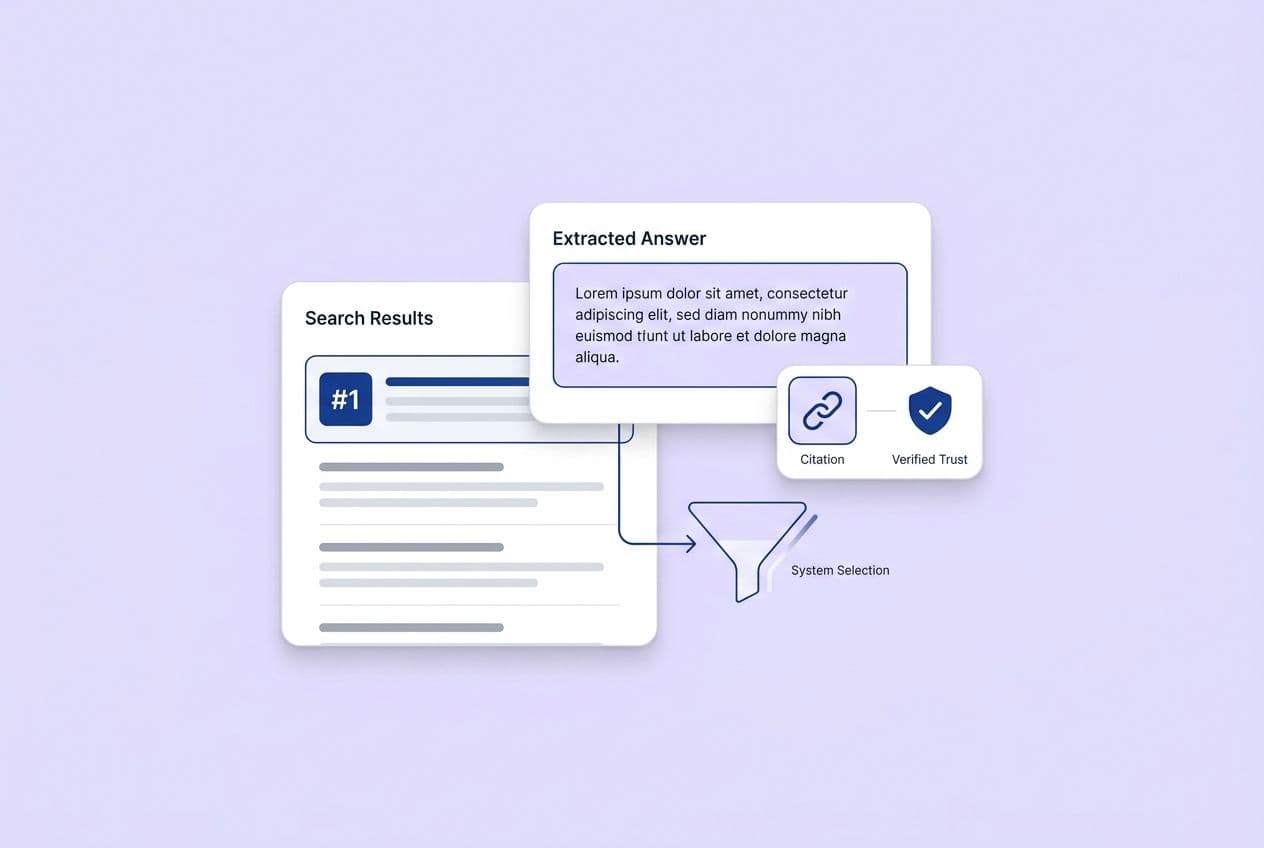
Let's get straight to it: AI citations aren't decided by who ranks highest. They're decided by extractable answer units and trust signals. A page gets cited when an AI can lift a clean, self-contained answer, confirm the source is credible, and match it to a user's question. If your answer is buried six paragraphs deep or your intro takes 300 words to warm up, you'll get skipped. It doesn’t matter if you’re in Google's top 10.
I’ve been there. You've done all the right SEO things. You rank. Your domain authority is solid. And then your CEO Slacks you: "Why is Competitor X getting all the ChatGPT citations and we're not?" That one stings, because it feels like your hard work doesn't count.
And in a way, it doesn’t. AI systems don't reward effort. They reward structure, clarity, and excerptability.
This isn't just theory. I'm going to walk you through the four-part triage framework I use to diagnose and fix this exact problem: (1) confirm the citation opportunity exists, (2) fix extractability on your highest-priority pages, (3) clarify your entity trust signals, and (4) measure what's working so you can do more of it.
If my page ranks in the top 10, why doesn't AI cite it?
This is the question that trips up almost every content team I talk to. Here’s the key distinction: Ranking tells AI systems where to look. It doesn't tell them what to pull.
Search rankings are just one signal that gets your page into the candidate pool. But getting cited is a separate decision made later, based on whether your page contains a clean, trustworthy, and easy-to-grab answer for the specific question the AI is trying to answer.
Think of it this way:
- SEO = retrieval (getting your page into the pool of candidates)
- AI citation = extraction + trust + query fit (giving the system something it can actually lift and use)
AI engines also pull from multiple sources at once. For a single prompt, the system might grab a definition from one page, a list of steps from another, and a counterpoint from a third. It will often source from outside the top 10 results if those pages have cleaner answers. This "fan-out" sourcing happens all the time, especially for tricky questions.
Semantic matching adds another layer. A page that doesn't even use the exact query phrase can earn a citation if it clearly answers the underlying question. On the flip side, I've seen pages stuffed with a target keyword get skipped because the actual answer was buried or unclear. Stuffing more keywords onto the page is almost never the answer. Making your answers clearer almost always is.
What AI systems are really selecting (not "the best article")
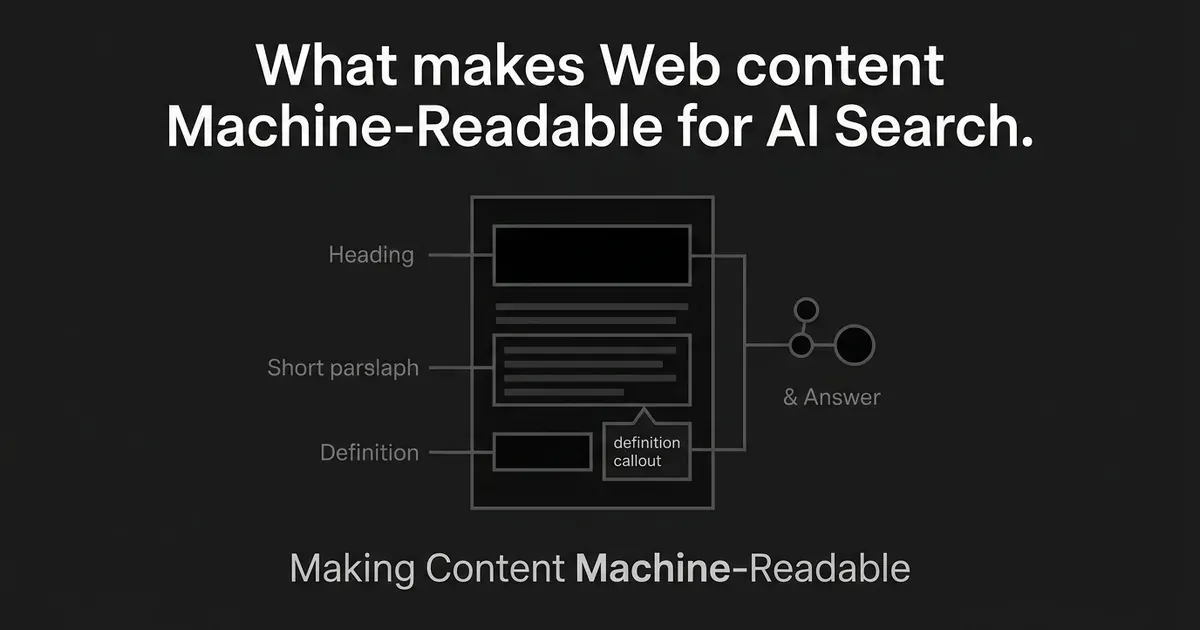
So what are these AI systems actually looking for? It's not the "best" or "most comprehensive" article. They're not human. They're scanning for what I call answer units: little, self-contained chunks of text (paragraphs, definitions, lists) that make sense on their own, without needing the surrounding text for context.
This is where I see most pages fail. Section openings are disproportionately important. The AI scans the first sentence or two under a heading to decide if the section is relevant. If you open with a folksy anecdote or a warm-up question, the AI just moves on, even if the perfect answer is sitting right there in paragraph three. It's brutal but true.
Why "comprehensive" pages can lose to "clean" pages
This is a tough pill to swallow for those of us who love writing deep, narrative articles. We bury the good stuff inside long paragraphs because it flows better for a human reader. But that's a total mismatch for how AI extraction works.
A 1,200-word page that opens every section with a direct claim and uses tight bullet lists will beat a 4,000-word guide that takes 200 words to "set up" each point. You have to internalize this: Comprehensiveness is a human value. Extractability is a machine requirement. The best pages do both, of course. But if you've only got 90 minutes to spare, for God's sake, fix your section openings first.
Is the answer missing, buried, or hard to extract?
Okay, let's get practical. The most common reason your high-ranking page is getting skipped isn't some deep technical voodoo. It's just that there's no clean answer for the AI to grab near the top of the page.
This is a fixable problem that doesn't require a full rewrite. Start by figuring out which of these common failures applies to your page.
Common extractability failures:
- Your intro rambles for 200–400 words before getting to the point.
- Your H2s are vague nouns like "Benefits of X" instead of direct questions or claims.
- Your paragraphs are long, competing claims, making it impossible to lift one clear point.
- Your sections open with transitions or context instead of a direct answer.
- You have no summary sentences to anchor your dense sections.
A fast on-page test: can you excerpt the answer in 40–60 words?
Here's a quick test you can run right now. It takes 10 minutes.
Go to one of your pages. Highlight the first 60-ish words under your main title and then under each big H2. Now, read just that highlighted text out loud. Does it answer a specific question? Be honest.
If you find yourself saying "well, kinda..." or "not really," you've found your first job. Rewrite those openings before you touch anything else. Don't mess with schema, don't write new FAQs, don't do anything until that's fixed. It is the single highest-leverage change you can make for AI citation likelihood.
This quick test immediately shows you which sections need a tune-up versus which are already good to go.
Build modular sections that AI can lift without context
The goal is to build your articles like they're made of Lego blocks. Each H2 section should answer one question cleanly. Each H3 should handle a smaller sub-question. If a section needs the reader to remember something from a previous section, it's not modular, and an AI will struggle to extract from it.
Use this answer-first paragraph template:
- 1–2 sentence direct answer (the definition, the recommendation, the main point).
- 2–3 sentences of constraints (the "it depends if…" conditions that add nuance).
- Evidence or example (a concrete story that makes the answer real).
Here’s what that looks like:
-
Buried version: "We've seen content structure evolve a lot over the last few years. With the rise of mobile and AI tools changing how answers surface, it's worth thinking about how your pages present information..."
-
Citation-ready version: "Answer-first structure increases AI citation likelihood because AI systems extract the opening sentences of each section. If your section opens with context instead of a conclusion, the extraction window closes before your actual answer appears."
Keep your paragraphs tight, around 2–4 sentences. If a section gets long (over 150 words), tack on a one-sentence summary at the end. And please, use bullet points and numbered lists for steps, options, or comparisons. They are far more extractable than a block of prose.
What page structures get you cited (and which get you ignored)?
Let's be clear: 'AI-friendly structure' does not mean "short, dumbed-down content." It means having a clear hierarchy, using these self-contained Q&A units, and formatting things so a machine can parse them without a headache.
| Structure signal | ✅ Human + extraction-ready | ❌ Human-only |
|---|---|---|
| H2 framing | Question or decision frame | Vague noun phrase |
| Section opening | Direct answer in 1–2 sentences | Context or transition |
| Lists | Bullets/steps for discrete items | Long prose blocks |
| Definitions | Placed at top of relevant section | Buried mid-paragraph |
| Naming | Consistent entity names throughout | Varied references to same thing |
| Section scope | One intent per section | Mixed strategy + tutorial + definition |
Where to place definitions, steps, and key takeaways
This next one feels wrong to a lot of writers I coach, but you have to trust me: Put definitions and step-by-step lists at the top of the section, not after your long explanation. We're trained to build up to the answer, to "earn it." You have to unlearn that habit for this.
If a term needs defining, define it in its first sentence. If a process has steps, number them immediately. Don't narrate your way into the list. And when you mention the same concept in different sections (which happens a lot in long guides), just repeat a short version of the definition. For AI extraction, think of every section as starting from zero. The AI has no memory of what it read in section one.
Positive patterns to build into your templates:
- Question-based H2s that sound like real buyer questions
- Decision framing ("when to use X vs Y")
- Tables for comparing options or trade-offs
- Internal linking that shows the depth of your topic cluster
Are entity clarity and trust signals the real reason AI skips your page?
Okay, let's say your structure is clean, but you're still getting skipped. The next place to look is entity clarity and trust signals. Basically: can the AI figure out what you're talking about, and does it believe you?
Entity clarity just means using consistent, unambiguous names for things. I once worked with a company that used "content brief," "editorial brief," and "article brief" all on the same page. A human can figure that out. A machine just gets confused and gives up.
Quick entity audit for any page:
- List the top 5–7 things the page discusses (products, concepts, frameworks).
- Check for consistent naming. Pick one term and stick with it.
- Make sure you define acronyms on first use.
- Attribute any named research, frameworks, or tools properly.
Beyond naming, trust signals matter at the page level, not just your overall domain authority. A well-optimized page from a trusted site can still be ignored if the page itself feels untrustworthy.
Here’s what I check for:
- Author attribution: Is there a real byline with credentials, not just a name?
- Last-updated date: For timely topics, this is a huge signal.
- References: Are you citing your sources or just making assertions?
- Structured data: This can help, but it's a secondary concern.
And please, hear me on this: schema markup is not a magic bullet. It helps machines interpret relationships, but it will not fix a page where the answer is buried or missing. I see teams waste so much time on this. Fix the words on the page first, then you can layer in markup.
Should you restructure an existing ranking page or publish a new one?
This is a classic "it depends" question, but the calculus is pretty simple. For most of us, especially in SaaS, restructuring a page that already ranks is your fastest path to a win. But sometimes the AI is asking a fundamentally different question, and a new page is the right call.
| Signal | Do: Restructure | Do: New page |
|---|---|---|
| Page ranking/impressions | Already getting traffic | Little to no visibility |
| Query intent match | Matches page topic | Narrower sub-problem or different context |
| Content promise | Can add answer-first format without changing scope | Multiple competing intents need separation |
| AI query type | "What is" or "how to" (matches your page) | "Which is best for [specific context]" (needs dedicated treatment) |
Restructure when: the page already ranks for the right topic and you can add modular Q&A sections and a new intro without breaking the page's original promise.
Publish new when: the AI is asking a much narrower question than your page covers, or your current page is a Frankenstein of multiple intents that should be separated.
If you're running a lean team (and who isn't?), batch this work. Find your top 5 ranking pages that aren't getting citations, run the 40-word excerpt test on them, and pick the two that would be fastest to fix.
This is where tools like DeepSmith can take a lot of the work off your plate. Its Content Studio can generate new drafts with AEO structure (answer-first openings, clear headings, internal links) already built-in, which means restructuring isn't a full manual rework.
The "restructure-first" sprint plan (1 page, 90 minutes)
Here's a 90-minute sprint you can run on a single page. No excuses, you can find 90 minutes.
- Rewrite the H1 intro (first 60 words) to lead with a direct claim about what the page answers.
- Convert your H2s to questions that sound like what a real customer would ask an AI.
- Add 3–5 citation-ready answer blocks, like bullet points, tables, or tight definitions at the top of key sections.
- Add or refresh the FAQ at the bottom with 4–6 standalone Q&A pairs (compress the answers, don't just copy them).
- Update the publish date and double-check your internal links to make sure they point to your most relevant pages.
That's it. That's the whole sprint. Notice you're not doing new research or a ground-up rewrite. You're just reorganizing the good stuff you've already created.
How do you measure AI citations and learn what's working?
You can't manage what you don't measure. Your Google Analytics traffic isn't going to tell you if you're winning at this game. You need to track things differently.
What to track:
- Citation rate vs. mention rate: A link is different from just being mentioned.
- Share of AI visibility by platform: ChatGPT, Gemini, Perplexity, and others all behave differently.
- Top cited pages: Who is winning and what is their page structure?
- Trendlines after updates: Did your restructure work? Check in 30–60 days.
Here's a simple 30-minute retro I run with my team every month:
- Pick 10 high-priority prompts (real buyer questions).
- Run each one and log which URLs get cited.
- Analyze the structure of the winning pages (where's the answer, do they use tables, etc.).
- Tag each of your gaps as "restructure this page" or "we need a new page."
- Push the highest-priority fixes into your next content sprint.
This is a huge pain to track manually, which is why tools like DeepSmith's AI Visibility module exist. They automate this whole process so you can see who's getting cited for what, and which competitors are publishing new content before it even starts ranking. Without a visibility layer like that, you're just guessing.
Just a heads-up: AI referral traffic converts differently than organic search traffic. Track it as its own channel so you don't muddy your organic metrics.
How do you balance human-first readability with answer-first AI structure?
The biggest pushback I get is, "But won't this make my writing sound like a robot?" Absolutely not. You don't have to choose between writing for humans and writing for AI. The same change, leading with the answer, makes content clearer and more useful for both.
Let me be super clear: Answer-first doesn't mean shallow. It just means you give the conclusion first, then you add all the context and nuance that supports it. Your human reader gets the payoff immediately and can decide if they want to dig deeper. The AI gets a clean extraction point right at the top. Everybody wins.
Here are three patterns I use constantly that work for both humans and machines:
- Claim → constraints → proof/example: State your answer, name the conditions where it might not apply, then share a real story.
- Table first → explanation second: Show the comparison in a structured table, then unpack the details in the text for those who want more.
- FAQ answer → deeper section link: Give the quick 2–3 sentence answer, then link to the full section for anyone who needs the implementation details.
The classic mistake is replacing your intro with a dry, Wikipedia-style definition like, "Answer-first writing is a content strategy approach that..." That's not what I'm talking about. That's just bad writing. Keep your voice. Keep your personality. Just state your main point right up front instead of hiding it on page two. A direct opening and a strong voice aren't in conflict; they're a powerful combination.