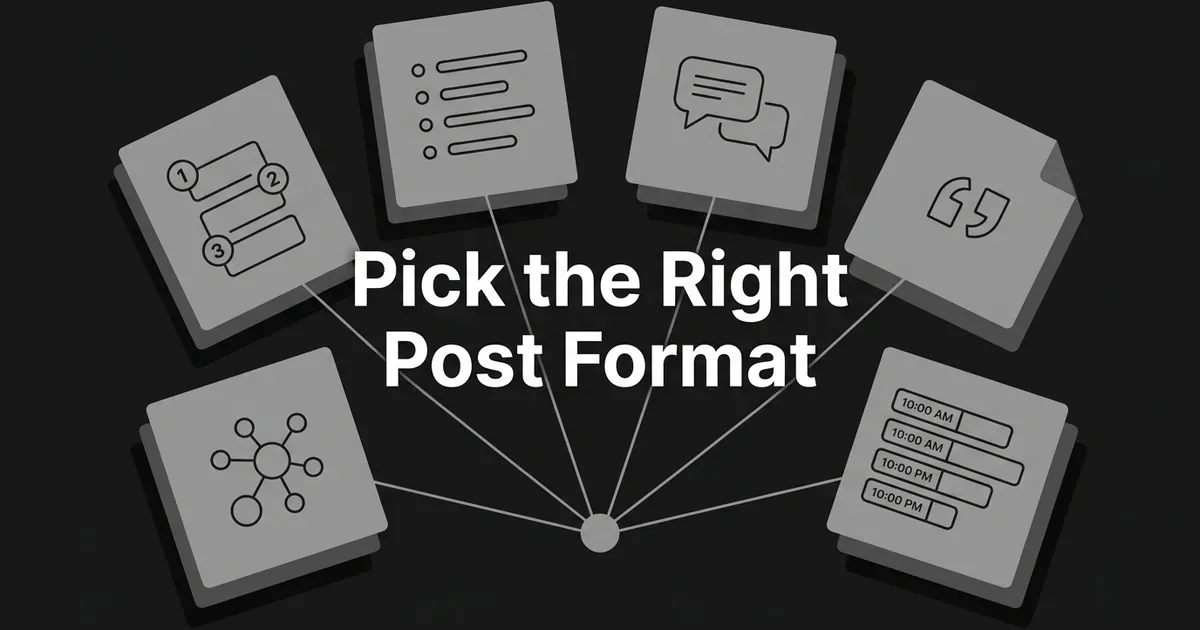
The six types of blog posts worth telling apart are the how-to, the listicle, the interview, the opinion post, the roundup, and the live blog. You choose between them by the job the reader needs done: finish a task, scan some options, hear one person's expertise, weigh an argument, catch up on several sources, or follow an event as it happens. If you have ever stared at a blank calendar slot and wondered what shape the post should take, this is where to start. These blog post formats are a practical selection and not a complete or official list, and by the end you should be able to look at a goal and name the format that fits it.
Guides, comparisons, research reports, and explainers exist too, and plenty of good posts mix two of these shapes. We're keeping to six here because they cover most of the choices a marketing lead makes week to week, and because each one asks for a different kind of input from your team.
The types of blog posts at a glance
Before the detail, here is the short version. The how-to vs listicle vs interview post choice is a good one to test it on. Read down the left column until you find the sentence your reader would actually say, and the format next to it is a good place to start.
| What the reader wants | Best starting format | What it looks like | Main constraint |
|---|---|---|---|
| "Show me how to finish this task" | How-to | A sequence the reader follows toward an outcome | Steps must be accurate and complete enough to follow |
| "Let me scan several distinct ideas" | Listicle | Numbered or bulleted items, each explained | Items must belong together and carry real substance |
| "What does this practitioner know?" | Interview | One person's answers and perspective | You need access, attribution, and an insight you couldn't supply alone |
| "What position should I consider, and why?" | Opinion | A clear claim backed by reasons and evidence | Label it as opinion and keep argument apart from reported fact |
| "What do several sources say about this?" | Roundup | A curated synthesis of many contributions or existing pieces | Selection and synthesis must add value beyond a pile of links |
| "What is happening right now?" | Live blog | Time-stamped updates on an unfolding event | Needs someone watching, verifying, and keeping it tidy |
A simple way to use the table is to start with the reader's verb. If they want to do something, write a how-to. If they want to scan, write a listicle. If they want to hear from one expert, run an interview. If they want to weigh a position, write an opinion post. If they want to survey several sources, build a roundup. If they want to follow developments, run a live blog. This is an editorial rule of thumb for finding the best blog post format for goal, and not a tested performance ranking, so treat it as a starting point you can adjust.
How-to posts: finishing a specific task
A how-to post walks the reader through a task in a sequence that makes sense. After reading, they should know what to do and in what order. It fits a procedural question, such as "How do we prepare a monthly content audit?" (that title is only an example, not a published article).
The value here is that the reader can act. A post that explains what a topic is, or why it matters, leaves the reader to work out the doing. A problem-and-solutions article might offer a few possible approaches, while a how-to gives the steps for one particular task.
Use a how-to when your team can actually back up the steps and the reader can take them. If there is no real sequence, a listicle, an explainer, or a comparison will probably serve better.
Listicles: scanning a bounded set of items
A listicle is organized as a numbered or bulleted list of ideas, examples, tips, or other items. It works when the reader wants to discover, compare, or skim several separate possibilities. An example title would be "Six ways to distribute one research report."
Each item needs its own useful explanation, because a bare inventory of names rarely helps anyone. That doesn't mean listicles are shallow, since an item can carry several paragraphs. It also doesn't mean the numbered list is a ranking. The number should reflect how many meaningful items there are, and it shouldn't be picked to make the headline look impressive. HubSpot's advice on list posts makes a similar point: the subject has to fit a list structure, and the items should stay consistent with what the headline promised.
Listicles start to fail when the answer depends on one sustained argument, when the explanation can't be divided cleanly into parts, or when filler entries get added to reach a round number. A good check is to look at your weakest item and ask whether it could hold a useful paragraph or two. If it can't, the list is probably shorter than you planned, and it's fine to rename the piece to match.
Interview posts: depth from one voice
An interview post gets its distinctive substance from a conversation with someone who has relevant experience. It can run as questions and answers, or as a reported article built around attributed answers. Brafton notes that interviews add qualitative insight, and that recorded podcasts or webinars can supply the material. An example title is "A content lead explains how her team chooses topics," which is a made-up example and not a real customer account.
What the reader gets is a firsthand explanation, or a perspective your publication couldn't credibly make up. So choose an interview when you want to show one contributor's approach, a decision they made, or something they lived through. Confirm the person's identity and what they said, and keep their opinion separate from what is generally established as fact. A raw transcript with no selection, no context, and no reason to care isn't automatically a good post.
One more boundary is worth knowing. A conversation with one person is an interview. If you ask several people the same question and pull their answers together, you have moved toward an expert roundup, which we'll get to in a moment. And an interviewee can share opinions without making the whole post an opinion piece.
Opinion posts: a defended point of view
An opinion post puts a position in front instead of presenting itself as neutral reporting. A workable example premise is "Why publishing more articles is not the same as covering more buyer questions." You would need evidence and clear reasoning before publishing something like that, because the title alone isn't a finding. Thought-leadership posts are a close relative, where a knowledgeable author offers a considered, sometimes unconventional take, and the research and reflection still have to be there.
The reader gets something they can examine and argue with, which helps most when an accepted assumption deserves a second look. To write one well, make the thesis easy to spot, explain the reasoning, acknowledge the strongest counterarguments, and be clear about which statements are evidence and which are interpretation. Reporting on what several people think, without taking a side yourself, is not necessarily an opinion post.
There is a trust point here as well. Poynter reports that readers don't always recognize newsroom labels like "editorial," and that plainly using the word "opinion" is less ambiguous. If a brand is putting forward its own position, label it, and don't lean on the feel of reported news to make it sound neutral.
Roundup posts: synthesis across several sources
A roundup brings together several relevant contributions, developments, or existing pieces around one defined question. Brafton describes its usefulness as helping readers keep up with trends or events without collecting the material themselves. There are two practical variants. An expert roundup organizes several people's answers or viewpoints, and a curated or news roundup selects and summarizes material that has already been published. Not every publisher uses those terms in exactly the same way, so treat them as handy labels. An example title is "What five content leads changed in their editorial reviews this year," but only if you really have five contributors and their actual answers.
The value is breadth with someone making choices. You should explain why these sources belong together and what their agreement, their disagreement, or their combined coverage tells the reader. Credit each source clearly. A handful of links or quotes with no reasoning behind the selection hands the reader back the gathering work the roundup was supposed to save them.
Roundups often get mixed up with two neighbors. An interview centers on one person and an expert roundup draws from several. A listicle is defined by how it's laid out, as discrete items, while a roundup is defined by collecting and interpreting material from more than one source. A single piece can be both, since a roundup is often displayed as a list.
Live blogs: updates while something unfolds
A live blog, sometimes called a live news page, collects short, successive updates about a developing story or a scheduled event on one page. It serves the reader who needs the latest development, and it doesn't serve the reader who wants a settled explanation. The Reuters Institute describes live pages as short updates in chronological order, and separates breaking news, sports, continuing subjects, and other scheduled events. For a marketing publication, a truly consequential industry announcement with ongoing developments could be a fair use. An ordinary evergreen advice article is not a live blog, and neither is a blog that simply publishes often.
In a Reuters Institute interview, a Guardian editor separates the need to stay up to date from the needs for context, basic explanation, and a wider view. The Guardian has used pinned key developments and filtering to help readers find their way through a long stream of updates.
The costs are real, so think them through before you commit. The format needs staff attention, verification, timestamps, and some way to stop late arrivals from losing the thread. Posting quickly and often raises the risk of mistakes. Once the event settles, a short explainer or recap will usually serve readers better, because by then they want a coherent account and not a stream.
How-to vs listicle vs interview post: where the lines blur
Real posts don't always fit one label, and that's normal. Rather than trying to force each piece into a single box, look at the primary promise the post makes to the reader. The headline or the formatting won't decide it for you. Here are the distinctions that come up most often, in the order people usually run into them.
- How-to versus listicle. A how-to is a task sequence, and a listicle is a set of separate options. Both can use numbers. Ask yourself whether the reader has to go through the steps in order, or whether they can pick whichever items apply to them. If skipping step two stops step three from working, the sequence is what holds the post together, and it's a how-to.
- Listicle versus roundup. One names how the article is laid out, and the other names where the material came from. They can overlap without being the same thing.
- Interview versus expert roundup. One subject explored in depth, against perspectives from several contributors gathered around a theme.
- Interview versus opinion. Whose position organizes the piece? An interview carries the subject's account, and an opinion post carries the author's own thesis. An interview can contain opinions without becoming an opinion piece.
- Roundup versus live blog. A roundup selects and interprets material for an overview, usually once enough of it exists to judge. A live blog follows developments as they arrive. A recap written after an event may draw on a live blog but makes a different promise to the reader.
There is one more distinction that trips people up. Format is not the same as topic, channel, or asset. "Technology blog" describes a subject area, "newsletter" names a way of delivering something, and a video can sit inside an interview or a how-to. None of those, on their own, tells you which post format fits the goal in front of you.
Picking the best blog post format for goal, audience, and capacity
Once you know these blog content format types, the practical question is which to choose this week. Start with what the audience needs, then check whether your team has the material and the time to do it properly.
A task question and a process you can verify point to a how-to. A cluster of genuinely different ideas points to a listicle. Access to a practitioner with firsthand knowledge points to an interview, and access to several relevant voices or publications points to a roundup. A position your company can defend points to opinion. A meaningful developing event, plus an editor who can keep watching it, points to a live blog.
If the inputs aren't there, change the format and don't make them up. That means no invented interviews, no invented quotes, no invented developments, and no steps you haven't actually tested. It's much better to write a solid listicle from real experience than a thin interview with no real interviewee.
If you keep an editorial calendar, one habit that helps is to write down the reader's verb next to each planned title, and to note which input you need in hand before the writing starts (a tested process, an interviewee, a set of contributors, an event). Any slot without its input is a slot to change before you're deep into the draft. If you want a wider way to choose among content types, a content marketing matrix can help, and formats also tend to line up with funnel stages, which is covered in functional content types for each stage of a lead funnel.
You can also give yourself a few questions to ask after publishing, and these are for your own review, not published benchmarks:
- Did the how-to help readers finish the task?
- Can readers find an item that applies to them in the listicle?
- Does the interview tell them something beyond a generic summary?
- Can readers identify the opinion's claim and its evidence?
- Did the roundup save them time while keeping attribution clear?
- Is the live blog timely, accurate, and understandable to someone who arrives halfway through?
Your team can pick its own measures for these, such as feedback on whether the task worked, engagement with particular sections, qualified responses, or repeat visits during an event. There isn't a universal target number that applies to every blog.
What the data does and doesn't tell you
It's tempting to hunt for a number that says which format wins, so it helps to be careful about what the research actually supports.
Orbit Media's 2025 annual blogger survey reports responses from 808 bloggers. In it, 76% say they publish how-to articles and 54% say they publish list articles. Those figures describe what surveyed bloggers publish. They don't tell you what readers prefer, or how likely either format is to succeed. The same survey describes long formats such as guides and ebooks, and collaborative formats such as interviews and roundups, as correlating with stronger reported results. That is an association in survey answers and not a controlled test, so it doesn't prove that changing a post into one of those formats would improve its performance.
The live blog evidence is older and comes from a different audience. A 2013 Reuters Institute account reports that 28% of surveyed UK live-page users found live blogs hard to understand. That was a UK news audience, so it isn't a current benchmark for marketing blogs, though the practical point still holds: a stream of updates is hard to follow when nobody gives the reader context.
Beyond those, no reliable ranking of these blog content format types by conversion, traffic, AI citations, or leads came out of the research behind this piece. So don't expect any one of these formats to guarantee rankings or AI visibility, and be wary of anyone who says it will. If you want to look at formats through the lens of AI answers specifically, there is a separate piece on which content formats AI answer engines cite most. Pick the format because it fits the reader's need and your team's capacity, and judge it by your own results.
Where to go from here
The thread running through all of this is that the blog post formats you choose are a promise about what the reader will get. When the promise matches a real need, and your team holds the material to keep it, the post tends to feel right to the person reading it.
If you'd like to plan and produce posts like these without the manual back and forth, you can start a DeepSmith free trial. Content Studio takes a planned idea through to a finished, publish-ready article, so you can spend more of your own time on choices like the ones in this piece.