You published a numbered list, and an AI engine cited someone else. That stings, and it is also fixable. Numbering alone is not what earns a citation, so learning how to write a listicle for AI search means learning to write each entry as its own small, complete answer. This guide is for marketing writers and content leads who already publish lists and want every item to stand on its own when an engine lifts it out of the page.
Here is the good news. You have probably already done the hardest part, which is knowing your subject well enough to have opinions about it. What is left is a pattern, and you can learn it in an afternoon. A list post that gets cited is rarely the cleverest one. It is the one whose entries survive being read out of context.
One thing to set expectations before we start. No format guarantees a citation. Google's own guidance says that meeting the requirements makes a page eligible for consideration, not guaranteed to be crawled, indexed, served, or cited. Relevance, evidence, source quality, the engine, and the exact prompt all still matter. What you control is whether the passage an engine finds is usable when it arrives on its own. That is the whole of listicle AEO in one sentence, and everything below is how to do it.
Step 1: Decide the one question your list answers
Start with a buyer question, not a keyword list. Write the dominant question your article answers in a single sentence, then write down the closely related ways a real person might phrase it.
Then make your list a set of distinct answers to that question. Not a pile of loosely related topics that happen to share a subject area. Writing list content for ChatGPT, Perplexity, or any other engine starts here, because an engine matching a passage to a prompt is doing exactly what you are doing right now.
For each prompt you write down, record four things: the exact wording, the intent behind it, the audience asking, and the kind of answer it expects. Include the branded and unbranded versions where both make sense. A person asking "best tool for X" and a person asking "how do I do X" want different shapes of answer.
Done when: you can say out loud, "This page answers X by covering Y, Z, and W," and every item you have planned maps to that question or a clear sub-question underneath it.
Where writers go wrong: they open a keyword tool first, mix informational and transactional intent in one list, or spin up a separate item for every keyword variation. Google says its AI systems understand synonyms and general meanings, so you do not need to force every long-tail phrase onto the page. Building thin pages for each query permutation can tip into a manipulation tactic, which is the opposite of what you want.
Get this step right and the rest of listicle AEO gets much easier, because every later decision has a question to answer to.
This is also where a tool earns its keep. DeepSmith's AI Visibility module tracks the prompts you define and reports mention and citation rates per prompt, and Discover Prompts generates a starter set from your product, persona, and buyer-stage context. The teaching point is not "use a tool and get cited." It is "start from the questions engines are actually being asked, then make each item answer one."
Step 2: Draft an item brief before you draft prose
Before you write a single sentence of copy, give every candidate item a short brief. This feels like extra work. It saves you the afternoon you would otherwise spend polishing an item that should not exist.
Here is the schema worth using:
| Field | What to record |
|---|---|
| Item number | The final sequence position, if the order carries meaning |
| Answer name | The explicit phrase that will become the heading |
| Direct claim | The answer in one sentence, with a named subject |
| Best for | The audience, job, stage, or situation where it fits |
| Constraint | When it is not the right choice, or the limitation that matters |
| Evidence hook | The fact, source, expert, test, or original observation behind it |
| Proof asset | A documented example, result, quote, data point, or visual |
| Target prompt | The question this item could answer if it were detached |
Now look across the rows and cut the overlap. If two items would open with the same claim and lean on the same evidence, they are one item wearing two hats. Combine them, or make the difference explicit.
Done when: every item has a specific answer name, a distinct claim, a fit statement, a boundary, and a plan for evidence. You can review that grid in five minutes and know whether the article is worth writing.
Where writers go wrong: they pad to a round number. Ten sounds better than seven, so two filler entries appear, and both of them are the item most likely to be extracted and found wanting. They also let an AI draft invent a proof point nobody verified.
If you plan lists regularly, this is the step where evidence-backed planning beats brainstorming. DeepSmith's Content Map shows which topics you cover, where a competitor covers more, and which topics you have nothing on at all. Opportunity Agents return ideas with the specific data point that justifies each one attached, so the brief starts with a reason instead of a hunch.
Step 3: Write headers that carry the answer
Your item header is the first thing a retrieval system sees and often the only line a skimming reader reads. Make it carry the answer, not just the topic.
Use the number for navigation. Use the words after it to name the tactic, entity, use case, or recommendation. Then mirror that language in the first sentence below it.
A few patterns that work:
N. [Action or answer] for [specific situation]N. [Named tactic]: [direct outcome]N. [Item name] is best for [use case]N. [Answer phrase] when [condition]
Done when: someone who sees only your header and your first sentence can tell what the item answers. The header does not borrow its subject from the article title or from the item above it.
Where writers go wrong: headers like "Better structure," "More data," or "Why it matters." Those are labels, not answers. If you want to go deeper on this one thing, question-shaped headings are worth studying on their own. Detached from the page, a passage under a heading like that is very hard to classify, and an engine deciding what a passage is about has the same problem your reader does.
Step 4: Put the direct answer in the first sentence
Bottom line up front. Open each item with a complete sentence that states the recommendation or the fact, with a named subject and a real verb. Explanation, process, and examples come after.
One main claim per paragraph. No mid-paragraph pivot from one question to another.
A sequence that holds up well inside an item:
- Answer. State the claim with a named subject.
- Reason or fit. Say why it matters and who it is for.
- Evidence. Name the source, date, data, expert, test, or observation.
- Constraint. State the boundary, exception, or tradeoff.
- Action or proof. Tell the reader how to apply or verify it.
Practitioner guidance often suggests a 40 to 60 word answer block directly below the heading, with paragraphs kept under 100 words. That is a useful starting point, not a rule handed down from Google. Google explicitly says there is no ideal page length and no need to split content into tiny pieces. Use the smallest block that still carries the meaning.
Done when: you can copy the header and the first paragraph into a blank document and it still reads as a complete answer. It names its subject. It does not lean on "this," "it," or "they" pointing backward at something the reader can no longer see.
Where writers go wrong: the answer gets buried under a warm-up sentence, five claims crowd into one paragraph, or shortness gets mistaken for completeness. If you take one habit from this guide on how to write a listicle for AI search, take this one.
Common mistake worth naming: do not shred the whole page into fragments because a guide told you to write atomic answers. Atomic means independent, not tiny. Over-fragment a nuanced item and you strip out the very condition that made the claim accurate. That is a worse outcome than a slightly long paragraph.
Step 5: Attach the evidence to the item, not the bibliography
A source list at the bottom of the page cannot rescue an item that reads as unsupported on its own. If the passage travels alone, its proof has to travel with it.
So for every material claim inside an item, name what backs it. Prefer primary research, official documentation, original first-party data, a clearly identified expert, or a documented test. For a statistic, record the exact number, the unit, the population, the time period, and the definition before you write the sentence.
Ask three questions of every piece of evidence:
- What is the claim, stated without exaggeration?
- What supports it, and why is that source relevant here?
- What does the evidence not prove?
That last one is the one people skip, and it is the one that protects you.
Here is a worked example. The GEO research paper tested writing interventions for visibility in generative-engine responses, using a benchmark of 10,000 queries and metrics it called Position-Adjusted Word Count and Subjective Impression. In that experiment, adding source citations, relevant quotations, and statistics produced relative improvements of roughly 30% to 40% on the first metric and roughly 15% to 30% on the second. The same paper reports negative results for some methods at some ranks, including an authoritative-tone intervention at minus 6.0% at Rank 1.
Now read how careful that paragraph is. It names the study, the metrics, and the direction of the finding, and it includes the result that cuts against the headline. What it never says is "adding statistics will lift your citations by 40%." Those numbers belong to that experiment, in that setup, at that time. Turning them into a promise for your article is the fastest way to lose a reader who checks.
Done when: every material factual claim has a source record, every source genuinely supports the sentence it sits next to, and anything that is your editorial judgement is labeled as editorial judgement rather than dressed up as a measured result.
Where writers go wrong: "research shows" with no research named. One general source stapled to ten unrelated items. Undated statistics. A secondary summary quoted as though it were the primary study.
Step 6: Say who it is for and where it stops
Every item should let a detached reader answer two questions: is this for me, and what should make me hesitate?
So give each item a plain fit statement and a plain limit. Something like this shape:
Best for: the specific reader or situation.
Why: the direct answer and its evidence.
Limit: the condition under which this weakens or changes.
This matters most when an item reads like a universal ranking, or when the words "best," "always," or "only" show up. Those words need a defined scope, or they need to go.
Give the item a real angle too. Your own test, your own first-party data, a documented example from your work. Generic advice repeated in your voice is still generic advice, and Google's guidance is pointed about this: it emphasizes unique, useful, non-commodity content and warns against recycling what is already available or could easily be produced by a generative model.
Done when: the fit and the boundary are visible without the introduction, and each item contributes a distinct answer rather than padding.
Where writers go wrong: every item sounds right for everyone, the qualification hides in the last line, or a vendor's own claim gets presented as independent proof.
Step 7: Assemble the page without breaking the blocks
Now put the pieces together, and do it in a way that leaves each block intact.
Keep the important information in text. Not in an image, not in a widget. Use a clear heading hierarchy, with subheadings only where an item genuinely has distinct parts. Add internal links that help a reader go deeper, but do not let navigation copy or a promo box interrupt an item's core answer before it finishes.
A finished page usually has a short task-focused opening, five to nine numbered entries in reader order, a worked example or template, at least one inline callout, a short next-action close, and a visible FAQ.
On schema: it is optional here. Google says there is no special structured-data markup required for its AI features, and that if you do use structured data it must match the visible text on the page. Never mark up hidden content, and never tell your team that FAQPage markup is what earns AI citations. A visible FAQ is useful because each question and answer is already a clean unit, and that is reason enough.
Done when: a reader can move from question to step to item pattern to evidence without hunting the page for missing context, and any single item still reads correctly when copied out.
Where writers go wrong: the key answer lives only in a graphic, evidence sits in a block far from the claim it supports, schema contradicts the visible copy, or a long FAQ just restates the article instead of answering new questions.
This is the point in the workflow where production tooling either helps or gets in the way. DeepSmith's Content Studio produces a researched, brand-grounded article with heading structure, AEO formatting, internal and external links, a cover image, and publish-ready metadata built during production rather than bolted on afterwards, and Deep IQ supplies the company, product, persona, voice, and content-type context every run is grounded in. The honest claim is less manual production work and steadier context, not guaranteed citations. You still verify every claim and every source.
Step 8: Run the detached-item test, then measure the real answers
Two tests, and they are different jobs.
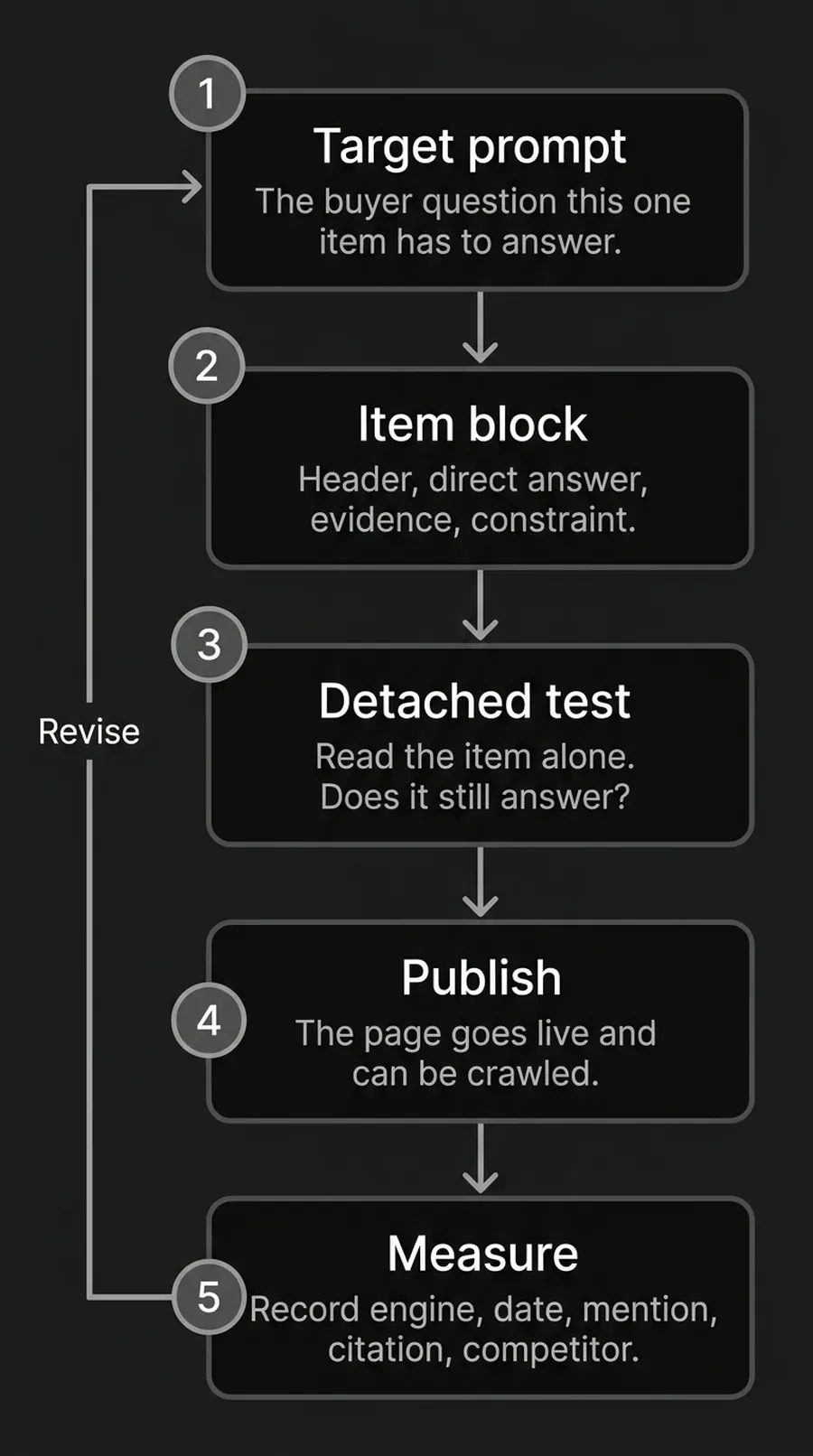
The first one is free and takes ten minutes. Copy an item's header, opening, evidence, and constraint into a blank note. Read it cold. Does it answer the target prompt without the introduction? Are there pronouns pointing at nothing? Is there a qualifier with no support, or evidence that actually belongs to a different item?
If you cannot tell what it is about, an engine will have the same trouble. Rewrite the item rather than adding length to it. Most of the time, a missing listicle AI citation traces back to an item that never named its own subject.
The second test is the live one. Run the exact prompts from Step 1 across the engines your audience actually uses. For each run, record the date, the engine, the prompt, whether your brand was named, whether your page was cited, which page or passage was cited when you can see it, which competitor showed up, and how the engine framed the answer.
Then keep the metrics separate, because they are not the same thing:
- Mention rate: how often an engine names your brand.
- Citation rate: how often it links to your pages as a source.
- Page attribution: which page earns the citation, and which prompts drive it.
- Share of voice: your visibility relative to competitors.
- Sentiment: whether the description of you is accurate and fair.
- Visibility trend: the direction across repeated collection periods.
Repeat the test over time. One answer on one day is a dated observation, not a ranking. AI answers move, and Google notes that AI Overviews and AI Mode can use query fan-out and different models, so the same question can produce different links in different places.
If a competitor gets cited instead, diagnose rather than despair. The item may not answer the prompt directly. It may lack evidence, or be too generic, or sit on a page that is not crawlable. Or the engine simply picked one of several fine sources. Change one thing at a time so you can tell which change did the work.
Done when: you have a baseline prompt set, an engine-by-engine record, a page-level citation record, and one clear hypothesis for the next revision.
Where writers go wrong: testing only ChatGPT, treating a Google ranking as an AI citation, lumping mentions and citations into one number, or overreacting to a single answer.
Doing this by hand works, and it is a good way to learn what the answers look like. It also gets heavy fast. DeepSmith runs scheduled prompt collection and reports per-prompt mention and citation rates, full answer history, page attribution, competitor citations, platform breakdowns, and trend, across ChatGPT, Gemini, Perplexity, Claude, Google AI Overviews, Google AI Mode, Grok, Meta AI, Microsoft Copilot, and DeepSeek. Engine coverage rises with the plan: Pro tracks ChatGPT, Grow adds Perplexity, Scale adds Gemini, and Enterprise or Custom covers all ten.

What to do next
Do not rewrite your whole library this week. Pick one list post that should be earning citations and is not.
Run the detached-item test on its three weakest items. Fix the headers first, then the opening sentences, then the evidence. Log the prompts, wait, and check the answers again in a few weeks. A list post that gets cited usually got there by revision, not by a lucky first draft.
That is the loop. One page at a time, momentum over perfection.
If you would rather have the tracking and the production sitting in one place, DeepSmith puts them together: define the prompts, see which pages earn citations, and produce the article that closes the gap, all off the same data. You can start a free trial and work with real prompts and real drafts before you pay.