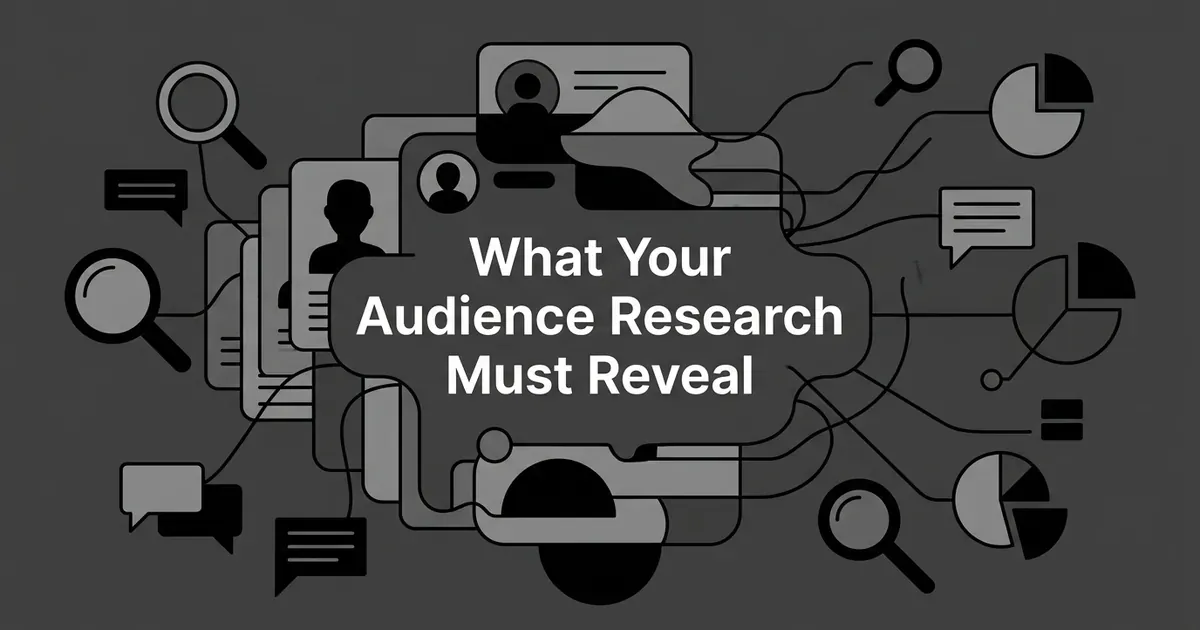
Audience research for content strategy is the work of finding out what a group already believes, what they are trying to get done, where they already go for answers, and what would make them trust something new. Most teams stop short of that. They pull together a few demographic facts, maybe a persona document, and call it done. That gets you a description of who might be reading. It does not tell you what to write, what to challenge, or what to prove.
This matters because a topic is not ready for your calendar just because it has search volume or sounds relevant to your business. It is ready when you can say what the reader already believes about it, what question they are actually trying to answer, where they currently go when they need help, and what would make them trust your version over the one they already found. Get those four things and the rest of the plan, the angle, the format, the proof, mostly writes itself.
Audience research is more than a demographic profile
Audience research is the study of a group's demographics, attitudes, behaviors, preferences, and needs. Audience analysis is what you do with that information: applying it to a specific piece of communication, paying attention to the audience's interests, their level of understanding, their attitudes, and their beliefs. A piece can be accurate and well written and still fail if it assumes the wrong starting knowledge, uses words the reader doesn't use, or answers a question they weren't actually asking.
Content strategy is the roadmap for producing and distributing content that attracts, engages, and converts the audience you're writing for. Audience research is one of the inputs that makes that roadmap specific instead of generic. It's the difference between knowing your reader is a marketing lead at a growing company and knowing that this particular marketing lead already understands basic SEO but is uncertain how AI citations are different from ranking, and is tired of reading generic advice that doesn't say anything new.
It helps to separate a few terms that get used loosely:
- Audience research is the evidence and the interpretation of it.
- Audience analysis is the reasoning that turns that evidence into decisions about what to write.
- A persona is a synthesized representation of a segment, built from research but not a replacement for it.
- A content plan is the set of editorial and distribution decisions made once you've done the first two.
A persona document can summarize research well. It can also be a set of assumptions wearing a name and a stock photo, and the two look identical on the page.
What the audience already believes
The first thing your research needs to establish is the audience's existing mental model: what they already know, what they assume, what they misunderstand, and what makes them skeptical. This is the part a demographic profile skips entirely. Knowing your reader is a marketing lead doesn't tell you whether they're new to the topic, have tried three approaches already, or are actively skeptical of the fourth generic explanation they're about to read.
Look for a few specific things. What is their baseline knowledge of the subject? What words do they use naturally, and do those words differ from your company's internal language? What do they believe that shapes how they'll read anything new you tell them? What have they already tried, and what do they believe did or didn't work?
Existing knowledge changes where you start. If your audience already understands the basic concept, an introductory explanation will feel like padding, and the piece should move toward comparison, diagnosis, or evidence instead. If they're carrying a mistaken assumption, you need to correct it before you can make a recommendation, or the recommendation won't land. And if the audience uses different words than your team does internally, the content should speak their language, or at least bridge the two clearly, rather than assuming they'll translate for you.
Beliefs also change the angle. The same subject needs different treatment for a reader who's curious than for one who's doubtful, risk-averse, or already committed to a different approach. Audience research content strategy work earns its keep right here: it's the difference between writing the piece that answers the question in the reader's head and writing the piece that answers the question you assumed they had.
What the audience is trying to accomplish
The second thing research needs to surface is intent: the situation, task, question, and outcome behind the reader showing up in the first place. A keyword is a signal of language and demand. It is not a full explanation of what someone is trying to get done. The same phrase gets typed by people chasing different goals, and one underlying task can show up as many different searches.
This is where content intent research comes in. It's the editorial work of figuring out the trigger that sent someone looking for information, the exact question they're trying to answer, the decision that comes after they find it, and whether the need is exploratory, diagnostic, comparative, or ready to act. Research on how people actually search backs up treating search as connected to tasks and shifting intentions across a session, rather than as one fixed category per keyword.
Intent determines what the page has to do. Someone trying to understand a concept needs orientation and a clear definition. Someone diagnosing a problem needs symptoms, causes, and a way to tell which one matches their situation. Someone comparing options needs the axes that actually differ between them, not a list of features that all sound the same. Someone getting ready to commit needs proof, constraints, and a clear next step.
Get the intent wrong and everything downstream is wrong with it: the topic priority, the headline, the heading structure, how deep you go, which examples you reach for, and even which channel you publish it on. Content intent research isn't a nice add-on to keyword research. It's the piece that tells you what a satisfying answer actually needs to contain.
Where the audience gets answers now
The third thing to establish is where your audience already goes when they need this information. This isn't a channel list. It's a map of the route someone takes from not knowing to feeling confident.
Find out which search engines, AI answer engines, communities, newsletters, or peers they actually consult, and whether that changes between discovery and verification. Some sources get used to find an answer quickly; a different source gets used to check it before acting on it. Find out what formats they reach for in this situation: a long explainer, a reference doc, a discussion thread, a worked example. Find out what's already out there that's useful but incomplete, outdated, or too promotional to trust.
This changes both what you write and how you position it. If the audience already gets basic definitions from a quick search, a new explainer needs a sharper point of view or a better answer to the part everyone else skips, not another restatement of the same definition. If they lean on peer communities for advice, your content needs to reflect the objections and language that actually show up there. A content plan that only tracks topics and ignores where people already look will produce technically correct articles that never become part of anyone's routine.
What would make a new source trustworthy
The fourth thing research has to establish is what makes this particular audience willing to believe, use, or recommend something they haven't seen before. Trust is not one universal signal. It's contextual: someone might trust one source for a technical how-to, a different one for an honest review, and a third for word of mouth from a peer who's actually tried it.
Signals worth checking for include demonstrated expertise, first-hand experience, named authors, association with a real organization, clear evidence and sourcing, and a willingness to admit limits and tradeoffs instead of overselling. Google's own guidance on people-first content asks similar questions: is there a clear intended audience, does the content show real expertise, will the reader actually learn what they came for, and is the sourcing trustworthy. Stanford's research on web credibility points the same direction: accuracy, a real organization behind the page, visible expertise, contactability, and restrained promotion all shape whether people believe what they're reading.
Trust requirements decide how much sourcing and qualification a piece needs, and who should write or review it. A skeptical audience needs transparent comparisons and an honest look at competing views before they'll take a recommendation seriously. If your reader is already wary of anything that smells like a sales pitch, the plan should lean toward useful information first and keep the commercial angle visible but secondary, rather than dressing up a pitch as an explainer.
How research changes the content plan
Once you have those four things, mental model, intent, current sources, and trust conditions, audience research content strategy stops being a list of topics and starts being a set of decisions you can defend.
Topic selection should follow real situations your audience is in, not just what sounds relevant to your business. The angle should meet their current mental model: explain the basics if they need orientation, challenge the misconception if that's what's holding them back, weigh tradeoffs if they're already comparing options. Depth and sequencing should match how much they already know: a beginner might need a short foundation before the detailed version, while someone experienced needs the edge cases and decision criteria instead of a definition they already have.
Structure should follow the reader's own question and task sequence, not an outline that feels tidy on a whiteboard. Format should fit the task: a complex decision might call for a comparison or a worked example, while a quick orientation question just needs a clear, short answer. Evidence and authorship should match what this audience actually trusts, whether that's named expertise, first-hand experience, or a transparent account of the tradeoffs. Distribution should follow where the audience already looks, since that's part of the decision, not something you figure out after the piece is already written.
A short readiness check works well here. Before a topic goes on the calendar, you should be able to say who has this problem in a specific situation, what they already believe about it, what they're actually trying to do, where they look for answers now, what would make them trust a new one, and what they should be able to do after reading. If the honest answer is a job title, a company size, and a generic pain point, you have a market description, not yet a piece worth writing.
Why personas alone are not enough
A persona can be genuinely useful. It gives a team a shared, memorable way to talk about a segment instead of arguing past each other about who they're writing for. The problem shows up when the persona quietly becomes the research itself.
A persona document describes a segment or an archetype. Audience research explains the situations, tasks, beliefs, sources, and trust conditions behind that segment. A persona often uses a name and a short narrative to help a team remember it. Audience research preserves the variation and the uncertainty that a tidy narrative tends to smooth over. A persona can stay stable for a long time because it's convenient. Audience research should change whenever the audience's beliefs, sources, or needs actually change.
The healthiest order of operations is to research the audience's situations, beliefs, tasks, and trust conditions first, segment only where those differences genuinely change what you'd write, summarize the recurring patterns into a persona if your team wants a shared artifact, and then keep the underlying findings available so the persona never quietly becomes a stand-in for the evidence behind it. A persona built this way earns its place. A persona built the other way around, starting from a name and a stock photo and backfilling goals that sound plausible, is an assumption dressed up as a profile, and it will steer a content plan just as confidently whether it's right or wrong.
None of this means audience research produces certainty. It reduces guessing. Findings drawn from a narrow sample, an old survey, or a single channel deserve to be held with appropriate confidence, not treated as settled fact. The goal isn't a perfect picture of your audience. It's enough evidence that the next piece you plan is answering a real question instead of an assumed one.