You asked ChatGPT a question in your space. Your brand showed up in the answer, but there was no link next to it. Did that count? Did anything just happen that you should be tracking?
Take a breath. Yes, something happened, and it counts more than you think.
That moment has a name. It is an AI brand mention, and it is quickly becoming one of the most important signals in how buyers find you. The good news is that the idea is simpler than the jargon makes it sound. By the end of this guide you will be able to define an AI brand mention in one sentence, name its two forms, tell a mention apart from a citation, and spot both inside a real answer from ChatGPT, Perplexity, Gemini, or Claude.
No frameworks to memorize. Just a clean way to see what is already happening to your brand. Let's start with the definition.
What Is a Brand Mention in AI?
An AI brand mention is any reference to your company, product, or person inside the body of an AI-generated answer. That is the whole definition. It does not need a link, and it is not the same thing as a citation.
So what is a brand mention in AI in practice? It is your name showing up where a reader will actually see it: in a sentence, a list, a comparison, or a recommendation the model wrote.
Here is what counts as a mention:
- Your brand is named in a sentence. "Asana, Trello, and Monday are leading project tools."
- Your brand appears in a shortlist or a recommendation set.
- Your brand sits inside a comparison paragraph, even with no link attached.
- Your brand is described so clearly a reader could resolve it. "The cloud storage company founded in 2012."
- Your brand shows up in a quoted fact, stat, or example.
And here is what does not count:
- Your brand only appears in the source list at the bottom of the answer. That is a citation, which we will get to.
- Your brand shows up only in a hidden system prompt the reader never sees.
- Your brand is in an image caption but not in the answer text the user reads.
One thing to hold onto: a mention lives in the answer body, the part a person reads. It does not matter which engine produced it. A mention counts whether it appears in ChatGPT, Perplexity, Gemini, Claude, or a Google AI Overview.
Your first action is small. Ask one AI engine a question your buyers ask, and just notice whether your name appears in the text. That is a mention. You are already doing this.
Linked and Unlinked: The Two Forms Every Mention Takes
Every AI brand mention is one of two forms. That is it. Once you can see the two forms, you can read any AI answer with confidence.
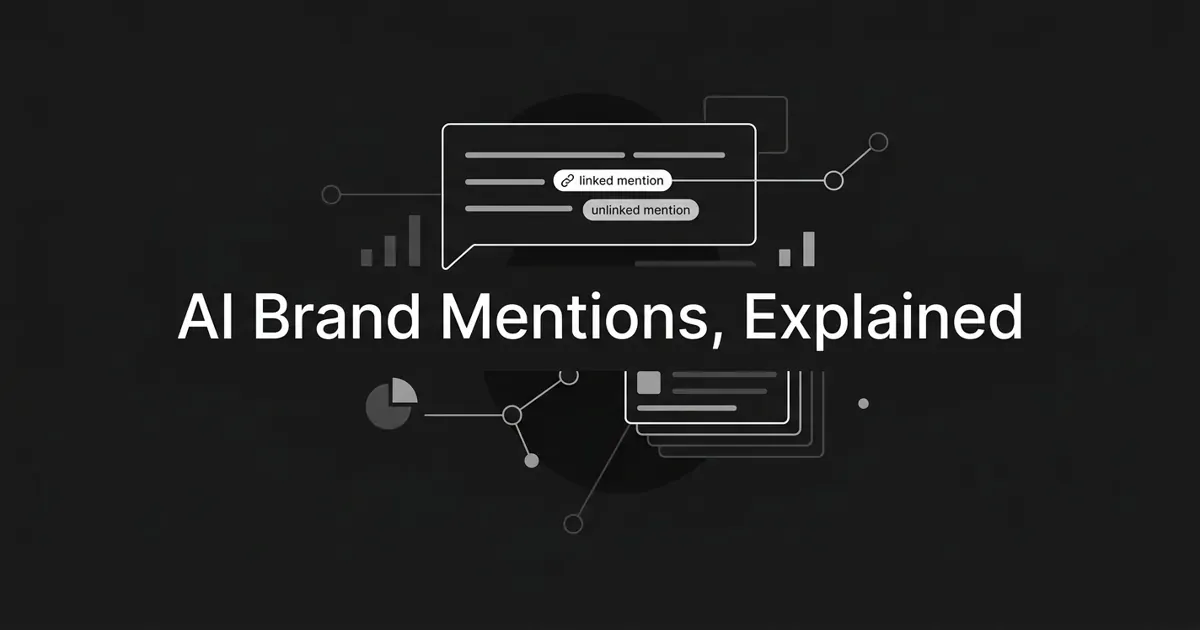
A linked mention is when your brand name appears as a clickable hyperlink inside the answer text. The name is the anchor. Click it, and you land on a page the model chose to surface, maybe your homepage, a product page, or a review.
An unlinked brand mention is when your name appears in plain text, with no link attached. It is a textual reference, nothing more. Your name is there, but it is not clickable.
Want the fastest way to tell them apart? Look at the color and the cursor.
- Linked mention: the name is blue, underlined, clickable, and sits right inside the sentence.
- Unlinked brand mention: the name is the same color as the words around it, with no underline and no change when you hover.
Here is what each looks like in the wild. In a ChatGPT list, you might read, "Popular options include Slack, Notion, and Asana." None of those names are links. Those are three unlinked mentions. In a Perplexity answer, you might see "Best for teams is Asana," where the word Asana itself is a clickable link. That is a linked mention.
Do not let the word "unlinked" fool you into thinking it is lesser. Both forms are real mentions. Both put your name in front of a reader. We will get to why the unlinked form matters just as much in a moment.
Your action here: the next time you see your brand in an AI answer, label it out loud. Linked or unlinked? That one habit will make you fluent fast.
Mention vs Citation: The Contrast That Trips Everyone Up
This is the distinction people get wrong most often, so let's make it clean. The mention vs citation AI question comes down to one idea: a mention is what the AI says about your brand, and a citation is where the AI got its information.
A mention is any reference to your brand in the answer body. No link required. The model lists you, recommends you, describes you, or names you in a sentence. You can read it without doing anything.
A citation is a specific, clickable link to a source the model used to build the answer. It usually shows up as a footnote number, a sidebar source, or a hyperlinked source title. You have to click or hover to see it. A citation is about where the answer came from, not about what the answer says.
Here is the analogy that makes it stick. A mention is a noun in the sentence. A citation is the footnote at the bottom of the page. A sentence can name your brand without a footnote. It can also carry a footnote to a page that never names your brand at all. That is the whole mention vs citation AI distinction in one line: two different things that often ride together but never mean the same thing.
Now for the part that surprises most marketing leads. Mentions are far more common than citations. A BrightEdge study found that ChatGPT mentions brands about 3.2 times more often than it cites them. A BuzzStream study found that roughly 76.9% of brand mentions in AI answers carry no citation at all. Read that again. Most of the times an AI names a brand, there is no link anywhere.
Why does this matter for you? Because if you only track citations, you are missing most of your presence. Mention rate measures how often the AI names you. Citation rate measures how often it points to your pages as a source. They answer different questions, and you track them separately. A brand can be named constantly and cited rarely, which usually means the model knows you well but does not anchor to your specific pages yet.
Your action: decide today that you will watch two numbers, not one. Mentions and citations are different votes, and you want both on the scoreboard.
How ChatGPT, Perplexity, Gemini, and Claude Handle Mentions
Every major AI engine produces both linked and unlinked mentions. What changes is the mix. Knowing the pattern for each one saves you from drawing the wrong conclusion after testing a single tool.
ChatGPT, in its default mode, answers from what it learned in training. That produces almost entirely unlinked mentions. Your name shows up in plain text. When web search is switched on, ChatGPT can render brand names as inline links to the pages it found, so you get linked mentions too, often alongside unlinked ones in the same answer. Remember that 3.2x figure from BrightEdge. Most ChatGPT mentions have no link.
Perplexity is the exception. It is built around sources, so it leans harder toward linked mentions than any other engine. Every claim is anchored to a numbered marker that maps to a source list. Sometimes your brand name itself is the clickable anchor. Other times your name sits in plain text and the citation marker attaches to the end of the sentence. Both patterns appear, but Perplexity produces the highest ratio of linked mentions you will find.
Gemini and Google AI Overviews blend plain-text mentions in the paragraph with a source strip beside or below it. Your name often appears in the prose without a link, while the matching URL sits in the citation strip. Both forms show up here, and the unlinked pattern is the more common one.
Claude, by default, writes plain prose with unlinked mentions. When it uses web search or tools, it can add inline links or footnote-style sources. Most everyday Claude mentions are unlinked.
The takeaway across all four: Perplexity leans linked, and ChatGPT, Gemini, and Claude lean unlinked in their default modes. If you only ever test Perplexity, you will overestimate how often links appear. If you only ever test ChatGPT, you might undercount your presence by ignoring all those unlinked names. A complete measurement watches every engine, and counts both forms on each one.
Your action: pick two engines your buyers actually use and check the same question on both. Notice how differently they handle the exact same mention.
Why an Unlinked Mention Still Counts
Here is the reassuring truth. An unlinked mention is not a consolation prize. It is a genuine visibility signal, and often the most common one you have. Let me give you four reasons it counts, even with no link in sight.
First, recognition. Every time an AI names your brand, a real person reads your name. That is exposure, link or no link. The reader now associates your brand with the question they asked.
Second, entity reinforcement. AI models build their working knowledge of brands from how often and how consistently those brands appear across the web. Each mention, linked or not, is one more data point tying your brand to a topic, a category, or a use case your buyers care about. An unlinked brand mention still strengthens that connection in the model's mind.
Third, it acts like a recommendation. When someone asks "best project tools for small teams" and your brand makes the list, the model just decided you belonged in the answer. That is the new version of ranking near the top of the page. The link is not what makes it a recommendation. Being named is.
Fourth, it is your visibility baseline. You cannot measure how present you are in AI answers unless you count mentions. Citation tracking alone misses up to that 76.9% of your presence, per BuzzStream. Ignore unlinked mentions and you are grading yourself on a fraction of the real picture.
There is a deeper point worth being honest about. This guide is not arguing about whether a link makes a mention more valuable. That is a real debate, and it deserves its own discussion. Here, the job is simpler and it is settled: an unlinked mention is still a mention, it still counts, and it still signals that the model knows your brand.
Think of it this way. A mention is the model's vote that your brand belongs in the answer. A link is a separate vote about whether it trusts your page as a source. Two votes, two metrics, both worth tracking.
Your action: stop dismissing the unlinked names you see. Start counting them. They are the bulk of your AI visibility.
How to Spot a Mention in Any AI Answer
Let's make this practical. You do not need a tool to read a single answer. Here is a simple scan you can run in under a minute.
- Read the answer the way a buyer would, for meaning.
- Note every brand, product, or company name in the prose.
- For each one, check: is it a clickable link, or plain text? Linked or unlinked.
- Ignore the source list, footnote numbers, and citation strips. Those are citations, not mentions.
- Count the unique brands named. That is the mention count for the answer.
Now, where do mentions like to hide? Look for them in a few predictable spots:
- In a recommendation list at the end of the answer.
- Inside a comparison paragraph. "Compared to X and Y, Z offers..."
- In a single shortlist. "Top five options: A, B, C, D, E."
- In a sentence that gives your brand a trait. "Notion is known for its flexible databases."
- In a quoted stat or example tied to a brand.
And where do mentions not count? Keep these out of your tally:
- The source list, footnote block, or citation strip.
- The model's hidden reasoning that no reader sees.
- Image alt text and metadata that never appear in the answer.
One honest caveat before you run off and test. AI engines are inconsistent. Research from SparkToro in January 2026 showed that the same prompt, asked the same way, to the same engine, can return different brands minutes apart. So one check is a snapshot, not a verdict. Test a set of questions, repeat over time, and read the pattern rather than any single answer.
That is also where doing this by hand starts to strain. Checking one answer is easy. Tracking dozens of prompts across four engines, every week, and watching the trend is a different job. This is the point where marketing leads reach for an AI visibility platform that runs the prompts on a schedule and reports mention rate, citation rate, and share of voice for you. Share of voice, by the way, is just your slice of all the brand mentions in your category. If AI answers in your space name brands 100 times and you appear 22 times, your share of voice is 22%. It is the one number that tells you how you stack up against competitors.
Your action: build a small list of ten questions your buyers ask. That list is the seed of every measurement you will ever run.
You Already Know More Than You Did
Here is the good news you have earned. You can now define an AI brand mention, name its two forms, tell it apart from a citation, and spot both in any answer. That is the whole taxonomy, and you have it.
The throughline is simple. A mention is the model's vote that your brand belongs in the answer. That vote comes in two forms, linked and unlinked, but it is the same vote either way. The link is a separate question for another day. What matters now is that you can see your brand's presence clearly, instead of guessing.
You do not need a bigger team to act on this. You need a smaller first step. Start by seeing where you actually show up.
When you want the full picture without the manual scanning, DeepSmith tracks your mention rate and citation rate across ChatGPT, Gemini, Perplexity, Claude, and Google AI Mode, then helps you close the gaps with on-brand content produced in the same platform. You can start a free trial and see real numbers for your own brand before you commit to anything.
Take it one prompt at a time. Momentum matters more than perfection.