If you're trying to figure out whether a page can compete for a search spot, you've probably bumped into two different numbers: Google's PageRank and Moz's Domain Authority. Here's the short version. There's no public accuracy winner between PageRank vs domain authority, because Google's current PageRank values aren't available to test against anything. For judging one page's link-based strength, reach for a page-level score like Page Authority. Use Domain Authority for context on the whole site. Neither one tells you where a page will land in search results on its own.
That's not a dodge. It's the honest shape of the question once you look at what each metric actually is and what it was built to do. The page authority vs pagerank mix-up is common too, since the names sound like cousins, and sorting that out is part of getting this right.
What PageRank tells us about link authority
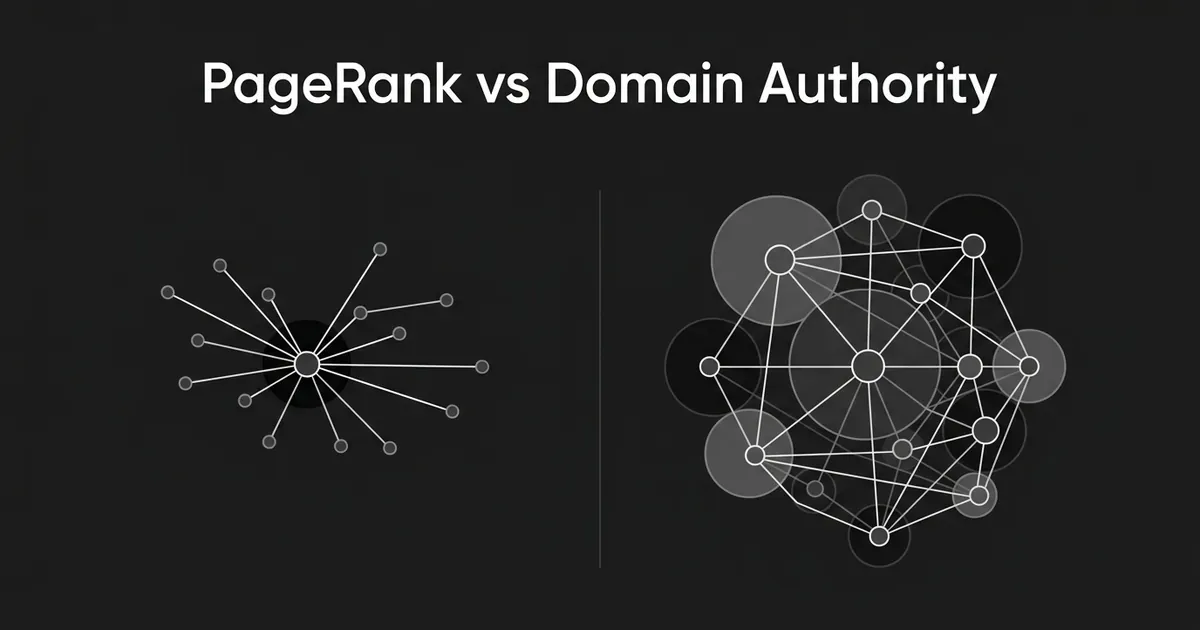
PageRank is Google's own internal system for reading the web as a network of links. The idea, going back to Google's earliest days, is that links between pages carry information: when one page links to another, it's treating that page as worth pointing to, and Google's systems use that pattern to understand pages and judge what might be useful for a given search.
Google still lists PageRank as part of its core ranking systems. Its ranking-systems guide, last updated in December 2025, says exactly that: the company uses systems that read how pages link to each other, and PageRank is named among them. The guide also says the system's operation has changed a lot since it first launched, so what runs today isn't the same thing published in the original research papers.
Here's where people get tripped up. For years, Google showed a public PageRank number through its Toolbar. That number is gone. Google confirmed back in March 2016 that it was shutting down the public Toolbar display, while saying plainly that it would keep using PageRank internally. The public number and the internal signal were never quite the same thing anyway. Google said as much back in 2011, explaining that the Toolbar figure differed from what it actually used for ranking, and warning against treating it as the whole story on search performance.
So when someone says "Google retired PageRank," that's not quite right. Google retired the public display. The internal system is still part of how Google ranks pages, you just can't see the number. That means there's no current, Google-issued PageRank score you can set next to Domain Authority for a fair comparison. Any tool that claims to show you "PageRank" today is estimating, not reporting a real Google value.
The takeaway: PageRank is useful for understanding why links matter to Google's systems. It's not a score you can pull up and use for benchmarking, because Google doesn't publish one anymore.
What Domain Authority and Page Authority estimate
Moz built two related scores to fill the gap left by a public PageRank number: Domain Authority and Page Authority. Both run from 1 to 100, and both exist to estimate ranking strength, but they measure different things.
Domain Authority, or DA, estimates how strongly an entire domain or subdomain is positioned to rank, relative to other domains. Moz calculates it using machine learning across Moz's own link index, with linking root domains and link quality as the main inputs, alongside other signals tied to ranking performance. Moz is explicit that DA is relative, not a pass-or-fail number. Moving from a DA of 20 to 30 is a different kind of climb than moving from 70 to 80, even though both are a 10-point jump.
Page Authority, or PA, scores a single page rather than a whole domain. Moz describes PA's scale as logarithmic, built from a model that tries to correlate with how pages actually rank across a large set of search results. It draws on more than 40 factors tied to that page's links specifically: linking URLs, linking root domains and subdomains, followed and nofollowed links, how varied the anchor text is, redirects, how old the links are, and more. Moz calls PA a link-centric metric for a reason. It explicitly leaves out on-page elements like keyword use or content optimization, because that's not what it's measuring. Moz's own guidance is to use PA to compare pages against each other, not as a standalone verdict on whether one page will rank.
The useful distinction to hold onto here isn't "which number is bigger." It's scope. DA tells you about a website. PA tells you about a page. They're not interchangeable, and a PA of 40 on one page isn't the same quantity as a DA of 40 on a domain.
Which level matches the decision?
This is the question that actually matters, and it's simpler than picking a winner between PageRank and Domain Authority. Match the level of your metric to the level of your decision.
| What you're deciding | Reach for this | What it won't tell you |
|---|---|---|
| How does this one page compare to competing pages on link strength? | A page-level score (like PA), plus a look at the actual links pointing to that page | Its real Google PageRank, or its future ranking |
| How strong is this whole website's backlink position against similar sites? | A domain-level score (like DA) | Whether every page on that site is equally competitive |
| Will this specific page rank for a specific search? | The actual competing results, how well the page matches the query, technical basics, page-level link evidence, and real performance over time | A guaranteed position based on any single authority number |
Google backs up the logic here. Its ranking-systems guide says its systems are built to rank individual pages, and while site-wide signals do feed into that, strong site-wide signals don't guarantee every page on the site ranks well, and weak ones don't doom every page either.
Picture two situations. First, a large, well-known website publishes a brand-new article that hasn't picked up many links yet. A smaller, more specialized site has an older page that answers the same search closely and has earned a solid set of relevant links over time. The big site's domain-level strength doesn't tell you, by itself, whether its new article actually out-links the specialist page or beats it in that search. You'd need to look at the two actual pages, not just the two domains.
Second, think about one website that has two very different pages: a heavily cited research report that other sites link to constantly, and a newer support page that nobody links to yet. They share the same domain, so a domain score treats them the same. A page-level score would tell a very different story about each one, because their link situations aren't close to equal.
Neither example is a measured result. They're there to show why a domain number can't answer a page-level question, and why matching your evidence to your decision matters more than picking a favorite metric.
Which SEO metric predicts rankings?
Here's the part worth separating out clearly: measuring link-based strength and predicting a future ranking are not the same task, even though people use "predicts rankings" loosely to mean both.
A handful of studies have looked at how authority scores line up with actual rankings. Moz ran its own analysis in March 2019, pulling 16,000 keywords from its U.S. Keyword Explorer corpus and checking the real first page of results for each one. Under that study's method, Moz reported a DA correlation of around 0.12 with rankings. That's Moz testing its own metric, using a 2019 model and a 2019 search environment, and a correlation like that isn't an accuracy percentage or a chance of ranking. It's one data point from one vendor's own benchmark.
A separate study published through Moz in December 2020, run by Eric Enge, looked at something slightly different: not the DA or PA of the ranking page itself, but the authority of the sites linking to it. That study grew from 6,000 queries in 2016 to 32,000 queries by late 2019, pulled from keyword-ranking reports across technology, healthcare, and finance. It reported values of 0.328 for linking-source DA and 0.307 for linking-source PA, using its own method for combining correlations across queries. Those numbers aren't directly comparable to Moz's 2019 figure, since they're measuring a different thing (the authority of the sites doing the linking, not the page being ranked) with a different method. The honest reading is that the authority of what links to you showed some association with how you ranked, in that historical sample.
An earlier piece from 2017, by Tom Capper, is worth mentioning for a different reason: it's a clear warning about how fragile correlation studies like these can be. An association between links and rankings could mean links help pages rank, or it could mean pages that already rank well tend to attract more links, or some third factor (like general brand reputation) could be driving both. The study also showed that how deep you sample results (top 10 versus a wider set) changes the correlation you get. A single number from a study like this means little without knowing the sample, the method, and when it was run.
Put together, what these studies show is that link-related authority estimates have, at various points, shown some association with search rankings. None of them hands you a reliable, present-day forecast, and none of them settles a PageRank vs domain authority contest, because none of them had access to Google's actual internal PageRank values to compare against.
There's also a limit that applies no matter which score you look at. Google names several systems built specifically to judge meaning, intent, and relevance, separate from link analysis entirely. A link-based score, however it's built, was never going to capture that side of ranking. And Page Authority's own documentation is a clean example of this limit in miniature: it explicitly skips on-page factors like keyword use, so even a well-built page-level score is only ever describing part of the picture.
One more floor worth knowing: a page has to clear basic technical requirements before rankings are even on the table. Google is checking three things for indexing eligibility: Googlebot isn't blocked, the page actually loads and returns a normal response, and there's indexable content there. Clearing those bars doesn't guarantee indexing, and indexing doesn't guarantee a ranking. A strong authority estimate on a page that fails those basics isn't worth much.
Why authority scores and rankings can move differently
A lot of the confusion around these metrics comes from treating a score change as proof of something happening in search. It usually isn't, at least not on its own.
Moz is upfront that DA can shift for several reasons that have nothing to do with your actual rankings: changes in your backlink profile, sure, but also changes in which linking domains Moz's index includes, movement elsewhere on the relative scale (since DA compares you to everyone else), or an update to Moz's underlying model. PA can move for similar reasons, tied to its own algorithm and input data. None of that is a direct readout of what Google is doing with your pages.
So if your DA drops ten points next month, that's a reason to look closer, not a diagnosis. It doesn't by itself mean you lost rankings, lost traffic, or got hit with some kind of penalty. The same goes in reverse: a PA increase doesn't confirm a ranking gain happened.
A few habits make these scores less misleading to track. Compare the same metric at the same scope over time, rather than mixing domain and page numbers. Note the date you pulled the number, since both DA and PA move as the underlying model changes. Stick with one provider's version of the metric when you're looking at a trend, rather than hopping between tools. Compare yourself against the competitors actually relevant to your market, instead of chasing a round number as if it were a pass mark. And when a score does move a meaningful amount, look at the actual links behind it before deciding what it means.
Here's a situation worth sitting with: a team notices their DA has dropped, but their priority pages are holding steady on search performance and conversions. The score moved. The business outcome didn't. That gap is the whole point. The team's time is better spent checking what actually changed in their link profile or Moz's index than running a campaign aimed only at pushing the number back up. Google's own 2011 guidance on this made a similar point: look at what's actually happening for your website and your business, not just a ranking-adjacent score.
When each approach is useful
Match the tool to the question you're actually asking.
When you're deciding about one article or landing page, start with page-level evidence. If a tool you're already using offers something like Page Authority, use it as a starting point, then go look at the real pages competing for that search and whether they answer the same need as yours. This isn't about proving PA beats every other metric. It's about using a page-level number for a page-level question.
When the question is about your broader competitive position, a domain-level score gives you useful context. It tells you something about where your whole site stands against similar sites. Just don't stretch that into a claim about every individual page you've published.
When you're trying to understand why links matter to search in the first place, PageRank is the right concept to reach for, understanding that you're explaining a system, not quoting a current number. It's useful for grounding the conversation in how Google actually works, even without a public figure attached to it.
When you're trying to tell whether your publishing or promotion efforts are paying off, judge that by the outcomes that actually matter: search visibility, traffic, and conversions on the pages you're investing in. An authority score moving in the right direction is encouraging, but it's not the same thing as more people finding and acting on your content.
Review one priority page against the pages it's actually competing with before you set your next authority-score target. That one habit does more for your decisions than chasing a higher number across the board.