You have a page that still earns attention, and somewhere in it sits a number from three years ago, a link that now lands on a homepage, and an "Updated" date nobody can explain. That is the most common shape of a page losing its right to be quoted. This guide walks you through the maintenance pass that fixes it: how to update stats in content, repair the trail back to the evidence, and handle dates honestly so you keep content citable. You will finish with a page whose claims are checked, whose sources are live, and whose next review is already on the calendar.
If that feels like a lot, take a breath. You are doing eight small passes, not one giant rewrite.
1. Baseline the page and its citation job
Start by writing down what this page is for. Not the traffic number. The job.
Name the questions it should answer, and the claims that make it worth answering them. A page earns a citation when someone, or something, can move from a specific claim to accessible evidence that supports it. So the first thing you need is a list of the claims you are defending.
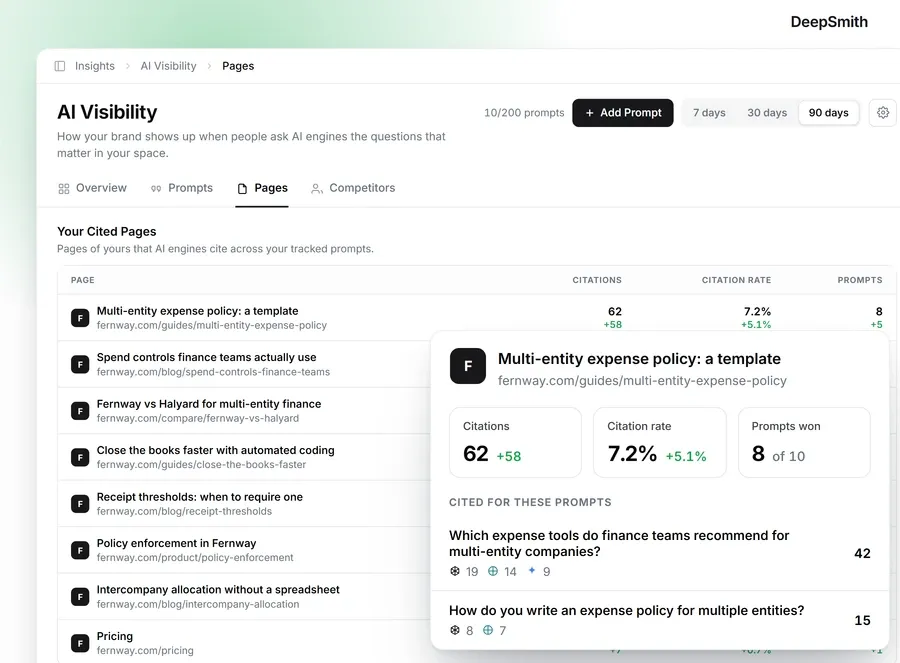
Then record where the page stands right now. Note the visible publication date, the visible update date, the dates sitting in its structured data, and the last time anyone actually reviewed the evidence. If the page is tracked in an AI visibility tool, capture its citation rate, its mention rate, the prompts driving those citations, and which competitor pages show up for the same questions.
This is the part people skip, and skipping it is expensive. Without a baseline you cannot tell later whether the work helped.
DeepSmith is one way to hold that baseline. Its AEO area tracks mention rate, citation rate, and share of voice with a per-platform breakdown, and its Pages view shows which of your own pages AI engines cite, each page's share of your total citations, and the prompts behind them. That gives you a before picture you can compare against. It does not check whether your statistic is right. That part is still yours.
How you know the step is done: you can say in one sentence what the page is supposed to answer, which claims matter most, what its citation baseline is today, and who owns the review.
Where people go wrong: they open the CMS and change the date first, because the date looks old. The date is the output of a real update, not a way to pretend one happened.
2. Inventory every claim that can age
Now read the page line by line and list everything in it that can go stale.
Everything means more than the headline statistic. Percentages, totals, prices, years, benchmarks, research findings, quotes, named reports, product features, screenshots, tool names, table cells, chart labels, footnotes, captions, and the source list at the bottom. Write down where each one appears, because a number you fix in the body will happily survive untouched inside a table three screens down.
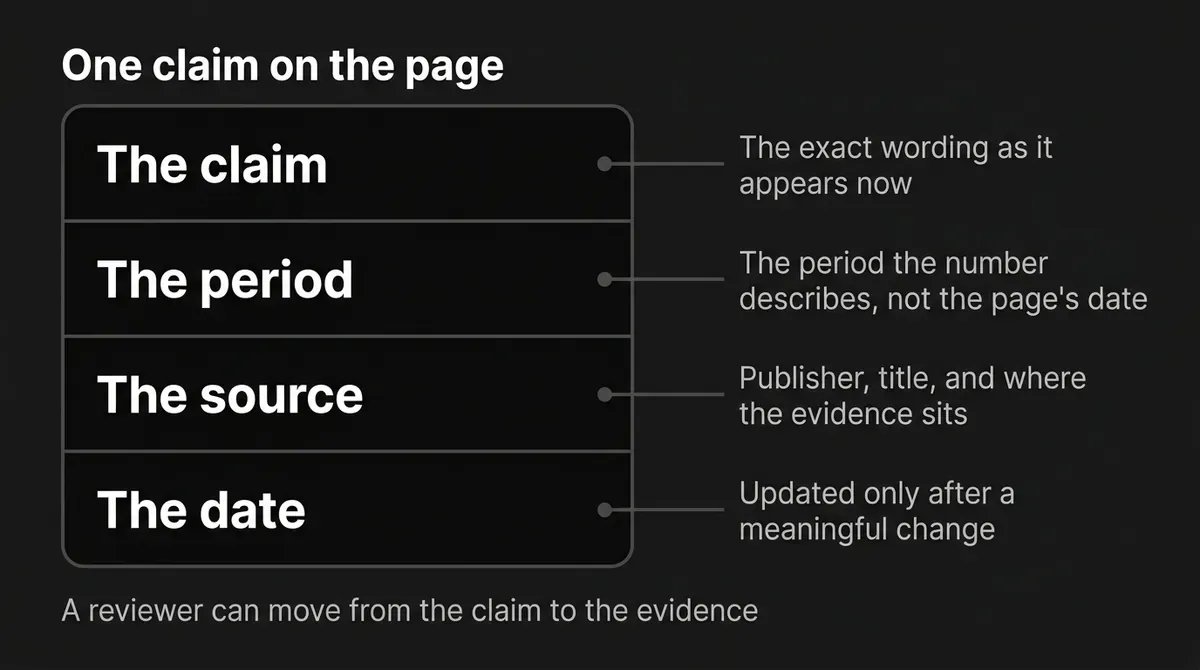
Put them in a simple claim register. Seven columns are enough to start:
| Column | What you record |
|---|---|
| Claim | The exact wording as it appears now, plus its section |
| Period | The period the number describes, not the page's date |
| Source | Publisher, title, and where in the source the evidence sits |
| Status | Keep, replace, qualify, remove, or repair the link |
| Verified | The date you last checked it against the source |
| Page impact | Whether this change is central enough to move the update date |
| Next review | Owner and the date of the next check |
Then tag each claim by how fast it moves. Prices, product features, regulations, and platform behavior move fast. Annual market data, surveys, and benchmarks move at a medium pace. Historical facts move slowly, though even those need a look if the source or its definition has changed. These tags are your own editorial control, not an official expiry clock. They just tell you where to spend your attention.
How you know the step is done: every number, date, quote, source, and time-sensitive fact on the page has a row, or you have deliberately ruled it out of scope.
Where people go wrong: they audit the big statistic in the intro and leave older figures sitting in examples, tables, screenshots, metadata, and the FAQ.
3. Re-verify each statistic against the source
Here is the step that does the real work. Open the evidence itself.
Not a search snippet. Not a blog post that quotes the study. The original dataset, filing, paper, government publication, standards document, or first-party report that produced the number. If the original is available, that is what you check against.
When you have it open, check more than the value. Check the unit, the denominator, the population, the geography, the time period, the sample, the methodology, the rounding, and any qualifying language. Then read your own sentence again and ask whether it quietly turned an estimate into a fact, a correlation into a cause, one subgroup into everybody, or a historical figure into a current one. That drift is the usual culprit when a claim goes wrong, and it happens without anyone touching the number.
Give every claim one of five decisions:
- Keep. The value and its context are still accurate, and the source is still the right one.
- Replace. A newer or corrected source supports a current value.
- Qualify. The claim still helps, but only with an as-of date, a scope note, or an estimate label.
- Remove. It cannot be verified, it has been superseded, or it no longer helps the reader.
- Repair. The evidence holds up, but the link or reference trail to it is broken.
If no newer figure exists, do not invent one. That is the whole rule. Keep the historical number only when its period and meaning are spelled out, or qualify it, or take it out. When you update stats in content, an honest gap always beats a plausible guess.
Pro tip: keep the old value and the new value side by side in an internal change log, along with the source and the reason for the change. Readers only need the current claim. Your team needs the audit trail, and future you will be very glad it exists.
How you know the step is done: a reviewer can move from any statistic on the page to the exact evidence behind its number and its context, and the register says why each one was kept, replaced, qualified, or removed.
Where people go wrong: they change "2024" to "2025" and leave the value, the denominator, the methodology, and the source alone. That is a label edit dressed up as a verified update. It is also the fastest way to publish something that is now simply false.
4. Refresh the source trail and repair links
A source list is only as good as where it actually lands. So test every external link and follow it.
You are checking two different things. First, does the link resolve at all? Second, and this is the one people miss, does it still reach the evidence you named? A link can work perfectly and still land on a generic homepage, a redirect to something unrelated, or a page whose content no longer supports your sentence.
For each source, record the publisher, the title, the publication or version date, where in the source the evidence sits, whether it is still accessible, and which claims depend on it. Prefer the original. Reach for a secondary source only when it adds analysis you genuinely need, or when the original is not available, and say clearly what its scope is. A publisher can be reputable and still be the wrong source for your particular sentence, because their population, period, or definition is not the one you are describing.
If a report has a newer edition, use it when it supports your claim, and update the wording around it so the data period matches. If the original source has vanished, look for a current publication from the same publisher or a credible archival record. If you cannot re-establish the claim, qualify it or remove it. A citation that no longer proves anything is worse than no citation, because it looks like proof.
A good rhythm here is to refresh sources and dates on a quarterly pass, and to re-verify statistics, quotes, and tool references at least once a year. Volatile subjects need a shorter interval. Nothing about those numbers is a law. They are planning bands you adjust to how fast your topic actually moves.
How you know the step is done: every source link resolves to the evidence it names, every source is current enough for its claim, and nothing on the page rests on a reference that has been superseded or cannot be checked.
Where people go wrong: they treat a live link as a valid source. Working and supporting are two different tests, and only one of them is automated.
5. Update the visible date only after a meaningful change
Now, and only now, you get to think about the date.
Ask one question: does this pass materially change the information a reader receives? Replacing a central statistic, correcting several claims, swapping out superseded evidence, or reworking a substantial section all say yes. A typo fix, a punctuation tidy, or one isolated link repair does not.
Keep the original publication date as the publication date. It is part of the page's history, and hiding it helps nobody. Add or update a clearly labeled "Updated" date for the meaningful revision. If your page shows a time as well, get the time right too. And be precise about what the date describes: it is when your page changed, not when a study you cite was published, and not when an event you write about happened.
There is no official word count that makes an edit "significant." So write your own rule and document it. Base it on the share and importance of the claims that changed, not on how many words moved. A single evidence correction at the heart of the page can be meaningful. A long cosmetic edit can be nothing at all.
This is what it means to keep content citable rather than merely current-looking. A reader who can see when the page was first published, when it was last genuinely revised, and what changed, has a reason to trust the claims in between.
How you know the step is done: your change log explains why the page deserves a modified date, the labels on the page distinguish published from updated, and the displayed date matches the actual revision.
Where people go wrong: the date moves every time the CMS saves. Artificial freshening misleads readers, and it does not create a single piece of supporting evidence.
6. Synchronize and validate your dateModified signals
The date on the page and the date in your structured data need to say the same thing. Right now they probably do not.
Update your Article or BlogPosting markup so datePublished still holds the first-published date and dateModified holds the most recent meaningful revision. Use ISO 8601 values and include timezone information. Then make the visible date and the structured-data date identical, timezone included when a time is shown. Google estimates a page's date from several signals, including prominent dates on the page and dates in structured markup, so giving it two versions of the truth helps nobody.
Then check your work rather than assuming it landed:
- Run a structured-data test and fix any critical errors.
- Use URL Inspection on the live page to see how Google actually reads it.
- Confirm the page is reachable by crawlers, and not blocked by robots.txt, a noindex tag, a login wall, or similar access controls.
- Refresh the sitemap signal and request a recrawl where that is available.
- Write down the deployment date and the recrawl date, so you know when the clock started.
Then wait. Discovery and re-indexing can take several days, and different AI engines run on their own schedules.
One honest note before you move on. This step is about making your page understandable, not about buying a citation. Google says it may use multiple date signals and does not guarantee it will use the one you supplied. Other engines retrieve and parse pages their own way. Clean, consistent dates are current data for AI trust in the practical sense: they make the page easier to read correctly. They are not a switch that turns citations on.
How you know the step is done: visible and machine-readable dates agree, the structured-data test shows no critical errors, the page is crawlable, and the deployment and recrawl dates are recorded.
Where people go wrong: the CMS quietly bumps dateModified on every minor save, or the visible date and the schema date sit in two different time zones and disagree by a day.
7. Run a claim-by-claim publication QA
You are nearly there. This is the pass that catches the mistake that would otherwise live on the page for a year.
Put the finished page next to your claim register and walk the rows. For each changed number, check that it appears the same way everywhere: in the prose, in tables, in charts, in captions, in examples, and in the source notes. Check that your qualifiers and as-of dates survived editing, because those are the first things a tidy-up pass deletes. Test the source links one more time. Look at the visible Published and Updated labels on the rendered page. Inspect the rendered structured data. Confirm that no retired reference is still sitting in the source list.
On high-value pages, use two people where you can. One makes the change, the other compares the page against the evidence. It is a small cost against publishing a wrong number under your own byline.
Then save the change log: claim ID, old wording or value, new wording or value, the supporting source, the reason, who reviewed it, the deployment date, and the next review date. That single file is what turns a one-off refresh into an editorial record your team can rerun.
How you know the step is done: every changed claim is traceable, every source is live and relevant, duplicate versions of the same number agree, the date decision is documented, and the technical date check passes.
Where people go wrong: they publish once the body is updated, before the source list, the table, the chart, and the structured data have caught up.
8. Measure the result and schedule the next check
Give the page time to be seen. Then compare it against the baseline you wrote down in step one.
Measure against that baseline, not against a feeling. Track citation rate, mention rate, which prompts are driving citations, which of your pages are getting the credit, and which competitor pages are showing up for the same questions. Normal page and keyword signals still count too. The point is to answer one question: did maintaining the evidence change anything?
This is where DeepSmith earns its place in the loop again. Its Prompts view keeps your tracked questions with per-prompt mention and citation rates and full answer history, and its competitor citations view shows which rival pages win those same prompts and how that varies by platform. That is enough to tell you whether this page recovered and which page deserves your next hour. It does not open the source and verify the statistic for you, and no tool does.
Then put the next check on the calendar before you close the tab. A fact freshness AEO routine is mostly this: a recurring date with a clear job attached.
- Quarterly micro-refresh. Scan the claim register, replace stale statistics, test external links, review your citation metrics, and record any date decision.
- Annual evidence review. Re-verify statistics, quotes, tool references, and source versions, more often for volatile claims.
- Event-triggered check. Review immediately when a source publishes a replacement, a definition changes, a product or regulation shifts, or a core claim stops being accurate.
- Volatility override. News and fast-moving facts may need a weekly or even daily look. A steady evergreen guide may be fine on a six-to-twelve-month source check if nothing else flags it.
A few signals are worth treating as prompts to investigate: a traffic decline of more than 20% over 90 days, a loss of more than five positions for target keywords, or no new referring domains for six months or more. One of those is worth a look. Two or more moves the page up your queue. An unexplained drop in citation rate is the most direct trigger of all for this kind of work. None of these are official thresholds from any engine. They are review signals, and that is exactly how you should use them.
How you know the step is done: the page has an owner, a next review date, a saved change log, a measured post-update baseline, and a rule for pulling the audit forward.
Where people go wrong: they check performance two days after publishing, see nothing, and decide the update failed. The page has not even been recrawled yet.
What to do next
Pick one page. Just one. Make it the page carrying your most valuable claims, the one you would least like to be wrong about.
Run the claim register on it before you touch the date. Verify the numbers against the sources that produced them, repair the trail, decide honestly whether the update date has been earned, then measure and schedule. Once you have done it once, you have a repeatable pass, and the second page takes half as long.
That is the whole habit behind fact freshness AEO work: current data for AI trust comes from evidence you actually checked, not from a timestamp you moved. Do that, and you keep content citable for reasons that hold up.
If you want the measurement half of this loop running on its own, start a free DeepSmith trial and watch how your citations move after the next refresh.