You already have the articles. They were written before AI answers mattered, so they bury the answer, carry a stale number or two, and lean on context that only makes sense if you read the whole page. That is a fixable problem, and it is cheaper than writing something new.
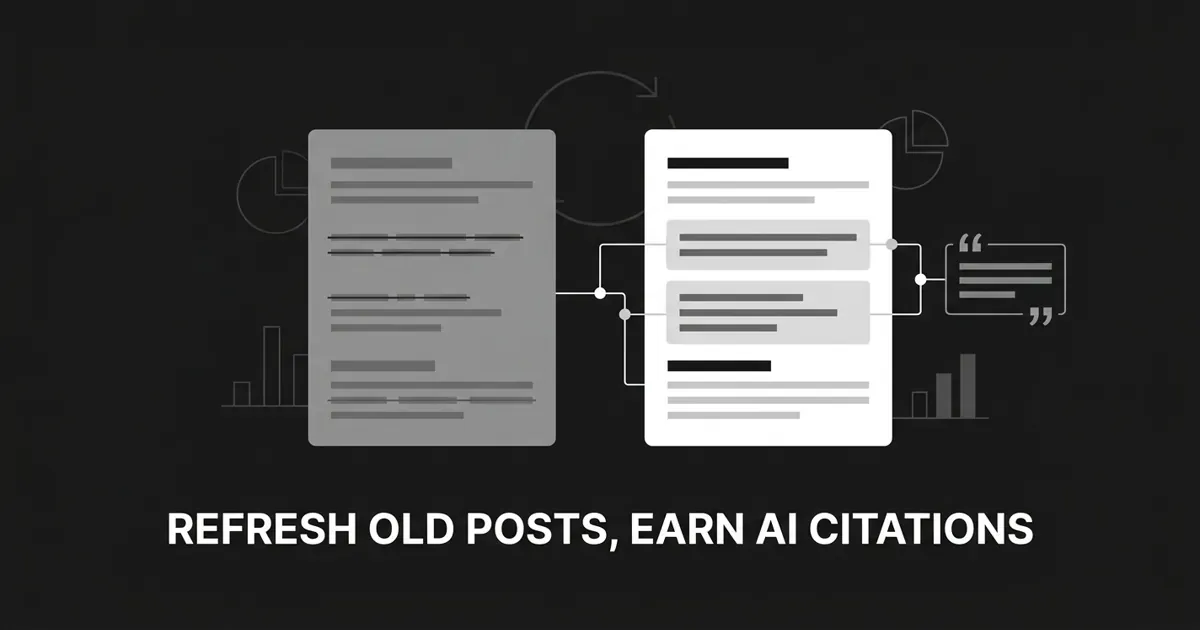
Here is the short answer on how to refresh content for AI search. To update old content for AI citation, replace stale facts with current evidence you can attribute, rebuild the outline around the exact question the page answers, put a direct answer at the top of every section, and rewrite key passages so they still make sense when lifted out. Then check that dates, authorship, and visible text are honest.
One caveat before you start, because it will save you disappointment later. No engine promises a citation. Citation-ready is an editorial standard, not a switch. Everything below is aimed at one thing: make old articles AI citable, without pretending the outcome is yours to control. You are making the page easier to understand, verify, and reuse, which makes it eligible more often. That is the honest deal.
Seven steps. Take them in order.
1. Pick a page with a real citation opportunity
Do not start with your oldest post. Start with the page that could become a better answer.
Build a short candidate list, then look for these signals. The topic is time-sensitive, like a year-specific guide, a statistics page, a product comparison, or a tutorial tied to an interface that keeps changing. The page still has demand but its usefulness is slipping. It sits just off the first page, often around positions 11 to 20, where a clearer answer changes things. It gets plenty of impressions and few clicks, which usually means the title or the opening answer is not matching what people wanted. Or a buyer question exists that your page circles without ever answering.
Not every URL deserves a refresh. Label each candidate: leave as is, update, rewrite, merge, or remove. Most of your effort should go to update and rewrite. Letting a dead page stay dead is a valid decision.
This is also the moment to look outside your own site. Which pages actually get cited for the questions your buyers ask, and are any of them yours? DeepSmith's AEO module tracks the prompts you care about, shows which of your pages AI cites, and shows which competitor pages win the ones you lose. Content Map adds the topic and coverage context around the page. That helps you choose and brief the refresh. It does not guarantee the refreshed page gets picked.
How you know it is done. You have one URL, one primary buyer question, a handful of follow-up questions, and a page promise. You can finish this sentence out loud: after this refresh, a reader will be able to do X.
Write down the current title, H1, visible date, audience, and format before you change a thing. You will want the before picture.
Where people go wrong. Choosing a page because the date looks old. Age is a reason to inspect a page. It is not evidence that a refresh will help.
2. Snapshot the page and label every section
Resist the urge to open the draft and start typing. First you need to know what is worth keeping.
Make a simple audit worksheet for the page. It is the backbone of every content refresh AEO pass you will run after this one. Record the URL and format, the title tag, H1 and meta description, the original publish date and any visible updated date, the author and whether the bio still holds up, the primary question and funnel stage, every current heading and the job it does, and every claim, statistic, example, screenshot, product name, and version reference. Note the internal and external link targets that need checking too.
Then walk each section and ask six questions.
- Does it answer a question your chosen reader actually has?
- Is the answer visible near the beginning?
- Would it still make sense if someone pulled it out on its own?
- Are its claims current and attributable?
- Does it add original explanation, experience, or analysis?
- Is it carrying history, repetition, filler, or claims nobody can support?
Give every section one label: keep, update, add, cut, or reorder. Do not invent a scoring system with decimal points. Notes are fine.
That is the whole step. It feels slow, and it is the reason the rewrite goes fast.
How you know it is done. Every section has a label and a reason. Every fact that could have changed has a status: current, needs checking, obsolete, or unsupported. You can name the article's strongest material without rereading it again.
Where people go wrong. Starting the rewrite before separating what is useful from what is stale. That is how a page loses the original insight that made it good and picks up generic prose instead.
3. Replace stale facts with current, verifiable evidence
When you update old content for AI citation, this is the step that decides whether the page is safe to reuse. An answer engine cannot separate your good sentences from your outdated ones. Neither can a reader.
Go after the claims most likely to have aged. Statistics, benchmarks, dates, prices, feature lists, rules, and product versions. Examples, screenshots, interface labels, and workflow steps. Definitions that have shifted. Anything you said about a competitor or about what a platform supports. Any sentence containing "latest," "best," or a year.
Replace what is obsolete with the strongest source you can find. Go to the original study, the official documentation, or your own first-party data rather than someone's summary of it. Name the organization, the study, and the period in the prose, so the sentence carries its own credibility. If you cannot verify a claim, cut it or relabel it as a recommendation or an example. Keeping an unverifiable number is worse than having no number.
Keep a source note for every changed data point: the claim, the source, its date, and the section it lives in. Your linking step needs that list anyway.
Pro tip. Write a "changed because" line for each major edit. "Replaced the 2024 figure with the current study." "Removed a feature that no longer exists." "Added the missing qualification." When someone asks whether this was a real refresh or a date change, that list is your answer.
Now the dates, because this is where good teams get sloppy. A substantive update earns a visible updated date. If both dates help the reader, show the original and the updated date and make the difference obvious. Do not post-date a page. Do not add a new date to a page that only got cosmetic edits. Freshening an unchanged page is exactly the behavior search guidance warns against, and readers notice it too.
How you know it is done. Every time-sensitive claim is current and attributable, rewritten with a clear timeframe, or gone. Screenshots match reality. Your sources are originals, not summaries of summaries. The visible date reflects work you actually did.
Where people go wrong. Changing the date and leaving the evidence, examples, and structure untouched. A new date cannot make old content current.
4. Rebuild the outline around the buyer's question
Structure before sentences. Always.
Put the primary question in the H1 or the opening promise. Answer it in the opening paragraph, before any background. Turn the real follow-up questions into descriptive H2s and H3s. Then open every section with its direct answer and put the explanation, evidence, steps, and exceptions underneath.
Use numbered lists for sequences, bullets for criteria, and tables only for genuine side-by-side comparisons. Keep one job per section. Call the same product, method, and audience by the same name all the way through.
Practitioner guidance suggests answering in the first sentence or two, with an opening answer around 40 to 60 words and sections in the 200 to 400 word range. Treat those as starting templates, not rules. A simple section needs less. A complex one needs more. The durable rule is that the answer comes early, stands on its own, and is followed by something useful.
Do not force a statistic into every section either. Numbers belong where they clarify the answer and can be verified. Forced numbers read as filler and cost you trust.
Worth saying plainly: Google's own guidance says there is no special AI writing style, no special AI file, and no special schema required for its AI features. Normal headings and structured content help because they help people scan and help systems see relationships. That is the whole mechanism.
Sometimes the audit says this is not a refresh at all, it is a rebuild. When that happens, DeepSmith's Content Studio can produce the replacement article with research, structure, SEO and AEO formatting, internal and external linking, metadata, and a cover image handled in the pipeline, so you review a finished piece instead of assembling one. You still decide what the page must say.
How you know it is done. Someone who reads only the H1, opening paragraph, headings, and first sentences can explain your answer. Every heading makes its question obvious. No section exists to hold a keyword.
Where people go wrong. Opening with a history lesson, a dictionary definition, or a line about a changing landscape. If the reader asked a task question, answer the task question.
5. Rewrite the key passages so they stand alone
Here is the part most refreshes skip, and it is the one that does the most to make old articles AI citable.
Treat every important section as a unit that has to survive on its own. The pattern is simple: subject or context, then the direct answer, then the scope or timeframe, then the evidence or qualification.
In practice, that means a few habits.
- Repeat the real subject instead of reaching for a pronoun.
- State the fact or recommendation in the first sentence or two.
- Name the audience, condition, timeframe, or product when it changes the answer.
- Define acronyms and specialized terms the first time they appear.
- Put the reason, evidence, or exception right after the answer, not three paragraphs later.
- Drop "as mentioned above," "this approach," and any "it" whose referent lives somewhere else.
- Keep the important information in visible text, not locked inside an image or a gated form.
Compare these two. "This makes the process easier. It also helps with citations." Now the version that survives extraction: "An answer-first refresh makes an existing article easier to reuse by placing the article's direct answer at the start of each relevant section. The opening passage states the scope and qualification instead of asking the reader to reconstruct them from earlier text."
The second one names its subject, explains the mechanism, and needs no neighbors. That is the bar.
How you know it is done. Copy a heading and its opening passage into a blank document. A reader should still know the question, the answer, who it applies to, and what limits it. If the passage becomes vague or misleading on its own, it is not done.
Where people go wrong. Chopping a long paragraph into short ones and calling it self-contained. Fragments that still start with "this" and hide the timeframe elsewhere are just shorter fragments.
6. Add original value and trust signals
Ask yourself the uncomfortable question. If this page were published today, would it deserve to be selected over the five pages that already say the same thing?
Being newer is not a reason. Give the page something only you can give it.
- First-hand experience with the process or product, where you genuinely have it.
- Original analysis, comparison criteria, calculations, or editorial judgment.
- A method you explain, so readers know how you evaluated things.
- Concrete examples tied to your reader's actual situation.
- Current data with named sources and reporting periods.
- A clear line between fact, recommendation, opinion, and illustration.
- A named author with a relevant bio, where readers would expect one.
There is research support for the evidence part. A study on generative engine optimization tested treatments like adding citations, quotations, and statistics, and found meaningful visibility improvements against its baseline on the two measures it defined. Those are experimental measures in a controlled setup, not live citation rates for your blog. Read it as a reason to add credible sources, useful quotes, and precise numbers. Not as a promise.
The other half of trust is consistency. If your product gets described differently on every page, that is a problem you fix once, in your context, not article by article. DeepSmith's Deep IQ stores your positioning, product profiles, personas, brand voice, and content types as structured context, so every piece the pipeline produces inherits the same facts and the same voice. It does not verify your claims for you. You still own the accuracy.
How you know it is done. The page holds at least one real reason to be preferred beyond being newer. Authorship and update context are clear. No claim rests on generic phrasing or an invented product fact.
Where people go wrong. Adding expert-sounding language without showing expertise. A byline is not evidence.
7. Run the QA pass, then publish an honest update
Last gate. Do not skip it because you are tired of the page.
Run four quick tests before you publish.
Answer test. Is the primary question answered in the opening? Does each heading name a real question, task, or decision? Does each section lead with its answer instead of background?
Standalone test. Does each opening passage name its subject? Does it carry the timeframe, audience, or limitation? Could you quote it without it becoming vague or false? Are the acronyms defined at first use?
Evidence test. Is every number, date, and feature verified? Is each important claim attributed? Did you prefer originals over summaries? Are your link targets handed to whoever does linking? Are the obsolete claims and screenshots gone?
Trust and date test. Is there original analysis or first-hand experience on the page? Is the authorship accurate and visible? Did the page change enough to justify the updated date? If you show both dates, is the difference obvious? Does any structured data match what a reader actually sees?
That is your content refresh AEO checklist. It fits on one page, and it is the same list every time, which is the point.
How you know it is done. An editor can pull any heading and its opening passage and verify it alone. A fact-checker can trace every time-sensitive claim to a source. The updated date matches the work.
Where people go wrong. Bolting on an FAQ block, schema, or more keywords to make up for a question you never answered. Structure makes good information easier to find. It cannot make weak information trustworthy.
What to do next
Do not refresh twenty pages this month. Pick one.
Run it through all seven steps, time yourself honestly, and note what slowed you down. Then turn your notes into the worksheet from step 2 and the checklist from step 7, and make those the default for the next one. Momentum matters more than volume here.
That is how to refresh content for AI search without turning your whole backlog into a project you quietly abandon in week three.
If you would rather have the diagnosis, the production, and the brand context living in one system instead of four tabs and a spreadsheet, that is what DeepSmith does. You can start a free trial and run one real refresh through it before you commit to anything.