Why content goes viral comes down to two separate things that people tend to mix together. One is why a single person decides to pass something on, and the other is how a piece ends up in front of many people. People share content when passing it on does something worthwhile for them or for someone else: it says something about who they are, it helps a relationship, it gives someone useful information, or it carries a feeling they want to hand over. A piece can be built to invite those decisions, but how far it travels also depends on whether the people who receive it pass it along in turn, and no trigger guarantees that.
If you lead a marketing team, that is a fairly good place to start from. It means you can't promise a viral piece, but you can make deliberate choices about the reasons a reader might have to share it. This article walks through the psychology of sharing content, what the research says about each reason, and how to turn it into a few questions you can ask before you publish.
What does it mean for content to be shareable?
What makes content shareable is that a particular person, thinking about a particular recipient, has a reason to send it on. That definition is a little narrower than the way most of us use the word, so it's worth going through the pieces.
Sharing is an action with someone on the other end. A person sends or presents something to a friend, a colleague, or an audience, so it's more than a reaction to the piece itself. Shareability is a useful editorial idea for that reason, but it isn't a fixed property you can measure on an article the way you'd measure word count.
It also helps to keep a few nearby words apart:
- Reach means many people saw the piece. It doesn't tell you any of them thought it was worth forwarding.
- Virality usually means wide spread through person-to-person sharing. Researchers use the term structural virality to describe a long, branching chain of people passing something along, as opposed to a big audience that arrived mostly through one or a few broadcasts.
- Intention is not action. Someone saying they would share a piece in a survey is not the same as someone actually forwarding it, and neither one is the same as a large cascade.
Here is a simple sequence to keep in mind. This is our own way of putting the research together, and it hasn't been tested as a formula. A person sees something relevant or feels moved by it, then thinks about what passing it on would mean for themselves and for the person receiving it, and then shares it or doesn't. Each person who receives it makes a fresh decision of their own. A good article can add reasons at the first step. It can't decide the steps that come after.
Why do people share to express themselves and connect?
People often share content because it says something about them, and because it helps them stay close to other people. This is the part of the psychology of sharing content that marketers tend to underrate, because it isn't really about the content at all.
Jonah Berger, a marketing professor who has studied why things spread, calls the reputational benefit of sharing social currency. When you pass along a smart explanation, you get to look informed, generous, or thoughtful. It doesn't have to be showing off. A person might pass along a careful explanation simply because it expresses what they believe matters.
The New York Times ran a well-known sharing study in 2011 with Latitude Research, using a survey of roughly 2,500 medium-to-heavy online sharers along with interviews and a sharing panel. In that survey, 68% of respondents said they share to give others a better sense of who they are and what they care about. In the same research, 78% said sharing helps them stay connected with people they might otherwise lose touch with, and 73% said it helps them connect with people who share their interests.
A few cautions go with those numbers. They are self-reported motives from frequent sharers in 2011, so they don't describe every share or every internet user today. The categories also overlap, which means you shouldn't add the percentages together or treat them as separate buckets. What the study does show is that identity and relationships were both in play for the same people at once.
What you can do with this is aim for an idea a reader would be comfortable standing behind. For a marketing lead, a careful explanation of the difference between reach and real forwarding may say more about their professional judgment than a big claim about a secret growth formula. That is an illustrative angle, and it isn't a measured prediction of results.
How do usefulness and recipient relevance change the decision?
People are usually thinking about the person who will get the content, and that changes what makes a piece worth sending. In the New York Times study, 94% of respondents said they carefully consider how what they share will be useful to the recipient. So sharing is often a small act of help or connection, and it has less to do with reaching the biggest audience.
Research by Danielle Cosme and colleagues, spanning six studies, points the same way. They found that how relevant a message felt to the person themselves, and how relevant it felt to others, were each linked to a stronger intention to share. In one experiment, asking people to think about those two kinds of relevance increased their intention to share, even though the message itself hadn't changed. The work covered 3,727 participants and 362 messages. It's a finding about intentions, though, so it shouldn't be reported as proof that any change to your content will raise real-world forwarding.
Practical usefulness shows up in the article research too. Berger and Katherine Milkman studied articles from The New York Times and found that practical usefulness was linked with more sharing, alongside how interesting and surprising a piece was. These were associations after accounting for things like how prominently an article was placed, and they don't rank the triggers in a fixed order for every piece.
Usefulness in this sense is fairly modest. It can be a clear distinction, a credible answer, or an explanation someone can reuse. A crisp line like "wide reach is not the same as a sharing chain" is easier for a reader to pass to a colleague than a general call to "create valuable content." More information isn't automatically more useful, either. It has to matter to the person on the receiving end.
So one practical habit is to picture the recipient. Ask who would benefit from this and what they would get out of it. An explanation of a commonly confused metric that a lead could use to get colleagues on the same page is a more precise offer than something that is "interesting to everyone."
What do emotion and surprise contribute?
Emotion helps when it is the kind that stirs people up, and the research is more specific than "make it emotional." The word emotion covers two different things. Valence is whether a feeling is positive or negative, and arousal is how activating it is. Awe and amusement are activating and positive. Anger and anxiety are activating and negative. Sadness tends to be less activating.
In their study of New York Times articles, Berger and Milkman found that positive content was generally more viral than negative content, but that activation sharpened the picture. Awe, anger, and anxiety were linked with more sharing, while sadness was linked with less. Their analysis accounted for how surprising and interesting a piece was, how practically useful it was, and whether it sat in a prominent spot. That doesn't mean every angry article beats every calm one, and it isn't a case for outrage as a brand strategy.
Berger also ran experiments in 2011 that were closer to cause and effect. In one, with 93 students, people put into a high-arousal state such as amusement or anxiety said they were more willing to share a neutral piece than people put into a low-arousal state such as contentment or sadness. In a smaller experiment with 40 students, 75% of those who jogged briefly emailed a neutral article, compared with 33% of those who sat still. Those are lab results about induced arousal in small student samples. They don't tell you what lift to expect from writing an exciting article, and you shouldn't quote them that way. A 2024 paper reports two replications of that arousal study, and the material we reviewed didn't settle what they found, so it's best to keep any claim tied to the original experiments and what they tested.
Surprise works separately from emotion. In the same article study, surprising and interesting content was linked with more sharing on its own. A useful surprise corrects an assumption and gives the reader a sound reason to pass the correction along. Being surprising isn't a sign of quality, and novelty is never a good reason to include something you haven't checked.
In practice, an honest and consequential insight can bring out surprise, concern, or real excitement on its own. That means you don't have to invent anger or hint at a threat that isn't there. Clarity and a credible emotional stake can sit together in professional writing, and accuracy matters more than intensity.
Why is reaching many people different from spreading through sharing?
Reaching a large audience and spreading person to person are different outcomes, and the difference explains why similar pieces can end up in very different places. Two articles can look alike in topic and format and still mean something quite different to each person who might share them. One gives the reader a more relevant point to pass on, or feels more fitting for the recipient, or gives a clearer reason to speak up. Those are possibilities grounded in the psychology, and they aren't a diagnosis of any particular piece.
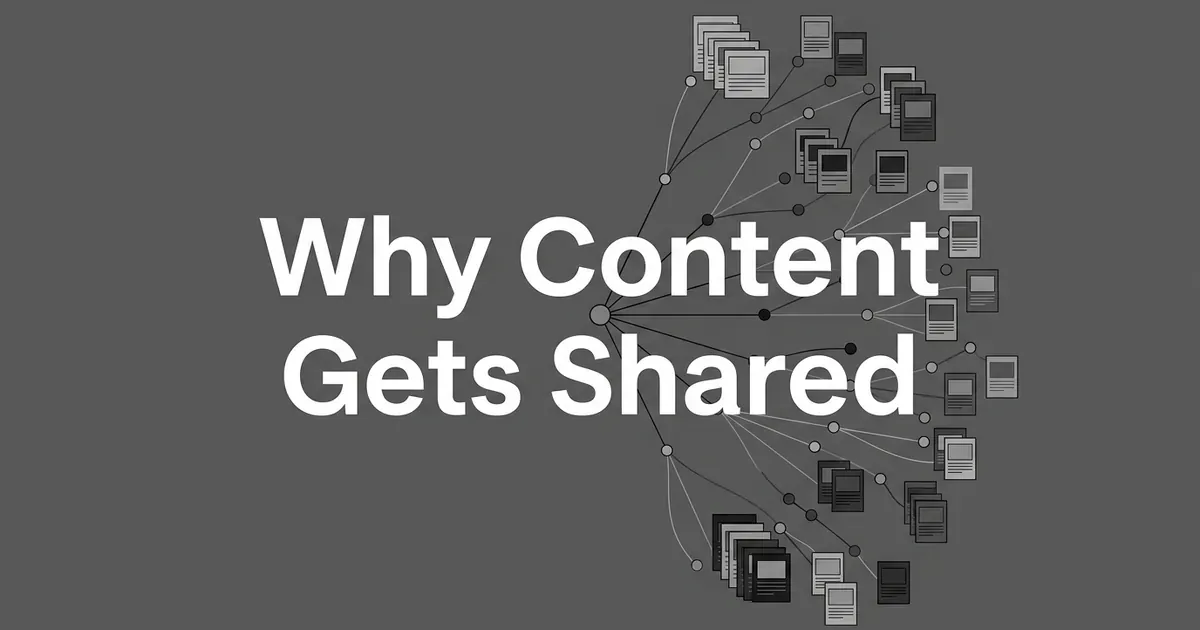
Outcomes also depend on diffusion, which means recipients have to see the material and then choose to pass it along themselves. Sharad Goel and colleagues looked at one billion diffusion events and found a lot of variety in how things spread. Popular events grew through broadcasts, through person-to-person cascades, and through mixtures of the two. Structural virality was usually low, and it didn't rise just because an event got bigger.
So it's worth being careful before you say a successful piece "went viral because everyone shared it." A large audience alone can't tell you which pattern happened. That study looked at diffusion patterns in a historical dataset, and it doesn't guarantee that a certain editorial treatment will produce a cascade.
One more distinction belongs here. A page that is useful to an AI answer and a page a person forwards to a colleague are separate outcomes. Nothing in the research covered here shows that improving one automatically produces the other, so it's better to judge them separately.
The most defensible answer to why some content spreads while similar content doesn't is this. Content differs in how strongly it serves a person's emotional, identity, relationship, or recipient-usefulness motives, and apparent success also reflects the chance for those decisions to repeat through an audience. Designing for shareability improves the reason to pass something on. It doesn't make spread certain.
How should a marketer design with these motives in mind?
You can use these findings on content virality triggers as four questions to ask about an idea before you write it. They are a practical reading of the research, and they aren't a validated scoring tool, so treat them as prompts for your own judgment.
What might the reader feel? Think about whether the piece could plausibly bring out surprise, concern, or real interest, and whether it does so honestly. If the honest answer is that it would feel flat, that is useful to know early. If an emotion is there, make sure it's earned by the facts. An accurate piece that makes people feel something is a better bet than an exaggerated one that makes them feel more.
What does this let them say about themselves? Read the draft as though you were the person about to forward it. Would they be comfortable being associated with it? A substantive point that makes a reader look thoughtful in front of colleagues gives them a reason to share. A vague claim they'd have to defend gives them a reason to hold back.
Who could benefit if they passed it on? Name one specific person or team, such as a colleague who keeps mixing up two metrics. If you can name who the piece is for, you can usually make the point clearer for them. If you can only say "everyone," the piece may need a narrower angle.
Is the insight accurate and easy to relay? A person has to be able to repeat the main idea in a sentence or two. A short human scenario can help here, for example a lead settling a recurring disagreement on their team with a clear explanation. That's just an illustration, and it isn't a documented campaign. Stories make an idea easier to retell, but nothing here shows that telling a story causes virality.
Berger's STEPPS framework fits into this too. It names six proposed drivers, which are Social Currency, Triggers, Emotion, Public, Practical Value, and Stories. It's a helpful way to organize your thinking, though it isn't one experiment showing that all six matter equally for every piece. Two of the ideas are worth adding to the questions above. Familiar cues can bring an idea back to mind later, and sharing that others can see can expose an idea to more people.
If you want a concrete next step, pick one draft you already have and run these four questions against it. Write down your answers, and see which one is hardest to answer. That is usually where the piece has the least to offer a sharer, and it's a reasonable place to spend your editing time. It's also worth noting that a piece can still do its job well without spreading widely, especially if the people who do read it are the ones you wanted.
How to keep this in proportion
The research here comes from very different places. It includes a historical self-report survey of frequent sharers, an observational study of newspaper articles, small student experiments, studies of sharing intentions, and a large diffusion dataset. These aren't interchangeable benchmarks, and none of them tells you how much reach a new article should expect. The New York Times survey dates from 2011, and the article analysis concerns newspaper stories, so the findings are informative about motives and less useful as current rates.
There is also no universal virality formula. Motivations differ by person and by recipient, and spread needs many separate decisions to line up. What you can do is give people better reasons to share, and then watch what actually happens with your own audience.