A post goes viral. Reddit picks it up, or a journalist links it, or it just gets shared a lot for a day or two. The graph in your analytics tool spikes hard, then it comes back down, and the question everyone asks is the same one: how much of that is going to stick around as real organic traffic.
The honest verdict is this: viral content traffic decay is fast and predictable, but the organic lift that survives it is not. Most of a viral spike is gone within days, and no study establishes a typical percentage that turns into lasting search traffic. The evidence for a durable lift is mixed, not confirmed and not debunked. It depends on what the content was, who linked to it, and whether it kept doing anything useful after the crowd left.
That is a less satisfying answer than "you keep 10% of it," and it is the true one. If you are trying to work out residual traffic after viral post activity settles, and whether that residual number is worth anything, the question you are really asking is does viral content help long term seo, and the answer is: sometimes, under specific conditions, never as a guarantee. Here is what the evidence actually supports, what it does not, and how to check your own numbers instead of guessing.
What the claim actually says
Before you can grade any of this, you need to keep a few things separate, because most of the confusion in this space comes from treating them as the same thing.
A viral traffic spike is the short burst of visits you get from rapid sharing: Reddit, a news pickup, a wave of social posts. It is concentrated in a narrow window, and the audience usually showed up because of the event, not because they were searching for your topic.
Referral or social traffic decay is the drop-off from that sharing channel once the post leaves the feed or the front page. This is the part that is measured the most, because it is the easiest to track.
Organic lift is a separate thing entirely. It is an increase in search impressions, clicks, rankings, or search-driven visits that shows up after the spike, and it can happen on the page that went viral, on other pages of your site, or both. You have to measure it on its own, apart from referral, direct, and social traffic, or the numbers will lie to you.
Residual traffic, the visits that keep coming after the initial burst, is not automatically organic either. It might be search traffic, it might be people coming back, it might be a newsletter mention. And durable organic traffic is the strictest version of all: search traffic that holds above your pre-spike baseline once the original referral event has actually stopped contributing, because the page keeps ranking for something people keep searching for.
A temporary bump in rankings during the news cycle does not count. That is still part of the spike, just wearing an organic costume.
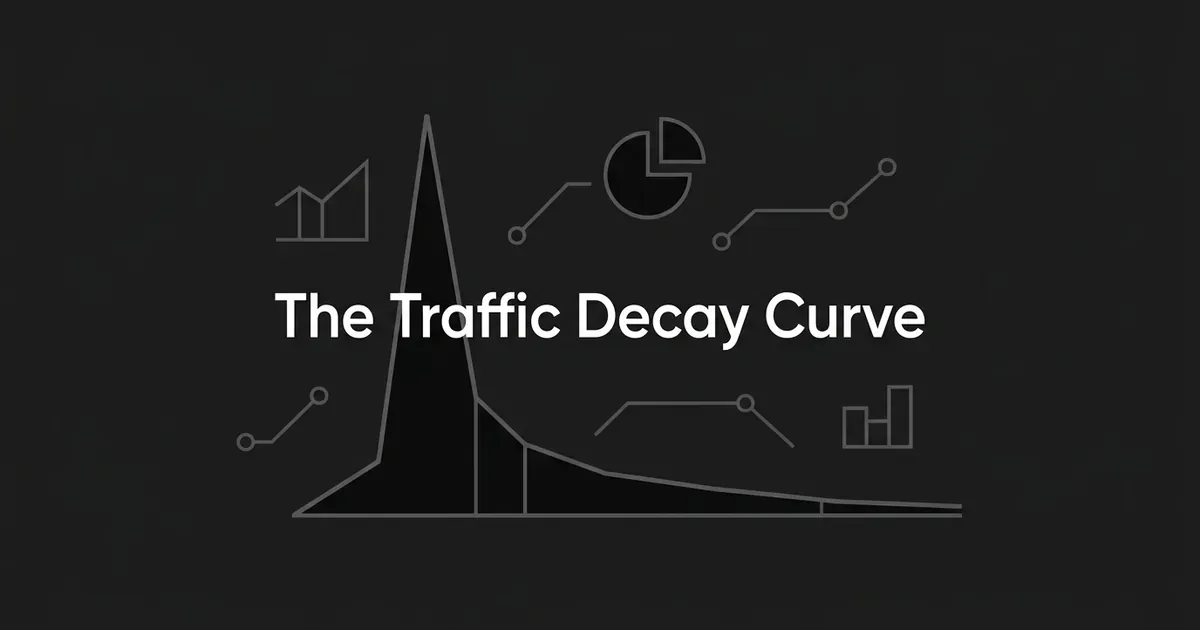
The shape of a typical traffic spike decay curve
The pattern that shows up across the available research runs in four stages, and it is worth having this picture in your head before you look at your own graph. Once you know the general traffic spike decay curve, your own analytics stop looking alarming and start looking normal.
The first stage is the launch burst, which runs from a few hours to a couple of days. This is almost entirely driven by whatever made the post spread in the first place. One widely cited account described a Reddit post that pulled in around 872,000 views and roughly 55,000 upvotes, with a traffic spike that lasted one or two days before the site's numbers returned to their normal, modest level. It is a useful picture of how fast referral traffic drops, not a benchmark you should expect to match.
The second stage is rapid decay in the first week, and this is where most of the volume disappears. A 2025 study in Scientific Reports looked at viral events across hundreds of European news outlets on Facebook and YouTube (663 Facebook pages and 9,790 posts, plus 236 YouTube channels and 5,879 videos) and found that in about half of the cases, the measured effect either faded within the first week or never really showed up at all. That is not a traffic-retention number. It is the share of cases where a spike's impact was already gone within seven days, measured as social engagement, not Google organic traffic. Worth holding onto, because people tend to round it into something it is not.
The third stage is a residual tail that runs from a few days to a few weeks, and this is where the size and source of what is left start to vary a lot from one piece to the next. Parse.ly's 2024 article lifespan study, built from first-party data across roughly two hundred premium media publishers, found a median lifespan of 2.6 days, using a definition where lifespan is the time it takes an article to reach 90% of its 30-day view total. Articles that pulled in above-average social referral traffic lasted about 14 hours longer than the rest. That 2.6-day figure describes when views accumulate in this particular sample, not a universal half-life for every viral post, so it is worth being precise about what it actually measures when you quote it.
The fourth stage, the one most people are actually asking about when they wonder about residual traffic after viral post activity fades, if it happens at all, is a durable tail that runs weeks and beyond. Parse.ly's own documentation describes the typical online article as living about three days and classifies a post as evergreen once it is at least 20 days old and still pulling meaningful traffic. That threshold comes from a proprietary algorithm, so treat it as an operational label, not an industry standard. A page that is still active past the initial cycle might be evergreen, might be search-driven, might be getting repromoted, or might just have an audience channel still pointing at it. You have to check your analytics to know which one it is. Guessing from the shape of the spike alone will not tell you.
The case for a lasting lift
There is a real mechanism here, and it is worth taking seriously before dismissing linkbait traffic lift as a myth entirely. A genuine linkbait traffic lift is possible, it is just conditional on more than the size of the spike.
Google's own ranking documentation confirms that its systems weigh multiple signals at the page and site level, and it specifically names link-analysis systems, including PageRank, as part of how it evaluates pages. Google's link guidance adds that links act as a signal for relevance and help the crawler find new pages, that descriptive anchor text helps Google understand what a linked page is about, and that internal links help both Google and readers understand how a site is put together.
That gives you a real path from a viral spike to organic lift. If a highly shared piece earns links that are relevant, crawlable, and connected to your site's other pages, those links can genuinely help discovery and context. Google is also clear about the limit: strong site-wide signals do not mean every page on your site will rank well. A link-mediated benefit and a guaranteed domain-wide boost are two different things, and the documentation only supports the first one.
The conditions that make a durable tail more plausible show up consistently across the research. A viral page is more likely to hold onto search value when it sits close to your actual products or subject area, when the links pointing at it come from relevant sites rather than a short news burst, when the anchor text is meaningful, when the page is wired into your site's internal linking, and when it answers a search need that keeps coming up rather than a one-time curiosity. None of that guarantees a number. It just tells you which pieces are worth watching for one.
The case against counting on it
Now the harder part, because this is where most of the optimism falls apart on contact with actual data.
Moz's review of several viral and highly linked campaigns is the clearest counterweight here, and it is worth walking through because the link counts alone would suggest a strong result. One campaign, for a hearing aid brand, earned 685 backlinks from 222 referring domains, and the site's traffic index moved up roughly 10%, but that change traced back to a single keyword climbing one position, while other commercial keywords actually dropped 76 points over the following month. Another set of pieces pulled in 588 links from 167 referring domains with no visible spike in search visibility at all. A third example, spread across three pieces, brought in more than 12,096 backlinks from over 1,347 referring domains and still showed no organic-search impact. A fourth case generated more than 5 million visits and 400,000-plus Facebook shares, attracted links from over 600 sites, and still produced no lift on the site's core commercial traffic. What traffic and visibility gains did show up faded over time and tracked more closely to the viral topic itself than to anything the business actually sold.
None of this proves viral content can never help SEO. If your honest question is does viral content help long term seo for your specific site, these cases are the reason the answer stays conditional: backlink counts, social shares, and total visits are bad stand-ins for durable organic lift on the queries that actually matter to your business. A big number in one of those columns tells you the post spread. It does not tell you whether it did anything for search.
The lift tends to be weak or absent when the viral page has nothing to do with your core topic, when it caught on because of novelty or a one-off event rather than an ongoing search need, when nearly all the links point at one isolated page with weak ties to the rest of your site, when the audience that shared it does not match the audience you sell to, or when nobody maintains the page once the spike passes. Moz's review names a similar list: off-topic pages, links that arrive all at once from a short news window, sources that come from the wrong country or audience for your site, or a viral page that is structurally disconnected from everything else you publish.
What the primary sources actually say versus what gets repeated
A lot of the confidence you will find in this space comes from repeating numbers past what they were ever measuring, so it is worth separating what a primary source states from what the industry has done with it since.
Google's documentation states that links are a signal, that they help with discovery and understanding a page, and that internal linking matters for both crawlers and readers. It does not state that a traffic-popularity event, viral or otherwise, is rewarded directly. That is an inference people add on top, not something the documentation itself claims.
The Scientific Reports study's "about half" figure describes social-engagement cases that faded within a week, measured on Facebook and YouTube for European news outlets over a defined period. Its own authors say the finding should not be generalized across every platform or every kind of content. It is not a traffic-retention rate for your blog post, even though it gets used that way in casual conversation.
Parse.ly's 2.6-day median does not mean 90% of a viral spike evaporates at that exact point for every article. It means that within this particular sample of publishers, under a specific 30-day, 90%-of-views definition, half the articles hit that mark sooner and half later. And a page that is still getting traffic after 20 days is not automatically ranking organically just because it cleared an "evergreen" label. That label is a proprietary classification, not proof of where the traffic is coming from.
Treat any claim that starts with "viral traffic converts at X%" as a red flag. No study in this space measures that number, because "viral traffic," "organic lift," and "lasting" do not have one shared definition across the research that exists.
How to check what actually stuck
Since no benchmark will tell you the answer, the only real option is to measure your own spike properly. This is the part that actually changes how you plan the next one.
Start with a pre-spike baseline: your organic clicks, impressions, rankings, referral visits, direct visits, returning users, and conversions for that page before the event happened, ideally over a comparable period so seasonality does not skew it.
Then isolate the spike itself. Note the first day of the event, the peak, where the traffic actually came from, which pages it landed on, and which queries were associated with it at the time. Not every visit during the peak behaved the same way, and lumping them together hides the split you need.
Once the spike passes, track the source mix separately: referral, social, direct, email, and organic, each on its own line. A total-traffic chart that stays above baseline can look like a win while the organic line underneath it has gone nowhere.
Compare organic outcomes against your baseline on their own terms too. Look at impressions, clicks, rankings, and the shape of the queries you are showing up for, and split branded, topical, and commercial terms apart. Ranking well on the viral topic itself is not the same as ranking on the terms that actually drive revenue.
Audit the links you picked up: how many referring domains are still live, whether the pages linking to you are relevant, what anchor text they used, and whether the links are even crawlable. A pile of links tells you nothing on its own.
Check the internal pathway from the viral page to your other relevant and commercial pages. Google specifically recommends contextual internal linking and says every page worth keeping should be linked from at least one other page on the site, so if the viral page is an island, that is worth fixing regardless of what else the data shows.
And the real test, the one that actually answers the original question: once the original referral source has genuinely stopped contributing, are organic clicks, impressions, relevant rankings, and qualified conversions still above where they were before the spike. That is the only line that tells you whether anything durable happened.
The verdict, and what changes it
Grade the overall claim as mixed. Viral content traffic decay is strongly supported: most viral attention and referral traffic decays fast, usually within the first week, and that part is close to settled. It is not supported that a fixed share of that traffic reliably becomes lasting organic traffic. The honest position is that virality creates the conditions where SEO value can show up, mainly through relevant links and topical connection to your site, but it does not guarantee that outcome, and the case evidence shows plenty of examples where large spikes produced nothing durable at all.
What would move this from mixed toward confirmed is a larger, controlled study that isolates organic search traffic specifically, across a range of industries and content types, with a consistent definition of both "viral" and "lasting." Until that exists, the responsible move is to measure your own events the way described above rather than importing someone else's percentage.
If you want a shortcut through that measurement work, this is the kind of thing worth setting up once and checking on a schedule rather than re-deriving after every spike: separate your traffic sources automatically, watch the organic line specifically, and see whether a page's rankings and internal link position actually improved once the noise settled.