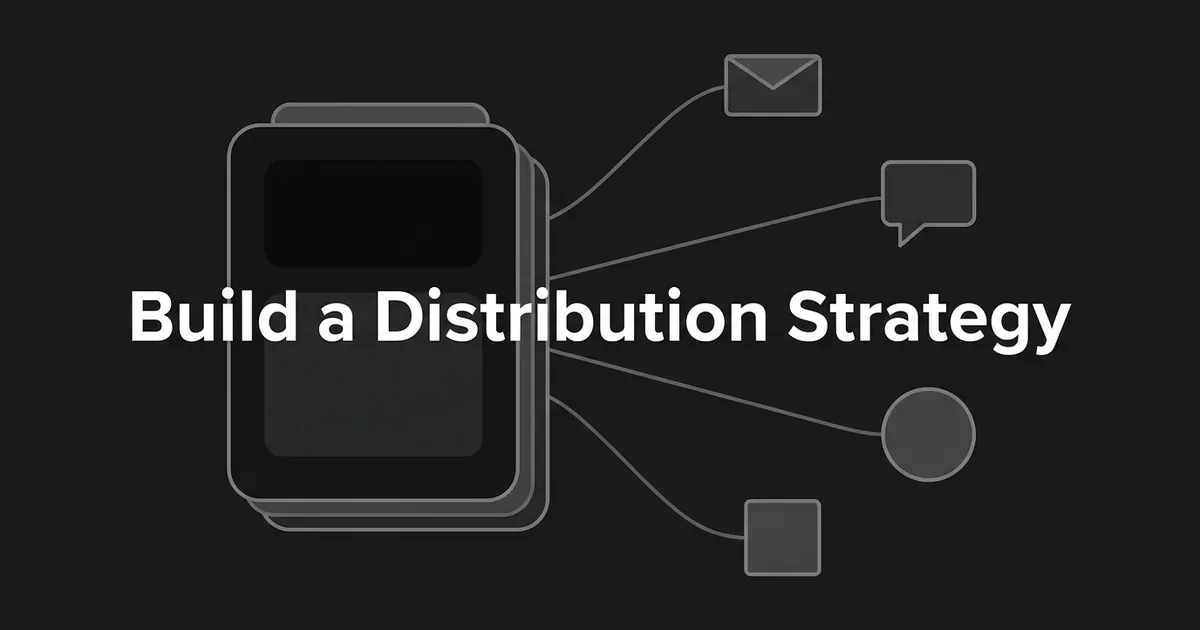
A lot of teams know the feeling. The article goes live on Thursday, someone says the newsletter section and the LinkedIn post will go out next week, and then next week fills up with other things. A month later the piece is sitting on the blog with no push behind it. This guide shows you how to distribute content on purpose and walks you through building a content distribution strategy so that doesn't keep happening. You'll take stock of what you can distribute, decide which channels have earned a place in your mix, and set up a routine where every piece gets a real send-off.
The short version is that you inventory your content, pick the reader each piece is for, choose only the channels your team can keep up, write a short brief for each one before the article is finished, turn the approved article into native assets, put those assets on the calendar with owners, and save the whole thing as a checklist. The result is a distribution engine, which just means publishing an article automatically kicks off a prepared set of releases instead of a single link and some hope.
One note before you start. The worksheets and scores in this guide are templates we're suggesting you try, not industry standards, and none of them come with proven benchmarks. Adjust them to fit your team.
1. Take inventory of the content you can actually distribute
What to do. Pick a scope you can finish, such as the pieces in your current publishing queue plus a small group of older articles on the same topics. Trying to fix your whole archive first is a common way for distribution to never start. Give the inventory one owner, and for each piece write down the title, where it lives, who owns it, the topic, the format, when it was created or last reviewed, who it's for, and what that reader is trying to get done.
If you've never built one, a content inventory is simply a list of what you have, and a content audit is where you judge it. Nielsen Norman Group lists title, URL, author or owner, topic, format, date, and metadata as the fields worth capturing, and its audit asks whether each piece meets the needs of a specific audience. Their outcomes are keep, update, or remove. For distribution you can add three practical labels of your own: ready to distribute, update before distributing, or hold. Record the fix and who owns it for anything that isn't ready.
A good question to ask about each piece is whether you'd stand behind the claims and send the page to the intended reader today. An outdated comparison, a statistic nobody can source, a broken link, or a piece written for a different buyer all need attention before you put any effort behind them. A sound older article can go straight into the queue, and you don't need to write a new piece on the same subject.
If you use DeepSmith, Content Map classifies your pages, and your competitors' pages, by topic and funnel stage, so you can see what you've published and where coverage is thin. It helps you see the shape of your library. It doesn't replace an editor checking whether a claim is still true or whether a page is ready to promote.
How you know it's done. Every piece in scope has a destination, an audience, a topic, an owner, a readiness decision, and a specific update task if it isn't ready.
Where people go wrong. Counting URLs without checking whether they're accurate or relevant, treating every archived article as equally worth promoting, and starting an audit so big that distribution never gets going.
2. Name the reader and the job each piece has to do
What to do. For each piece marked ready, write one sentence that says who the reader is, what question or task brings them to it, where they are in their decision, and what useful thing they should get before they ever click. Draw on what you already know from customer conversations and your existing buyer research, and if you need a starting point, audience research and a set of B2B buyer personas will fill most of the gaps.
Then ask where those people already go to find an answer. It might be a professional feed, a newsletter they opted into, an industry publication, a partner community, or a live discussion. Try to separate two things that get mixed up a lot. Your buyers being present on a platform is one thing, and their being willing to engage with this particular subject there is another.
A worked example helps. Say you've written a practical how-to for marketing leads. A professional post could give one usable decision rule from it. A newsletter section could explain how that rule applies to the subscriber's current problem. The website article could hold the complete walkthrough. These are sample assignments and not rules about any platform, but they show the idea that the same piece can do a different job in each place. Also decide what you'd like the reader to do next, such as reading the full guide or subscribing, and don't ask a stranger for a big commitment the first time they see you.
How you know it's done. You can say who should see the idea, what useful part they'll encounter in each setting, and why that setting suits that reader.
Where people go wrong. Assuming that because you sell to businesses, every social platform is worth your time. Opening every channel with "new blog post." Mixing up the format your team likes with the context your audience is actually in.
3. Choose a channel mix your team can sustain
What to do. Start by treating your website as the home for the full piece, since that's where the complete argument lives. Then look at four kinds of routes you could add. Owned email is the permission-based list you control. Rented social is a company or personal account on a platform that decides who sees what. Earned placement is when someone else chooses to feature or invite your contribution, like an industry publication, a partner newsletter, or a podcast. Paid is anything you buy, such as ads, sponsorships, or syndication.
For each candidate channel, answer five questions. These make up a simple channel selection framework you can reuse for every piece.
- Audience fit. Is there a credible reason your readers use this channel for this kind of problem?
- Information job. Can the channel deliver a useful part of the idea on its own, or is it only a place to drop a link?
- Format fit. Can the article become a post, an email section, or a contributed insight without distorting what it says?
- Access and control. Do you have a subscribed audience, a plausible outside partner, an active account, or a suitable paid placement, and who decides whether the content appears?
- Operating capacity. Can someone prepare, approve, publish, and, where it applies, reply in this channel as part of your normal cadence?
Put the answers in a table with columns for channel, audience and situation, job, native format, access, owner, effort, and decision. Mark each row use now, test as a limited addition, or do not include yet. If your team likes numbers you can rate each question from 0 to 2, but treat that as a way to start a conversation. Nobody has shown that a particular total score or a set number of channels works. Content Marketing Institute suggests picking the channel that best matches your audience and goals before you add more, and each extra one is more work to run.
Each type has its own quirks. Email gives you a more direct relationship with people who opted in, so segment by what readers need and don't send every subscriber the same copy. On social you're reaching people through a platform you don't control, so put the insight in the post itself instead of leaning entirely on a link out. Earned opportunities need a contribution worth featuring, some lead time, and another party's approval. Paid is optional, needs a budget and a piece that suits it, and won't make up for weak audience fit.
Surveys can give you places to look. The 16th annual B2B content marketing research from Content Marketing Institute and MarketingProfs ran from June 24 through August 14, 2025, and the B2B findings draw on 1,015 marketers, mostly in North America. When it asked which channels were most effective for distributing thought leadership, marketers named LinkedIn most often at 76%, then email newsletters at 54% and speaking events or webinars at 52%. That tells you what marketers reported about their own experience with thought leadership. It doesn't say those channels will work for your buyers, and it doesn't mean you should use all three.
Common mistake: "Publish on the blog, then share the URL on every network" is a posting checklist, and it doesn't work as a channel selection framework. Decide what useful part of the piece belongs in each selected place before you pick the format.
How you know it's done. Every channel you kept has a reader, a distinct job, a suitable asset type, an owner, and a realistic place in the workload. The attractive channels you can't support are written down as excluded for now.
Where people go wrong. Opening accounts everywhere, counting one person's follower total as a guaranteed channel, paying to promote a weak or outdated piece, and treating a survey ranking as proof that a channel suits your team. If you're weighing how much effort each route deserves, a look at organic, paid, and social channel economics can help you talk it through.
4. Write a channel brief before you write the piece
What to do. Decide how the article will be distributed while you're still planning it, since that's much easier than doing it afterward. The Content Marketing Institute channel plan covers things like the audience, the goal for the channel, topics, how often you'll post, formats, tone and engagement rules, resources, and the call to action. Their audience-development guidance also recommends deciding up front where each slice of an idea's value will live.
A short, reusable channel brief can hold the following.
- The target reader and their task
- The channel and why you chose it
- The useful idea or proof you'll give there
- The native format
- What stays in the full article on your site
- The next step you'd like the reader to take
- Any permissions or partner dependencies
- Who publishes, who approves, and the publishing slot
If a row is for an earned placement, say which outside audience would value the contribution and who has to accept it. If a row is for paid, name the person who is authorized to spend the budget, and leave the amount to your own situation, because there's no standard threshold to borrow.
DeepSmith fits in here in a limited way. New Ideas and Planned Content take an idea through to a scheduled article, and Autowrite can generate a planned article on the date you set, so your publish date becomes predictable. You'll still need to record the channel choices, the outside commitments, and the distribution owners yourself, because scheduling an article doesn't create a strategy on its own.
How you know it's done. Someone who didn't write the article can explain why each planned asset exists and who has to approve and publish it.
Where people go wrong. Finishing the full article and then asking a teammate in a rush to make a social post. Writing one teaser and shortening it for each platform. Promising a partner placement before the partner has agreed to it.
5. Turn the approved source into channel-native assets
What to do. Lock a current, approved version of the article first. Note its main argument, its intended reader, its home URL, the next step you want, any claims that need to keep their qualifications, dates, and any rights limits. Then pull out a small number of separate ideas that each stand on their own, such as a problem, a lesson, an example, a definition, a step, or a piece of proof. Match one useful idea to each channel brief and rewrite it for that setting. You're keeping the meaning and changing the shape, so don't just carry the paragraph over.
If a claim is outdated, disputed, or not in the approved article, hold it for review, because a punchier post that says something the article doesn't is a problem waiting to happen.
For a sense of what native looks like, DeepSmith's own repurposing workflow uses these house settings. A LinkedIn post is built around one idea in roughly 80 to 180 words, an X thread runs five to seven short posts, and a newsletter section is roughly 100 to 180 words with a reader problem, a useful insight, and a next step. These describe one editorial workflow and they aren't measured best lengths or platform rules. Choose only the formats your team can review and use. If you want to see how that can be built as a repeatable process, there's a longer walkthrough on setting up an agent workflow that repurposes an article into many assets.
Then check every version against the source for names, numbers, dates, qualifications, meaning, voice, rights, and fit for the channel. A person should approve each final asset. Keep in mind that generating a post doesn't publish it and doesn't win anyone's attention.
This is a step where DeepSmith does real work. Every finished article arrives with social posts already written, and the Apps Library adapts a finished article into channel-native versions for LinkedIn, X, Medium, Substack, newsletter and nurture email, Reddit, and other formats. Deep IQ holds your company, product, persona, and voice context, so those versions sound like you, and it's the same idea as grounding content in your brand voice and product facts. You still choose the channels, check the claims, approve the assets, and arrange the actual publishing.
How you know it's done. Each selected channel has an approved asset that stands on its own, traces back to an idea in the source, and has a fitting next step. Nobody has to click away just to find out the point.
Where people go wrong. Copying the introduction into every feed, generating versions from an outdated source, adding a statistic to a shorter post that the article doesn't contain, and setting a quota of assets even when the article doesn't have that many separate ideas.
6. Put the distribution assignments on your publishing calendar
What to do. Make each card on your calendar a package. Alongside the article's approval and release date, record each derivative's draft deadline, the reviewer, the publisher, the channel, and the planned release window. An earned placement gets its own line for the pitch and for the partner's acceptance. Add a paid placement only once it's approved. If the article supports a later angle that's really different, leave room for it, and don't repost the same teaser.
If you're wondering how to distribute content once the assets are ready, a sequence you might try is to prepare the assets before the article goes live, release the approved article and the ready channel assets in their assigned slots, and then publish any later or partner-dependent versions only when their prerequisites are met. It's an example of a workflow, and there's no research behind any particular timing or frequency, so build the schedule around what your team can actually do. If you're laying out the calendar itself, planning a content calendar around a build shows one way to do it.
Make each channel card say what pace you expect, what tone to use, and who handles replies. The Content Marketing Institute framework includes the management process and editorial plan for exactly this reason. If nobody can own the responses or approvals for a channel, take it out of the current mix, and don't add a task with no owner.
How you know it's done. A calendar entry names the full piece, every approved channel asset, the person responsible, the review and publishing steps, and anything that could block a release.
Where people go wrong. Assigning "social" to the whole team, setting the article date and leaving the derivative assets to be invented later, and treating a generated asset as if it were a finished distribution task.
7. Make the handoff repeatable for the next piece
What to do. Write one short exit checklist that the publishing owner runs for each suitable article. It might say that the source is approved and current, the reader and selected channels are recorded, the channel-native assets exist, the claims and rights are checked, owners and slots are assigned, and any outside placements have either accepted the contribution or are marked pending. Add a separate hold path for content that isn't safe or useful to distribute. Then store the finished brief with the piece so that a teammate can run the same process when the usual writer or manager is out.
This is what a distribution engine really is in practice. It's a recurring editorial handoff with a clear trigger and an owner, and it doesn't guarantee reach or mean you automate every decision. If your team's capacity is limited, shrink the channel mix, and don't decide that distribution is optional once the article is written. If you'd like to see how one article can stretch over a longer stretch of time, turning one article into a month of content is a useful read for a lean team.

How you know it's done. Another person can take a newly approved article through the same channel selection, adaptation, approval, and scheduled release without rebuilding the process.
Where people go wrong. Calling the job finished once the page is live, assuming automatically written posts have been approved or posted, and building an elaborate plan that nobody has time to run.
What to do next
Pick one article that's coming up in the next couple of weeks and run it through the steps above, from the readiness check to the exit checklist. It's fine if the first pass is rough. You'll see quickly which channels have an owner and which ones only looked good on paper, and you can trim the mix from there.
If you'd like production and distribution assets to come out of the same place, you can start a DeepSmith free trial and try the Apps Library and Planned Content on your own next article.