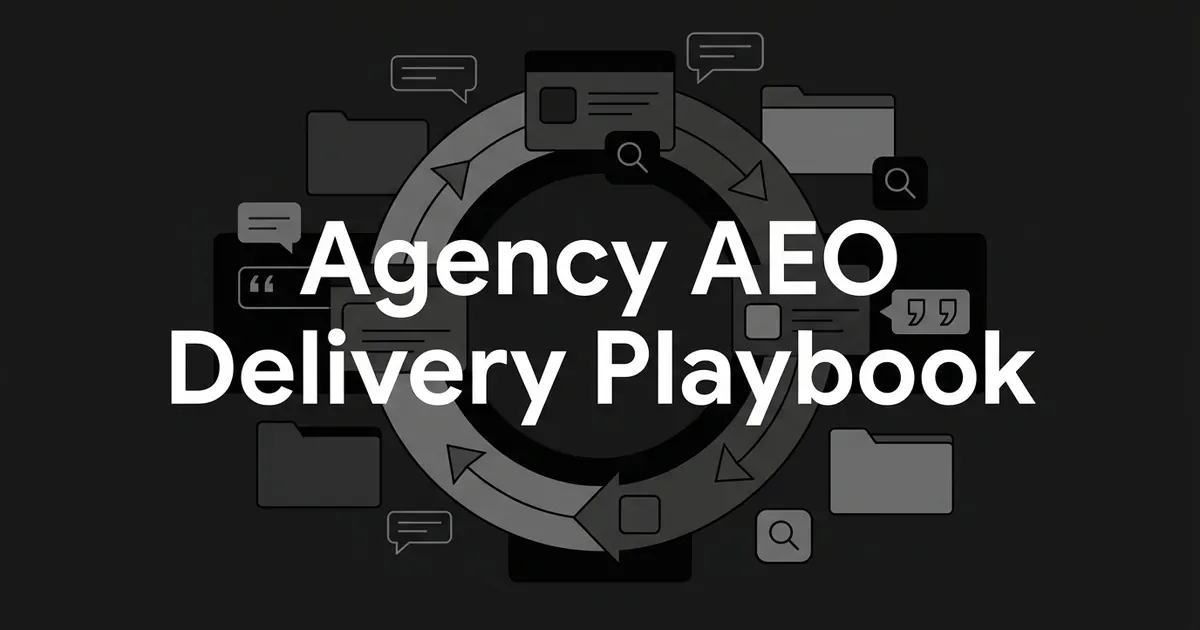
A client asks whether their competitor showed up in ChatGPT, and you realize you do not have a real answer. You have audits, you have content production, you have reporting, but you do not have one system that connects the three. That gap is where most agencies sit right now with AEO, or GEO, or whatever the client calls "the AI search thing." This guide gives you the operating loop to close it: how to onboard a client, set a real baseline, diagnose gaps with evidence, produce and publish content that answers the buyer's question, and re-test on a schedule that actually tells you something. By the end you will have a repeatable delivery model you can run for one client and then standardize across your whole roster.
This AEO agency playbook is about delivery, not sales. It does not cover how to price or package the service, run an audit as a lead magnet, white-label the reporting, or format a client deck. Those are separate pieces. What follows is the actual work: agency AEO services and GEO services for clients, done the same way every time, for every account.
Step 1: Isolate the client and capture the context that governs everything downstream
Before anyone writes a word, set up one contained workspace for this client. Not a folder in a shared drive, not a doc that lives in one strategist's head. A place that holds the client's positioning, their products and approved claims, who they sell to and at which stage, their voice, and who their competitors are.
This step is easy to skip because it feels like setup instead of delivery, and setup does not feel billable. But skipping it is how agencies end up with generic drafts, voice drift between clients, and a strategist who becomes the only person who remembers client X's rules. If a writer or a model has to guess at a client's product facts, they will guess wrong eventually, and you will spend more time correcting than you would have spent capturing the context once.
At minimum, write down the client's positioning and differentiators, their products and the claims they are allowed to make (and the ones they are not), their buyer personas and what those buyers actually care about, their brand voice, and their real competitor set. DeepSmith's Multi-Workspace setup is built for exactly this problem: each client gets a separate workspace with its own context, competitors, tracked prompts, and content queue, so one account's product facts never leak into another's draft. Deep IQ is where that context actually lives, structured once per client and reused by every draft instead of re-briefed each time.
You know this step is done when you can answer, without digging through anyone's notes, what the client sells, who buys it, what claims are approved, what the brand should sound like, and which competitors matter. The real test is the first draft that comes out of the workspace: it should already sound like the client and use their real facts, not a rewrite waiting to happen.
Common mistake: starting from a generic prompt like "write an article about this keyword" instead of a client-specific one. That is the exact failure mode this whole system exists to prevent. Generic input produces generic output, and generic output is what sends you back into hours of correction work per article.
Step 2: Map the questions buyers actually ask AI engines
Once the client's context exists, the next job is building a prompt set from real buyer behavior, not from a topic list the agency happens to want to publish. This is where how agencies deliver AEO starts to look different from a normal SEO keyword sheet, because a prompt is a question a person actually types or speaks to an AI engine, and it needs to be treated that way.
Build three groups of prompts: problem-aware questions from someone trying to understand or solve something, category questions asking for tools or approaches, and comparison questions weighing one vendor or method against another. A useful starting set is 10 to 20 prompts, and for an ongoing program you want a stable core of roughly 15 to 20 that you keep tracking the same way every cycle, adding a smaller exploratory batch when the market or the client's positioning shifts.
DeepSmith's Discover Prompts feature generates a starter list from the client's product, personas, and buyer stages, which saves the blank-page problem, but treat that list as a draft, not a finished set. Read it, cut what nobody actually asks, and add what the client's own sales team hears in real conversations. For every prompt worth tracking, record the buyer stage it belongs to, why it matters commercially, which competitors you expect to show up, and which client page could plausibly answer it.
You are done with this step when you can explain, for every prompt on the list, why it matters to this client's buyers. If you cannot explain the connection, cut the prompt.
Pro tip: resist the urge to change the whole prompt set every week just because a new idea sounds interesting. A moving target makes it impossible to tell real progress from a measurement change. Keep a stable cohort and run new prompts as a separate exploratory batch instead of swapping them in.
Step 3: Establish a baseline that separates presence from proof from competition
Before you publish a single piece of AEO-driven content, run the prompt cohort across the client's tracked engines and freeze that result as the baseline. Without this, you have no way to tell a client whether anything changed, and every future report becomes a guess dressed up as an insight.
Run each prompt more than once, a few days apart, for a cleaner initial read, since a single answer can be noise rather than signal. For each result, record whether the brand is mentioned, whether one of its pages is actually cited as a source, which exact page that is, which competitors show up instead, and how the answer describes the brand. Keep the vocabulary consistent: mention rate is how often the brand is named, citation rate is how often a page gets linked as a source, share of voice is visibility relative to the tracked competitors, sentiment is whether the description is positive, neutral, or negative, and visibility trend is how any of that moves over time.
DeepSmith's AI Visibility tracks mentions and citations as separate numbers, which matters because they answer different questions, and breaks results down per engine, per competitor, and per cited page. The platform covers ten engines total, including ChatGPT, Gemini, Perplexity, and Claude, though which ones a given client's plan actually tracks depends on their tier, so do not promise broader engine coverage than the plan supports.
You are done with the baseline when you have one view showing the prompt cohort, the engines covered, mention and citation rates, share of voice against named competitors, and a short list of the highest-value prompts where the client is missing, mismeasured, or losing. A brand that is often mentioned but rarely cited probably has weak supporting pages. A brand with citations but low share of voice probably has thin category coverage. Treat both as hypotheses to check against the actual answer, not as conclusions.
Step 4: Diagnose the gap and turn the evidence into a backlog you can defend
A baseline tells you where the client is losing. This step figures out why, for each prompt that matters, so the backlog you build is made of specific fixes instead of vague content ideas.
Common reasons a client is losing a prompt: no page directly answers the question, the answer exists but is buried under paragraphs of scene-setting, a page covers the topic but not the specific comparison the buyer is actually asking about, a competitor has a sharper and more specific page, or the client is mentioned by name but its page is never the one that gets linked. Read the competitor's cited page when you find one. Do not copy its structure, but ask what it makes easy for an answer engine to extract: a direct answer near the top, clear definitions, an honest comparison, and real evidence.
This is where DeepSmith's Content Map and Opportunity Agents do real diagnostic work. Content Map classifies the client's pages and competitors' pages onto a shared topic and funnel view, so a coverage gap becomes something you can see rather than something you sense. Opportunity Agents read the visibility and coverage data and return content ideas that each carry the specific data point behind them, which turns "I think we should write about this" into "the competitor is cited for this exact prompt and we have no equivalent page," a claim you can put in front of a client and defend.
Prioritize what makes the backlog by commercial importance of the prompt, size of the gap, whether a content change could plausibly close it, and how much effort the fix actually requires. You are done here when every backlog item names the prompt it responds to, the buyer stage, the specific gap, the intended fix, and what you will check later to know it worked.

Common mistake: treating a competitor's citation as proof that copying their word count and headings will win the same result. It will not. The competitor's page earns its citation from clarity and evidence specific to that brand, not from its shape.
Step 5: Produce content that answers the question and holds up to review
Now you know what to fix. Choose the right move for each item: a new page where nothing exists, an update where the source is relevant but unclear, an added comparison or limitation section where the page only covers the basics, stronger internal links where related pages exist but sit disconnected, or better evidence where a claim needs backing.
Structure every piece so the answer sits near the top, the key claim or definition comes before the supporting detail, headings state the actual question rather than a vague theme, and each section carries one clear point instead of several half-made ones. Define terms before you use them, be honest about limitations, and use specific examples grounded in the client's real product facts. None of this is writing for a machine instead of a person. A reader who scans the page and understands the answer immediately is exactly what makes the page easy for an AI system to extract accurately too.
DeepSmith's Content Studio takes a backlog item from idea to finished article: research, drafting, internal and external linking, a cover image, and publish-ready metadata, all grounded in the client's Deep IQ context so the draft already sounds like them. Autowrite can carry a scheduled idea all the way to Produced Content without anyone touching it that day, which is the difference between content as a task you run and content as a system that runs itself. None of that removes the need for a strategist to check the draft against the client's approved claims, the specific gap it was meant to close, and anything that needs legal or factual sign-off before it goes live.
Common mistake: calling a polished AI draft finished just because it reads cleanly. A grammatically correct article that does not actually answer the diagnosed prompt, or that drifts from the client's approved positioning, has not done its job yet.
Step 6: Publish, distribute, and build the credibility around it
A finished page sitting unpublished helps nobody, and a published page with no distribution plan gets less mileage than it should. Push the piece live on the client's own CMS, then get the idea in front of people through the channels that actually matter to that client's audience, in a way that reinforces the same accurate positioning rather than scattering disconnected promotional fragments.
DeepSmith publishes finished articles to WordPress, Webflow, Strapi, Sanity, Contentful, or a custom webhook, and its Repurpose and Apps Library features turn one article into channel-native versions for LinkedIn, newsletters, Reddit, and several other formats without a separate rewrite for each one. One well-built source page can supply a short explainer, a comparison snippet, a checklist, and a newsletter section, all pointing back to the same answer.
For some gaps, content alone will not be enough. If the client's own site makes a claim but nothing independent backs it up, look at third-party reviews, industry directories, and credible external mentions as trust signals worth pursuing, understanding these take longer and are not something you can promise will land on a schedule.
You are done when the piece is live, technically reachable, linked from the relevant parts of the site, and distributed through whatever channels you agreed on with the client. Do not judge the piece from the very next AI answer you check. Crawling, indexing, and retrieval by an answer engine take time, and an absence a day after publishing is not evidence of failure.
Step 7: Re-test the same prompts and read the pattern, not the screenshot
Run the stable prompt cohort again after your agreed comparison window, typically monthly for the core program, and compare against the baseline using the same prompts and engines wherever you can. Look at whether mention rate, citation rate, and share of voice moved, which pages gained or lost citations, whether the specific page you produced or updated is the one now getting cited, and whether a competitor has displaced the client somewhere new.
One good answer on one prompt is not a trend. Answer engines vary their responses, so treat a single favorable result as noise until it repeats across more than one prompt, more than one engine, or more than one check-in. A pattern worth reporting to a client looks more like consistent citation on several related prompts across two platforms over a few consecutive checks than a single lucky screenshot.
Use whatever the re-test shows to decide the next move: expand a page that is gaining ground, fix a page that is mentioned but never cited, correct something the answer is getting wrong about the client, or retire a prompt that no longer reflects how buyers actually ask the question. You are done with this cycle when you can answer, in plain terms, what you learned, what changed, what is still unresolved, and what happens next.
Common mistake: changing the prompt list, the engines, and the content strategy all in the same cycle. If everything moves at once, neither you nor the client can tell what the work actually did.

Step 8: Standardize the loop across your whole client roster
This sequence is how agencies deliver AEO at scale rather than reinventing the workflow per account. Once this works for one client, write it down as a repeatable sequence: set up the isolated workspace, complete the brand and product context, approve the initial prompt cohort, configure competitors and the collection schedule, capture the baseline, review the cited pages on both sides, approve the first backlog, move the chosen ideas into production, publish, distribute, re-test the stable cohort, and record the next move. That is the whole loop, and it is the same loop for every account, even though the client, the prompts, and the competitors underneath it are all different.
Assign the roles clearly so the system does not depend on any one person's memory. The strategist owns prompt selection, prioritization, and the client conversation. A subject-matter reviewer checks product and industry facts. An editor checks voice, clarity, and evidence. The production system handles the repeatable mechanics: research, formatting, linking, and metadata. The client signs off on sensitive claims and, where required, final publication.
Templatize the process, never the client's voice. Every account should move through the same sequence while keeping its own context, prompts, competitors, and approval rules intact. You know this is working when a new strategist can pick up an account without leaning on someone else's memory, and a new client can enter the system without weeks of unstructured discovery before the first useful page goes live.
Leading clients through the shift from ranking to getting cited
The hardest part of this work often is not the mechanics. It is the conversation. Leading clients to AI search means changing how they think about a result, not just changing which report they read. Clients spent years learning to think in rankings, and AI search asks a genuinely different question: does the answer mention the brand, and does it link to one of the brand's pages as a source. Those are related to ranking but not the same thing, and collapsing them into one number does a client no favors.
Tell clients plainly that SEO is not being replaced. Technical SEO, helpful content, crawlability, clear site structure, and credible information all still matter, because Google's own guidance confirms that existing search fundamentals remain relevant to AI-generated results. What changes is that you are now also measuring whether an answer engine names the brand and which sources it leans on when it does.
Set expectations before you run the first intervention. You cannot guarantee an answer engine will cite a client, guarantee traffic, or guarantee revenue, because market and engine behavior are outside your control. What you can control is prompt selection, measurement consistency, content quality and accuracy, page structure, internal linking, product-fact and voice enforcement, competitor monitoring, and how quickly and consistently you run the whole cycle. Say that out loud early, because a client who understands what you actually control will read a flat month very differently from one who was promised a specific outcome.
When a client shows up with "I saw our competitor in ChatGPT," resist the urge to answer with a single counter-screenshot. Add that prompt to the tracked cohort, run it consistently, look at the page the competitor is actually being cited for, and decide with evidence whether it is a durable gap or a one-off fluctuation. That response, repeated every time, is what turns AEO from an anxious reaction into a system your client trusts.