You set up the tracking. The dashboard fills with mention rate, citation rate, share of voice, and competitor deltas. Two or three months pass, and the picture looks almost exactly the same. If your AI visibility tracking not improving feels like a personal failure, take a breath. It usually is not a you problem, and it is almost never a data problem.
Here is the good news. You already did the hard part, which is seeing the gap. This guide is the next part: how to act on AI visibility data and close AI visibility gaps with fixes that actually move a number. By the end you will have a six-step playbook that turns any visibility report into a prioritized backlog, ships the fixes in a short sprint, and re-measures to confirm what worked.
This is not a guide to setting up tracking. It assumes your tracking exists. It is the missing half: how to turn AEO data into action.
First, the reason nothing is moving
Before the steps, one premise will save you months. The truth about AI visibility tracking not improving is simple: it is a fix problem wearing a data problem's clothes. When your numbers sit flat, the bottleneck is almost never measurement. It is the fix.
Three patterns explain most stuck dashboards.
The first is volume without depth. You published more, on more topics, and none of it deepened a single subject. AI engines tend to cite sources with real topical authority on a defined subject, not sources that have touched everything once. Depth on one topic beats breadth across many.
The second is a healthy mention rate sitting next to a stalled citation rate. Your brand gets named, but rarely linked. That is not an awareness gap. It is an extractability gap: the content is not structured or sourced well enough for the engine to lift it as a source.
The third is watching the wrong engine. Citations overlap surprisingly little across ChatGPT, Perplexity, and Google AI Overviews. If you only watch one, you can be quietly invisible on another while your dashboard says "stable."
Feel any of those? Good. That means the rest of this is a fix system, and you can run it starting this week.
Step 1: Pull a clean baseline from your tracking data
Before you change anything, lock the numbers. You cannot prove a fix worked if you never wrote down where you started.
What to do: export the last 90 days of your core metrics. Mention rate (how often AI names your brand), citation rate (how often AI links to one of your pages as a source), share of voice (your citations divided by total citations in your category), and the visibility trend on each. Add the per-prompt breakdown, the competitor leaderboard, and the pages on your site AI already cites.
Then tag. Tag every prompt by buyer stage, awareness through decision. Tag every page by topic cluster. This tagging is what makes the later prioritization honest.
How to tell it is done: you have one view with a row per prompt, showing its stage tag, current mention and citation rate, the 90-day trend, the top competitors winning it, and your cited page if you have one.
Where people go wrong: they skip the stage tagging and burn a sprint optimizing awareness prompts when the buyer is at the decision stage. They also react to a single bad week instead of the 90-day trend. Do not chase noise. Chase the trend.
This is the natural moment for a platform that already holds the data. DeepSmith's AI visibility module reports mention rate, citation rate, share of voice, and trend per engine, with a competitor leaderboard and a Pages view showing which of your pages earn what share of your citations. The point is not the dashboard. The point is having one clean baseline instead of five browser tabs.
Step 2: Decompose the gap so you know what the data is saying
A stuck number is a symptom. Step 2 turns each symptom into a specific gap you can name in one sentence.
Run every gap through three lenses.
Lens one, mention versus citation. High mention and low citation means an extractability and authority problem: AI knows you but will not source you. Low mention and low citation means a presence problem: AI does not think of you at all. Healthy on both but low share of voice means a competitive problem: rivals are simply winning more of the prompts you both fight for. Studies of AI answers keep finding that brands are far more likely to be cited without a mention than to earn both together, so treat these as two different jobs.
Lens two, per platform. The engines have different taste. Google AI Overviews lean toward known brands. ChatGPT leans toward encyclopedic, reference-grade depth. Perplexity leans toward community and real-time sources. A gap on ChatGPT and a gap on Perplexity are not the same gap, and they do not take the same fix.
Lens three, prompt cluster versus site cluster. Line up the prompts you lose against your own coverage. Lose on a cluster where your site is thin? The fix is depth. Lose on a cluster where your site is already rich? The fix is structural, not more words.
How to tell it is done: for every gap, you can finish this sentence. "We lose on these prompts because of ____." If you cannot fill the blank, you have not decomposed it yet.
Where people go wrong: they treat one number as the whole answer. Share of voice alone will not tell you whether to fix content or authority. Decompose first, then prioritize.
DeepSmith's Pages view and Competitor citations view are built for exactly this cross-reference: which of your pages earn citations, and who beats you on each prompt, on which exact page, and on which platform. That is the fastest path from a raw number to a named gap.
Step 3: Diagnose each gap against five failure modes
Now give each gap a label. A low citation rate is a symptom. These five failure modes are the actual causes, and each one has its own fix class. Match the mode, and the fix picks itself.
Failure mode one, missing answer surface. You never built a page that answers the question the way buyers actually ask it. The tell: you write for broad keywords but lose on natural-language, long-tail prompts. The fix: publish a definitive page that answers one buyer question per page.
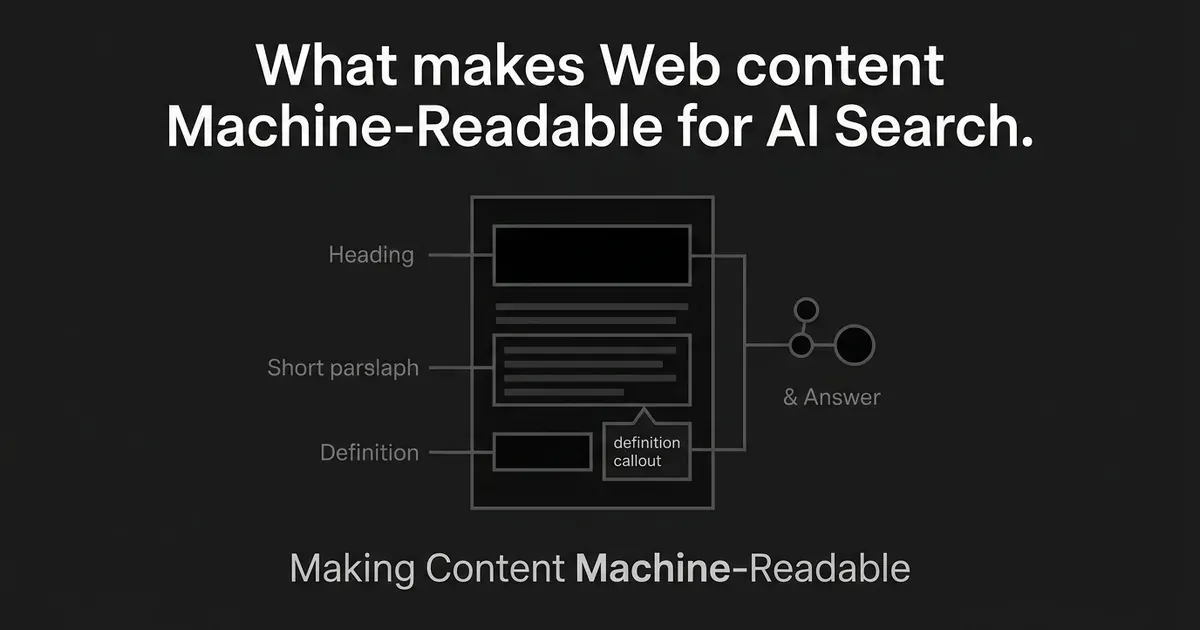
Failure mode two, poor extractability. The page exists, but AI cannot lift a clean answer from it. The tell: walls of text, vague headings, no lists or tables. The fix: rewrite answer-first, with a crisp summary near the top, real structure, and short paragraphs.
Failure mode three, weak entity chain. The page is about the right thing, but your brand, product, and author are not clearly connected to the wider knowledge graph. The tell: thin or missing schema, no verifiable author profiles. The fix: structured data and author bios that link out to real, checkable identities.
Failure mode four, proof deficit. The page makes claims and backs none of them with anything original. The tell: recycled industry stats, no proprietary data, no named sources. The fix: add your own data, original tables, and primary evidence. Pages dense with real, connected entities get selected far more often than thin ones.
Failure mode five, weak third-party authority. The page is good, but nothing outside your own site corroborates you. The tell: low share of voice despite solid owned content, and almost no presence in the sources AI trusts. The fix lives off your site: reviews, mentions, and profiles in the places AI leans on.
How to tell it is done: each prioritized gap carries exactly one mode label and one fix class.
Where people go wrong: they fix the symptom ("improve the page") instead of the mode ("this page has poor extractability"). Five different modes can produce the same flat number, and each one needs a different move.
Pro tip: keep these labels concrete and observable, not a rigid taxonomy. The value is that "poor extractability" tells a writer what to do on Monday, while "low citation rate" does not.
Step 4: Score every gap and build a prioritized backlog
You cannot fix everything at once, and trying is how teams stay stuck. So score, then sequence. This is where you close AI visibility gaps on purpose instead of at random.
Score each gap on three dimensions, one to three each.
Strategic value: does this prompt touch a high-intent stage, like a comparison, an alternative, or pricing? Your stage tags from Step 1 drive this. Decision-stage prompts earn the high scores.
Fix feasibility: can you ship it this sprint with the team and assets you already have? A page that exists and needs a refresh scores high. A net-new research project scores low.
Competitive gap size: how far behind are you? A 30-point share-of-voice gap outscores a 5-point one.
Add the three. The range runs three to nine. Nines ship first, then eights, then sevens. Anything scoring three or four goes on a watchlist, not into this sprint.
For every backlog row, write the target metric to move. Not "improve the page," but "move citation rate on this prompt from zero to thirty percent in thirty days." If a row has no target, you will never know whether the fix worked. This scoring is how you turn AEO data into action instead of a reading exercise.
How to tell it is done: a backlog with one row per gap, each carrying its failure mode, its three scores, its total, an owner, a ship date, and a target metric.
Where people go wrong: they over-weight feasibility and ship only easy wins on low-value prompts. Easy and pointless is still pointless.
This is the moment tracking data becomes a production queue. DeepSmith's Content Intelligence turns competitor pages that are winning into ready-to-use idea titles you can drop into your Idea Bank, and its topic views surface keyword clusters with your coverage gap already marked. Your losing prompts stop being a report and start being a to-do list.
Step 5: Run one focused two-week sprint
A backlog does nothing until you commit a slice of it to a deadline. Two weeks is the sweet spot: long enough to ship real work, short enough to stay honest.
Pull your top five to eight items, the sevens and above. For each one, name four things. The fix (one mode, one fix class). The owner (writer, editor, technical SEO, or engineer). The success metric (a specific prompt, page, or share-of-voice target). The ship date.
Then hold the line. New gaps will surface mid-sprint, because they always do. Log them, queue them for next time, and do not let them in. Scope creep is how a two-week sprint becomes a two-month drift.
One more thing about "ship." Shipping means publish-ready and live, not a rough draft parked in a doc. And remember the leverage move: a few hours of substantive depth on one high-value page often beats five thin new articles. Refresh over volume, most of the time.
Where people go wrong: they let the sprint swell to hold everything, then finish nothing. Pick few. Finish them. This is how you convert AI tracking to content fixes instead of good intentions.
If production is your bottleneck, this is where a system earns its keep. DeepSmith's Content Studio turns one planned idea into a finished, brand-grounded article, with research, internal and external links, schema, a cover image, and metadata built in, and Autowrite can put that on a schedule so the pipeline keeps moving even during a busy fortnight. It does not guarantee a citation, and no honest tool will. What it does is take the manual drag out of shipping the fix.
Step 6: Close the loop by re-measuring what changed
A fix you never re-measure is a guess you never checked. This last step is what turns a one-time push into a loop that compounds.
Within roughly one to two weeks of shipping, re-run tracking on the exact prompts and pages you touched. Substantive refreshes tend to show early movement in that window, so this is when the signal starts to appear.
Look for four things. Did citation rate on the targeted prompt move? Does your page now show up in the cited sources? Did share of voice tick up on that cluster? Did adjacent prompts move too?
If it moved: log the mode, the fix, and the lift, then replicate on the next similar gap. You just found a repeatable play.
If it did not move: do not immediately ship another fix on the same prompt. Go back and check whether your Step 3 diagnosis was right. Re-diagnose before you re-fix. Otherwise you ship the same wrong fix twice.
How to tell it is done: every backlog row has a measured outcome attached, hit, miss, or neutral. Your next sprint is built from the misses plus whatever new gaps the latest run surfaced.
Where people go wrong: they measure too soon, before engines refresh, or too late, after they have lost the thread between fix and lift. Check at about two weeks, then again at thirty days.
This closing loop mirrors what HubSpot calls Loop Marketing, a move away from long campaigns toward a live feedback cadence measured in days, not quarters. Your sprint is one turn of that loop. Run it again next month, and the velocity compounds.
What to do next
Here is the whole thing in one breath. Baseline, decompose, diagnose, score, sprint, re-measure. Then run it again. You do not need a perfect first cycle. You need one honest cycle, and the second one will be easier because the template already exists.
If you only change one thing this month, make it this: never let a tracking review end without a backlog row that ships in the same week. The dashboard is the input, not the deliverable. The teams that pull ahead are the ones that act on AI visibility data every single sprint, not the ones with the prettiest report. That habit, repeated, is the whole game of AI tracking to content fixes.
The reason most teams stay stuck is that tracking lives in one tool and production lives in another, so every sprint pays a coordination tax. A system that both finds the gaps and produces the content to close them turns this loop from manual to continuous. That is the model DeepSmith is built on: see where you show up in AI answers, find the gaps, and close them with on-brand content, from the same data. If you want to run your first sprint on real numbers, you can start a DeepSmith free trial and pull a baseline this week.
You have got this. One sprint at a time.