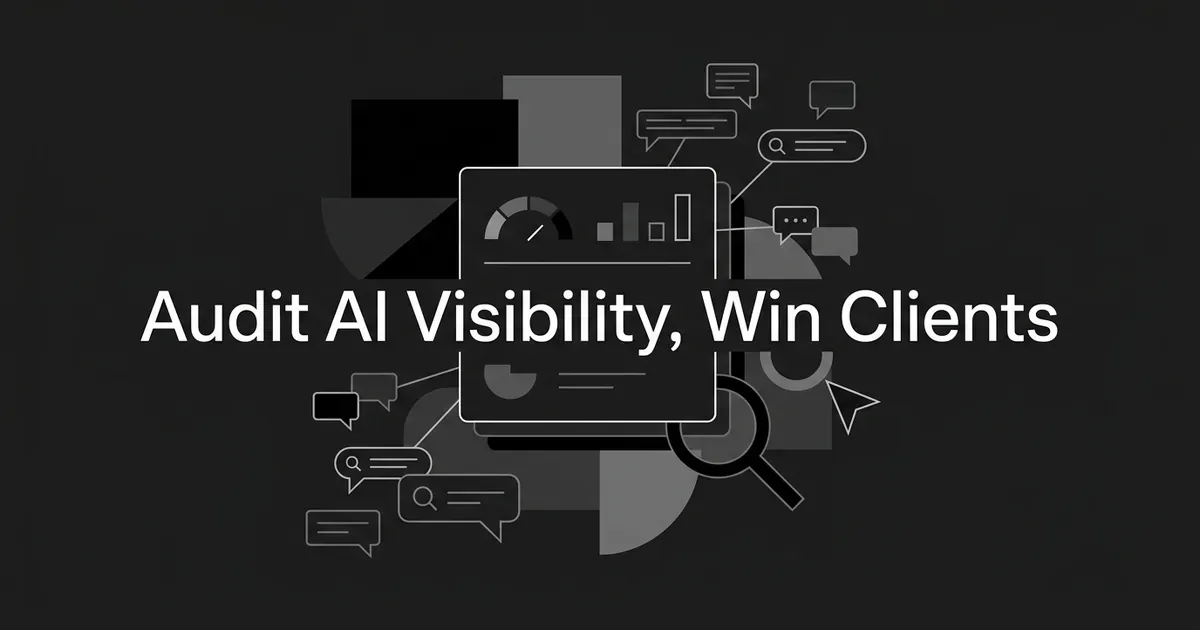
Most agencies get the same question from a client or prospect these days: are we showing up in ChatGPT, and what are we doing about it? An AI visibility audit is how you answer that question with evidence instead of a shrug, and it doubles as one of the strongest lead magnets an agency can offer right now. This guide walks through how to build an AEO audit lead magnet from scratch, run it on a real prospect, and turn the findings into a signed engagement. By the end you will have a repeatable process for choosing prompts, testing visibility, packaging a score, and running what agencies increasingly call a win clients AI search audit instead of a generic pitch deck.
Step 1: Choose a prospect and define the sales question
Start with a prospect whose buyers already ask recommendation, comparison, or problem-solving questions out loud, whether that is to a salesperson, a support rep, or now, an AI engine. The best candidates for a first audit usually share a few traits: a clear category with recognizable competitors, a real commercial decision sitting behind the questions, enough public content and third-party discussion to make the audit informative, and a visible gap between how they show up in traditional search and how they show up in AI answers.
Before you open any tool, write the sales question in one plain sentence. It might be something like "is this software brand being recommended when buyers compare project-management platforms," or "which local providers get named when customers ask for emergency service." That sentence becomes the spine of everything you build next.
You know you are ready when you have one prospect, one category, one market, a preliminary list of their competitors, and a specific business question the audit is going to answer.
Common mistake: do not start with a tool's dashboard or a list of generic AI prompts you found somewhere. Start with the prospect's buying decision. A broad report that tests everything usually lands as less persuasive than a narrow report built around the questions tied to revenue.
Step 2: Map the buyer prompts
Build your prompt set from the prospect's own buyer language, not from a marketer's guess at what people ask. Pull from sales-call questions, customer-support tickets, the website's product and service language, comparison pages, review language, competitor positioning, and the prospect's locations, use cases, and personas.
Sort what you gather into rough categories: discovery prompts ("what are the best options for..."), comparison prompts ("brand A vs brand B" or "alternatives to..."), problem-based prompts ("how do I solve..."), use-case prompts, local prompts, informational prompts, and decision prompts around pricing, suitability, and vendor trust. Mix these deliberately. If every prompt is easy, the prospect will look artificially strong. If every prompt is brutally competitive, the report can make them look invisible without pointing at a realistic opportunity.
For a prospecting audit, a focused set of ten to thirty high-intent prompts is a practical starting range. Some agency guidance pushes toward twenty to thirty or more for broader coverage, and ongoing tracking programs sometimes run thirty to fifty, but these are planning ranges, not requirements. Expand the set when the prospect has several products, personas, or genuinely different use cases, and hold the line when they do not.
DeepSmith can generate a starting list of candidate prompts straight from a brand's product, persona, and buyer-stage context through its Discover Prompts feature, which shortens this step considerably. The agency still owns the final selection and can add its own prompts on top of what the tool suggests.
Pro tip: you will know the prompt set is done when every prompt has a clear purpose, a buyer stage attached, and a reason it could move a real commercial decision. A good set includes prompts where the prospect might already win alongside ones where a competitor is likely to expose a gap. Watch for two common mistakes here: leaning only on branded prompts, which flatters the prospect, and treating regular keyword search volume as if it maps directly onto AI prompt volume. It does not, and there is no reliable way to invent that number, so do not try.
Step 3: Run a controlled baseline across the engines that matter
Once the prompt set is approved, run it consistently across the answer engines the prospect's audience actually uses. For each prompt, record the exact wording, the engine and surface, the date of collection, whether the brand was mentioned, whether one of its own pages was cited, which competitors showed up instead, which source pages appeared, and a note on sentiment and accuracy.
Two terms matter here and agencies should never blur them. Mention rate is the share of tested answers where the AI names the brand at all: answers that name the brand divided by valid answers tested. It answers an awareness question, nothing more. Citation rate is the share of answers where the AI links to one of the brand's own pages as a source: answers that cite a brand page divided by valid answers tested. A brand can be mentioned constantly and cited rarely, or the other way around, and a good audit shows both numbers separately rather than folding them into one score too early.
This is the phase where DeepSmith's AEO tracking does the heavy lifting. The agency defines the buyer questions, or starts from Discover Prompts, sets a collection schedule, and reviews the captured answers as they come in. DeepSmith separates mentions from citations automatically, keeps a full answer history, breaks results out by engine, and offers 7-, 30-, and 90-day views so a single bad day never gets mistaken for a trend. The platform currently tracks ten named engines: ChatGPT, Gemini, Perplexity, Claude, Google AI Overviews, Google AI Mode, Grok, Meta AI, Microsoft Copilot, and DeepSeek, with coverage tiered by plan. Pro tracks ChatGPT, Grow adds Perplexity, Scale adds Gemini, and Enterprise or Custom covers all ten, so confirm which engines a prospect's audit needs before promising coverage you cannot deliver on that plan.

You are done with this step when you can reproduce every headline number straight from the exact prompt set and answer history, with no mixing of different prompt samples, engines, or collection periods without a clear label.
Step 4: Separate presence, evidence, competition, and sentiment
Resist the urge to collapse every result into a single visibility number this early. Read the results as four layers instead. Brand presence asks whether the prospect was named, and if so whether it was recommended, merely listed, or mentioned in a negative light. Owned evidence asks whether one of the prospect's own pages was cited, and whether that citation was actually relevant to the claim being made. Competitive substitution asks which competitors were named or cited in the prospect's place, and which of their pages did the winning. Context and reputation asks whether the tone was accurate and fair, and whether reviews, directories, or other third-party sources appear to be shaping what the engine says.
A few patterns show up often enough to name. Mentioned but not cited usually means the brand is known but lacks an owned page the engine trusts as evidence. Cited but not mentioned prominently can mean the site is trusted as a source even though the brand's association with the answer stays weak. A competitor cited instead usually means that competitor has a page or source relationship that fits the prompt better. Absent from both mention and citation often points to a real category or topical coverage gap. None of these are guaranteed explanations, so confirm each one by actually reading the answer and the cited source before you write it into a report.

Common mistake: never equate a citation with a positive recommendation. A page can be cited inside a critical or inaccurate answer just as easily as a flattering one, so always check the surrounding language.
Step 5: Build a transparent score and a memorable story
A single score makes a report easy to grasp at a glance, but it should always sit beside the underlying numbers, never replace them. This is the heart of AI visibility score prospecting: the number opens the conversation, and the raw numbers underneath it earn the trust to keep having one. A workable first version normalizes each of these to 100 and averages them: mention presence across the approved prompts, citation presence across the same set, share of voice against a defined competitor group, coverage of priority buyer-stage prompts, and accuracy or sentiment. If you weight these differently, for instance giving a decision-stage prompt more weight than an informational one, say so plainly rather than letting the number look like an objective standard.
Share of voice deserves its own definition here: brand mentions divided by total mentions across the tracked competitive set. State the denominator every time, because it might include only named competitors or every brand the engine surfaces, and changing that definition between reports quietly breaks any comparison over time. It is a comparative metric, not a stand-in for clicks or revenue, so keep that distinction visible in how you talk about it.
A useful scorecard includes the overall score, a grade or status label if you use one, the prompt and engine counts behind it, mention rate, citation rate, share of voice, the strongest and weakest engines, the single most important lost prompt, and the competitor or source currently taking that opportunity. Some third-party agency audit templates dress the score up with a letter grade and a plain-language assessment on top of the numbers, which is a packaging convention worth borrowing, not proof that a universal AI visibility grade exists. Around that scorecard, build a three-part story for each finding: the proof (the exact answer or citation), the business consequence (which buyer moment it affects), and the action (the page, source, or fact to fix).
Pro tip: a prospect should understand the score in under a minute, then see the two or three findings that explain it, with the raw numbers still visible underneath. Never present a number like seventy-two as if it means something universal. Explain how many prompts were tested, how the score was built, and what it leaves out, and never call it an industry benchmark unless an actual benchmark backs that claim. Handled this way, AI visibility score prospecting reads as evidence, not as a marketing gimmick.
Step 6: Package the report around three opportunities
Once the score exists, this is where an audit to sell AEO earns its keep: the report should read like a proposal a prospect wants to act on, not a spreadsheet dump they file away.
Do not walk a prospect through every row of data you collected. Pick three findings that make a balanced case: one lost commercial prompt where a competitor wins a comparison or decision question, one citation or page gap where the prospect is mentioned but has no supporting page, and one engine or reputation gap where performance drops sharply on an important engine or the description turns negative.
For each of the three, lay out the exact prompt, the engine, the prospect's actual result, who or what won instead, the source or URL that won it, why that prompt matters to a real buyer, the next action you would take, and what evidence would show progress later. Sort the recommended fixes into quick wins (clarifying a fact, strengthening an existing page, fixing an obvious inconsistency), medium-term actions (new comparison or use-case content, better internal linking), and strategic actions (sustained authority building, third-party coverage, ongoing competitor monitoring).
Be careful with the promise you make here. The honest claim is that a given action addresses an observed gap and creates a measurable test, not that it will force a specific engine to cite a specific page on a specific date.
Step 7: Present the audit as a proposal, not a data dump
The report should set up a conversation, not replace one. A workable meeting sequence starts by confirming the prospect's category, audience, and competitors, then explains the prompt sample and why it reflects real buyer decisions. From there, show the score and the mention, citation, and share-of-voice numbers behind it, walk through one answer where the prospect wins and one where a competitor wins, show the pages and sources behind that difference, and lay out the three priority opportunities. Close by asking which one matters most to the business, and scope the next engagement around whatever they pick.
Make the call to action specific rather than open-ended: review the three priority gaps together, choose the first prompt cluster to address, or start the next measurement cycle. For a lighter-touch lead magnet, a one-page scorecard is enough, with the fuller answer history and roadmap held back for the live readout. For a higher-intent prospect, hand over the fuller report up front and use the call to scope the work.
Common mistake: do not email a dense report with no context and hope it sells itself. AI answers vary, and a citation is not the same thing as traffic or revenue, so the evidence needs a person walking a prospect through what it actually means. Some agencies describe a real audit as several hours of expert analysis rather than a tool export, precisely because someone has to select the prompts, read the answers, and decide what they mean before a prospect ever sees the report.
Step 8: Convert the audit into a repeatable agency workflow
Once one audit works, standardize it so the next one does not require rebuilding the method from scratch. Build reusable templates for prospect intake, prompt research, buyer-stage classification, competitor selection, the engine matrix, score calculation, evidence screenshots, the priority roadmap, the executive readout, and the follow-up email. Keep each prospect and client's context separate as the roster grows, since one account's competitors, brand facts, and reporting history should never bleed into another's audit.
DeepSmith is built around that kind of repeatability. Multi-Workspace keeps every client's brand, content, and plan fully isolated, which matters the moment an agency is running the same audit process across several accounts at once. Deep IQ holds each client's positioning, product facts, and voice as structured context, and Content Map can compare a prospect's site against its competitors' sites across a shared topic taxonomy, which is useful once the audit surfaces a coverage gap worth investigating further. Opportunity Agents turn visibility findings into content ideas with the specific data point that justifies each one attached, so an idea born from the audit does not lose its evidence on the way into a content plan.
If a prospect becomes a client, the same visibility finding can flow straight into production: from the gap, to an evidence-backed idea, into New Ideas, then Planned Content, through the Writer, and out as Produced Content. DeepSmith's Content Studio produces brand-grounded articles with internal and external links, schema, cover images, and publish-ready metadata already built in, and Autowrite can run that production on a schedule once the plan is set. These capabilities are worth mentioning to a prospect only after the audit has established a real content or citation gap, never before.
DeepSmith does not promise a guaranteed citation, ranking, or revenue outcome, and neither should the agency. What the platform and the audit both offer is a clear, evidence-backed view of where the gap is and a testable plan for closing it.
What to do next
Treat this as your audit to sell AEO template: pick one ideal prospect and run the process on them before you try to scale it. Build the prompt set, run the baseline, separate the four layers, build the score, and package it into three opportunities. Refine your templates after that first run rather than before it, since a real audit will teach you more about what a prospect responds to than any amount of planning in advance.
If you want to build that first audit on real data rather than assumptions, start a DeepSmith free trial and set up tracking on your own prompts, or a willing prospect's, to see what an AI visibility audit prospecting run actually turns up.