AI can hand you a draft that reads well and still gets your product wrong, uses the wrong term for a feature, or makes a claim your company cannot back up. That's the real risk with AI content, not that it sounds robotic. This guide gives you an AI content QA checklist you can run on any draft before it goes live, so you know how to review AI drafts before publishing and catch off-brand voice, wrong terminology, and unsupported claims while there's still time to fix them. What you need before you start: the near-final draft, the approved source material for anything it claims, and the brand rules or examples the draft is supposed to follow.
Set the draft's review target before you edit anything
Before you touch a single sentence, write down what this draft is supposed to do. Who is it for, what stage of the buying process are they in, and what should they understand or do by the end. Note which sources are approved for any facts in the draft (your own product pages, a named study, a customer quote you have permission to use), and flag anything claim-sensitive: pricing, performance numbers, regulated topics, competitor comparisons, customer proof, or anything time-sensitive that might already be out of date. Also note the final format, since a blog post, a landing page, and a help article carry different rules.
You want to review a near-final draft, not a rough first pass pulled straight from brainstorming. Wait until the copy is stable enough that you can judge claims, voice, and formatting together, because judging a moving target wastes your time twice.
You'll know you're ready when you can answer five questions: who is this for, what is it trying to get the reader to understand or do, which sources back its facts, which claims need extra scrutiny, and what format and accessibility rules apply. If you can't answer those, the draft isn't ready for review yet. Don't try to guess the missing context from the prose itself.
A common mistake here is jumping straight into line edits before you've nailed down the audience and purpose. A sentence can be grammatically perfect and still be wrong for the reader you're writing to.
This is where structured brand context earns its keep before a draft even reaches you. DeepSmith's Deep IQ stores your company facts, product details, buyer personas, brand voice, and content type rules in one place, so a writing system starts from something more specific than a one-line prompt. That cuts down on briefing gaps, but it doesn't replace this review. A well-briefed draft still needs a human to check it before it publishes.
Verify every claim before you polish the prose
Check accuracy first, tone second. If you edit for voice before you've confirmed the facts, you'll end up polishing sentences you're about to delete.
Work through the draft paragraph by paragraph rather than skimming the whole thing at once. For each claim, ask what type it is (a product feature, a statistic, a date, a quote, a policy statement, a comparison, a customer result, or an opinion), whether there's an approved source for it, whether that source is current and actually supports the exact wording used, and what you should do about it: keep it, rewrite it, source it, or cut it.
Give extra attention to product features and limitations, any statistic or price or date, customer results or testimonials, competitor comparisons, and any superlative like "best," "only," "fastest," or "guaranteed." Also check anything the draft says an AI engine or third-party platform does, since that's an easy place for a model to state something as fact that it actually inferred.
When you find a claim with no approved source, you have four options: delete it, rewrite it as a clearly bounded opinion if that's honest, narrow it to only what the source actually shows, or go find an approved source if the article really needs the point. A source that backs a narrow statement doesn't automatically back a broader one, so read the source itself rather than trusting that a citation exists.
Run every persuasive line through this test: does it say more than the source supports, does it turn a possibility into a guarantee, does it turn one example into a typical result, does it leave out a limitation that matters, does it use a superlative with nothing behind it, does it describe a capability that isn't in your approved product facts, and does it imply that using a checklist or a tool guarantees an outcome like rankings or compliance. If the draft sounds confident but you can't point to what earned that confidence, narrow the wording or take it out.
A good example: "DeepSmith's writing pipeline includes keyword coverage, heading structure, schema markup, internal linking, and metadata during creation." That stays inside the approved facts. A bad example: "DeepSmith guarantees every article will rank and get cited by AI engines." That invents an outcome nobody approved, and it should never make it into a published piece.
When you're done with this step, every factual statement in the draft should be in one of three states: supported, rewritten to match what the evidence actually says, or removed. Write specific flags as you go. "Paragraph 4 uses an unsupported superlative" tells the next reviewer exactly what to check. "Possible brand issue" doesn't tell anyone anything.
Compare the draft against your brand voice and terminology
Once the facts are settled, check whether the draft sounds like you. Look for specific, testable things rather than asking yourself whether it "feels right," because that question is too vague to act on consistently.
Read for whether the draft sounds like your company or like a language model trying to sound professional, whether the formality level fits the audience and channel, and whether the point of view is distinctive or has drifted into generic consensus language. Check the sentence patterns and level of directness against your brand's rules, and look for banned terms, unnecessary jargon, empty superlatives, or passive constructions that shouldn't be there. Confirm the draft consistently uses "you," "we," or third person the way your brand does, and check whether the tone actually fits the subject rather than being oddly cheerful or dramatic for no reason. Repeated generic adjectives, predictable transitions, and formulaic conclusions are the clearest signs a draft has slipped into sounding machine-written.
Reading the draft aloud, or having someone else read it without seeing the prompt that generated it, is one of the fastest ways to catch unnatural rhythm and inflated language you'd otherwise skim past. This is the step where you check AI content on brand most directly, since accuracy and voice are different questions and this one is about voice.
Build a quick keep, replace, remove list while you're at it. Keep your approved product names, feature names, and preferred category language exactly as written. Replace near-synonyms that quietly change the meaning, old product names, or generic labels that water down a specific claim. Remove invented features, unsupported adjectives, and anything on your brand's never-use list. Never rename your own product's features in an article. If your product has named modules, use those exact names every time, not a paraphrase that sounds close enough.
Whenever you check AI content on brand, remember that a common mistake at this step is treating a grammar fix as a brand fix. A sentence can become more polished and lose the specificity or proof that made it sound like you in the first place. Don't accept an edit just because it reads more smoothly if it costs you your point of view.
Structured brand voice context is genuinely useful here too. DeepSmith's Deep IQ includes Brand Voice, About Company, Products and Services, Buyer Persona, Visual Guidelines, and Content Types as their own stored elements, which gives a writing system something specific to draw from instead of a one-off prompt. Even so, compare the finished draft against your approved rules and examples yourself. Structured context shapes the first pass; it doesn't sign off on the final one.

Check clarity for the reader you actually wrote this for
A draft can be accurate and on-brand and still fail its reader if it's hard to follow. Check whether the intended reader is obvious from the opening, whether the draft answers their question early enough, and whether any acronym gets explained the first time it shows up.
Look at whether sentences are direct, whether each paragraph makes one clear point, and whether your examples are concrete enough that someone could actually act on them. Watch for jargon, inflated phrasing, or vague abstractions that sound sophisticated but say nothing specific. Check whether every section is doing real work or whether some of it reads like padding added to hit a word count. And check the ending: does it give the reader something to do next, or does it just restate the introduction in different words.
Plain language doesn't mean dumbing a topic down. It means using the words, structure, and level of explanation that let this specific audience understand and act, which is a different bar depending on who you're writing for.
If the subject is technical or the stakes are high, test the draft on a real reader, editor, or subject-matter expert. Ask them to explain the article's main point and what they'd do next after reading it. If they can't, that's a sign to revise, not a sign to assume they'll work harder.
Here's what passes and what doesn't. Passes: "Check every product claim against an approved source. If you can't find support, remove the claim or narrow it." Fails: "Ensure all messaging is robustly aligned with the organization's holistic content ecosystem." The first one tells you exactly what to do. The second one could mean almost anything.
Inspect structure, links, metadata, and formatting
Now review the draft as it will actually be published, not as plain text in a document. Check that the page has a clear, descriptive title and that headings follow a logical hierarchy, with nothing faked using bold text, larger type, or all caps instead of a real heading. Long sections should be broken up with headings, shorter paragraphs, and lists where a list genuinely helps. Use numbered lists when the order matters and bulleted lists when it doesn't.
Click every internal and external link and confirm it reaches the intended page. Check that link text describes the destination on its own, without needing the surrounding sentence for context, and remove any vague "click here" or "read more" link text. Watch for stale, duplicated, or irrelevant links left over from an earlier draft.
Check that the title, description, tags, schema, and URL are accurate and match what the article actually delivers, and that metadata never promises something the piece doesn't cover. Confirm keywords appear naturally rather than being repeated in a way that reads oddly. Look for duplicate claims, empty headings, or gaps where a section should be but isn't, and check that images render and the layout is scannable on the device your readers actually use. If you use a table, make sure it's holding data and not standing in for page layout, with clear row and column headers and nothing merged in a way that breaks navigation.
DeepSmith's Content Studio produces articles that come with internal and external links, a cover image, and publish-ready metadata already in place, which cuts down on the manual cleanup this step usually involves. That structure being built in doesn't mean every link, claim, title, and metadata field is automatically correct in every single draft. Built-in structure narrows the work here; it doesn't remove the need to check it.
Run the accessibility and media check
Use your CMS's accessibility checker if it has one, then preview the actual page and fix what you can control from there. Confirm the page has a clear title, headings follow a logical order, and no important information depends only on bold styling, color, shape, or position to get across.
Check that link text explains its own destination, that images carrying real information have alternative text describing what they show and why it matters, and that purely decorative images are marked decorative rather than given alt text that adds noise. Alt text shouldn't start with "image of" or "picture of" unless that phrasing genuinely matters. Any text that appears inside an image should also exist as real, readable page text. Lists should use your CMS's actual list structure instead of typed symbols, and any table needs proper headers and a simple layout. If the piece includes video with spoken audio, check the captions by hand, since auto-generated captions get things wrong. Audio-only content needs a transcript.
For a typical article without video or downloads, the checks that matter most are headings, links, images, alt text, lists, tables, plain language, color dependence, and how it reads on a phone. Don't add video or document requirements to a piece that doesn't have those assets, but don't skip them when it does.
A person using assistive technology or a small screen should be able to navigate the article, understand its structure, get the information without relying on color or an image alone, and use its links and lists without friction. This is also a good point to review AI drafts before publishing against the device your readers actually use, not just a desktop preview.
One caution here: this checklist is a solid starting point, not proof of full accessibility conformance. Don't tell anyone that finishing this review makes a page legally compliant at a specific standard. Real conformance depends on your actual implementation and what applies to your organization, which is a separate question from what this checklist covers.
Complete the final human read
Run your mechanical checks first, then read the near-final draft straight through as one piece, the way a reader would.
Ask whether the opening makes the promised answer clear, whether the voice and point of view stay consistent from start to finish, and whether every important claim still has the support it needs. Check whether any paragraph reads as generic or padded or disconnected from what the reader came for, whether the examples are accurate and representative, and whether the conclusion actually gives the reader something to do next. Look at the article in its real preview, not just as a document, and flag anything that needs a subject-matter, legal, or senior review because of how sensitive the topic is.
This final pass is the actual AI content brand review: the point where every flag from every earlier step gets a real disposition, keep it, rewrite it, source it, escalate it, or delete it. A flag is not a verdict on its own. Automated checks are good at catching missing citations, terminology mismatches, incomplete metadata, duplicate claims, and missing alt text. They cannot judge tone, cultural context, or whether a technically true claim is misleading in this specific piece. That judgment stays with a person.
Give extra scrutiny to anything high-risk: regulated claims, executive messaging, pricing pages, customer-facing policy language, or anything touching sensitive data. An AI content brand review that skips this step is only half done, since it's exactly where a confident-sounding sentence can carry the most risk.
A common mistake to avoid here is leaning on an AI detector as a stand-in for this review. Detection tools and human readers can both get it wrong, and knowing whether text was AI-written doesn't tell you whether it's accurate, on brand, or ready to publish. The question that actually matters is whether the draft passes the checks above, not who or what wrote the first draft.
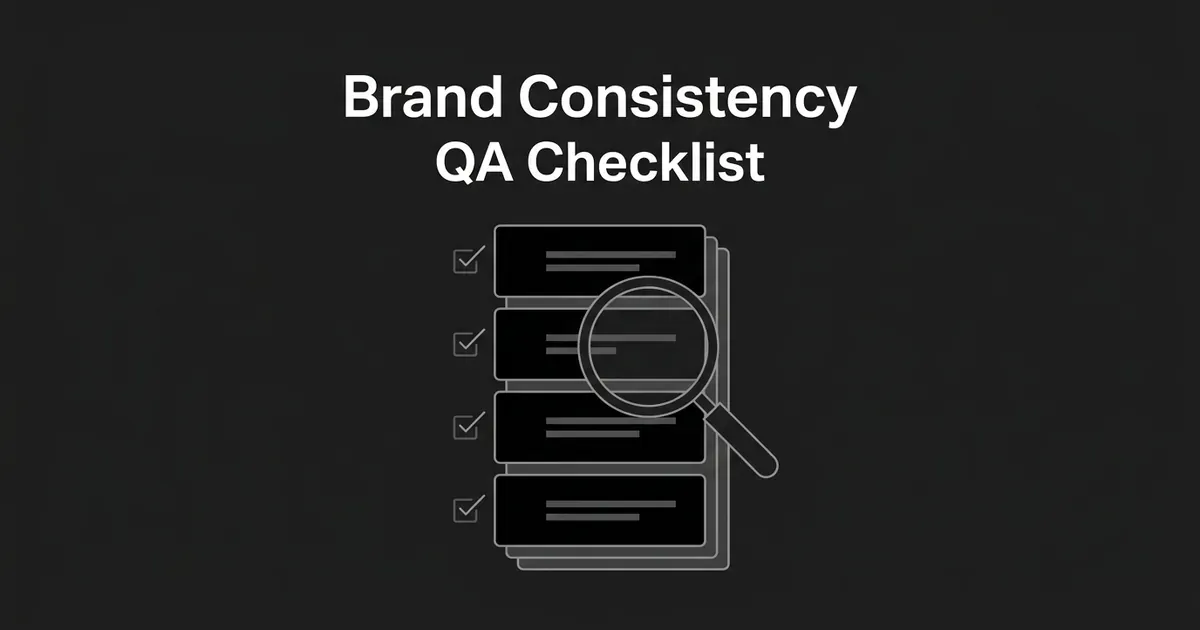
Copy this AI content QA checklist
Save this brand consistency checklist as your reusable pre-publish template and run it on your next AI draft before it goes out.
Context
- You know the audience, buyer stage, channel, and purpose.
- You know the output format and the action the draft should drive.
- You have approved source material for any product, policy, research, or customer claims.
- You've flagged any high-risk subject matter for deeper review.
Claims and evidence
- Every factual statement, number, date, quote, and comparison has an appropriate source.
- You checked each source directly rather than trusting the citation.
- The wording doesn't go beyond what the source actually supports.
- No unsupported superlatives, guarantees, or invented statistics remain.
- Any quote is verified in its original context.
- Unsupported statements were deleted, narrowed, or rewritten with real source support.
Brand voice and terminology
- The draft sounds like your company, not generic AI copy.
- The tone fits the audience, topic, and channel.
- Approved product names and terms are used exactly.
- Near-synonyms that change meaning have been replaced.
- Banned terms and formulaic transitions are gone.
- No grammar edit removed proof, precision, or personality.
Audience and clarity
- The opening makes the reader and their task clear.
- The answer appears near the top of each section.
- Acronyms and technical terms are explained on first use.
- Examples are concrete enough to act on.
- The conclusion gives a clear next step.
Structure and formatting
- The title is descriptive and matches the content.
- Headings follow a logical hierarchy, not bold or all caps standing in for one.
- Every internal and external link works and goes where it says.
- Metadata, tags, and schema are complete and accurate.
- No duplicate claims, empty headings, or structural gaps remain.
Accessibility and media
- Informative images have contextual alt text.
- Decorative images are marked decorative.
- No meaning depends only on color, shape, or position.
- Any video has human-checked captions; any audio has a transcript.
- The page has been previewed and checked on mobile.
Final human read
- A person has read the near-final draft start to finish.
- Every flag has a disposition: keep, rewrite, source, escalate, or delete.
- High-risk claims got the right level of review.
- The draft is accurate, on brand, clear, and formatted correctly.
Pro tip: when you flag something, name the exact location and the exact problem, like "unsupported superlative in paragraph 4," instead of a vague note like "possible brand issue." A specific flag saves the next reviewer from re-doing your work.
If you'd rather not run a brand consistency checklist by hand on every article, DeepSmith's Content Studio builds keyword coverage, internal linking, and publish-ready metadata into a draft as it's produced, so less of this list needs manual cleanup by the time a piece reaches you. You can start a free trial and see what a draft looks like before it hits your desk.