If you lead a marketing team, you've probably been asked some version of this question: should we use an AI writing assistant, or keep paying people to write? The honest answer is that neither side wins everywhere. Most of the useful thinking about ai vs human writers comes down to which jobs you give to which one, because the strengths are quite different.
This guide goes through five areas where an ai writing assistant vs human writer comparison tends to show differences: speed, consistency, original insight, subject expertise, and editing. It uses a few published studies as evidence and notes where they stop being useful. We're only looking at capability here. Pricing and budgets depend on your team and volume, so that's a separate decision.
The short answer: ai writing assistant vs human writer in one table
AI writing assistants tend to be stronger at producing and reshaping text quickly. Skilled human writers and editors should lead firsthand reporting, distinctive positions, specialist interpretation, and the final call on what gets published. The table below is a way to divide the work, not a ranking.
| Criterion | AI writing assistant | Skilled human writer or editor | A sensible split |
|---|---|---|---|
| Speed | Strong at drafts, alternative headlines, summaries, and format changes | Adds reporting, source conversations, and deliberate editorial choices | Automate bounded drafting; save human time for evidence and decisions |
| Consistency | Applies supplied terms, structure, and brand rules again and again, and can also repeat a wrong instruction | Spots when a situation needs an exception to the usual style | Use shared brand context and checks, and let people handle exceptions |
| Original insight | Useful for brainstorming and recombining ideas | Leads interviews, firsthand observation, and positions the company can defend | Start from distinctive human inputs and use AI to develop them |
| Subject expertise | Summarizes sources and explains concepts, but fluent text is not proof of correct text | Judges assumptions, exceptions, and whether the evidence supports the advice | Use AI for synthesis and a qualified reviewer where the stakes are high |
| Editing | Good at concision, grammar, formatting, and challenging an argument | Owns meaning, sensitive wording, and final approval | Let AI propose and check; let an accountable editor decide |
One note on terms before we go on. "AI-generated" means a system wrote most of the wording. "AI-assisted" means a person used AI for parts of the process, like outlining or rewriting. "Human-led" means people own the evidence, the argument, and the decisions, whether or not AI helped with the text. A piece can be human-led and heavily AI-assisted at the same time, so the binary in ai content vs human content hides a lot of what actually happens.
Quality is also several things at once: fluency (it reads smoothly), correctness (the claims hold up), originality, usefulness, and brand fit. An article can be fluent and wrong, or correct and generic, so each needs its own check.
Speed: where AI writing assistants pull ahead
AI has its clearest advantage when the job is to produce or reshape text from a decent brief. Turning approved notes into an outline, drafting a section from a source pack, writing a few alternative headlines, shortening an explanation while keeping the key points, and adapting a finished article into a summary are all good examples.
There's real research behind this. In a preregistered experiment published in Science in July 2023, Shakked Noy and Whitney Zhang gave 453 college-educated professionals writing tasks that matched their occupations. About half were randomly given access to ChatGPT. On average, the people who used it finished their tasks 40% faster in terms of time, and independent graders rated their work 18% higher in quality. The people who started with weaker skills gained the most.
That result is worth taking seriously, and it's also worth reading carefully. The people in the study were professionals who had an assistant, not an AI replacing an editorial team. The tasks were bounded, so it says little about reporting or long-form publishing. And "40% less time on a task" isn't the same as "your team will publish 40% more articles."
That last point matters for marketing leads, because the real measure is time to an approved, published article, not time to a first draft. Sourcing, technical review, links, images, metadata, formatting, and publishing can all stay slow even when drafting gets fast.
Reporting is a different job from generating an outline from existing material, so it shouldn't be judged by how fast someone types.
Consistency: easier with AI, as long as the inputs are right
Consistency comes in three forms, and AI helps with them unevenly. Mechanical consistency covers spelling, preferred terms, capitalization, and repeated structures. Brand consistency covers positioning, tone, product descriptions, and approved claims. Editorial consistency is a steady standard of evidence and judgment.
AI is well suited to the first kind, because checking explicit rules is something it does patiently and without getting tired. It can help with the second kind when the context it works from is stored and kept current, since you don't have to explain your product and voice from scratch for every piece. The third kind still depends on people.
The catch is that a shared mistake becomes a consistent mistake. If an outdated feature description sits in the input, it can show up across many articles. We didn't find a controlled benchmark showing that AI keeps a brand voice better than skilled humans do, so it's more accurate to call this a workflow advantage that has conditions than a settled win.
This is also where a good editor earns their keep. A customer apology, a technical guide, and a product announcement shouldn't all sound the same just because they share a brand, and a person can tell when an exception is the right call. If you're building the rules that both people and AI should follow, our guide to documenting your brand voice and tone is a practical place to start.
Original insight: people should lead, with AI as a partner
When an article needs something your competitors can't get from the same public pages, a person should lead. That means interviews with customers or practitioners, firsthand implementation notes, product tests, proprietary data with a stated method, and an opinion based on real experience. If your writers want a starting point, journalism techniques for content writers covers interviewing and sourcing.
It would be wrong to say AI can't be creative, though. In a study by Anil Doshi and Oliver Hauser, published in Science Advances in July 2024, 293 participants wrote eight-sentence stories with either no AI help, one AI-suggested idea, or up to five. 600 evaluators then rated the stories. Writers who had access to up to five ideas scored 8.1% higher on novelty and 9.0% higher on usefulness. The same study found that the AI-assisted stories were more similar to each other than the human-only stories were.
So AI can help one person produce work that readers rate as more creative, while the whole collection of work starts to look alike. The participants were not professional writers and the task was a short story, so it doesn't prove that professionals always beat AI. It does show where the risk is.
The useful distinction is between a sentence that sounds new and evidence that actually is new. An assistant can help you express an observation, but it can't perform the observation. It shouldn't claim to have interviewed a customer, used a product, or seen an outcome that didn't happen.
A small illustration, not a real case: a generic claim might be that onboarding goes well when teams communicate clearly. A stronger, evidence-led angle would be that an implementation team found one approval handoff that kept delaying onboarding, explained why, and documented the change they tested. The second one needs a person who was there. An AI can then help organize it, test the argument, and draft the article around it.
A human author can also write generic, derivative work, so a byline doesn't guarantee anything.
Subject expertise: fluent is not the same as correct
The more serious the recommendation, the more it matters that someone qualified can check it and stand behind it. AI can summarize approved documentation, pull out definitions and requirements, draft explanations at different levels, find inconsistencies between your materials, and suggest questions for a specialist. A relevant human specialist should decide whether the explanation is materially correct, which assumptions it depends on, which exceptions change the advice, and whether an example reflects real practice.
There's good evidence that the line between those two jobs is not obvious. The "Jagged Technological Frontier" study, published in Organization Science in March 2026, ran a preregistered experiment with 758 knowledge workers in a management-consulting setting. On 18 tasks chosen to sit inside what the AI could do, the AI users completed 12.2% more tasks, finished 25.1% faster, and produced work with 32% better quality on average. On one complex task chosen to sit outside that frontier, the AI users were 19 percentage points less likely to get the right answer. Correctness was around 84.5% without AI and 70.6% with GPT alone.
This wasn't a writing-only study, and only one task was outside the frontier, so it's best read as a caution and not a verdict. The lesson is that good expertise includes knowing when a smooth answer is wrong. The NIST guidance on generative AI describes this risk as confabulation, where outputs can be inaccurate or inconsistent while still sounding plausible, and it recommends reviewing and verifying sources and citations in generated output. A citation-shaped string isn't verified evidence, and a real source can be cited for something it doesn't say.
The same fairness applies to people. A generalist writer isn't automatically a subject expert, and "human-written" isn't a quality certificate. When you assign a reviewer, name the competence you need. "A specialist who has implemented this process" says more than "a human who understands it better."
Editing: let AI propose and let a person decide
AI can help at almost every stage of editing, but a better-sounding rewrite isn't automatically a better edit. It helps to split editing into its separate jobs.
- Structural editing: AI can suggest an outline, flag repetition, and point out missing sections. A person decides what argument the piece makes and what the reader needs first.
- Substantive or technical editing: AI can flag unsupported statements, contradictions, and unclear terms. A person checks the evidence and decides if the explanation is right.
- Line editing: AI can offer clearer sentences and shorter paragraphs. A person keeps the meaning, the qualifications, and the voice.
- Copyediting: AI can check spelling, terms, punctuation, and stated style rules. A person decides when an exception is intentional.
- Publication checks: AI can check links, headings, metadata, image descriptions, and formatting. A person confirms that the finished page is accurate and appropriate.
Nielsen Norman Group has written about how it uses AI in its editorial process, and it's a useful real example. AI helps with concise wording, constrained summaries, adapting a piece to different channels, and challenging the logic of an argument. The group keeps human editors responsible and warns that shortening a piece can muddy an argument or drop nuance.
The Associated Press takes a similar line. Its standards allow AI help with research, summaries, transcription, headlines, and grammar, and say generated output is reviewed and edited before publication, and that AI does not replace reporting, sourcing, or verification. Whatever your team's size, that's a useful pattern to borrow: AI proposes and checks, and a named person is accountable. Our piece on where editors fit in an automated pipeline goes deeper on that handoff.
If you want to set up that kind of review, we walk through the steps in how to add human review and QA gates to an AI content pipeline.
DeepSmith: a production system built around human judgment
So far we've compared an assistant and a writer on single tasks. For a marketing lead, the problem is usually bigger than a single task. It's the work around the writing: preparing briefs, structuring and optimizing the article, finding internal links, making an image, filling in metadata, keeping a calendar moving, and getting the article ready to distribute. A general writing assistant that sits beside a blank document doesn't take much of that off your plate. If you're unsure how a writing tool differs from a platform, we break that down separately.
DeepSmith is an AI search analytics and content production platform, so it works on both sides of that problem. It's a production engine, not a writing assistant, and the ai vs human writers question looks different when you see it that way. It shows you where you appear in AI answers, helps you decide what to write, and then produces the article, with your people supplying the evidence, the position, and the decision to publish.
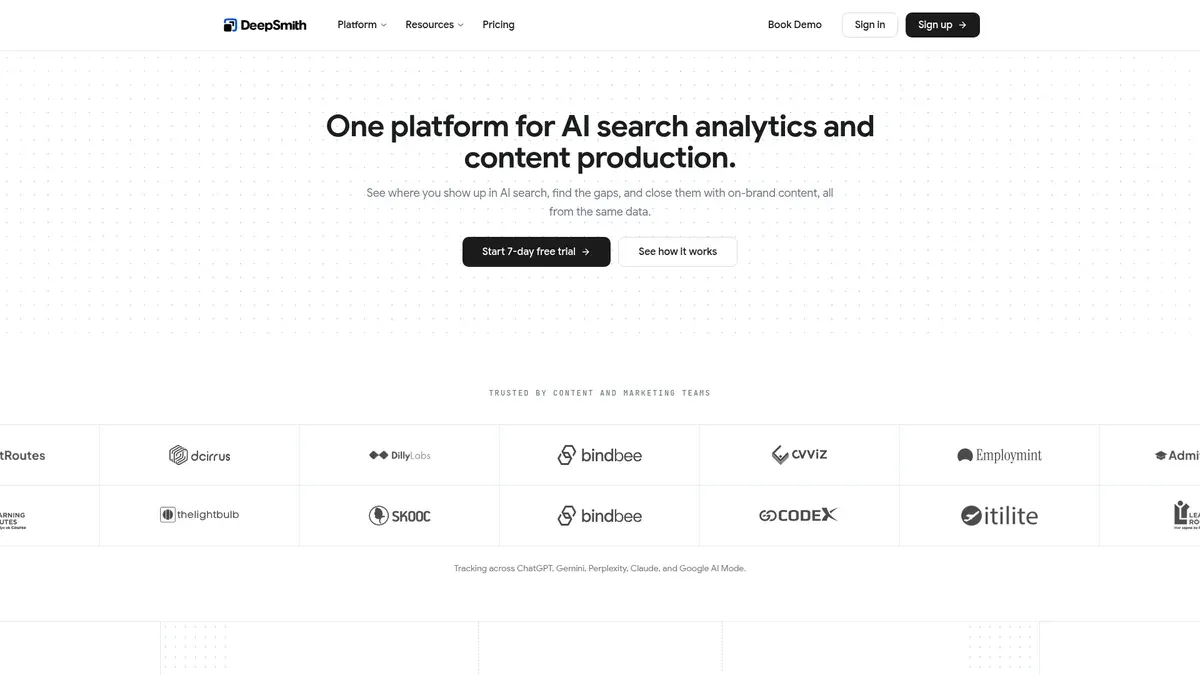
Here's how the pieces fit together.
Measurement comes first. The AI visibility area tracks mention rate, citation rate, and share of voice across the engines on your plan, with competitor comparisons. That tells the team what to write about, and Opportunity Agents turn that data into content ideas with the reason attached. A coverage gap is something to evaluate, not proof that another article will perform, so the strategy stays with your team.

Context is stored once. Deep IQ keeps your company, product, persona, voice, visual, and content-type context, and every writing run uses it. The benefit is not having to re-brief a disconnected generator for each article. Grounding is only as good as the information you keep in it, and it isn't a guarantee that nothing will ever be wrong, which is why review still matters.
Production covers the whole job. The documented Content Studio pipeline includes research, brief generation, drafting, quality checks, a humanization pass, internal linking, image creation, and packaging for your CMS. Keyword coverage, structure, internal links, and metadata are built in as the article is written. Planned Content and Autowrite let you schedule an article to be produced on a set date, even when nobody is in the app, and finished pieces land in Produced Content, where you can preview, edit, and publish to WordPress, Webflow, Strapi, Sanity, or Contentful. Scheduled writing and editorial approval are different decisions, and review is where your judgment goes.
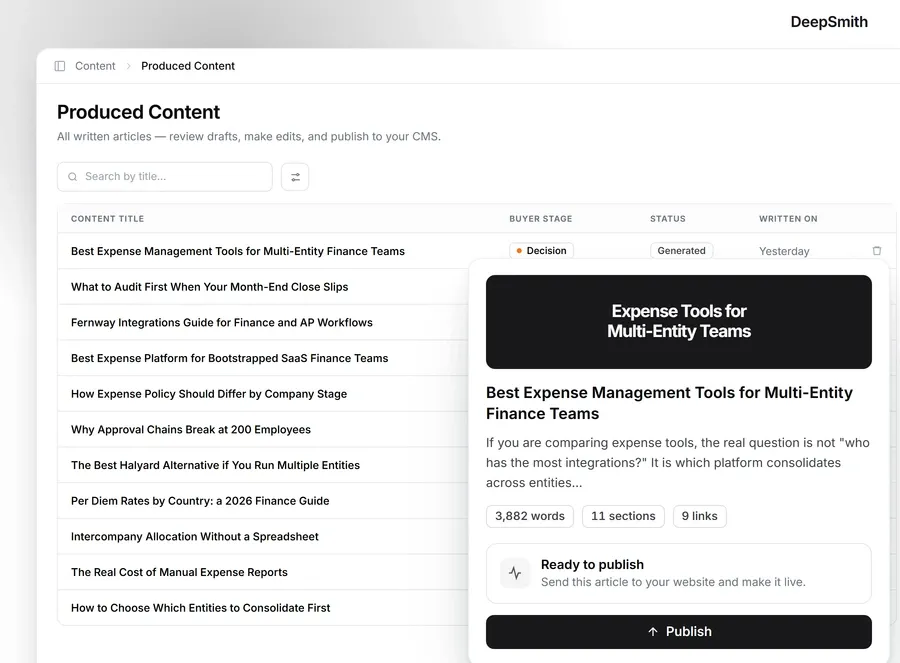
The honest limit is that this doesn't replace a specialist. If an assignment depends on access, interviews, testing, sensitive interpretation, or a distinctive argument, a writer or expert should lead it. That person shouldn't also have to assemble every link, cover image, metadata field, and channel version by hand. Keeping the expertise and removing the avoidable production labor around it is the point. A plain writing assistant is still a fine choice for occasional help with wording.
For more on where a platform stops and a person starts, see what AI content agents can and cannot automate. If you want the setup steps, our guide to keeping editorial control covers approvals and fact checks when a platform drafts your content.
Who does what: a task guide for marketing leads
The table below is a suggested operating model, not an experimentally proven ranking. The right column is the condition that should be true before the piece goes out.
| Content or task | Who should lead | What AI or DeepSmith does | Before it goes out |
|---|---|---|---|
| Routine explainer from stable, approved information | AI-assisted production with an accountable editor | Research synthesis, structure, draft, optimization, packaging | Claims and examples match reliable sources and current product facts |
| Customer case study | Human interviewer and editor | Interview prep, transcript organizing, drafting from approved material | Customer facts, quotes, permissions, and outcomes are verified |
| Executive point of view | The executive or an experienced writer | Explore counterarguments, organize their thinking, improve wording | The position is genuinely held and defensible by the named person |
| Proprietary research report | Research owner and specialist writer | Organize findings, draft explanations, create summaries | Methods, calculations, and limits are checked |
| Technical implementation guide | Practitioner or technical reviewer | Draft from approved documentation | Steps are checked against the real implementation |
| Health, safety, or similarly consequential advice | Qualified specialist | Support drafting and document synthesis under controls | Qualified review of recommendations and potential harm |
| Internal links, cover image, metadata | Production system | Prepare the publishing package | Links, descriptions, and alt text are checked |
| Final publication decision | A named human owner | Supply the assembled article and QA support | The owner accepts responsibility for accuracy |
A good workflow behind that table is fairly simple. Write down the reader's question and why the article should exist, and name an editorial owner before anything is generated. Supply approved inputs: current product facts, voice guidance, trusted sources, and any original material. Generate from that brief and let missing evidence stay visible as a gap instead of an invented statistic. Review the substance before the style, then check the finished page, including links, metadata, and image descriptions. Measure time to an accepted article, not time to a first draft.
If you want a fuller look at the finishing work, the last 40 percent of AI content covers how different platforms handle it.
What this means for search and AI visibility
Teams often worry that the ai content vs human content choice will hurt them in search. Google's guidance on generative AI content says it can be used for research and for structuring original material, and it warns that producing many pages without adding value for users may break its scaled content abuse policy. The line Google draws is between helpful, reliable content and low-value output at scale, not between AI and human authors. We cover the evidence in more detail in does Google penalize AI-generated content.
Google's people-first guidance asks whether content offers original information, reporting, research, or analysis, and whether it was written or reviewed by someone who knows the subject. E-E-A-T isn't a single ranking factor, so human authorship isn't an automatic advantage. Google also says its existing SEO practices still apply to AI Overviews and AI Mode, and nothing guarantees a citation.
Which should you choose?
Here is a way to decide by situation.
- You need new interviews, customer evidence, or a distinctive executive argument. Make it a human-led assignment, with AI supporting production. The value is in the access, the evidence, and the person who stands behind the position.
- You have approved expertise and source material but keep stalling on the execution. DeepSmith, with a named editorial owner, covers more of the bottleneck than text generation alone.
- You only need occasional rewrites or help with wording. A writing assistant inside your existing process is enough.
- You publish recurring marketing content and also want to know where you're missing in AI answers. DeepSmith connects the evidence about what to publish with the workflow that produces it, with people directing it.
- The content gives consequential technical or sensitive advice. Put a qualified person in charge of it and review it carefully, with AI in a limited support role.
Try it on a real assignment
The best test is a real one. Start a 7-day free trial of DeepSmith and give it an assignment you'd normally brief by hand. Then look at how complete the article is, how well it fits your brand, how much editing is left, and whether the visibility data helps you decide what to write next.
Related guides
- WordHero Alternatives: 8 Best AI Copywriting Tools for 2026: For lifetime-deal users who now need long-form output, this ranks eight AI copywriting tools (DeepSmith, Writesonic, Jasper, Scalenut, Anyword, Copy.ai, Rytr, Hypotenuse AI) on template breadth, real article.
- Yarnit Alternatives: 7 Best AI Content Platforms for 2026: Ranks seven Yarnit alternatives, DeepSmith, Jasper, Writesonic, Simplified, Typeface, Copy.ai, and Canva, against workflow coverage, agentic automation, SEO and AI-search depth, visual output, and pricing, recommending each for.
- Are Free AI Writers Good Enough for Business Blogging?: Judge where free AI writers suffice for business blogging and where they fall short.
- Seven Content Automation Myths That Cost Teams Time and Traffic: Spot seven common myths about content automation, such as that volume alone wins or that automation removes editing, and see how each one wastes team time or costs.
- How Content Optimization Scores Work and Whether They Predict Rankings: Understand how optimization scores are generally built from competitor term coverage, length and structure signals, and weigh what evidence exists on whether a higher score leads to better.