If you have published a few AI-assisted articles and some of them show up in Google while others just sit there, it's natural to wonder whether the AI is the reason. Usually it isn't. People often ask do AI articles rank at all, and the answer is yes, they can, and the ones that don't get indexed or don't rank are held back by things like duplication, thin content, crawl and technical problems, or plain competition, not by a rule against AI. This guide walks through each of those so you can see which parts you control, and it focuses on Google, since that's where the best documentation and most of the studies are.
Indexing and ranking are different outcomes
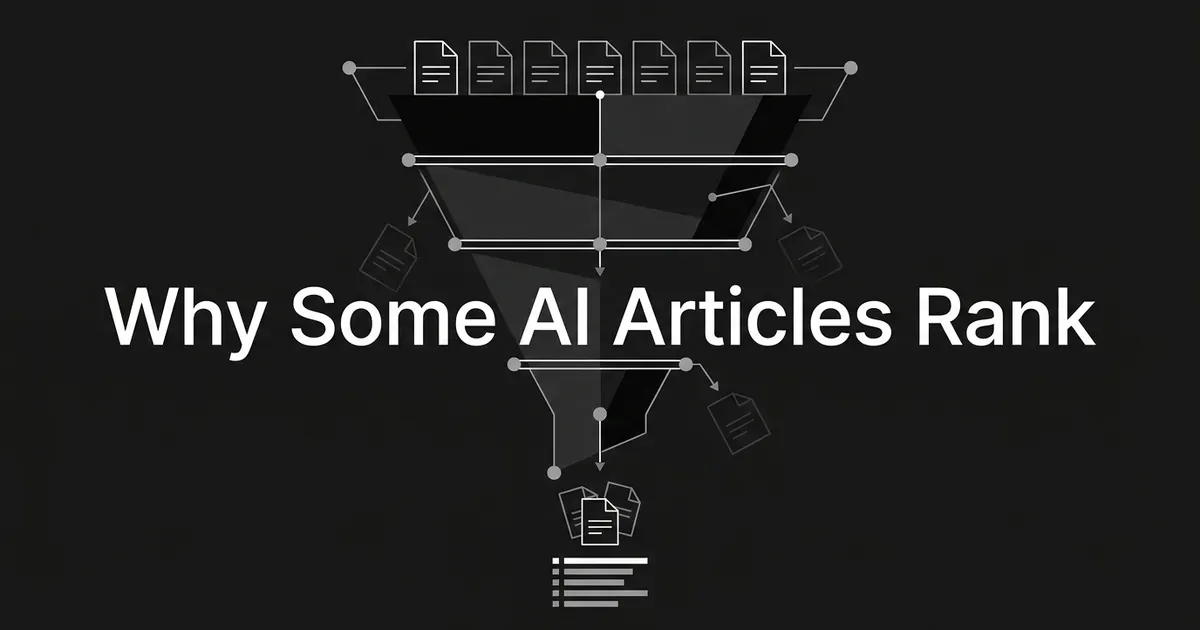
An article has to get through several stages before anyone sees it, and it can stall at any of them.
| Stage | What it means | What it doesn't promise |
|---|---|---|
| Publication | You made the article available on your site or in your CMS. | Google has found it. |
| Discovery | Google learns the URL exists, through links or a sitemap. | Google will crawl it. |
| Crawling | Googlebot requests the page and its resources. | Google will index it. |
| Rendering | Google processes the page, including JavaScript. | The page looks the same to Google as it does in your browser. |
| Indexing | Google analyzes the content, deals with duplicates, and decides what to store. | The page will show up for any particular search. |
| Ranking and serving | Google picks and orders results for a specific search. | A high position, impressions for every term you want, or clicks. |
Google describes the big picture as crawling, indexing and serving, and its documentation says plainly that not every page makes it through every stage, even when a site follows its guidelines. That means a missing article doesn't point to one cause. Four quite different things can look the same from the outside. A great article might not have been discovered yet. A crawlable article might have been fetched and left out of the index. A near-copy might have been dropped in favor of the version Google prefers. Or an indexed article might simply lose to better answers on the results page. Saying "Google rejected my AI writing" doesn't fit any of those four very well.
The labels in Search Console are a good example. "Discovered, currently not indexed" means Google knows the URL but hasn't crawled it yet. "Crawled, currently not indexed" means it fetched the page and chose not to index it for now, and Google's own help page says this is common and doesn't always mean something needs fixing. "Alternate page with proper canonical tag" and "Duplicate without user-selected canonical" often describe Google working as intended, since it picks one representative version of similar pages. None of these labels says an AI detector flagged your writing, and none says the exclusion is permanent.
So when someone says AI content not indexed is the whole problem, the first question is which stage the article is stuck at.
Google looks at the result, not the writing method
The most direct answer to the "is AI allowed" question is in Google's February 2023 guidance on AI content, which says appropriate use of AI or automation is not against its guidelines. It says the focus is the quality of the content, not how it was produced, and it also says AI gets no special ranking boost. A useful, original, helpful page can perform whether or not AI helped write it.
That's a narrower statement than some people read into it. It doesn't say all automation is safe, and it doesn't say mass-produced AI output performs the same as careful human-led work. Google's current generative AI guidance, last updated October 1, 2026, goes further and says it's critical to manually fact-check and review AI-generated content for accuracy and trustworthiness before you publish it. It also warns about inaccuracies and hallucinations. The review it describes covers more than the body text. It includes title elements, meta descriptions, structured data and image alt text.
Checking claims against sources, choosing the right evidence and adding expertise you really have addresses Google's stated concerns much more directly than smoothing out a few robotic phrases. Our guide on editing AI drafts so they read like original expert writing covers that pass. There's no documented number of editing minutes or human-to-AI ratio, so it would be a mistake to chase one.
Where Google does draw a hard line is scaled content abuse. Its spam policy describes generating many pages mainly to manipulate rankings instead of helping people, and it lists examples such as producing lots of AI pages that add no value, scraping and reshaping other sites' material into many pages, stitching pages together without making them useful, and writing pages full of keywords that don't make sense to a reader. The policy applies however the content was made. Google says violations can lead to lower rankings or no appearance in results, and the documentation doesn't give a volume threshold, so you can't say a certain number of articles a day is safe or spammy. If you're curious how this plays out in practice, we've gone through what the evidence says about whether Google penalizes AI-generated content.
Commercial AI detectors are probabilistic and make mistakes, and Google's public guidance doesn't treat a detector score as something publishers need to meet. Passing a detector doesn't show your content is safe, and failing one doesn't show it's doomed. For more on how reliable those tools are, see what the evidence shows about AI content detectors.
Originality means adding something worth finding
Google's helpful content guidance asks questions like whether a page gives original information, reporting, research or analysis, whether it goes beyond the obvious, and whether it adds real value instead of copying or lightly rewriting other sources. That's a different test from whether your sentences are unique. An article can be word-for-word unlike anything else online and still contribute nothing, for example when it rearranges the same definitions and general advice every other result already has.
It also doesn't mean you have to invent a new fact in every paragraph. A carefully sourced explanation, an expert's interpretation, a useful comparison, or an example from real experience can add value to a topic that's already well covered, as long as you never make up tests, experience or customer stories to get there.
To make that concrete, picture two hypothetical articles on the same subject. One says quality matters and tells you to post consistently, without defining indexing or backing up a claim. The other explains the separate search stages, describes Google's AI policy accurately and says what a marketing lead can actually control. The second is much closer to what Google's published criteria describe, though that doesn't guarantee it ranks or that the first stays out of the index.
Usefulness also depends on matching the question. A technically correct article can still be a poor fit for what the searcher wanted, and someone asking whether AI articles can rank wants an answer about eligibility and evidence, not a pitch for writing software. If AI-assisted drafts in your own library all sound alike, why AI-generated content sounds the same across competitors explains where that sameness comes from.
Accuracy and trust matter more than seeming human. Google describes E-E-A-T as experience, expertise, authoritativeness and trustworthiness, and says trust is the most important of the four. E-E-A-T isn't a single ranking factor or a public score, and the evidence on whether E-E-A-T is a Google ranking factor is worth a read if you want the detail. The bar is higher for topics that could affect someone's health or finances. Made-up author profiles, credentials or experience undermine trust.
Site context and crawl signals change the odds
Your article doesn't compete on its own. Google says its ranking systems mainly evaluate individual pages, while site-wide signals also feed in. Good site-wide signals don't mean every page will rank well, and poor ones don't mean every page must rank badly, so an established domain isn't a shield for a weak article and a new domain isn't barred. How a low-quality section affects the rest of a site is its own topic, and we've covered what Google has said about low-quality content hurting a site's rankings.
When people say "site quality" it helps to make it concrete. It can mean a clear audience and purpose, articles that add value instead of repeating each other, claims and authorship readers can trust, important pages connected through useful links, and a server that reliably delivers content. It doesn't mean a mysterious authority number.
Links do two jobs here. They help Google discover pages, and they help it understand how pages relate. Google says every page you care about should be linked from at least one other page on your site. An article with nothing pointing to it loses an important way to be found, though a sitemap or outside links can still expose it. If your back catalog has pages like that, adding internal links to an existing content back catalog is a practical place to start.
Crawling has its own limits, and publishing more doesn't buy more attention. Google defines crawl budget with two parts. Crawl capacity is how much Google can fetch without overloading your server, and crawl demand is how much Google wants to fetch, based on things like site size, how often content changes, page quality, relevance and popularity. A faster server doesn't create demand by itself, and Google says it may crawl less when demand is low even if capacity is available. Slow responses and server errors can lower capacity, and duplicate or unnecessary URLs can use up crawling that would have gone to useful pages. The Google crawl budget documentation lays this out in detail.
Here's where AI can matter, and this is my inference, not something Google has said. AI can fill a publishing queue faster than a team can grow its review capacity or its useful topic coverage, which can multiply weak pages and extra URLs. That's a production risk, and it isn't evidence that Google restricts crawling of AI-written pages.
It's also easy to blame crawl budget too quickly. Google's advanced guidance is aimed mainly at sites with roughly a million or more unique pages, or ten thousand or more that change very quickly, and Google calls those rough groupings, not cutoffs. A modest marketing blog with a handful of unindexed articles should look first at discovery, content selection and specific technical barriers.
A few points on timing and requests are worth knowing. A sitemap helps Google discover URLs, but it isn't an instruction to index every one. Google says repeatedly asking for a recrawl of the same URL doesn't make it crawl faster, and that crawling can take a few days to a few weeks, which is neither a promise nor a deadline. If you want to automate the submission side after you publish, we explain how to submit new articles for indexing automatically after publishing, including what each method does and doesn't guarantee.
Technical barriers can keep a good article out
Google's minimum technical requirements are that Googlebot isn't blocked, the page works and returns an HTTP 200 success response, and the page has indexable content. Meeting them makes a page eligible, and eligibility isn't a guarantee. The table below describes causes, and it's not a set of troubleshooting steps.
| Condition | Why it can change the outcome | Worth knowing |
|---|---|---|
| Login or access barrier | Googlebot can't normally retrieve a private article. | Being saved in your CMS isn't the same as being public. |
| Robots.txt restriction | Google may not fetch the page or the resources it needs to understand it. | Robots.txt controls crawling and doesn't reliably keep a URL out of results. |
| A crawlable noindex rule | Google can read an instruction not to index the page. | It can sit in an HTML meta tag or an HTTP response header. |
| Soft 404 or empty template | The page returns success but shows an error, no content or an empty application shell. | A 200 status alone doesn't prove the article text is there. |
| Rendering limits | Important text or links may be missing from what Google can render. | Google can run JavaScript, so "Google can't read JavaScript" is wrong. |
| Duplicate or near-duplicate main content | Google may pick another URL as the representative version. | Some duplication is normal and isn't automatically spam. |
Robots.txt and noindex get mixed up often. Google has to be able to crawl a page to see its noindex instruction, so if robots.txt stops it from fetching the page, it can't read the rule, and a blocked URL can still sometimes appear in results based on links. Google also doesn't support a noindex directive inside robots.txt.
Duplication works on the main content, not on shared formatting. Google can group pages whose main content is very similar and pick a canonical representative, and a shared blog layout or a common disclaimer doesn't turn every article into a duplicate. A canonical is a hint, not a command, so Google still makes the final pick. If you publish through automation, the guide on handling canonicals, slugs and metadata in automated publishing covers how to keep those signals consistent.
The takeaway from this section is that content quality can't make up for every technical exclusion, and technical eligibility can't make up for weak content. You need both.
What the studies show, and what they can't
Once an article is indexed, it still competes. Google describes ranking as based on hundreds of factors, and relevance depends on the query and the user's context. An indexed AI-assisted article might get little visibility because another page answers the question more directly, because it adds little beyond the existing results, because the site lacks helpful signals compared with competitors, because the query calls for a different type of answer, or because the content is inaccurate or stale where freshness matters. No prevalence data ranks these by how often they happen.
Page experience belongs in the same picture, but Google says good scores don't guarantee top rankings. It also says it has no preferred word count, so a longer AI article isn't automatically more useful or more competitive.
The vendor studies are where people usually look for proof in AI generated content SEO, so it helps to know what each can and can't tell you. All of these were run by SEO software companies, and all of them use detectors to estimate which pages are AI-written.
- Ahrefs, July 7, 2025. Ahrefs took 100,000 random keywords, pulled the top 20 ranking URLs and analyzed 600,000 pages with its own AI content detector. It classified 4.6% as pure AI, 13.5% as pure human and 81.9% as mixed, so 86.5% had some AI content. The correlation between the estimated AI percentage and ranking position was 0.011, which is effectively zero. You can read the full write-up in the Ahrefs study. It shows that pages classified as AI-generated or AI-assisted can sit among strong Google results. It doesn't show that 86.5% of all AI articles rank, because pages entered the sample by already ranking, and Ahrefs notes its detector can give false positives.
- Ahrefs, June 2026 data. In a later analysis of one million pages from the top ten positions across 100,000 results pages, Ahrefs classified 5.3% of pages in positions one to three as 100% AI-generated and 9% as at least 80% AI.
- SE Ranking, 2024 to 2026. SE Ranking launched 20 new sites and published 2,000 AI-generated articles, 100 per site, on November 5 and 6, 2024, with no edits. The domains had no history or backlinks, and the team did no link building or promotion. In the first 36 days, 70.95% of the articles, or 1,419 pages, were indexed. Around the three-month mark, the share of pages in the top 100 fell from 28% to 3%, and by month 16 about 66.9% were still indexed despite generally weak visibility. You can read the SE Ranking experiment for the details. It's useful because it shows unedited AI content can get into the index and that being indexed isn't the same as keeping a ranking. It's a single experiment on new sites, so it can't say AI authorship caused the later drop.
- Semrush, April 1, 2026, and Graphite, October 14, 2025. Semrush found human-classified pages made up roughly 80% of position one in its sample, and Graphite found 7% of position-one articles classified as AI-generated. They used different detectors and filters, so the numbers aren't directly comparable.
The headlines look like they disagree, but they mostly measure different things. The studies differ in which detector and thresholds they used, which keywords and dates they sampled, whether they looked at the top ten or the top twenty, and whether they measured result composition, rank correlation, indexing, impressions or survey answers. The fair reading is that AI-written and AI-assisted articles can rank, and that the evidence doesn't support a universal success rate, a safe AI percentage or the idea that how an article was made explains whether it succeeds. Observational data can't cleanly separate AI involvement from editing quality, site history, links and topic.
What you can control, and what nobody can promise
It helps to sort the factors by how much say you have. This isn't a ranked list of causes, since nobody has frequency data for that.
| Area | How much control you have | What it means for you |
|---|---|---|
| Audience and editorial purpose | Direct | Commission articles that answer real reader questions, not keyword permutations. |
| Original contribution | Direct | Decide what evidence, analysis or experience each article adds. |
| Accuracy and attribution | Direct | Require real fact-checking and truthful authorship or review details. |
| Internal links and sitemap | Largely direct | Make important articles easy to find, without treating submission as a guarantee. |
| Google's crawl demand and timing | Influence only | A clean structure and quality help the environment, but asking for attention doesn't force it. |
| Final indexing and ranking | None directly | Treat eligibility and quality as necessary work, not a promise of results. |
The scalable unit is a publishing standard you can check, not a larger number of generated articles.
One more distinction belongs in the picture. Everything above is about content made with AI appearing in ordinary search. That's separate from your content being used as a source inside an AI-generated answer. For Google's AI Overviews and AI Mode, a page has to be indexed and eligible to appear in Search with a snippet to qualify as a supporting link, and Google's July 10, 2026 guide says it doesn't require special AI markup. Eligibility isn't selection, so an indexed page may still not be cited for a given question. If AI citations are what you're after, whether AI-generated content gets cited in AI answers is a good next read.
The same throughline holds for AI generated content SEO as a whole. AI-written content doesn't face a single pass-or-fail test. It faces a chain of decisions about accessibility, selection and competitive relevance, and you can improve the work and the conditions around it, but publishing it doesn't turn into a guarantee of indexing or rankings. A good next step is to look at your last few articles that didn't perform and ask which stage each one stalled at.
Related guides
- Best AI Content Tools with WordPress and CMS Auto-Publish: Ranks nine AI writers that push finished posts into a CMS rather than leaving text to paste, explaining three publishing models (auto-publish, scheduled or one-click, webhook or import).
- How AI Search Changes What You Should Ask of a Content Platform: See how AI search shifts what to demand from a platform, such as grounded sources, answer-ready structure, citation tracking and freshness, compared with older keyword and ranking features.
- How to Audit Your Content Stack and Retire Overlapping Tools: Audit your content stack by listing each tool, mapping its tasks and costs, finding overlaps, and deciding which tools a platform already covers and can be retired without.
- Content Optimization Tool or AI Writer: Which Gap Are You Filling?: Decide whether you need an optimization tool, an AI writer or both by identifying whether your gap is improving existing drafts, producing new ones, or both, and what.
- How to Measure Whether an AI Content Platform Is Paying Off: Measure whether a platform is paying off by comparing cost per article, hours saved, output volume and search or AI visibility results against your baseline over a fixed.