You are shopping for one tool that does everything, and every vendor says they are that tool. That gets tiring fast.
Here is the good news. The shortlist is smaller than it looks once you decide what "all-in-one" has to mean for your team. Most Allable alternatives cluster into two camps: platforms that go wide across research, writing, SEO, and publishing, and platforms that go deep on one job and stay honest about the rest.
This guide walks through seven all-in-one AI content tool options for 2026, with what each one actually does, what it costs, and one honest limit on each. Take it one section at a time. By the end you will know which two to trial, not which seven to research.
How we picked these Allable alternatives
Criteria first, so you can argue with them.
Every tool on this list had to do three things: help you decide what to publish, help you produce it, and give you some read on how AI engines answer questions about your brand. That last one is the newer requirement, and it is why several familiar SEO names look different in 2026 than they did two years ago.
We ranked by fit for a marketing lead who owns both output and reporting, not by the longest feature checklist. Breadth almost always trades against depth. A platform that covers eight jobs will be the deepest tool in maybe one of them, and pretending otherwise is how teams end up paying for a suite they use a quarter of.
Pricing and plan limits come from each vendor's published pages at the time of writing. Where a vendor did not publish a number, we say so rather than guess. Plan tiers move, so confirm before you buy.
One more note. Most searches for Allable AI alternatives are really searches for a system, not a writing app. That is the frame we used. Allable itself is not reviewed here. This is a list of what to use instead.
The 7 best Allable alternatives at a glance
| Rank | Tool | Best for | AI-search visibility | Entry price |
|---|---|---|---|---|
| 1 | DeepSmith | Teams that want visibility data to drive production | Core product, tiered by plan | $99/month (Pro) |
| 2 | Writesonic | Broad SEO, GEO, agents, and integrations | ChatGPT, Gemini, Google AI Overviews; 10 platforms at Enterprise | $79/month billed annually |
| 3 | Scalenut | Clusters, optimization, and WordPress or Shopify publishing | ChatGPT and Google AI Overviews; Perplexity on Professional | $59/month |
| 4 | Frase | Page audits, scoring, and multiple CMS options | ChatGPT and Google AI; Perplexity and more by tier | $39/month billed yearly |
| 5 | Surfer | Optimization depth for SEO specialists | Google AI Mode, AI Overviews, Gemini, ChatGPT, Claude, Perplexity | $49/month billed yearly |
| 6 | Semrush | Teams already invested in a broad SEO suite | ChatGPT, Google AI, Gemini, Perplexity | $60/month (Content Toolkit) |
| 7 | Jasper | Enterprise brand governance and campaign workflows | GEO listed in Business workflows | $59/month billed yearly |
1. DeepSmith
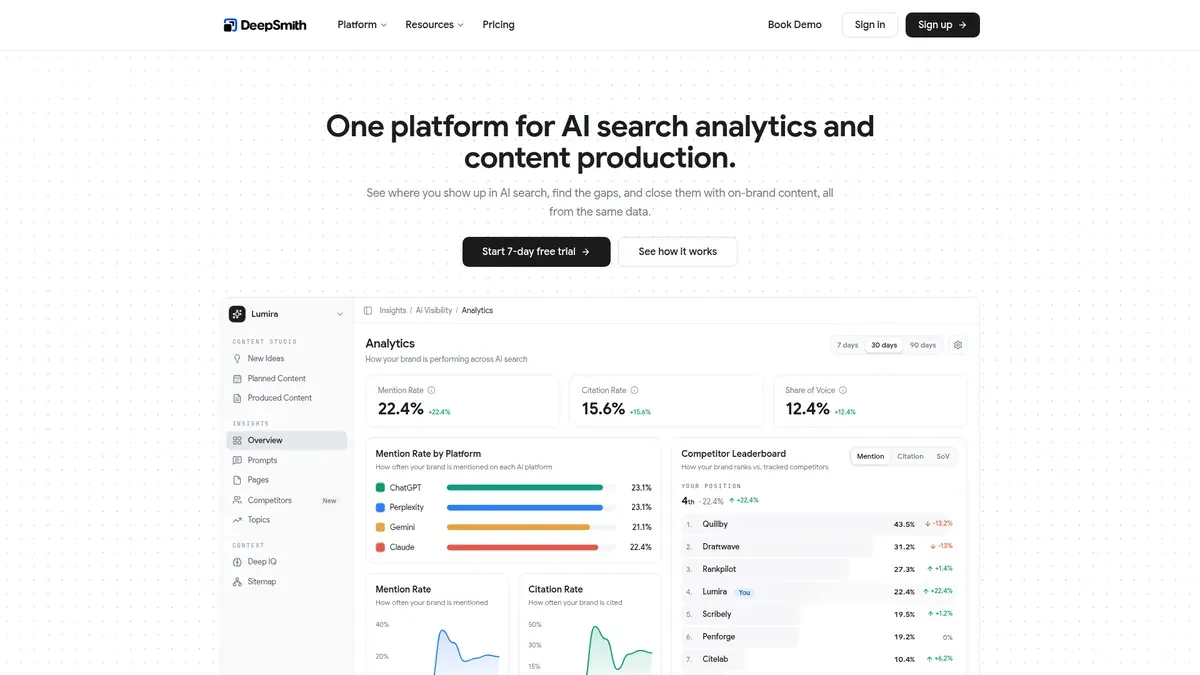
Best for: marketing leads who want one loop from "where are we losing in AI answers?" to "what should we publish?" to "did that move?"
Most tools on this list treat AI-search tracking as a dashboard you check on Fridays. DeepSmith treats it as the input to what gets written. That is the whole idea, and it is why it sits at number one for this reader.
Here is how the loop works in practice.
AI Visibility reports Mention Rate, Citation Rate, Share of Voice, and Sentiment, with trends, a per-platform breakdown, and a competitor leaderboard. Prompts carry per-prompt mention and citation rates plus full answer history, so you can see the exact question where a rival keeps winning. Pages shows which of your pages AI actually cites and which prompts drive those citations. Ten engines are covered across the range: ChatGPT, Gemini, Perplexity, Claude, Google AI Overviews, Google AI Mode, Grok, Meta AI, Microsoft Copilot, and DeepSeek.

Content Map crawls your site and your competitors' sites into one shared taxonomy. Every page gets a granular topic and a funnel stage. That turns coverage into a measurement instead of a hunch, and it surfaces two things you can act on this week: coverage gaps, where you publish but a competitor publishes more, and untapped topics, where a competitor publishes and you have nothing at all. Sitemaps are re-checked every 24 hours, so new pages fold in without a re-import.
Opportunity Agents read that data and hand back ideas with the evidence attached. Get cited for a tracked prompt. Turn mentions into citations. Take a competitor's citations. Close the decision-stage gap against up to four competitors at once. Every idea travels with the data point that justifies it, which is the difference between a backlog you can defend and a backlog you brainstormed.
Then Content Studio turns those ideas into published articles. New Ideas holds the backlog, Planned Content is where a date makes an idea real, and the Writer produces a researched, brand-grounded article with SEO, internal and external links, a cover image, and publish-ready metadata. Autowrite takes it further: configure an article when you plan it and it writes itself on its scheduled date, with nobody in the app.
 Produced Content is where you review, edit, and publish straight to WordPress, Webflow, Strapi, Sanity, or Contentful, or to your own webhooks.
Deep IQ is the layer that keeps all of it sounding like you. Company positioning, claims to make and avoid, product profiles, personas, brand voice, visual guidelines, and reusable content types, stored once and used by every module. No re-briefing per article. No voice drift at volume.
Every finished article arrives with social posts already written, and the Apps Library turns it into LinkedIn, X, Medium, Substack, newsletter, Reddit, and more. Distribution stops being the step that falls off.
Key features
- AI Visibility with Mention Rate, Citation Rate, Share of Voice, Sentiment, and per-prompt answer history
- Content Map with a shared taxonomy across your site and unlimited competitor sites, refreshed every 24 hours
- Opportunity Agents that return evidence-backed ideas, with logged runs
- Content Studio plus Autowrite for scheduled, hands-off production
- Deep IQ brand context and multi-workspace support for agencies and multi-brand teams
Pricing: Pro is $99/month, Grow is $199/month, and Scale is $399/month, or $80, $160, and $299 per month billed annually. Those tiers include 20, 40, and 90 articles per month, 50, 100, and 200 tracked prompts, and 5, 7, and 10 seats. Enterprise is custom and adds 1:1 onboarding and a dedicated account manager. There is a 7-day free trial, no long-term contracts, and no cancellation fees.
Honest limitation: full ten-engine coverage sits at Enterprise. Pro starts with ChatGPT, Grow adds Perplexity, and Scale adds Gemini. If your board wants cross-engine numbers on day one, price the Enterprise conversation early. For most teams the first real job is a focused set of buyer prompts, and coverage widens as the plan does.
2. Writesonic
Best for: teams that want the widest AI-search and integration surface in one platform.
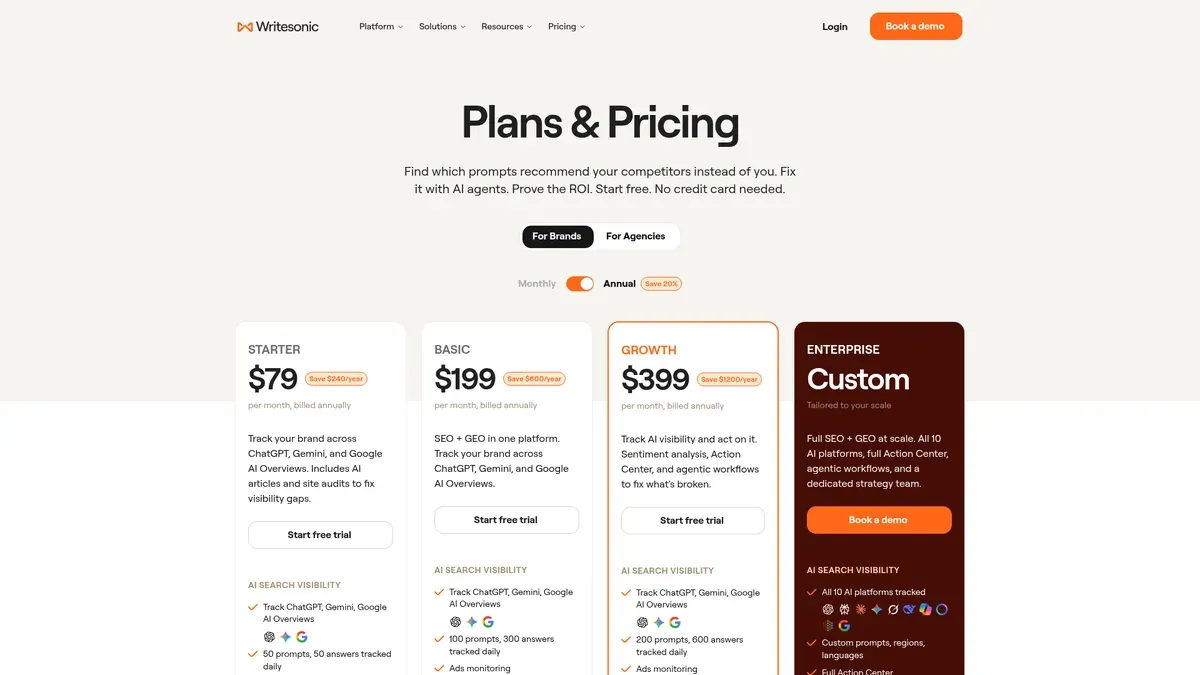
Writesonic goes broad and does it well. It tracks AI visibility across ten stated platforms at Enterprise, with Starter, Basic, and Growth covering ChatGPT, Gemini, and Google AI Overviews. Alongside that sit AI articles, site audits, and an SEO AI Agent that researches trends, competitors, keywords, intent, personas, and competitor gaps, then builds data-driven content plans and long-form articles.
The integration list is the real differentiator. Google Search Console, Ahrefs, WordPress, Sanity, Contentful, Contentstack, Drupal, Vercel, Cloudflare, Fastly, Akamai, GA4, Looker Studio, LinkedIn, YouTube, a Chrome extension, and a public API with webhooks. If you want AI-search data sitting next to CDN and analytics data, this is the shortest path.
Key features
- Ten-platform AI visibility at Enterprise, with prompts and answers tracked daily
- AI articles at 15, 25, and 50 per month on Starter, Basic, and Growth
- Site audits at 10, 20, and 50 per month, covering 100, 1,200, and 2,500 pages
- SEO AI Agent for research, planning, on-page and technical SEO
- 20+ native integrations plus REST endpoints and webhooks
Pricing: the public annual display shows Starter at $79/month, Basic at $199/month, and Growth at $399/month, with Enterprise custom. The page also describes self-serve starting from $99/month, so read the plan table carefully rather than the headline.
Honest limitation: breadth comes with plan gates. Ten-platform visibility, the full Action Center, custom regions and languages, and several advanced insights are Enterprise features. The SEO AI Agent documentation also marked publishing as Coming Soon, so confirm which agent and publishing functions are live in the plan you are quoted. Pick Writesonic over DeepSmith when a very wide integration and monitoring surface matters more than a tight visibility-to-production loop.
3. Scalenut

Best for: SEO-led teams that want clusters, briefs, optimization, and direct publishing at a low entry price.
Scalenut is the value play here, and it is a serious one. Automated keyword and content research runs on GEO. SERP-based clustering produces topic ideas, competitor outline analysis, and topical-authority plans. Cruise Mode drafts optimized content in your brand tone. The GEO scoring blends conventional SEO metrics with AI-readability signals, so a single score tells you whether a page is ready for both.
The practical parts are strong too. One-click fixes for on-page issues. Internal links pulled from your own domain. Existing-article optimization, content audits, and topic gaps. Plus and higher plans auto-publish to WordPress and Shopify, and the WordPress Publisher handles export, scheduling, and direct publishing.
Key features
- SERP-based keyword clustering and topical-authority planning
- Cruise Mode drafting plus GEO scoring for new and existing content
- One-click on-page fixes and domain-sourced internal linking
- WordPress and Shopify auto-publish on Plus and above
- Cannibalization analysis and unlimited workspaces on Professional
Pricing: monthly displays are $59 for Starter, $89 for Plus, and $199 for Professional, with annual-equivalent displays of $24, $36, and $80. VIP Service is custom. The pricing page does not state word limits for the public plans.
Honest limitation: the AI visibility is narrower than the SEO breadth. Starter and Plus list ChatGPT and Google AI Overviews, and Professional adds Perplexity. If the widest monitoring footprint is the point, this is not it. If SEO and GEO production depth at a low price is the point, Scalenut is hard to beat.
4. Frase
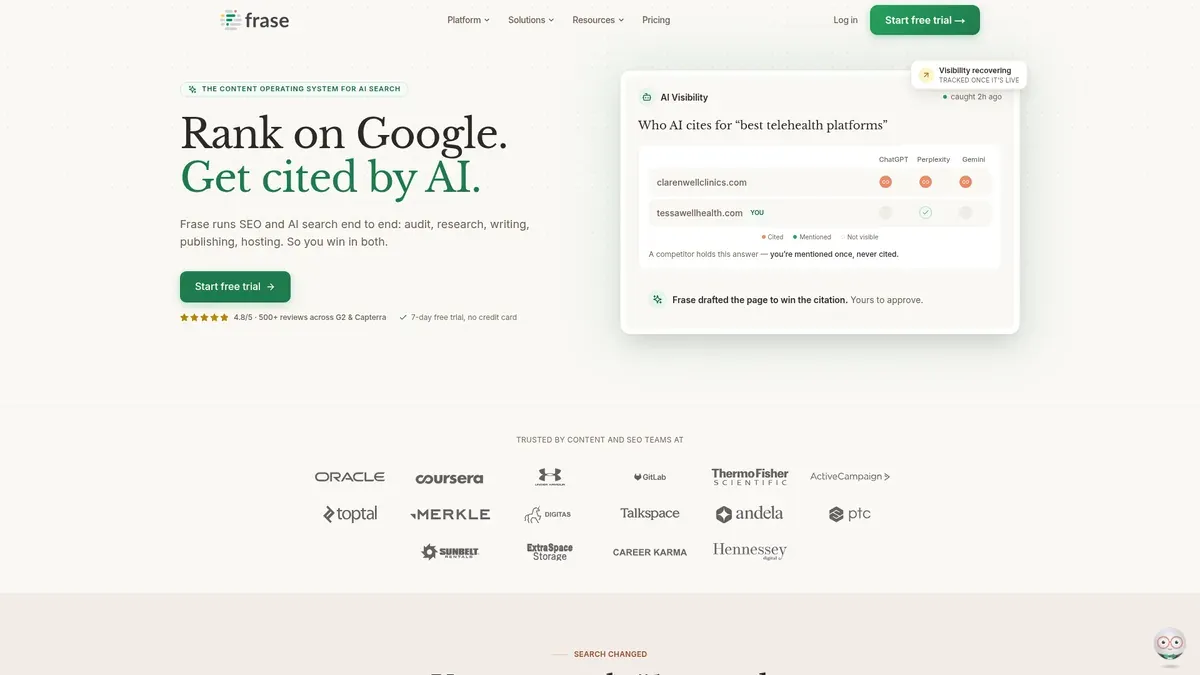
Best for: teams that want an end-to-end SEO and GEO loop with real page auditing.
Frase crawls your site page by page, scores SEO and AI readiness, and ranks fixes by impact. That audit-first framing is what sets it apart from the drafting-first tools. From there it researches live SERPs, competitors, content gaps, and unanswered questions, drafts in your voice, and carries brand and competitor context through the whole workflow.
Content Guard is the piece worth understanding. It watches a set of your pages, monitors rankings and traffic, and drafts revisions when a page slips. Paired with daily AI-citation and Share of Voice monitoring, it makes maintenance a scheduled job rather than a fire drill. Publishing goes to WordPress, Webflow, Sanity, Wix, or Frase's own hosting.
Key features
- Page-by-page site audit with impact-ranked fixes
- SEO and GEO scores plus AI citation and Share of Voice monitoring
- Content Guard page watching with automatic revision drafts
- Content calendar, internal-link suggestions, and AI crawler monitoring on Professional
- Google Search Console integration for real search-performance data
Pricing: Starter is $39/month billed yearly or $49 monthly. Professional is $103 or $129. Scale is $239 or $299. Enterprise is custom and adds white-label reports, SSO and SAML, an account manager, and API access. Every plan has a 7-day free trial with no credit card.
Honest limitation: platform coverage is tightly tiered. Starter is ChatGPT and Google AI, Professional adds Perplexity, and Claude and Gemini sit on Scale. Choose Frase over DeepSmith when page-level auditing and CMS or hosting flexibility matter more than an evidence-backed production queue.
5. Surfer
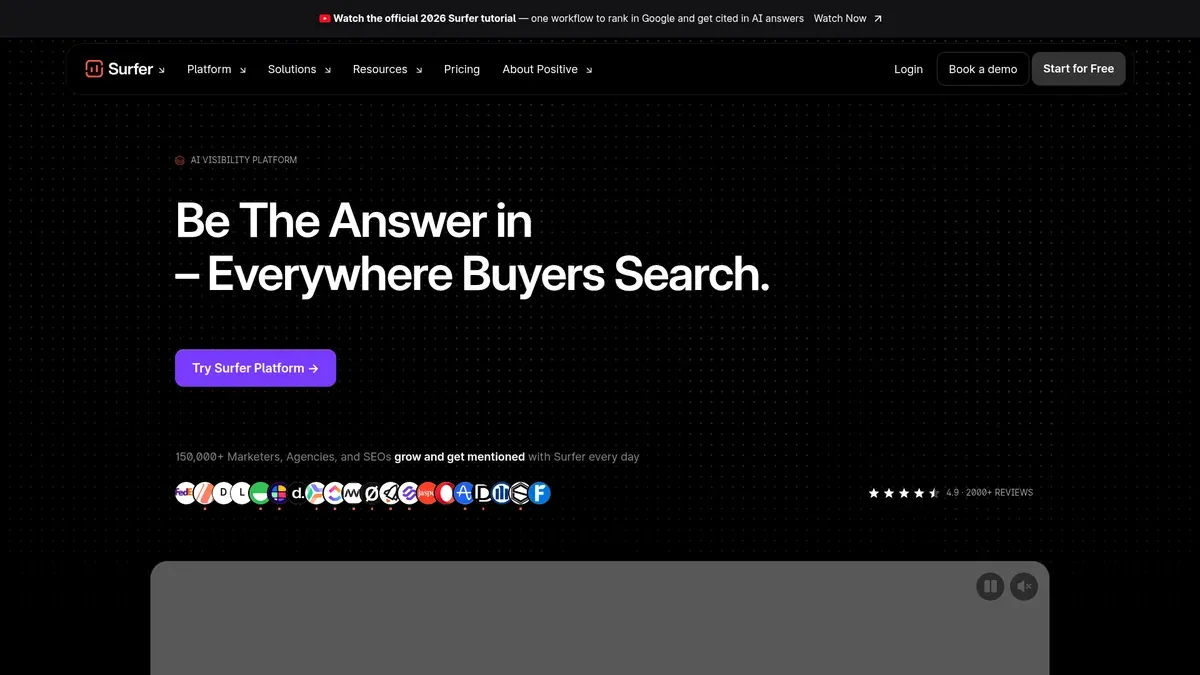
Best for: SEO specialists who want optimization precision above everything else.
Nobody on this list beats Surfer at telling you exactly what a page needs. The Content Editor analyzes 500+ ranking factors covering keyword optimization, entities, link equity, relevance, topic coverage, and topical authority, and the Content Score updates as you write. Outline Builder generates headings and questions. Topics finds ideas and content gaps from competitors. Auto-Optimize adds missing terms and sections, and Internal Linking finds anchors and inserts links for you.
Surfer has extended into AI-search visibility too, with messaging covering Google AI Mode, Google AI Overviews, Gemini, ChatGPT, Claude, and Perplexity. Integrations include Google Docs, ChatGPT, WordPress, Contentful, and Zapier, and the free WordPress plugin supports real-time guidelines, one-click export, and direct publishing.
Key features
- Content Editor across 500+ ranking factors with real-time Content Score
- Surfy for editing and rephrasing, with Custom Voice preserving tone
- Auto-Optimize and automatic internal linking
- Audits that identify underperforming content and prioritize recovery
- AI Search Analytics available as a separate product
Pricing: Discovery is $49/month, Standard is $99, Pro is $182, Peace of Mind is $299, and Enterprise is $999. AI Search Analytics is $158/month. Prices are displayed as monthly billed yearly unless stated otherwise, and the page does not publish annual totals.
Honest limitation: Surfer is an optimization tool that has added visibility, not a production system. There is no evidence-backed opportunity backlog or scheduled automatic production of the kind DeepSmith runs, and some publishing language carries "soon" dependencies, including Surfy Agent publishing at scale. Pick Surfer when improving page quality is the central problem and you already have a way to decide what to write.
6. Semrush
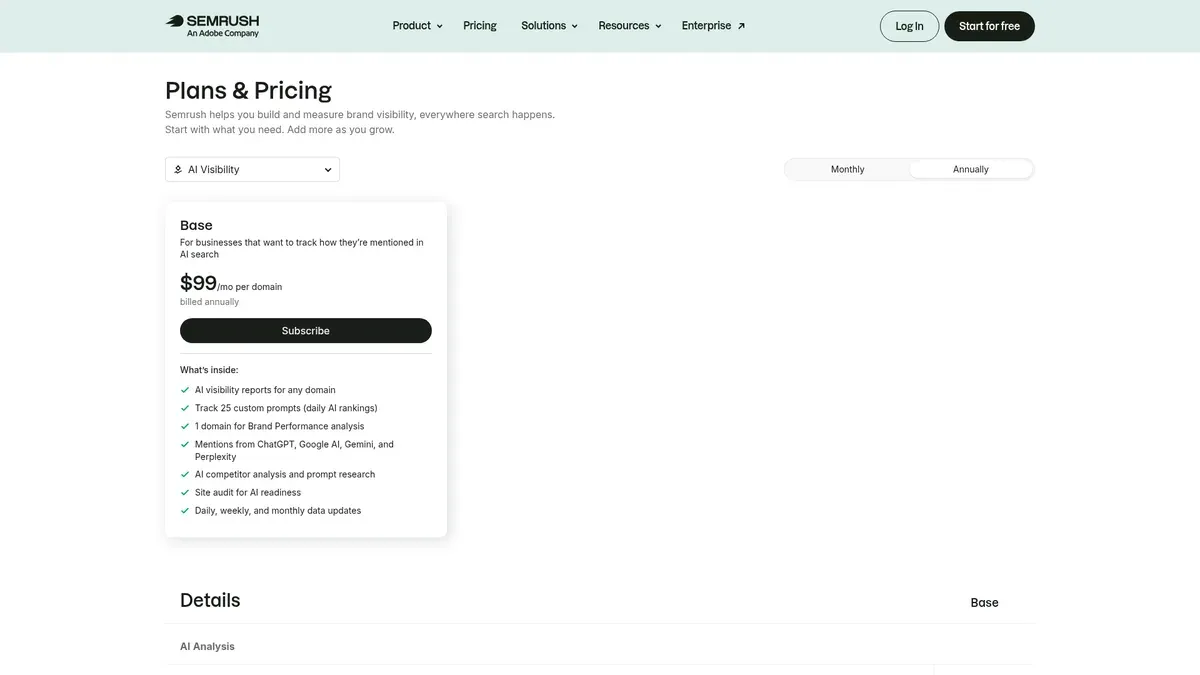
Best for: teams already invested in a broad SEO ecosystem.
Semrush brings the deepest conventional SEO bench on this list, and it has moved into AI search with a dedicated product. AI Visibility Base is $99 per domain per month billed annually and covers mentions from ChatGPT, Google AI, Gemini, and Perplexity, plus AI competitor analysis, prompt research, an AI-readiness site audit, and 300 reports per day with daily, weekly, and monthly updates.
Production lives in a separate Content Toolkit at $60/month after a 7-day free trial. That includes Topic Finder, an SEO Brief Generator, keyword research, SERP analysis, an AI Article Generator in 6+ languages, a Content Optimizer, an AI Search Optimizer, repurposing into social and email, and WordPress and Mailchimp publishing. Five SEO-boosted articles are included per month, with ten more available for $30.
Key features
- AI Visibility with competitor analysis, prompt research, and AI-readiness audits
- Content Toolkit for briefs, drafting, optimization, and repurposing
- WordPress, Mailchimp, and Canva integrations plus a Chrome extension
- SEO plans covering five websites and 500 keywords tracked daily
- Enterprise adds unlimited projects, custom prompt tracking, and multi-brand visibility
Pricing: AI Visibility Base is $99/domain/month billed annually. Content Toolkit is $60/month. The broader SEO and AI Search plans list an SEO plan at $139/month or $117.33 billed annually, Starter at $199 or $165.17, Pro+ at $299 or $248.17, and Advanced at $549 or $455.67, with a free tier at $0. Semrush does not publish a combined price for Content Toolkit plus AI Visibility.
Honest limitation: you may be assembling the platform yourself. Visibility and production are priced and packaged separately, and the buying picture is less simple than a single subscription. That is fine if you already live in Semrush. It is friction if you want one joined workflow.
7. Jasper
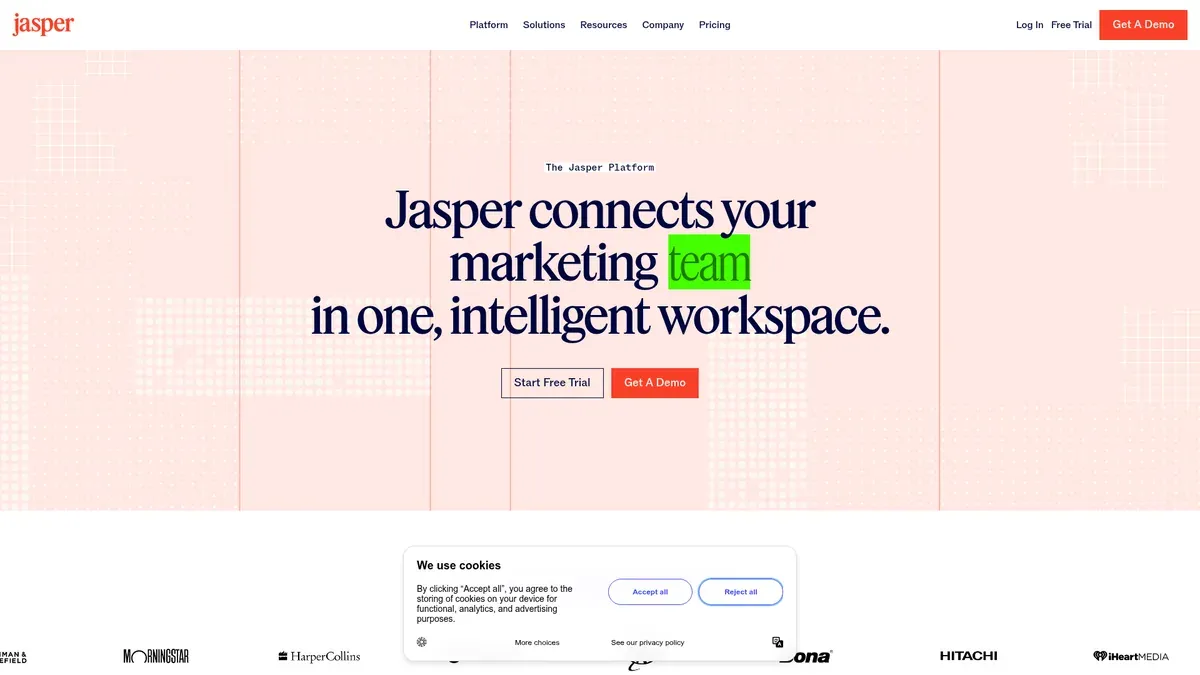
Best for: larger marketing teams where brand governance matters more than SEO depth.
Jasper's pitch is one workspace connecting marketing teams, brand, content, workflows, agents, knowledge, and rules. Pro includes Canvas for on-brand content creation, agents for core marketing workflows, two Brand Voices, five Knowledge assets, and three Audiences. Business is where the platform really opens up: complex workflows including GEO, translations, and deep research, a no-code Custom AI Agent builder, Jasper Grid for scaled content execution, unlimited IQ customization, API access, admin controls, and dedicated account management.
The enterprise credentials are genuine. SOC 2 Type II, GDPR, CCPA, SSO and SAML 2.0 with Okta, Azure AD, and Google Workspace, encryption in transit and at rest, US-based data centers, and a stated policy that customer data is not used to train AI models. If procurement is the hard part of your buying process, that list matters.
Key features
- Canvas plus marketing agents for campaign workflows
- Brand Voices, Knowledge assets, and Audiences as reusable governance
- Jasper Grid for systematic scaled content execution on Business
- Gmail, WordPress, Docs, HubSpot, and LinkedIn connections plus API
- Enterprise security and admin controls
Pricing: Pro is $69/month or $59/month billed yearly, with one seat. Business is custom and begins with a 12-month commitment. A 7-day free trial of Pro is offered. Business credits can apply to usage-based features such as GEO Hub reports and Agents.
Honest limitation: SEO and AI-search capability is plan-dependent and less clearly exposed than the brand tooling. GEO, complex workflows, and API access are Business territory, and GEO Hub and Agents can consume credits. Choose Jasper when governance and campaign collaboration outrank a direct path from AI-search gaps to scheduled articles.
How to choose the right Allable alternative for your team
Not sure where to start? Start with the job that is currently costing you the most time.
If you cannot answer "where do we show up in AI answers?" pick DeepSmith. The measurement feeds the backlog, and the backlog feeds production, so the reporting you build also decides what you publish.
If integration surface is the constraint, pick Writesonic. Nothing else here connects CDN, analytics, CMS, and AI-search data as widely.
If budget is tight and the work is SEO-led, pick Scalenut. The published entry price is the lowest on this list and the cluster-to-publish workflow is complete.
If your problem is old pages decaying, pick Frase. Audit-first plus Content Guard is built for maintenance.
If your writers need better guidance, not more volume, pick Surfer. The Content Editor is the most precise optimization tool here.
If you already run Semrush, stay. Add the pieces you need rather than migrating a whole team.
If procurement and brand governance are the gate, pick Jasper. Nobody else on this list is built for that first.
One practical tip before you trial anything. Write down the three questions you want answered in ninety days. Something like "are we cited for our top ten buyer prompts?" or "can we publish twelve pieces a month without hiring?" Then trial only the tools that answer those three. A demo that impresses you on a fourth question is a distraction.
Ready to see your own numbers? Start a free DeepSmith trial and get real visibility data and real drafts in seven days, with no contract.