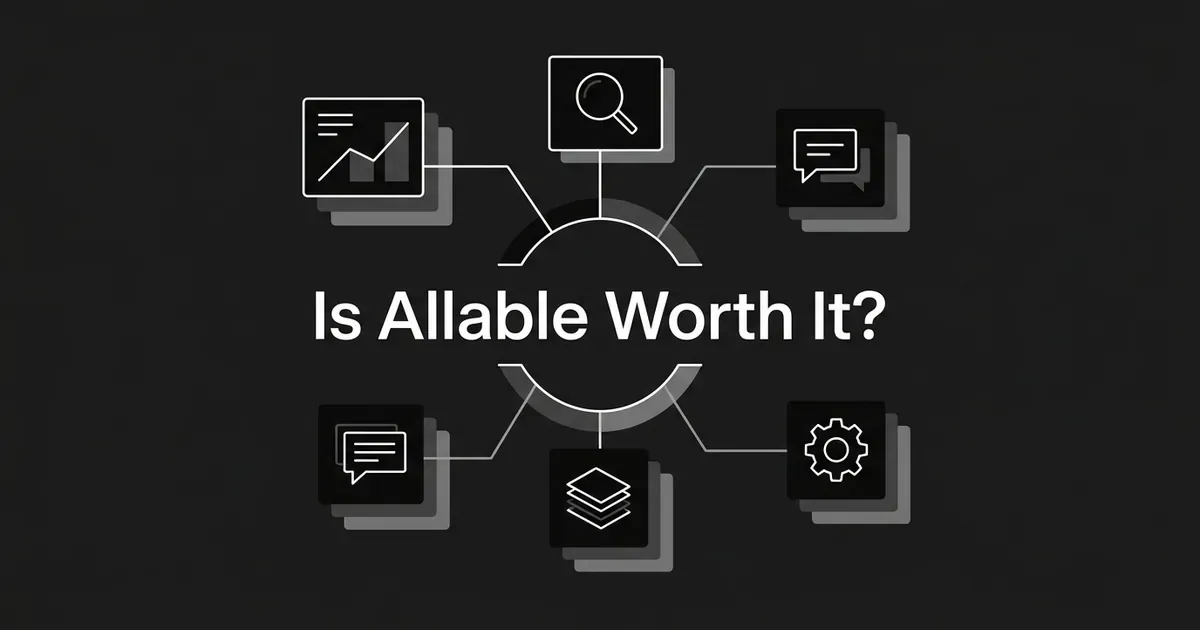
If you're weighing an all-in-one AI content tool, this Allable review looks at what it actually covers and what's still thin. Allable AI marketing bundles SEO research, content production, paid ads, social posts, analytics, images, and publishing into one app. It's built by a company called Flexyma, and the pitch is simple: one workspace instead of fifteen open tabs. This review judges it on breadth versus depth, Allable pricing, integration maturity, and how much of the "publish-ready" promise holds up once you look past the homepage.
The short version: Allable is worth testing if your main problem is a fragmented stack and you'll actually use several of its modules together. It's a weaker fit if you need deep SEO data, mature integrations, proof that its output can go live without review, or prompt-level tracking of how AI engines cite your brand, which is the half something like DeepSmith covers alongside the content that closes those gaps. The seven-day trial is there for exactly this reason, use it before you commit.
What Allable Is and Who Makes It
As an Allable AI marketing workspace, it positions itself as a single application for SEO, PPC, social, strategy, analytics, content creation, and publishing, run by a coordinated team of AI agents instead of a stack of separate tools. It's made by Flexyma, co-founded by Martin Haring and Martin Janeček. Haring is described as having run the marketing teams the product now automates, and Janeček's stated belief is that software should feel like a teammate rather than another dashboard to check.
The founders point to a familiar problem: a tab for keywords, a tab for ads, a tab for social, a tab for analytics, and a lot of manual work just keeping them aligned. Allable's answer is to put planning, execution, and publishing into one workspace so the agents share context instead of starting fresh each time.

A few things worth flagging before you go further. Allable's public pages say thousands of SEOs, PPC specialists, and agencies have replaced their stack with it, that it can replace fifteen or more tools, and that users recover two full days a week. These are marketing claims, not numbers anyone has independently checked, so treat them as positioning rather than proof. The public material also doesn't say much about the company's size, funding, or how long it's been around, so there isn't a lot to go on beyond what the product itself does.
What Allable Does
The feature list is long. On the SEO side, Allable names keyword research, a performance analyzer, competitor analysis, internal linking, content refresh, meta-tag generation, technical audits, rank tracking, backlink analysis, and even GEO optimization for AI search. It says it uses live keyword, SERP, and volume data rather than pure AI estimates, which matters if you've been burned by tools that guess at numbers.
The content side is where the workflow gets more specific. You enter a target keyword, Allable builds a brief with competitor gaps, a recommended structure, tone notes, and entities to cover, and your project's brand voice settings get applied automatically. From there the writer drafts against the brief, the draft gets scored against the keyword while you edit, and your team reviews and publishes. That's a more connected loop than a plain writing assistant that starts from a blank prompt every time.

Beyond writing, Allable covers paid ads (Google Ads setup, Meta Ads creation, audience research, budget allocation, A/B testing), social (post creation, hashtag research, calendars, direct publishing), a cross-channel analytics dashboard, an AI image generator that picks between models like DALL-E 3, Flux 1.1, Ideogram 3, and Stable Image, and natural-language document editing where you describe a change and the system applies it.
The catch is that a long feature list doesn't tell you how deep each piece goes. Allable doesn't publish the size of its keyword database, exact rank-tracking refresh rates, or technical-audit checks, and it doesn't offer a controlled comparison of its drafts against human-written content or a measured editing-time reduction. Some of the automation claims are strong too. The homepage says Allable can monitor PPC campaigns, apply negative keywords, remove overlap, and pause campaigns automatically, but it doesn't explain the approval safeguards, audit logs, or rollback behavior behind that. If you run paid media, that's worth testing carefully rather than trusting outright.
Integrations: What's Live and What's Coming
This is the part of an Allable review that's easy to skim past and shouldn't be. The public integrations directory confirms four live connections: WordPress for publishing, Google Ads for campaign optimization, Google Analytics 4, and Google Search Console. Everything else, and there's a lot else, is marked coming soon: Meta Ads, Twitter/X, Instagram, Facebook, Discord, Telegram, Slack, Notion, Airtable, Salesforce, HubSpot, Shopify, and more.
There's also an inconsistency worth calling out. The homepage lists Meta Ads creation and broad social publishing as features, but the integrations directory shows Meta Ads, Instagram, Facebook, and X as not yet connected. So the feature exists in the product's description before it exists as a live connection everywhere the copy implies. If your workflow depends on any of the coming-soon integrations, don't assume day-one availability.
Pricing and Plans
Allable pricing shows individual plans in euros, with a currency toggle for dollars. Pro runs €83 a month, Business €166, and Scale €333, or €990, €1,990, and €3,990 billed yearly (roughly two months free on the annual option). The same pricing comparison table also shows $99, $199, and $399 as the monthly USD price points. Credits scale with the plan: 2,500 for Pro, 6,000 for Business, and 15,000 for Scale, and unused credits roll over. Each paid individual plan includes one user, three projects, and three free guest seats.

Allable pricing gets murkier once you look at the agency tier. The main pricing page describes an Agency tier built for client work (three seats, extra seats at €9 each, unlimited projects, nine free guest logins), but doesn't clearly publish a complete rate card for every Agency, Growth, and Scale level. A separate Allable page for content teams quotes €199 a month for Agency and uses that number in a stack-cost comparison, but that figure isn't confirmed on the pricing page itself. If agency pricing matters to your decision, verify the current number directly before you commit.
Credits are spent per action, and the cost changes with the length and complexity of what you're asking for, so a plan's monthly credit total doesn't translate cleanly into a fixed number of articles or campaigns. Top-ups run €0.05 per credit (500 for €25, 2,000 for €100, 5,000 for €250). Every paid plan starts with a seven-day trial with full access and 750 credits, a card is required upfront, and the plan you picked starts billing automatically on day seven if you don't cancel. There's also a separate free tier mentioned in the terms of service, 30 credits a month with no rollover, which is a different offer from the paid trial and easy to confuse with it.
One more detail that affects your total spend: cancellation stops future billing but doesn't refund what you've already paid, even mid-cycle. And each workspace is billed as its own subscription, so running multiple brands or clients through separate workspaces multiplies the cost rather than sharing one plan across them.
Honest Pros and Cons
What Allable does well. It genuinely covers a lot of ground in one place: SEO, content, paid ads, social, analytics, images, and publishing, which can cut down on the tool-switching that eats a lot of a marketing lead's week. The brief-to-draft-to-score-to-publish workflow is more structured than a generic writing tool, and storing brand voice at the project level is a real fix for the freelancer-drifts-off-tone problem. The agency setup (unlimited projects, free guest logins, separate client visibility) is built with client work in mind, and the seven-day full-access trial with 750 credits gives you a real test drive before paying.
Where it falls short. The feature list is broader than the documentation backing it up, so you can't assume every named feature is as deep as a specialist tool built around just that one job. Many of the integrations you'd actually rely on are still coming soon, and the Meta Ads and social-publishing claims don't fully match what's live today. Credit consumption is variable enough that predicting your monthly capacity takes actual usage, not just reading the plan table. Agency pricing isn't fully transparent, refunds aren't available after billing, and there isn't much independent evidence yet on how good the output actually is once you get past the marketing copy. The terms also note that Allable may delete your data after a subscription ends, so exporting anything important before you cancel is worth remembering.
Who Should Use Allable, and Who Should Skip It
Allable is a reasonable trial candidate if you're a solo marketer or small team trying to run SEO, content, ads, social, and analytics without juggling five logins, or an agency that needs guest access and multi-client visibility. It also fits content teams that want keyword briefs, brand voice, drafting, and SEO scoring connected in one flow, as long as someone reviews the output before it goes live.
It's a weaker fit if you need independently benchmarked SEO data, granular PPC controls with documented rollback safeguards, or integrations with the CRM, commerce, or project-management tools your team already runs on, since a lot of those are still marked coming soon. Enterprise buyers who need governance documentation, audit trails, or service-level guarantees won't find that level of detail in the public material either. And if your main pain is one specific job rather than the whole marketing operation, a specialist tool built for that one job will probably out-perform a piece of a bundle.
Alternatives to Consider
If Allable's breadth is the appeal but its depth or integration maturity is the worry, these are the options most often weighed against it.
- Semrush. The established choice when SEO and paid-search depth matter more than consolidation, with a keyword and backlink index that Allable does not publish comparable numbers for.
- Jasper. Positioned around brand-voice content at volume across marketing and ad copy, which is the closest match if writing output rather than the whole marketing operation is your bottleneck.
- Surfer SEO. Focused on SERP-driven content optimization and scoring, the specialist version of the brief-and-score loop Allable bundles into its wider workspace.
- DeepSmith. DeepSmith is the alternative on a narrower axis than Allable's: tracking how AI engines answer questions about your brand and producing the content that earns citations, not PPC, social, or cross-channel analytics. It tracks mention rate, citation rate, and share of voice per prompt across engines including ChatGPT, Perplexity, and Gemini, shows which competitor pages win the citations you don't, and produces publish-ready articles from that same context. Worth a look if AI-search visibility is the specific piece your stack is missing, not as a replacement for Allable's breadth.

Is Allable Worth It?
Allable earns a look if the problem you're actually solving is a fragmented stack and the coordination cost of keeping several separate tools in sync. Worth testing for content teams that want briefs, brand voice, SEO scoring, and publishing connected in one place. Worth considering for agencies if the guest and project model fits your client roster and you confirm the Agency pricing directly before signing.
It's a harder case if specialist depth, mature integrations, or independently verified output quality matter more to you than convenience. The coming-soon integration list is long enough that the all-in-one promise isn't fully delivered yet, and the review evidence doesn't support treating Allable as a drop-in replacement for every dedicated tool in your stack. The honest read is conditional: test it against your actual workflow during the trial, and don't take the feature list at face value until you've seen what it does with your own keywords, your own brand voice, and your own campaigns.
Where DeepSmith Fits, If At All
If your unmet need sits specifically on the AI-search side, tracking whether AI engines like ChatGPT and Perplexity actually cite your brand, and producing the content that closes those gaps, that's a narrower problem than Allable's broad marketing bundle is built to solve. Allable names GEO optimization but its public material documents SEO, PPC, social, analytics, and publishing rather than a prompt-level AI visibility system, and that is the exact axis where DeepSmith is the alternative. DeepSmith tracks mention rate, citation rate, and share of voice for the prompts you choose, shows which of your pages AI actually cites and which competitor pages take the rest, and produces publish-ready articles from that same context to close the gaps it finds. It's worth a look specifically if AI-search visibility is the piece missing from your stack, not as a wholesale replacement for the PPC, social, and cross-channel work Allable covers.
Ready to see where you actually stand in AI search? Start a free trial and check your own visibility gaps in minutes.