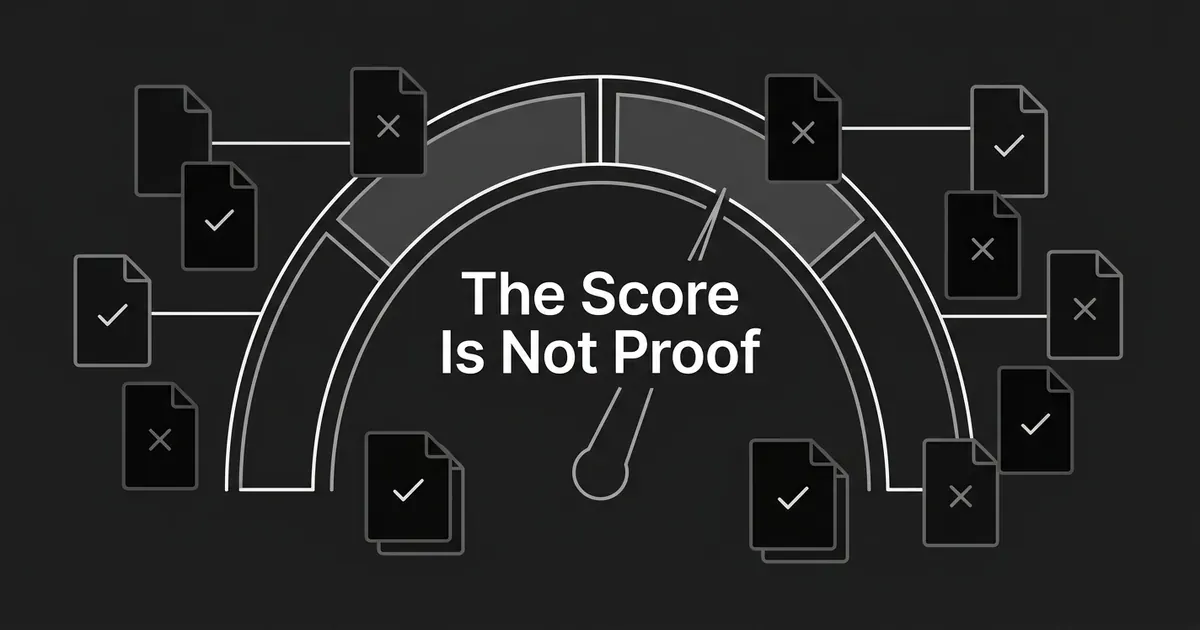
Someone pasted your article into a detector and it came back "92% AI." Your stomach dropped. Take a breath, because that number is not what you think it is.
Here is the honest picture on AI detector accuracy in 2026: these tools can sort clearly human from clearly machine text under the narrow conditions they were tested on. They fall apart outside those conditions. And the way they fall apart is not random, which is the part that should worry you most.
This piece walks you through what the studies actually measured. You will see where the numbers come from, why a high score and a high error rate can live in the same tool, and how to read any result you get without overstating it. No hand-waving, no vendor marketing, just the evidence and what it can honestly support.
You do not need to become a statistician. You just need to know which questions to ask.
The short answer: a score is a signal, not proof
An AI detector does not watch anyone write. It reads finished text and guesses whether that text looks like patterns it associates with machine generation. That is a very different job from establishing who typed the words.
So the short answer is this. Detectors sometimes work as narrow classifiers, on the models, genres, languages, and text lengths they were tested against. They are not reliable enough to serve as standalone proof that a person used AI.
That answer frustrates people on both sides. Ask "do AI detectors work" and you will find loud voices at both extremes. If you wanted "detectors are perfect," the evidence says no. If you wanted "detectors are useless," the evidence says no to that too. Some tools do useful discrimination in the right conditions.
The trap is treating a conditional result as a universal one. A detector that scores well on English academic abstracts written by one model tells you almost nothing about a marketing blog post written by a different model. Same tool, different world.
Your action for this section: before you react to any score, write down one sentence about the text that produced it. What language, what genre, how long, and was it written from scratch or edited from something else? That sentence is the context every number below depends on.
What an AI detector score actually measures
A detector is a classifier. It looks at text and puts it in a bucket. That is all.
The two errors it can make are not the same error, and this is the single most useful thing to understand. A false positive is human writing wrongly labeled AI. A false negative is AI writing that slips through unnoticed. One damages a person's reputation. The other just misses something.
Here is the part vendors rarely lead with: a detector can improve one of those numbers by getting worse at the other. Lower the threshold and you catch more machine text while flagging more real people. Raise it and fewer humans get burned while more AI text passes. There is no setting that makes both perfect.
That is why a single "accuracy" figure can hide a mess. AI detector accuracy is just the share of decisions matching the known labels in one specific test set. It is not a permanent property of the tool. Always ask for the false-positive rate and the catch rate separately.
One more thing worth unlearning: a percentage is not a probability of authorship. Different tools report different things. One gives you a classifier confidence value, another gives the share of qualifying text it assigned to an AI-like category, another gives a label after a threshold was applied. A score of 80 from one tool is not the same quantity as 80 from another, and neither one means an 80% chance that a named person used AI.
Base rates matter too. If genuine AI writing is uncommon in whatever you are screening, even a low false-positive rate can make a real share of your flags wrong. That is arithmetic, not cynicism.
Your action for this section: when a tool gives you a number, find out what kind of number it is before you interpret it. Confidence, percentage of text, or category. If the tool will not tell you, that is your answer about how much weight it deserves.
So do AI detectors work? What independent tests found
Researchers have run this exact experiment many times, and the results scatter widely. That scatter is the finding.
A 2023 evaluation published in the International Journal for Educational Integrity tested 12 publicly available tools plus Turnitin and PlagiarismCheck, running 54 test cases through each for 756 tests in total. Human-written English text was usually identified with accuracy above 80%. AI-generated text was often caught only around 50%. Every single tool scored below 80% overall accuracy, and only five cleared 70%.
The error spread in that study is the part to sit with. False positives ranged from 0% for one tool up to 50% for another. False negatives ranged from 8% to 100%. Same test, same day, wildly different behavior.
The largest robustness benchmark in this evidence is RAID, presented at ACL in 2024. It is big: roughly 6.2 million generations across 11 generators, eight domains, 11 adversarial conditions, and four decoding strategies. Twelve detectors were benchmarked against it, both open-source and commercial.
RAID found what you might guess and then quantified it. Detectors struggled to generalize to models and domains they had not seen. One detector could exceed 95% accuracy on five domains generated by GPT-2, then rarely clear 60% on those same domains when a different model wrote the text. Nothing about the topic changed. Only the generator did.
RAID also calibrated its main results to a 5% false-positive rate on human text, and that detail matters more than any headline. The paper warns directly that strikingly high accuracy claims can be produced at similarly high false-positive rates. Few detectors in the benchmark could operate below a 1% false-positive rate at all.
The most current evidence points the same way. A study published in February 2026 evaluated 192 English texts across four authorship categories, including authentic EFL student writing and hybrid compositions, using Turnitin and Originality. Turnitin scored 0.86 accuracy on Humanities texts and 0.51 on Science texts. Originality scored 0.96 and 0.58. The link between detector performance and genre was statistically significant for both systems.
Read those four numbers again. Same tools, same study, and accuracy nearly doubles depending on what the text is about.
A 2025 study of journal abstracts adds the other half of the picture. GPTZero reached 97.22% overall accuracy in a scenario with clean human-versus-AI ground truth, while ZeroGPT managed 64.35% and DetectGPT 54.63%. The error rates behind those middle numbers were rough: ZeroGPT showed a 16.67% false-positive rate and a 45.14% false-negative rate, DetectGPT 31.94% and 52.08%.
That 97.22% is real. It is also abstract-only, with clean binary ground truth, under one study's conditions. Any AI content detector test tells you about the conditions it ran under and nothing more.
Even the humans do badly. In a 2025 survey experiment, 63 university lecturers judged 200 to 300 word excerpts and correctly recognized 57% of AI texts and 64% of human texts. Professional-level AI text was correctly classified by fewer than 20% of them. The comparison between the human judges and the detectors was not statistically significant.
So "trust your gut instead" is not the lesson here. Neither a score nor a quick impression proves authorship.
Your action for this section: whenever someone quotes an AI content detector test at you, ask three questions. Which tool, which text, and what false-positive rate was it calibrated to? A number without those three is not portable.
Why AI detection false positives land unevenly
This is the section that should change how you use these tools.
AI detection false positives are not spread evenly across writers. They concentrate. And the group they concentrate on most clearly in the research is people writing English as a second language.
One widely cited 2023 study ran seven GPT detectors over 91 human-written TOEFL essays. The average false-positive rate was 61.22%. Every one of the seven detectors unanimously flagged 18 of those 91 essays, or 19.78%, as AI-authored. At least one detector flagged 89 of the 91, which is 97.80%. The same study's comparison set of US eighth-grade essays came back with a 5.19% average misclassification rate.
Those essays were written by humans. All of them.
Then the researchers did something clever. They had ChatGPT enhance the word choice in the TOEFL essays to sound more native. The average false-positive rate fell from 61.22% to 11.77%. Only one essay out of 91 stayed unanimously flagged. Running it the other direction, simplifying the US eighth-grade essays to read more like non-native writing pushed misclassification from 5.19% up to 56.65%.
Nobody changed who wrote anything. They changed how the sentences sounded. The detectors followed the style, not the author.
The proposed mechanism is linguistic regularity. Writing with a narrower range of word choices looks more predictable to a model, and predictability is one of the things these systems lean on. Treat that as an observed pattern with a plausible explanation, not as a rule that applies to every writer or every tool.
Style is not the only axis. False positives also move with:
- Genre and discipline. The 2026 study's Humanities and Science gap is the clearest recent example.
- Length. OpenAI reported its own classifier was very unreliable below 1,000 characters.
- Predictability. OpenAI also pointed out that some text cannot be attributed to anyone. A list of the first 1,000 prime numbers is identical no matter who produces it.
- Author group. The 2025 abstract study found the direction generally favored native-author text across all three tools it evaluated.
- Mixed authorship. More on this in a moment, and it is a genuine hole.
There is one more myth worth killing. Agreement between detectors is not confirmation. If several tools key on related surface signals, they can share the same blind spot and produce the same wrong answer together. Eighteen human essays flagged unanimously by seven tools is the proof. "Three detectors agreed" and "the authorship was proven" are not the same sentence.
Your action for this section: if your team writes in English as a second language, or works in a discipline with heavily conventional prose, assume elevated false-positive risk before you run anything. Do not let a score be the first thing anyone learns about a colleague's work.
Why editing and small changes break detection
Detection is fragile in a way that surprises people. Modest changes to text can move a detector's output a long way without changing what the text says.
Across the studies, this shows up again and again. The 2023 multi-tool evaluation found paraphrasing significantly lowered accuracy for five of the tools it tested. A reliability paper that stress-tested detectors rather than assuming cooperative input found that recursive paraphrasing significantly reduced detection rates while often only slightly degrading the quality of the writing.
RAID tested this systematically across paraphrase, synonym swaps, misspelling, homoglyphs, whitespace, and article deletion. The effects were large and specific to each detector. Metric-based methods could lose as much as 36.1% when a small share of words were swapped for synonyms. Every detector except one was sensitive to homoglyph substitution. One whitespace condition could push detectors toward labeling everything positive or everything negative.
Not every perturbation lowered every score, which is its own kind of warning. Some conditions raised a particular detector's benchmark number because the change shifted the sample distribution. A system whose output moves unpredictably when you nudge the input is not measuring what people assume it measures.
I am describing robustness failures, not writing you a recipe. The point is not that you should go modify text to pass a detector. The point is that a score which flips on a paraphrase was never solid enough to end an argument about authorship.
Then there is the hole underneath all of this: hybrid writing.
Real work is rarely all-human or all-machine. People brainstorm with a model, accept a grammar suggestion, translate a paragraph, rewrite one weak section. A detector that answers "is this passage AI" is solving a different problem from "how much assistance happened here." Both recent studies that tested mixed authorship found trouble. One used a fixed 50/50 hybrid category and reported both systems had difficulty with it. The other found one tool labeled more than half of AI-assisted abstracts as 0% AI across most author and discipline groups.
A binary score can look precise while confidently answering the wrong question.
Your action for this section: stop asking "did AI touch this" and start asking "what did the process look like." Process evidence is drafts, notes, sources, revision history, and a conversation. That is the thing a detector cannot see, and it is the only evidence that survives scrutiny.
Can you trust a score in practice?
Yes, in a limited role. No, as a verdict. Let me make that practical.
A detector score is fine as triage. It can tell you where to look first when you have more text than time. What it cannot do is carry the weight of a decision that affects someone's job, grade, or reputation.
Here is a short checklist you can actually use. Work down it before you act on any result.
- Name the number. Confidence value, share of qualifying text, or category label. They are not interchangeable.
- Name the conditions. Language, genre, length, model family, and the date the tool was evaluated.
- Split the errors. Get the catch rate and the false-positive rate separately. Never accept "accuracy" alone.
- Check the threshold. A result calibrated at 5% false positives is a different result from one calibrated at 1%. A vendor's reporting threshold is a product choice, not a law of nature.
- Keep scores tool-specific. Do not average across detectors, and do not assume 70 here equals 70 there.
- Watch for confounds. Non-native English, EFL writing, conventional academic prose, short text, code, lists, and predictable sequences all deserve extra care.
- Never let it stand alone. A score can start a fair review. It cannot finish one.
- Raise the bar with the stakes. If a real consequence is on the table, corroborate with process evidence. A second detector is not corroboration, because two tools can fail for the same reason.
One note on vendor numbers, since you will run into them. Turnitin has publicly stated a document-level false-positive rate of less than 1% for documents where its system identifies 20% or more AI writing, and its own guidance warns that false positives happen more often when the reported percentage sits between 0% and 19%. That is a company-reported claim with its own test conditions. It can be true at the same time as a 61% false-positive rate in a different population, because those are different populations. Report the provenance of every number, including that one.
And remember what happened to the most transparent detector of all. OpenAI's own classifier correctly identified only 26% of AI-written text on an English challenge set while mislabeling human text 9% of the time. The company recommended it for English only, called it unreliable on code, and withdrew it in July 2023 because of low accuracy. That is not a number to quote as "26% accurate." It is a documented example of an organization publishing its own failure plainly.
Where this leaves your content team
If you are asking about detectors because you want your content to be trusted, the score was never the real goal. The goal is work that holds up: accurate claims, real sources, a point of view a reader recognizes, and a process you can describe out loud.
That is worth saying because it changes where you spend your effort. Chasing a number that flips on a paraphrase is not a quality strategy. Grounding your work in real research and your own brand context is.
This is the part of the problem DeepSmith was built for. It produces research-grounded, on-brand articles from your stored product, persona, and voice context, so what you publish is accurate and sounds like you, then it tracks how AI engines actually describe and cite your brand. It is not a detector and it does not score text for AI probability. It is the other half of the job: making the content genuinely good, and knowing whether it earned any visibility.
If you want to see what that looks like on your own site, start a free trial and get real data and real drafts before you pay.
One last time, because it is the whole piece in a sentence. A detector can sound certain without being certain. Read every score as a conditional signal, ask for its error trade-offs, and never let it be the only thing you know.