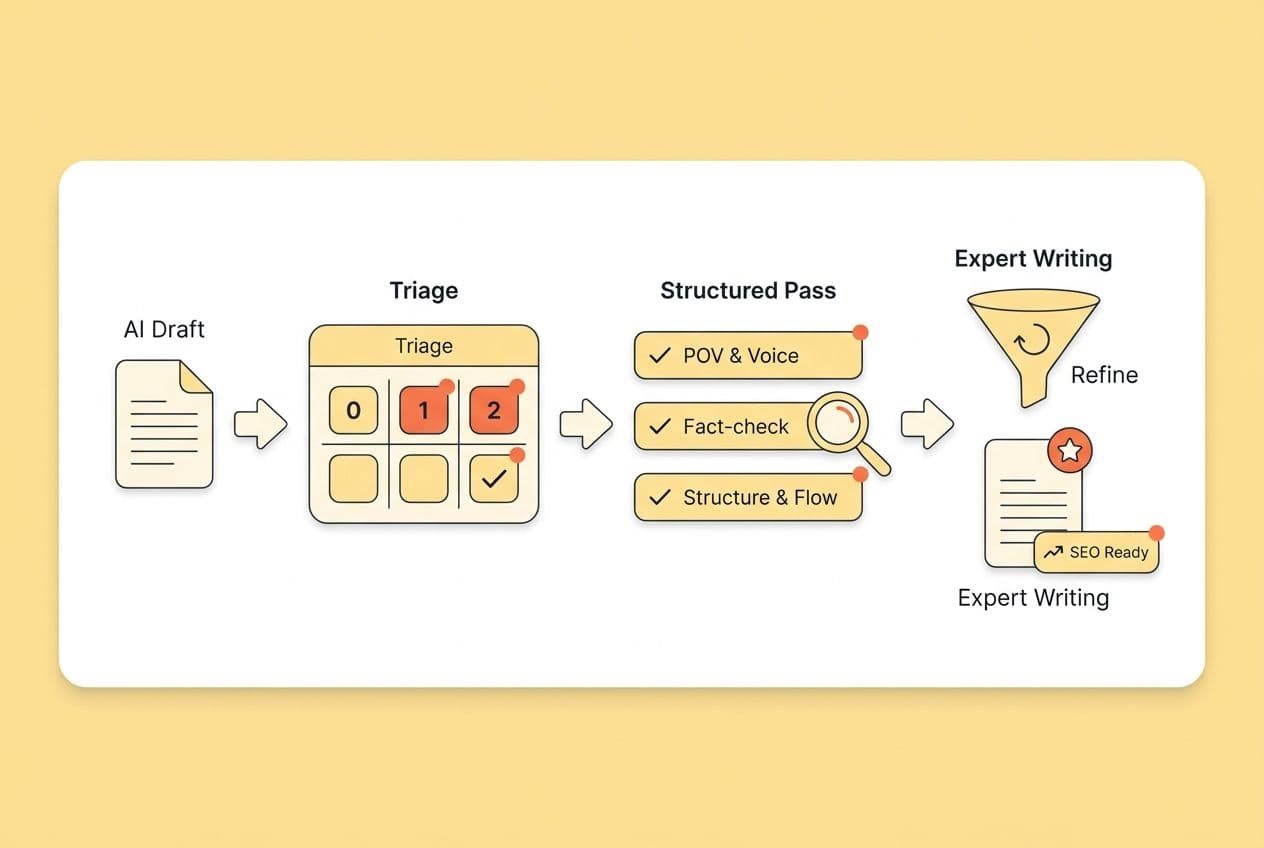
That sequence is everything. Each pass clears the way for the next one. If you do them out of order, you’ll spend an hour polishing sentences you should have deleted on minute one. Trust me, I’ve been there.
Here’s what that looks like when you’re the one who has to ship the "last 40%."
You paste the AI draft into a doc. It looks fine, structurally. Then you actually read it. The intro is a generic platitude. Three paragraphs in a row say the same thing. There’s a statistic from “a 2022 study” with no link. No internal links. The tone is a perfect copy of a corporate newsletter from 2019. You try to fix one thing, but it breaks another. An hour goes by. You’re not sure if you’ve improved it or just moved the problems around. And your boss wants the post live by Friday.
Sound familiar? This article is the system I wish I had five years ago. Stick with me, and you’ll get a decision gate for when to edit or restart, a pass-by-pass checklist you can use on every draft, and a team workflow that doesn't fall apart when you bring in freelancers.
When Is an AI Draft Worth Editing vs. Rewriting from Scratch?
First rule: don't commit to editing a bad draft just because it exists. A low-quality draft is a cognitive trap. You’ll spend more energy trying to fix its broken structure than it would take to build the right one from scratch.
This little scorecard is our team’s 10-minute test to decide whether a draft is worth our time.
Score the draft across five dimensions (0–2 each, for a total of 10):
| Dimension | 0 | 1 | 2 |
|---|---|---|---|
| Intent match | Wrong query/buyer stage | Partially aligned | Directly answers the target query |
| Structure | Sections repeat or contradict | Minor redundancy, fixable | Clean H2 logic, clear argument spine |
| Specificity | All generic claims | Mix of specific and vague | Concrete examples throughout |
| Accuracy risk | Multiple dubious stats/facts | A few claims to verify | Mostly verifiable, low hallucination risk |
| Voice fit | Completely off-brand | Noticeable drift, patchable | Close to your default style |
Score 7–10: Edit it. The foundation is solid. You’re mostly polishing, adding your expertise, and sharpening the voice.
Score 4–6: Proceed with caution. Before you commit, figure out what’s actually salvageable. You might reuse a few strong paragraphs and rebuild the rest around them.
Score 0–3: Restart. Don’t even think about it. The draft is actively fighting you. Rewriting from a better outline will be faster than trying to patch this broken foundation.
A few tell-tale signs we learned to spot the hard way:
Kill signals (restart immediately): The angle is totally wrong for the reader. The "facts" feel invented. Three or more sections are just rephrasing each other. The tone is so off that every single line needs to be rewritten. The thesis is just gone.
Keep signals (this is worth editing): The core argument is correct. The claims are mostly accurate. The structure makes sense. The draft just needs your voice, some specific examples, and your expert take.
My practical rule: if you spend 10 minutes on a draft and you’ve already deleted or reordered 40% of it, just stop. Restart with a sharper outline. I promise you, patching a broken draft is almost always slower than writing a focused one from scratch.
A 10-Minute Triage Routine You Can Run Before You Commit
Before you start fiddling with paragraphs, run this quick scan:
- Read only the intro, every H2, and the conclusion. Skip all the body paragraphs.
- Highlight three things: (a) the main argument or thesis, (b) any insight that’s genuinely useful or specific, and (c) every single claim that makes you think, "I'm going to have to fact-check that."
- Make the call: keep/edit or rewrite. Then, no matter what you decide, write down three non-negotiables for the final piece. These are the points the article must make, even if nothing from the original draft survives.
That last step is more important than it seems. It anchors your editing to a specific outcome, not to the AI’s mediocre first attempt.
What Should You Change First So the Draft Has a Real Expert POV (Not "Average Internet")?
Originality isn't about finding clever synonyms. It's about stance and selection. What you argue, and more importantly, what you choose to cut. Before you touch a single paragraph, get clear on three things:
- Reader outcome: What can the reader do after reading this that they couldn't before? Be specific.
- Editorial stance: What do you actually believe about this topic? "AI drafts can be useful" is not a stance. "AI drafts only save time if you have a kill-or-keep threshold" is a stance.
- Angle: How is this article going to be different from the five generic posts already ranking for this query?
Once you've got those locked, run what I call the POV reset:
- Write down three blunt opinions you'd share in a private Slack channel with your team. No marketing polish. Your actual take.
- Add two trade-offs or limits. Where does your advice break down? What does it cost the reader (in time, money, or effort)?
- Add one surprising rule. What’s the counterintuitive thing you believe that most other articles on this topic get wrong?
This is how you replace a vague thesis like "AI writing tools can help teams produce content faster" with real decision guidance: "AI drafts cut research time but increase editing risk. Your workflow has to account for that with a structured review, or the speed gains are a mirage."
Selection creates originality. Cut entire sections that state the obvious. Nobody needs you to define what AI writing is. If a section isn't supporting a specific decision the reader needs to make, it's just diluting your signal. The shorter, sharper article with a real stance will always outperform the comprehensive, neutral one.
A Fill-in-the-Blank POV Block You Can Paste Above the Draft While Editing
I do this for every single draft. Before I start editing, I fill this in and keep it at the top of my doc as a north star.
- "If you do only one thing: ___."
- "Most advice fails because ___."
- "Our rule of thumb: ___."
- "This breaks when ___."
I keep this visible while I edit. You'll catch yourself polishing a paragraph that has nothing to do with your stance, and you'll know to just delete it.
How Do You Beat Anchoring Bias So You Don't Just Polish the AI's Phrasing?
Anchoring bias is the silent killer of AI-assisted content. The moment you read that AI draft, it becomes the default reality. Every edit you make is a reaction to what’s already there. That means the model's framing, its angle, and its structure all quietly shape your final article. You think you're in control, but you're really just coloring inside the lines the AI drew for you.
Here are a few tactics my team uses to break that pattern:
-
Outline-first rewrite. Before you touch the body text, rewrite all the H2s from scratch, without looking at the draft's headings. Then compare what you wrote to the AI's version. If yours are sharper and more specific, use them. If the draft's are better, fine. At least you made a conscious choice instead of blindly accepting the default.
-
Blank-page insert. Find the most important section in the article. Close the draft. Open a blank page and write your best version of that section from memory. Then, and only then, compare the two. Steal the best ideas from both, but write the final prose yourself.
-
Two-draft method. If you can, generate two different drafts using different prompts, or get drafts from two different sources. Your job is to combine the strongest ideas from each, not the sentences. Frankenstein the substance together, then write the prose yourself.
-
Question inversion. Rewrite each H2 as a harder, more specific question. "Why does AI writing sound generic?" becomes "What are the five structural patterns that make AI writing sound generic, and which one is the easiest to fix?" Specific questions demand specific answers.
-
Cut-to-bone pass. Before you add a single word, delete 20% of the draft. It feels brutal at first, but it forces you to figure out what’s actually essential. Then you can rebuild with intention.
For teams, have a second editor review just the outline and the stance, not the prose. This helps catch "generic angle" problems before anyone wastes a single minute polishing the wrong article.
The "No-Sentence-Left-Behind" Trap (and How to Avoid It)
I see this all the time, especially with new editors. They get locked into weak structures because they start line-editing too early. Once you've spent 15 minutes polishing a paragraph to perfection, you become psychologically invested in keeping it, even if the whole section is redundant.
The rule is simple: structural edits before style edits. Substance before cadence. Get the argument right. Get the sections in the right order. Then, and only then, make it sound good. Never do it the other way around.
What Edits Make AI Writing Sound Human and Credible (Without Rewriting the Whole Article)?
Go after the highest-signal AI tells first. These are the filler scaffolding, the buzzwords, the uniform sentence rhythm, and the hedged claims. Fixing these is fast and gives you immediate wins in readability and authority.
Kill filler scaffolding. Phrases like "In conclusion…", "It's important to note…", "In today's fast-paced environment…", and "As we've explored…" add zero information. Delete them on sight. Every single one.
Replace buzzwords with concrete verbs. When you see a word like "leverage," ask yourself, "leverage how?" Then replace it with the action. It's a simple pattern:
| Banned phrase | Replace with |
|---|---|
| leverage | use / apply / run through |
| unlock | enable / make it possible to |
| robust | name the actual capability |
| seamless | describe the reduction in steps |
| synergy | describe what the two things do together |
| holistic | specify what's included |
Vary your sentence rhythm. AI drafts love uniform sentence length. Medium, medium, medium. It's hypnotic in a bad way. Break it up. Short punch. Then a longer sentence that builds out the idea with more context and nuance. Then short again. See?
De-duplicate mercilessly. AI repeats itself constantly. When you find two paragraphs making the same point, collapse them into a single, sharper claim.
Use specific nouns. "Content strategy" becomes "a 10-post cluster targeting mid-funnel buyers who are comparing alternatives." The more specific your nouns, the more expert your writing sounds.
Here are four quick before-and-afters:
Generic intro → direct claim: Before: "In today's competitive landscape, content teams are turning to AI tools to streamline their workflows." After: "AI drafts can cut your research time, but without a structured editing workflow, they also amplify genericness, factual errors, and that robotic AI cadence."
Buzzword sentence → concrete instruction: Before: "Teams can leverage AI to unlock new efficiencies in their content production process." After: "Use AI to generate first drafts. Then spend your editing time on POV, specificity, and internal linking, which are the things the model can't reliably do."
Over-hedged claim → scoped, testable claim: Before: "AI writing may sometimes produce content that could potentially seem less authentic to some readers." After: "AI drafts without human editing fail on specificity and stance, two signals readers use to judge credibility."
Repetitive paragraph → merged, tighter paragraph: Before: Two paragraphs explaining that AI drafts need editing, both saying roughly the same thing. After: One paragraph with the sharpest version of the claim, cut by 40%.
One more habit: read the draft out loud before you call it done. Your ear will catch robotic phrasing and awkward transitions that your eyes skim right over.
A "Banned Phrases" List for SaaS AI Drafts (and What to Use Instead)
Here are a few more to add to your team's hit list during line edits:
- "It's worth noting" → Just say the thing.
- "At the end of the day" → Cut it and lead with your conclusion.
- "Game-changer" → Name the specific change.
- "In order to" → "to"
- "The fact that" → Restructure the sentence.
- "Moving forward" → Cut it.
- "Utilize" → "use"
Put this list in your style guide. Give it to your freelancers. It'll save you a full editing pass on every article.
How Do You Inject Real Expertise (and Avoid Hallucinations) During the Edit?
Expert writing isn't about using bigger words. It's about verified claims, causal logic, honest trade-offs, and concrete examples. AI drafts rarely get any of this right. You have to add it deliberately.
I think about expertise injection in four categories:
- Proof: This can be named frameworks, your own first-party data, or observable patterns you can honestly generalize. For example: "Teams that skip the triage step commonly find they've spent an hour on a draft they should have restarted."
- Mechanism: Explain why your recommendation works. "Use question-based H2s" is advice. "Use question-based H2s because AI engines scan section openings to match queries, and vague noun-phrase headers don't match how people actually search" is expertise.
- Trade-offs: When does your advice backfire? What's the cost? An article that only tells people what to do reads like a brochure. An article that tells them where the advice breaks reads like a real practitioner wrote it.
- Decision criteria: How does a reader choose between two valid options? This is the most valuable type of content for buyers, and it's almost always missing from AI drafts.
Your defense against hallucinations:
Treat every single statistic in an AI draft as unverified until you can confirm it. If you can't, replace it. A credible general claim ("Many content teams find that...") followed by a verifiable mechanism is far more trustworthy than a specific-sounding number you can't source.
We use a simple claims ledger as we edit:
| Claim | Needs source? | Verified? | Action |
|---|---|---|---|
| [Stat or assertion] | Yes / No | Yes / No | Keep / Replace / Remove |
For a 1,500-word article, you might only have 8–12 rows in this table. Flag them, verify them, and remove or replace anything you can't back up.
For the SME pass: Don't ask your subject matter expert to read the whole article. They're too busy. Just ask them to validate the 5–10 claims from your ledger, the ones where being wrong would cost you credibility. A scoped review gets done; an open-ended review gets postponed forever.
How Do You Do an SEO + AEO Editing Pass Without Stuffing Keywords or Ruining Flow?
Think of SEO and AEO as being about structure and answer quality, not keyword density. This pass isn't about jamming keywords in. It's about making sure you answer the right questions directly, in the right format, and in the right place.
Run this pass in this specific order:
- Confirm the primary query is answered in the first 100 words. If a reader skims your intro and can't figure out the main point, it's a miss for both search engines and human readers.
- Make each H2 a real question your buyer would ask. "Content Strategy Overview" is a corporate section title. "How do you build a content strategy for a Series A SaaS company?" is a real query.
- Open every section with a 1–2 sentence direct answer. AI engines (and skimmers) love this. If your opening is just throat-clearing context, you'll lose the citation to a competitor who gets straight to the point.
- Add citable blocks. Think definitions, rules of thumb, checklists, and mini-frameworks. Discrete, attributable claims in a clean format get extracted. Flowing prose usually doesn't.
- Use internal links as an editorial act. Add links where the reader would logically need the next concept, not just where you need "SEO juice." Use descriptive anchor text. I'd rather have 3–7 meaningful links than 15 random ones.
Here's a summary of the full pass system:
| Pass | Fixes | Red flag you missed it | Output artifact |
|---|---|---|---|
| Kill-or-keep threshold | Wrong drafts being edited | You spent 2+ hours on a draft that needed a restart | Score + decision |
| POV + outline reset | Generic angle, missing stance | Article could have been written by anyone | POV block + revised outline |
| Expertise injection | Vague claims, no trade-offs | No mechanism explanations, no constraints named | Claims ledger |
| Clarity + anti-AI cadence | Filler, buzzwords, uniform rhythm | Reads fine silently, sounds robotic aloud | Clean draft |
| SEO/AEO + internal linking | Missed query coverage, no citable blocks | Headings are noun phrases, sections open with context | Final SEO draft |
| Final QA / read-aloud | Awkward transitions, missed errors | You find embarrassing typos after publish | Published-ready doc |
AEO-Ready Section Openings: A Simple Formula
This is the formula we use: Direct answer → condition or limit → next-step instruction.
This is how to write for AI extraction and future answer engines: direct, bounded, actionable.
What Does a Repeatable Team Workflow Look Like (Checklists, QA Gates, and Attribution)?
To scale expert-level edits, you need a system, not just more effort. When the volume goes up and you start working with freelancers, quality and voice will drift unless every stage has a defined owner, a clear input, and a clear output.
This is the minimal viable workflow we use on our lean content team:
- Stage 1 — Outline and stance approval: An editor or content lead approves the angle, the POV block, and the H2 structure before any drafting starts. This is a fast, five-minute gate that prevents massive rework later.
- Stage 2 — Draft generated or written: An AI draft or writer draft is produced against the approved outline.
- Stage 3 — Editor pass: This is the highest-skill stage. The editor runs a POV check, injects expertise, and does the anti-AI cadence line edit.
- Stage 4 — Fact-check and SME validation: This is scoped to the claims ledger, not a full re-read. Just 5–10 key claims for a focused review.
- Stage 5 — SEO/AEO structure review: Check headings, section openings, citable blocks, internal links, and metadata.
- Stage 6 — Final polish and read-aloud: Read the entire thing out loud. You'll catch all the awkward bits your eyes missed.
Checklists are what make handoffs clean:
- Writer/AI operator: POV block filled in, outline approved, claims flagged in draft.
- Editor: Threshold scored, filler cut, examples added, trade-offs named, read-aloud done.
- SME: Claims ledger reviewed, top 5–10 claims confirmed or corrected.
A quick note on attribution: Track what changes between the AI draft and the final version. It doesn't have to be granular, just a rough sense. Which sections were completely rebuilt? What examples were added? This creates accountability, and over time, it tells you which types of drafts need the most work, which helps improve your prompts and your threshold scoring.
The specific tool you use matters less than having an audit trail. Quality dies when you're switching between platforms, losing track of which draft is the current one, or skipping stages because the process only lives in one person's head.
The specific tool you use matters less than having an audit trail. Quality dies when you're switching between platforms, losing track of which draft is the current one, or skipping stages because the process only lives in one person's head.