Google Preferred Sources lets people choose websites they want to see more often, and Google can then highlight content from those sites in relevant Search results, including AI Overviews and AI Mode. If your team has started asking what are preferred sources Google added this year, that one sentence is the whole feature. The rest of this piece is about the Google Preferred Sources AI Overviews connection specifically: what it actually changes for you, and what it does not.
Google rolled Preferred Sources out in two stages. It launched for Top Stories in August 2025, first in the United States and India, then more broadly within days. It expanded into AI Overviews and AI Mode in May 2026, which is the part most content and marketing teams are asking about now. The gap between those two dates matters, because most of what has been written or clarified about the feature so far was written about the Top Stories version, and some of that language does not carry over cleanly to AI Overviews.
What are Google Preferred Sources?
Preferred Sources is a Search preference. A person searching on Google can pick the publications or websites they trust or follow, and Google will try to show more from those sites when the content fits what they searched for.
The word "preferred" describes the searcher, not Google's opinion of your site. A source is preferred by the person who picked it, not selected or endorsed by Google for everyone who searches. Two readers can search the exact same question and see different results, because one of them added your site as a source and the other never has.
This matters because a lot of the language around the feature sounds like a ranking or a badge of quality. It is neither. It is closer to a subscription list a person keeps inside Google Search, and Google uses that list to shape what shows up for them specifically.
How does Preferred Sources work?
There are two ways someone adds a site. They can search a topic that is currently in the news, find the Preferred Sources control next to Top Stories, and add a publication from there. Or they can go into Google's source preferences settings inside Search personalization and add favorite sources directly.
Once a site is added, a few things can happen for that person:
- The site shows up more often in Top Stories when it has something fresh and relevant to the query.
- Content from selected sites can appear in a "From your sources" section in Search.
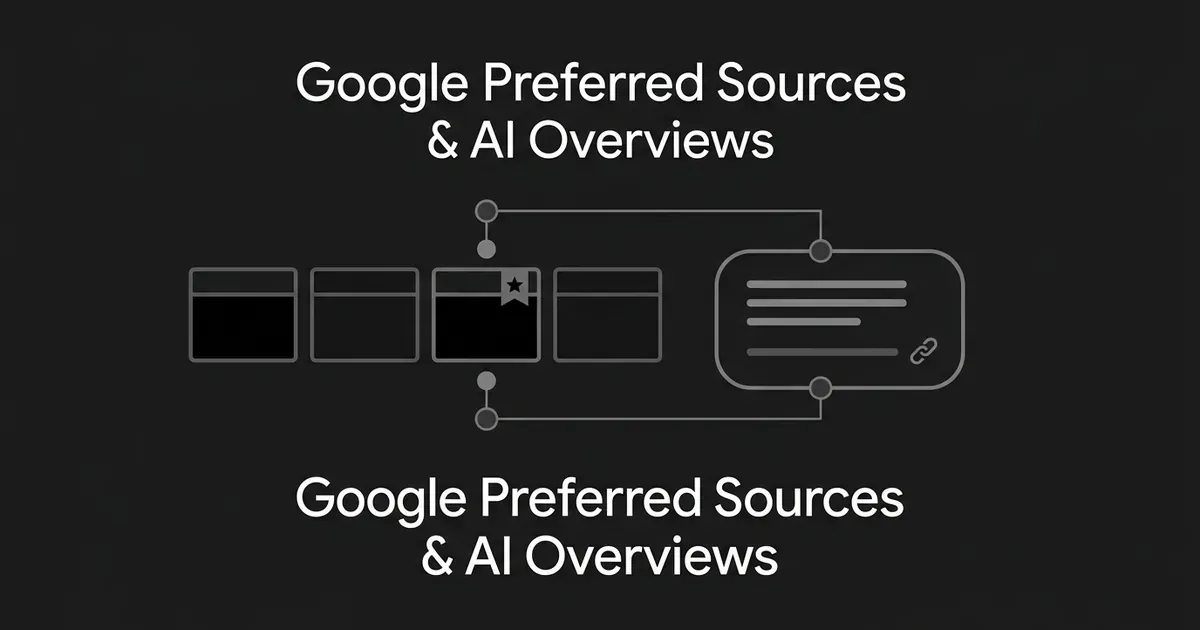
- Links from a selected source can carry a Preferred badge in AI Overviews and AI Mode.
- The person keeps seeing other sites too. Adding a source does not shut out everything else.
- They can add or remove sources whenever they want, and Google says there is no cap on how many they can pick.
None of this happens automatically just because a site exists. The source still needs to publish something that actually fits the search. Selecting a publisher does not pull every one of its articles into every result that person sees.
For a publisher, the practical requirement is narrower than it sounds. Your site has to show up in Google's source preferences tool for a reader to pick it in the first place, and Google Search Central is specific that only domain and subdomain level sites are eligible there. A page like yoursite.com/blog is not its own eligible source, but yoursite.com or news.yoursite.com would be. Google's broader announcement about AI Search says any site publishing fresh content is eligible, and that is true as a general description, but the actual mechanics run through that domain-level tool.
There is no separate approval process or certification to become a Preferred Source. You do not apply and wait for Google to bless the site. You make it easy for readers who already trust you to select it, and Google handles the rest through the tool.
Google gives publishers a few ways to encourage that selection. There is a standard button you can drop onto a page using Google's publisher library, which is localized automatically and supports light and dark themes. There is an advanced version for teams that want to build their own trigger around it. And there is a plain deeplink for sites that cannot run the JavaScript version, which just sends the reader to the source preferences tool to add the site themselves. None of these buttons make a site preferred on their own. They only make it easier for a reader to do the choosing.
What changes in AI Overviews?
This is the part most teams actually want answered. Google's current documentation says a selected site's link can carry a Preferred badge inside AI Overviews and AI Mode, and that badge is there to help the reader recognize sources they already chose. That is a real, documented change to how your link looks for the person who picked you.
What it is not, at least based on what Google has published, is a general lift in how often your site gets pulled into an AI Overview for people who never selected you. Google has not described Preferred Sources as a ranking signal, has not published any formula connecting a site's selection count to its odds of being cited, and has not said the badge extends to searchers outside the group that added the source. So the confirmed part is presentation for people who opted in, and everything about broader inclusion stays unconfirmed.
It helps to hold two categories apart here. A ranking signal changes how a system orders or evaluates results in general, for everyone. A personalization signal changes what one particular user sees, based on choices that user made. Everything Google has published about Preferred Sources describes it in the second category. Selected content is more likely to appear for the person who selected it. That is not the same claim as selected content becoming more likely to appear, period.
Google's own John Mueller addressed this directly in May 2026, when he was asked whether Preferred Sources could override normal quality checks in Top Stories. His answer was that the feature helps a reader see more of what they chose, but it would not make sense for that preference to surface low-quality or spammy content just because someone picked the site. Your normal relevance and quality bar still applies, and Preferred Sources sits on top of it rather than replacing it.
Where else does it show up?
Top Stories is still the clearest and most established use case, and Google says it is available globally there, in every language where Search itself runs. The "From your sources" section works the same way, giving selected content its own spot in results. AI Overviews and AI Mode carry the Preferred badge, in the languages and regions where those features are live. Google's May 2026 announcement also mentioned a carousel for developing news topics that surfaces Preferred Sources more prominently, though that is described as showing up for certain searches, not every one.
Across all of these, the underlying mechanic is identical: a person picked a source, and Google is making that source easier to notice for that person specifically.
Where the feature gets misunderstood
A few claims about Preferred Sources circulate that the documentation does not actually support, and it is worth naming them directly so your team does not repeat them internally.
It is not a Google endorsement. Being available as a Preferred Source does not mean Google has judged your site more authoritative or trustworthy than the sites people did not select. It reflects a reader's choice, not an editorial decision by Google.
It is not a shortcut into AI Overviews. Adding the button, or getting readers to select your site, does not force your content into an AI Overview that it would not otherwise be eligible for. The button promotes selection, but it does not guarantee that Google treats the page as a source.
It does not replace the need for relevant, current content. A reader selecting your site does not make an outdated or off-topic article suddenly relevant to their search. The content still has to earn its place the normal way.
And it is not a Search Console feature. Some people search Preferred Sources Search Console assuming there is a setting to configure there, but there is not. The reader-facing control lives in Search personalization and the source preferences tool, and the publisher-facing guidance lives in Google Search Central and Publisher Center documentation. Search Console itself has nothing to do with it.
What should publishers actually do?
Treat Preferred Sources as a way to turn an audience you already have into an explicit Search preference, not as a new acquisition channel or a ranking lever.
Start by checking whether your domain or subdomain actually appears in the source preferences tool, since that is the baseline requirement before anyone can select you. From there, make the selection option visible to people who already read, subscribe to, or follow you regularly. Google's standard button is the lowest-friction option if your site can run it, and the deeplink covers you if it cannot. Be accurate about what you are asking readers to do: you are inviting them to add your site as a preferred source, not promising them anything changes about search rankings.
Keep publishing fresh, relevant material regardless. Preferred Sources rewards a site that already has something worth showing a reader at the moment they search. It does nothing for a site with nothing current to offer.
And be careful how you measure it. If you see a Preferred badge on your own account after selecting your own site, that tells you the badge exists for you, the person who chose it. It does not tell you whether unselected readers are seeing your site more often, whether your underlying citation rate in AI Overviews has actually moved, or whether any change you notice came from this feature at all rather than from ordinary content or ranking shifts. Google has reported that people were about twice as likely to click through to a source they had selected, and that publishers collectively had over 345,000 unique sources selected as of the May 2026 announcement, but neither number tells you what happened to your specific site's unselected-user visibility. Treat those as Google's own reported figures about the feature overall, not as a benchmark for what any one publisher should expect.
A useful way to think about measurement here is to keep three separate questions apart, because Google's own documentation does not give you a dashboard that separates them for you. First, does your site show up in AI Overviews at all for users who never selected it, which is your baseline citation behavior and has nothing to do with this feature. Second, does a selected user see your link marked with a Preferred badge or presented more prominently, which is the part Preferred Sources actually controls. Third, how often are your pages genuinely being linked as sources across a representative set of prompts and users, which is the number that tells you whether your actual AI visibility is moving. Conflating the second question with the third is the most common mistake a team makes after this feature launched, because a badge you can see on your own screen feels like proof of something bigger than it is.
If your team tracks AI visibility on an ongoing basis, that is where a tool like DeepSmith's AEO module is useful: it checks how often your pages actually get cited across AI engines on the prompts that matter to your business, on a schedule, so you can separate a genuine change in citation frequency from a one-off badge you noticed on your own screen.