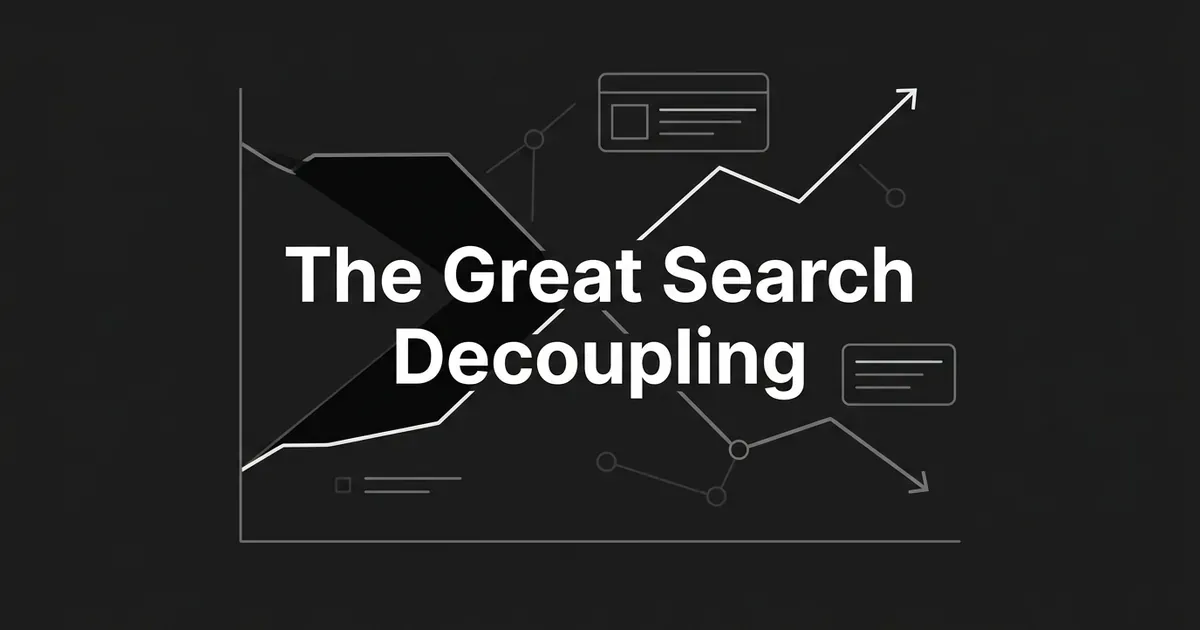
If your Search Console graph shows impressions climbing month over month while clicks stay flat or slide, you are looking at what a lot of SEO teams now call the great decoupling seo teams keep asking about: search console impressions vs clicks moving in opposite directions instead of together. It usually means your pages show up in more searches, but a smaller share of those searches send anyone to your site. This is not an official Google metric. It is a label that has caught on because so many teams are watching impressions up clicks down happen in their own reports.
The short version: impressions count how often Google recorded your result as eligible to be seen. Clicks count how often someone actually left Google and landed on your page. Those are two different moments in a search, and the second one can keep shrinking even while the first one grows.
Impressions and Clicks Are Measuring Different Things
Search Console defines an impression as the number of times a link to your site showed up on a results page. The exact rule for what counts depends on the result type. Some results need to be scrolled into view or expanded before they count. Others follow different rules entirely. What all of them share is this: an impression tells you Google made your result eligible to be seen. It does not tell you anyone noticed it, read it, or thought about clicking it.
A click is a different thing. It means someone left Google and went to your site. If a person expands an answer box, opens a map, checks the weather, or refines their search without ever leaving Google's own pages, none of that counts as a click to you. They interacted with the search results. They did not visit your site.
Click-through rate ties the two together with a simple formula: CTR equals clicks divided by impressions. If your impressions go from 100,000 to 150,000 in a month and your clicks stay at 5,000, your CTR drops from 5 percent to just over 3 percent. Nothing broke. The math just worked the way it has to when the denominator grows faster than the numerator. This is organic ctr decline in its plainest form, and it is often the first symptom teams notice before they understand the cause.
Average position adds another layer people misread. It is an average across every impression a page earned, not a fixed rank you hold. A page can keep the same average position while sitting below more content than it used to, because the same numerical spot can land under a different mix of features from one search to the next, or look completely different on a phone than it does on a desktop. Position also shifts on its own as a page starts ranking for a wider spread of queries, some more valuable than others. Read position next to device, query, and date range, not on its own.
One more wrinkle worth knowing: Search Console attributes clicks, impressions, and position to whichever URL Google treats as canonical. If Google consolidates a few variations of a page under one URL, a page-level report can look like it dropped even when the underlying traffic just moved to a different URL in Google's own accounting.
What "Impressions Up, Clicks Down" Actually Tells You
Total clicks break down as impressions times CTR. So when clicks fall while impressions rise, the honest question is not "why did I get more impressions." It is which impressions you gained and how much real click opportunity came attached to them.
CTR itself responds to a long list of things: your rank, how prominent your listing looks next to everything around it, the intent behind the search, whether the searcher already knows your brand, the device they're using, and whether ads or other features sit above you. A site can absolutely gain more chances to appear on a results page while losing the percentage of people who pick its result. That gap between visibility and organic click share is the whole pattern in one sentence, and it's the clearest way to describe the great decoupling seo teams keep running into as impressions climb.
SERP Features Are Changing Who Gets the Click
Featured snippets, People Also Ask boxes, image packs, video carousels, local packs, shopping modules, knowledge panels, and related searches all compete for the same space your listing used to have mostly to itself. None of them guarantee a lost click on their own. What they do is add more stops between the searcher and your result, and sometimes answer the question before your listing is ever reached.
A 2023 study published on arXiv looked at 24 different SERP features against organic click-through rate using cross-site data. It found that SERP features reduced organic CTR on average, and that the first organic result in particular tended to lose clicks as more features stacked up around it, even when that result had nothing to do with the feature itself. The effect wasn't one-directional for every position, though: a lower-ranked result that got pulled into a feature like an image pack could actually gain clicks, while the same feature could cost clicks to a result that wasn't included in it. The Image Pack, for instance, showed a negative relationship with CTR for results left out of it, and a positive one for results included in it.
That last point matters because it means the story isn't as simple as "features are bad." An older but widely cited analysis of roughly 250 million searches, run by Perficient Digital and AuthorityLabs and reported by Search Engine Land, found that featured snippets were close to click-neutral in aggregate. CTR on queries with a snippet was only slightly higher than on queries without one, and the difference wasn't meaningful on its own. What varied enormously was the individual snippet: some answered the question completely and kept the searcher on Google, while others pulled in noticeably more traffic to the source page than a plain listing would have.
So the honest read is that SERP features change how clicks get distributed across a results page. Some sites lose out, some gain, and the direction depends on the query, the feature, and whether your result is part of it or standing next to it.
The Gap Shows Up Fastest on Mobile
Mobile search compresses everything. A smaller screen means Google can fill more of what a searcher sees before they ever reach a traditional listing, with direct answers, maps, carousels, and other modules stacked at the top. Your result can still be on the page and still count as an impression. It just sits farther down, past more scrolling, competing with content a searcher can act on without leaving Google at all.
A widely discussed 2020 investigation by The Markup analyzed more than a million rows of mobile results across over 15,000 popular queries. It found that Google's own properties and direct answers filled 41 percent of the first page of mobile results in its sample, and 63 percent of what it estimated as the first visible screen on a phone. For one in five searches in that sample, no external website link appeared on the first screen at all. Google pushed back on parts of the methodology, including how the investigation classified certain answer types, and noted the sample leaned toward trending queries that may pull in more news and knowledge features than typical searches do. Treat the numbers as a real illustration of how crowded mobile can get, not a fixed rate that applies to every query.
A separate clickstream study from Datos and SparkToro in 2024 found that almost half of mobile searches in the US and EU ended the session right there, with no further browsing, more than double the rate seen on desktop. That's a broader behavioral finding about how people search on their phones, not a Search Console benchmark you can apply directly to your own CTR. It's still useful context for why a mobile-heavy page can show the decoupling pattern more sharply than a desktop-heavy one.
If you want to check whether mobile is your driver, split your Search Console data by device. If mobile impressions are climbing while mobile clicks fall and desktop stays roughly steady, mobile SERP crowding is a strong candidate. If both devices decline together for the same queries, look elsewhere first.
Google's Own Products Are Keeping More Searches Inside Google
Beyond individual SERP features, Google now answers a lot of queries directly through its own destinations: maps and local business information, shopping and inventory listings, flights and hotels, weather, sports scores, stock quotes, movie showtimes, and knowledge panels pulled from licensed sources. When one of these can fully answer a search, the journey can end inside Google without ever needing an outside link.
This isn't a penalty against your site. It's a change in where the search journey stops. A user checking a flight status or the weather doesn't need to click through to a third-party page when Google already shows the answer. Your result might still appear and still register as an impression. It just isn't the destination anymore.
The market-level numbers back this up. That same 2024 Datos and SparkToro study, drawing on tens of millions of users across the US and EU, found that for every 1,000 Google searches in the US, only 360 resulted in a click to a site that isn't Google-owned or paying for ads. In the EU it was 374 per 1,000. Around 58 to 60 percent of searches in both regions produced no click at all, and nearly 30 percent of the clicks that did happen in the US went to Google's own platforms. These are market-wide figures, not a forecast for any single site's CTR, and the study's authors noted real gaps in how well it captured iPhone and iPad users. Use them to understand the environment your site is competing in, not as a number to hold your own pages against.
Where People Get This Pattern Wrong
A few habits lead teams to the wrong conclusion when they see impressions up and clicks down together.
The first is assuming a falling CTR means rankings dropped. It doesn't have to. Average position can hold steady while CTR falls, because position is an average across a changing mix of queries and doesn't capture how prominent a listing actually looks on the page.
The second is blaming every SERP feature equally. The evidence doesn't support that. Some features cost clicks to results that sit outside them and add clicks to results included inside them. Featured snippets in particular were close to neutral in aggregate in the largest study available, even though individual snippets varied a lot.
The third is treating market-level zero-click statistics as if they were your own site's expected CTR. A study showing that most Google searches end without any outbound click describes overall search behavior across millions of users. It says nothing about what your specific pages should expect, and using it as a direct benchmark will lead you to the wrong fix.
The fourth is assuming new impressions carry the same click potential as your existing ones. A site often gains impressions from more long-tail queries, lower-volume variations, or queries where it ranks further down the page. Those impressions tend to convert at a lower rate than the queries that built the site's traffic in the first place, which pulls the average CTR down even when nothing about the core rankings has changed. Branded queries illustrate this well: one large study found position-one CTR near 70 percent for branded searches and under 20 percent for non-branded ones at the same position, which shows how much query mix alone can move an average.
How to Diagnose the Pattern in Your Own Data
Start by comparing periods across a few dimensions instead of reading the headline impressions and clicks numbers on their own. The goal is to pin down which part of search console impressions vs clicks actually shifted, and for which pages.
Split by device first. Mobile impressions rising with mobile clicks falling, alongside a stable desktop, points to mobile SERP crowding. Look next at query groups. If branded clicks hold steady while non-branded clicks decline, competition or SERP features on generic terms are the more likely explanation. If average position looks flat but CTR is falling anyway, the visual layout around your listing has probably changed even though the number hasn't.
Check where the new impressions are coming from. If they cluster in lower position buckets or in queries you didn't rank for previously, you're likely looking at expanded reach rather than lost rankings. And if certain page types, like local, shopping, travel, or informational pages that overlap with Google's own verticals, show the sharpest declines, that overlap with a Google-owned surface is worth investigating directly.
Search Console's Search Appearance report can help here too. It won't show you every feature that surrounded your result on a given search, but it can separate ordinary web listings from rich or enhanced result types, which is often enough to spot where the shift happened.
None of this points to a single fix, because the pattern usually isn't a single cause. A site typically gains impressions across a wider set of queries, some of those queries carry weaker intent, SERP features take up more of the page, mobile compresses what's visible even further, and Google answers a slice of searches without sending anyone anywhere. Put together, visibility keeps climbing while organic click share keeps shrinking.
The point of the decoupling label isn't to alarm anyone. It's a reminder that visibility and traffic aren't the same measurement anymore, and reading them as if they were will point you at the wrong problem. The more useful habit is checking where your new impressions came from, which devices and query groups lost click-through, and what now sits on the results page around your listing before deciding what, if anything, needs to change.