Someone on your leadership team asked what your brand looks like inside ChatGPT. You didn't have an answer.
That's normal. Almost every marketing team is starting this from zero, and the ones who look confident mostly started three months earlier.
Here's the good news: you don't need an engineer, an API key, or a data warehouse to fix it. You need one tool that shows you where you stand and points at what to do next.
This guide compares the best AI visibility tools for marketers on the things that matter when you're the person running it. Can you read the dashboard without an analyst? Can you have it live this week? Can you send your CMO a report they'll actually understand?
Nine tools, honest pricing, and a clear answer on who each one is really for.
What AI visibility tools actually measure
AI visibility is whether your brand shows up when someone asks ChatGPT, Perplexity, Gemini, Claude, or Google AI Mode a question in your category. You'll also see it called AEO (answer engine optimization) or GEO (generative engine optimization). Same idea.
Three numbers carry most of the weight:
- Mention rate. How often an AI answer names your brand at all.
- Citation rate. How often an AI links to one of your pages as a source.
- Share of voice. Your slice of the visibility across a set of tracked prompts, measured against competitors.
A mention and a citation are not the same thing, and the difference matters. A mention means the model knows you exist. A citation means it sent someone to your page. Good tools report both.
Why can't you just use your rank tracker? Because a large share of the pages AI engines cite never ranked in Google's top 10 for the same query. Your existing SEO stack is measuring a different race.
The marketer AI search visibility question is simple: when your buyers ask AI about your category, do you come up? Everything below is about answering that without a project plan.
How we picked
Five criteria, all weighted toward a non-technical marketing team:
- Dashboard clarity. AI visibility dashboards should be readable without an analyst sitting next to you.
- Engine breadth on the entry plan. What ships on day one, not what's gated behind an upgrade.
- Bundled content production. Does it only tell you the gap, or help you close it?
- Onboarding speed. Time to first insight without engineering involved.
- Pricing transparency. Published numbers beat "contact sales" when you're building a budget.
One thing worth saying up front: measurement-only is a real, legitimate scope. Several tools here deliberately don't touch content. That's a choice, not a missing feature.
The nine tools at a glance
AI visibility software for marketing teams runs from $29 a month to $800. The spread comes down to two things: how many engines you get, and whether the tool helps you close the gaps it finds.
| Tool | Entry price | Engines on entry plan | Content production | Free trial or tier | Best for |
|---|---|---|---|---|---|
| DeepSmith | $99/mo (Pro) | 1 (ChatGPT), all 10 on Enterprise | Yes, full writing pipeline | 7-day free trial | Teams that want tracking and the content to close gaps in one place |
| Profound | $99/mo (Starter, billed yearly) | 1 (ChatGPT) | Agents layer | Demo-gated | Enterprise teams with budget for the deepest analytics |
| Otterly.AI | $29/mo (Lite) | 4 | No | 7-day free trial | Solo marketers and small teams on a tight budget |
| Peec AI | ~$100/mo (Starter) | 6 | No | Free trial | Agencies running several brands at once |
| Ahrefs Brand Radar | Add-on to an Ahrefs plan | Multiple | No | Free AI Visibility Checker | Teams already paying for Ahrefs |
| Goodie AI | $399/mo (Explorer) | 3 | Yes, content optimization | Free AI Search Assessment | Mid-market teams wanting measurement and fixes in one loop |
| AthenaHQ | Free (Essential) | 1 (ChatGPT) | Yes, agent workflows | Free Essential plan | Teams who want to start free and grow into paid |
| Knowatoa | $59/mo (Starter) | 2 | No | Free audit | Small teams wanting weekly actions, cheap |
| Evertune | $800/mo (Pro) | Up to 11 | Partial, ads and agents | Demo-gated | Large brands needing premium model coverage |
1. DeepSmith

Best for: marketing teams who need to see where they're invisible in AI answers and publish the content that fixes it, without adding a tool or a person.
Most AI visibility software for marketing teams stops at the dashboard. You get a number, a trend line, and a competitor leaderboard. Then you're back where you started, briefing a writer for the gaps you just found.
DeepSmith closes that loop. It's an AI search analytics and content production platform in one, so the same data that shows the gap also feeds the article that closes it.
On the analytics side, the AEO module tracks mention rate, citation rate, share of voice, and sentiment with trends, broken out per platform, with a competitor leaderboard and the sources AI cites most. Coverage runs across ten engines: ChatGPT, Gemini, Perplexity, Claude, Google AI Overviews, Google AI Mode, Grok, Meta AI, Microsoft Copilot, and DeepSeek. The Prompts view gives you per-prompt mention and citation rates plus full answer history, so you can see exactly which questions you lose. The Pages view is the one marketers tend to like most: it shows which of your URLs AI actually cites, each page's share of your total citations, and the prompts driving them. Competitor Citations shows who's beating you, on which exact page, per platform.

You don't have to invent the prompt list either. Discover Prompts generates a starter set from your product, persona, and buyer-stage context.
On the production side, Content Studio takes an idea to a finished article: research, internal and external links, cover image, and publish-ready metadata. It's a production engine, not a writing assistant, so what lands is publish-ready, not a first draft to rescue. Autowrite goes further and writes on a scheduled date with nobody in the app. You publish to WordPress, Webflow, Strapi, Sanity, or Contentful, or fire a webhook.

Everything is grounded in Deep IQ, a stored context layer holding your positioning, products, personas, brand voice, and visual guidelines, which is what keeps output sounding like you at volume.
Key features: mention, citation, share of voice, sentiment, and trend tracking across ten engines; page-level citations; competitor citation tracking; Discover Prompts; Content Map topic coverage and competitor gaps; Opportunity Agents that return ideas with the data point that justifies them; a full writing pipeline with Autowrite; the Apps Library for LinkedIn, X, newsletter, Reddit, and more.
Pricing: Pro $99/mo (20 articles, 50 prompts, 5 seats, ChatGPT), Grow $199/mo (40 articles, 100 prompts, 7 seats, adds Perplexity), Scale $399/mo (90 articles, 200 prompts, 10 seats, adds Gemini), Enterprise custom (all ten engines). Annual billing brings those to $80, $160, and $299. There's a 7-day free trial and no long-term contract.
The honest limitation: engine coverage is tiered, and the Pro plan tracks ChatGPT only. The full ten-engine set sits on Enterprise, so if you need Perplexity or Gemini on day one you're starting at Grow or Scale, not $99. Keep that in perspective, though. ChatGPT drives roughly three quarters of generative-AI traffic, so a ChatGPT baseline still shows you most of what your buyers see, and every engine you add up the tiers comes bundled with the full writing pipeline that measurement-only tools never include. And no tool controls outcomes. DeepSmith tracks and produces, it doesn't guarantee citations, rankings, or traffic.
2. Profound

Best for: enterprise and mid-market teams with real budget and a research mandate.
Profound is widely treated as the deepest measurement layer in this category, and the depth is real. Answer Engine Insights covers visibility score, share of voice, sentiment, keyword themes, and per-prompt answer history. Prompt Volumes is the standout: it surfaces actual demand happening inside AI platforms, so you can see what users are really asking rather than guessing at a prompt list.
It also reaches into surfaces most tools ignore, including shopping and agent analytics, plus crawler activity on your own site.
Key features: Answer Engine Insights, Prompt Volumes demand data, agent and shopping analytics, crawler tracking, an agents layer for content workflows.
Pricing: Starter $99/mo billed yearly (ChatGPT only, 50 prompts). Growth $399/mo billed yearly (3 engines, 100 prompts). Enterprise is custom, up to 10 engines, with SSO/SAML and SOC 2. Engines covered across tiers include Perplexity, ChatGPT, Claude, Gemini, Grok, Copilot, Meta AI, DeepSeek, and Google AI Overviews and AI Mode.
The honest limitation: it's priced above peers at comparable depth, the Starter tier is ChatGPT-only, and content creation is an add-on rather than bundled with measurement. If your team is three people and nobody has time to action a research dataset, you're paying for range you won't use.
3. Otterly.AI

Best for: solo marketers, small teams, and agencies who need to start cheap.
Otterly is the most accessible on-ramp here. Lite is $29/mo for 15 prompts a month across four engines: ChatGPT, Google AI Overviews, Perplexity, and Microsoft Copilot. Four engines at $29 is real value, and every plan refreshes daily.
The seat policy deserves a mention. Team members are uncapped on every plan, which is unusual and very agency-friendly. Nobody has to share a login.
It leans on generative engine optimization, so alongside monitoring you get content audits and recommendations for AI surfaces.
Key features: four engines on the entry plan, daily refresh, uncapped seats, GEO content audits and recommendations.
Pricing: Lite $29/mo (15 prompts), Standard $189/mo (100 prompts, API access, MCP), Premium $489/mo (400 prompts). Claude, Google AI Mode, and Gemini are add-ons at $99 per 100 prompts each.
The honest limitation: those add-ons stack up fast. Wanting broad engine coverage can push your effective price well past the sticker, and it's measurement-first with no bundled content production.
4. Peec AI

Best for: in-house teams and agencies juggling several brands.
Peec is analytics-first with a clean, calm interface built for marketing teams and SEO agencies. It tracks visibility, ranking position, sentiment, share of voice, and prompt coverage across ChatGPT, Google AI Mode, Google AI Overviews, Copilot, Perplexity, and Gemini. Six engines is broad coverage for the price band.
The project-based workflow is the real differentiator. Spinning up a separate workspace per brand or client takes seconds, which matters when you're reporting to five stakeholders who each only care about their own numbers.
Key features: six engines, project-based multi-brand workspaces, sentiment and ranking position, integrations with Slack, Notion, Segment, and Looker.
Pricing: tiers are framed as project-based rather than flat public numbers, and higher tiers are sales-led. Independent reviews put Starter around $100/mo, Pro around $241/mo, and Advanced around $505/mo. Treat those as directional, not quoted.
The honest limitation: pricing isn't transparently published, which is friction when you're building a budget. It's also measurement-only, with no content production surface.
5. Ahrefs Brand Radar

Best for: teams already paying for Ahrefs.
If Ahrefs is already in your stack, this is the path of least resistance. Brand Radar is the AI visibility arm sitting on top of Ahrefs' existing crawler infrastructure, so your AI numbers live next to the SEO numbers you already check every Monday.
It tracks AI share of voice across multiple assistants, identifies the pages AI engines cite most in your category, and monitors visibility for the prompts your audience actually uses. There's also a free AI Visibility Checker if you want a look before committing to anything.
Key features: AI share of voice, AI citation tracking at page level, AI prompt tracking, a free standalone visibility checker.
Pricing: sold as an add-on to a standard Ahrefs subscription rather than a standalone SKU, so the cost lands on top of a plan that already runs into the low-to-mid hundreds per month depending on tier.
The honest limitation: it's an add-on to an already premium subscription, so it's poor value if you're not an Ahrefs customer. It's also an analytics layer, not a content production tool.
6. Goodie AI

Best for: mid-market teams that want measurement and page fixes in one loop.
Goodie is built around closing the loop, and it's explicit about it: research, then visibility, then optimization, then page fixes, then revenue attribution through GA. For a marketer being asked to prove impact, that last step is the interesting one.
Explorer covers ChatGPT, Google AI Overviews, and Perplexity with 100 prompts. Pro adds Gemini, Claude, and Copilot with 250 prompts, plus prompt and demand research and SKU-level tracking for agentic commerce. That SKU-level view is a genuine edge for e-commerce and retail.
Key features: closed-loop AEO workflow, GA revenue attribution, MCP server, agentic commerce and SKU-level visibility, a free AI Search Assessment at signup.
Pricing: Explorer $399/mo (3 engines, 100 prompts, $25 signup credit). Pro is custom via demo. Enterprise is custom with up to 11 engines and 500+ prompts.
The honest limitation: $399 is a real jump from budget tools, and the content side stops at optimization and fixes. It's lighter than a full publishing pipeline, so you'll still need somewhere to actually produce and ship.
7. AthenaHQ

Best for: teams that want to prove the concept before spending anything.
The free tier is real, which is rare. Essential gives you 300 credits a month on ChatGPT with unlimited members, plus sources, sentiment, and recommendations. That's enough to run a baseline, screenshot it, and walk into your next leadership meeting with data instead of a vibe.
The product is organized around agents that handle prompt and demand research, monitoring, and content production, so it spans further than pure measurement.
Key features: genuine free tier, unlimited members, agent library across research, monitoring, and content, built-in demand research from Starter up.
Pricing: Essential free (ChatGPT, 300 credits/mo). Starter $295/mo (adds Perplexity, 3,600 credits/mo, includes prompt and demand research). Growth is custom and covers all seven engines with a dedicated account team.
The honest limitation: the free tier is ChatGPT-only, and the jump to Starter at $295/mo is steep for what's still two engines. Growth pricing is quote-based.
8. Knowatoa
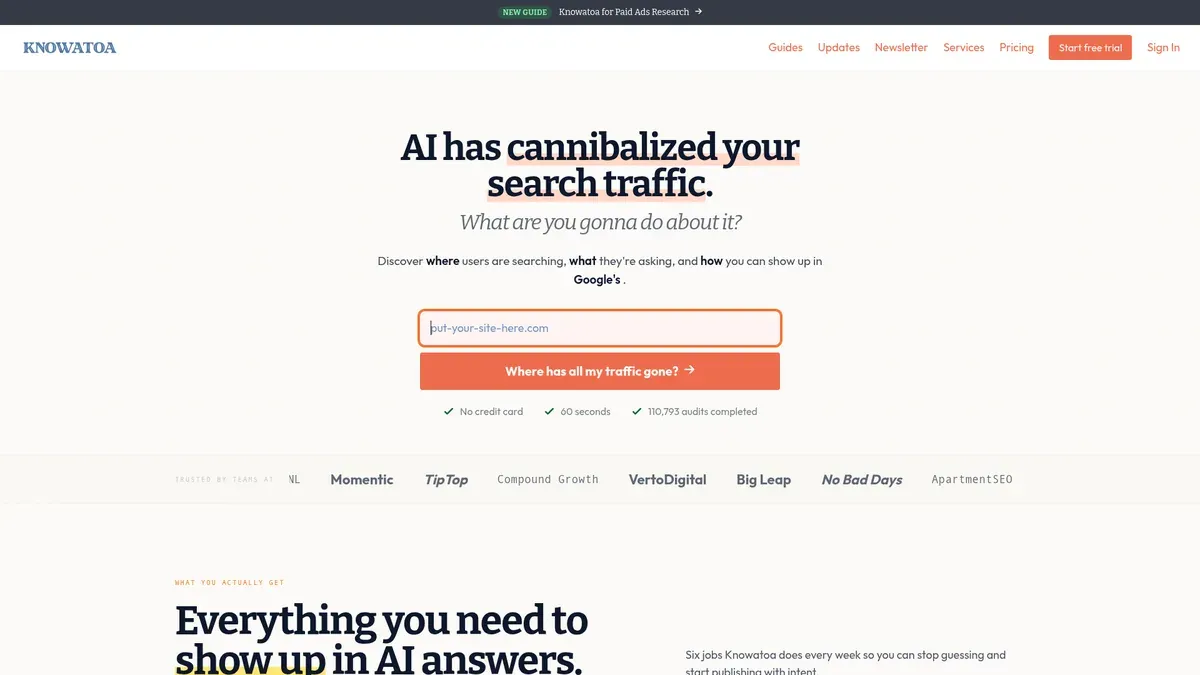
Best for: small marketing teams who want to be told what to do this week.
Knowatoa is aimed squarely at small and mid-sized teams, and the $59 entry price is the lowest here outside Otterly. There's a free audit at signup, so you can see your baseline before you decide anything.
The AI Marketer Agent is the reason to pick it: weekly actions, alerts, and recommendations, delivered rather than discovered. If your problem is that you open dashboards and don't know what to do next, that framing helps.
Key features: $59 entry, free audit at signup, AI Marketer Agent with weekly actions and alerts, Slack and email support on every plan.
Pricing: Starter $59/mo (ChatGPT and Google AI Mode). Growth $199/mo (all seven services). Enterprise custom with a dedicated rep.
The honest limitation: Starter covers only two engines, so you're blind to Perplexity and Copilot until you upgrade. There's no content production surface.
9. Evertune
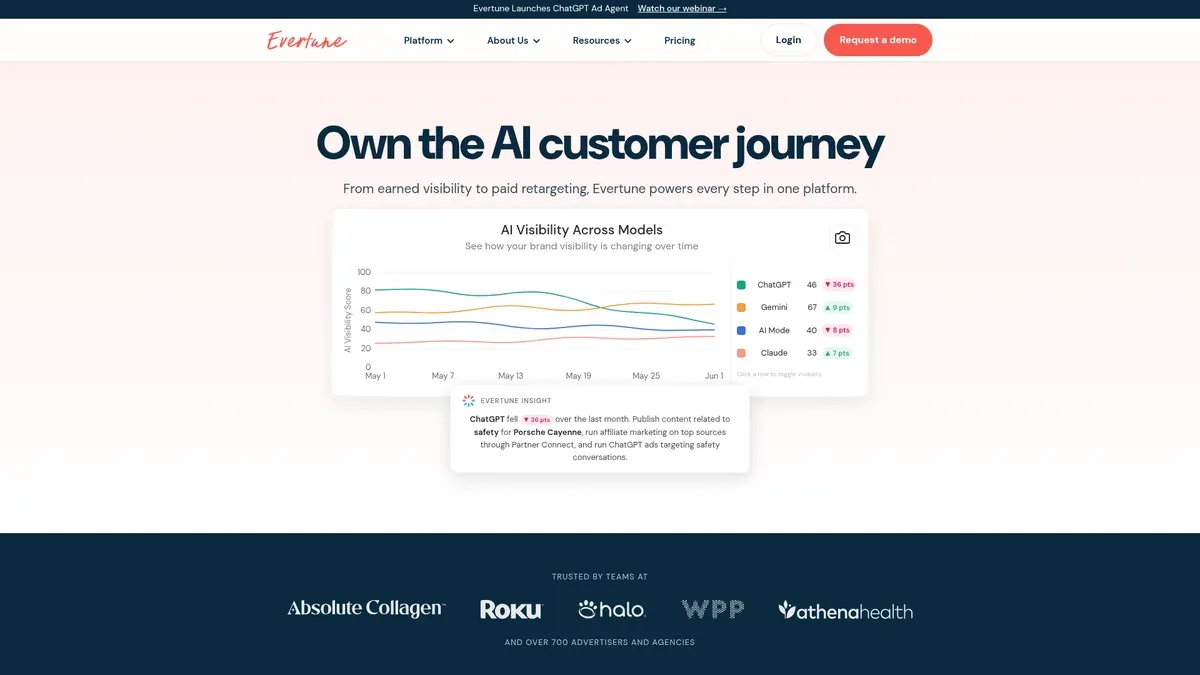
Best for: large brands and agencies who need premium model coverage.
Evertune sits at the top of the price band and is built for brands with real budget. Its Composite Brand Score blends how often you appear with where you rank across AI answers, which is a cleaner single number to put in a board deck than a wall of separate metrics.
Coverage reaches up to 11 AI models, and strategy is informed by a large consumer panel of real user prompts.
Key features: Composite Brand Score, coverage across up to 11 models, consumer-panel prompt dataset, ChatGPT Ad Agent for advertising inside ChatGPT.
Pricing: Pro $800/mo (up to 100,000 prompts analyzed, up to 11 models). Enterprise custom. There's no public free trial and demos are gated.
The honest limitation: $800/mo is the highest entry point in this roundup, and gated demos mean evaluation runs through a sales cycle. If you're a team of two, this isn't your tool.
How to choose
Take a breath. You're picking a starting point, not signing a five-year contract.
Match your situation to the shortlist:
You have almost no budget and need a baseline this week. Start with Otterly at $29/mo or Knowatoa at $59/mo. Or run AthenaHQ's free tier and pay nothing at all. Get the number first, argue about tools later.
You need the deepest analytics and have budget to match. Profound, genuinely. If your mandate is research, prompt-demand data, and enterprise-grade measurement, it's the strongest measurement layer here and we'd point you there over ourselves.
You already pay for Ahrefs. Add Brand Radar before you buy anything new. One less login, one less invoice, one less rollout.
You run multiple brands or clients. Peec AI's project-based workspaces are built for exactly that shape of work.
You're e-commerce and need SKU-level visibility. Goodie AI, for the agentic commerce tracking and GA revenue attribution.
You're a large brand needing 11-model coverage or AI advertising. Evertune.
Your site is large and technically complex. Look at Scrunch AI, which crawls the way AI agents do and surfaces blockers like robots.txt and schema gaps, or Conductor Intelligence if you want AEO folded into a long-standing enterprise SEO platform.
Your real problem isn't knowing, it's shipping. This is where most marketing teams actually live. You can already guess you're losing to a competitor in ChatGPT. What you don't have is 20 hours a week to write the pages that fix it. That's the case for DeepSmith: ten engines tracked at the top tier, and the measurement and the production sit in the same place, so the gap you find on Monday becomes the article you publish on Thursday.
One more piece of advice. Whatever you pick, be suspicious of anyone promising guaranteed citations or placements. Nobody controls what a model says. Any honest vendor here tracks, recommends, and produces. That's the whole job.
Start with real data, not a guess
Every marketer AI search visibility problem starts the same way: no baseline. You don't need a bigger team to fix that. You need one number and one thing to do next.
Start a 7-day free trial and see real data and real drafts before you pay. Your prompts, your competitors, and your first batch of ideas get populated during onboarding, so you'll know where you stand before the week is out.